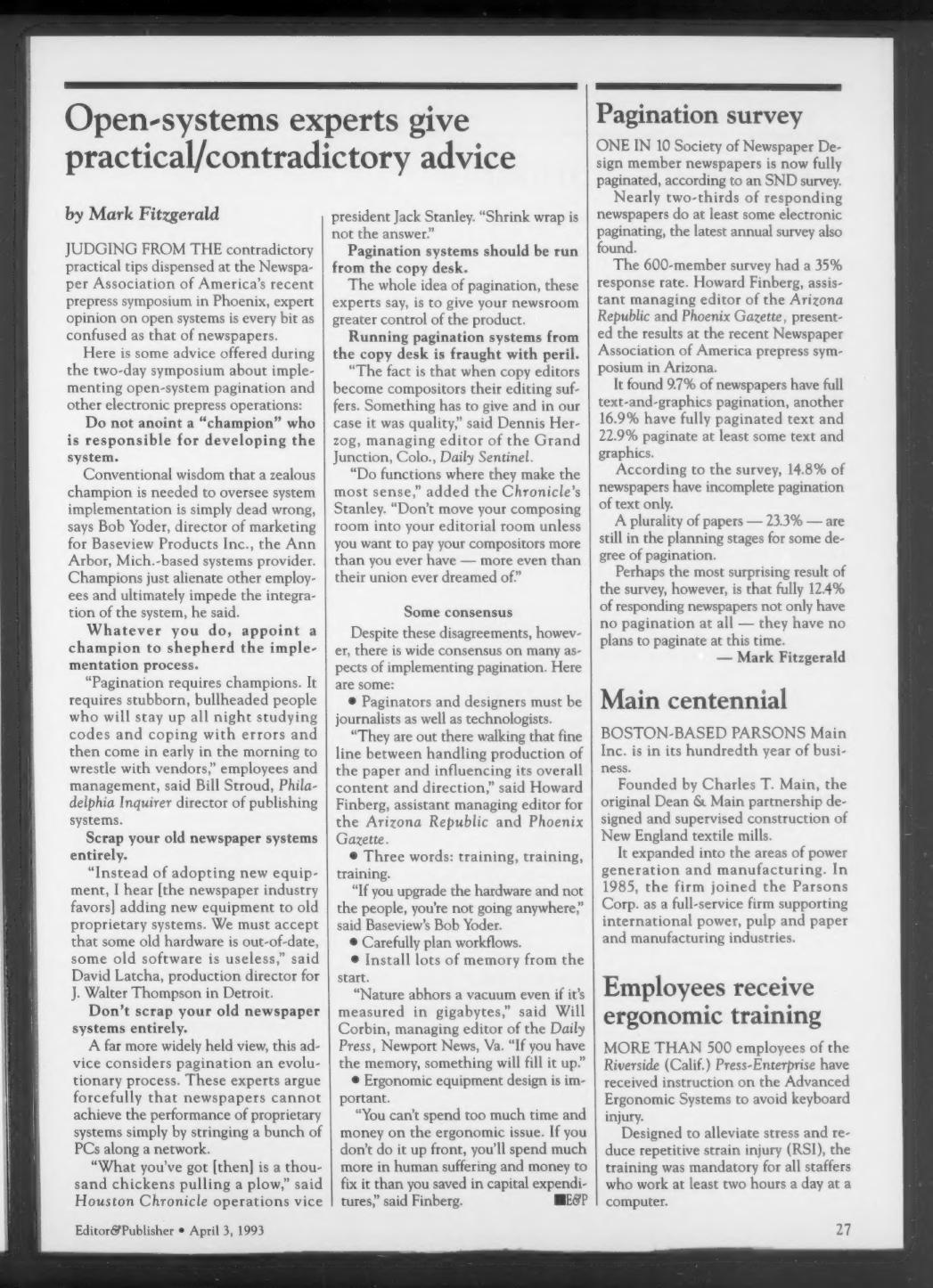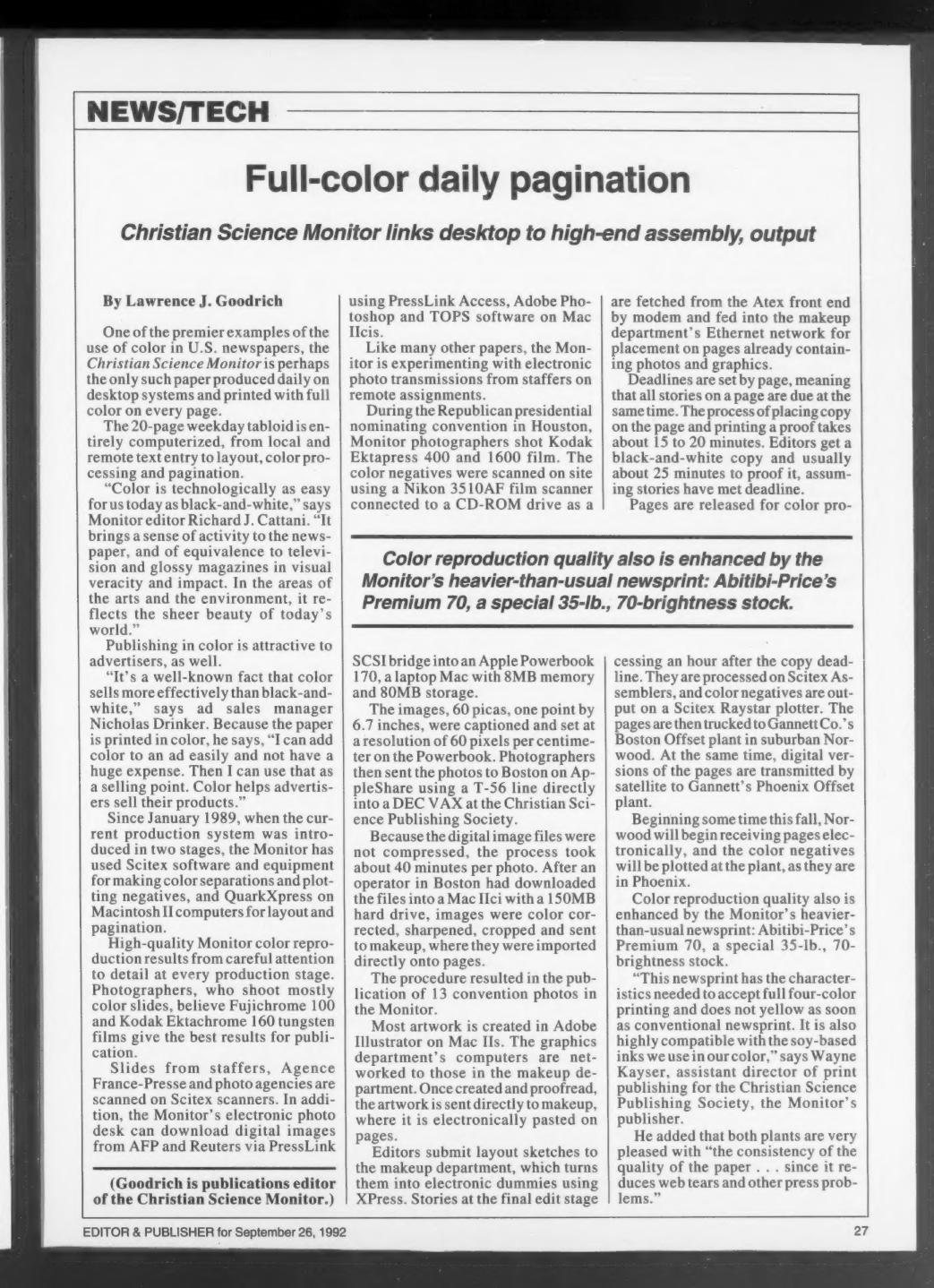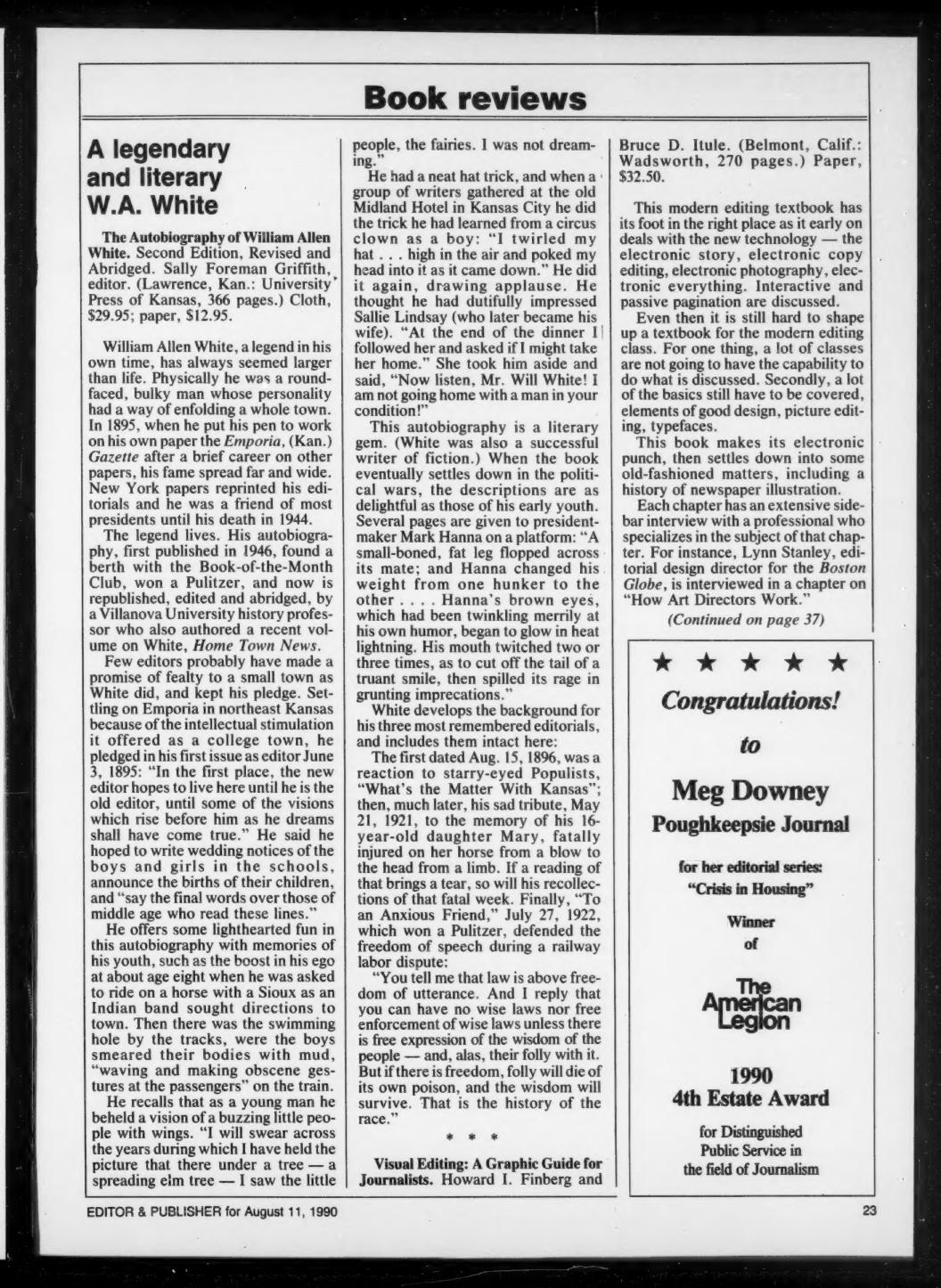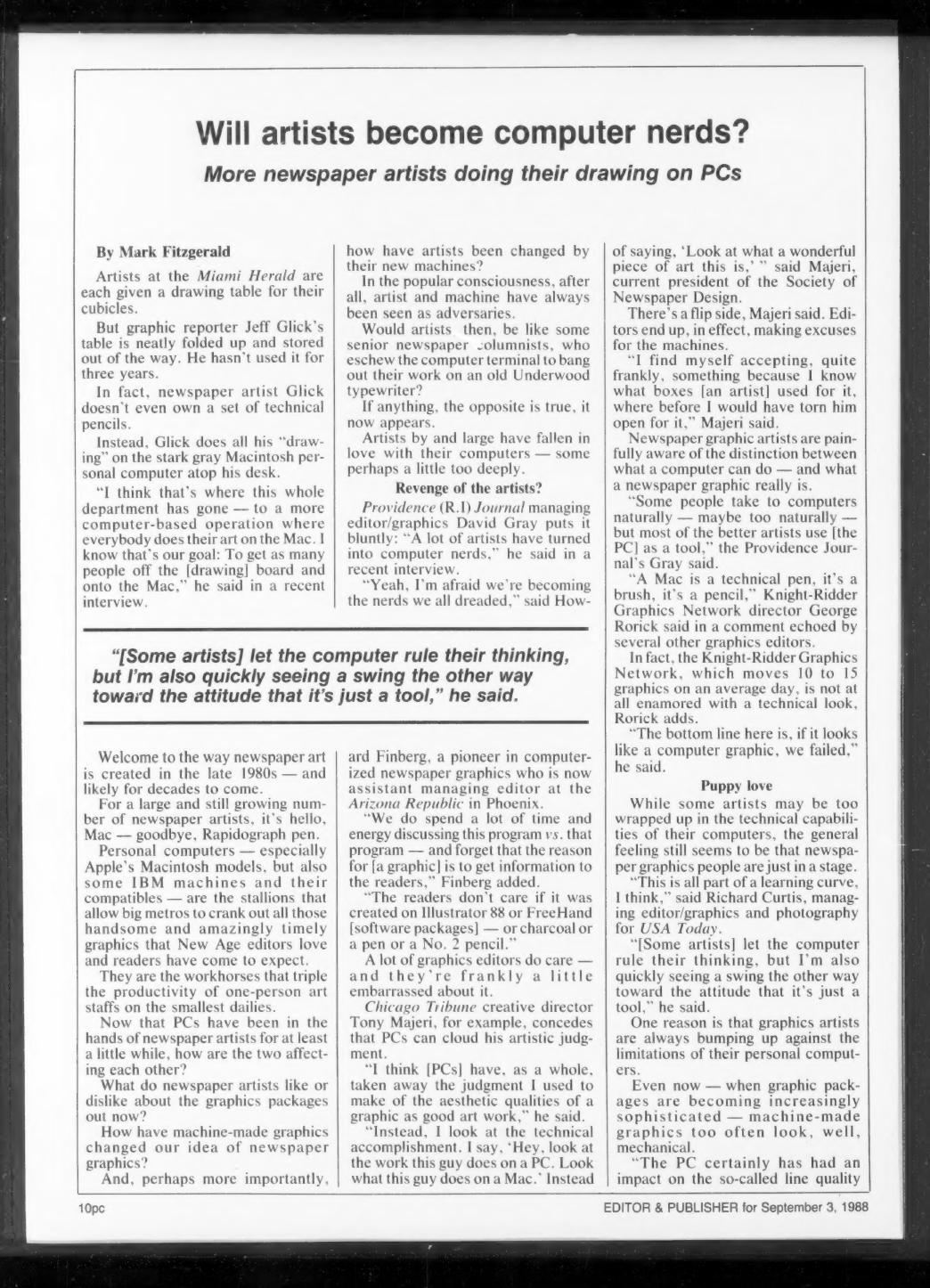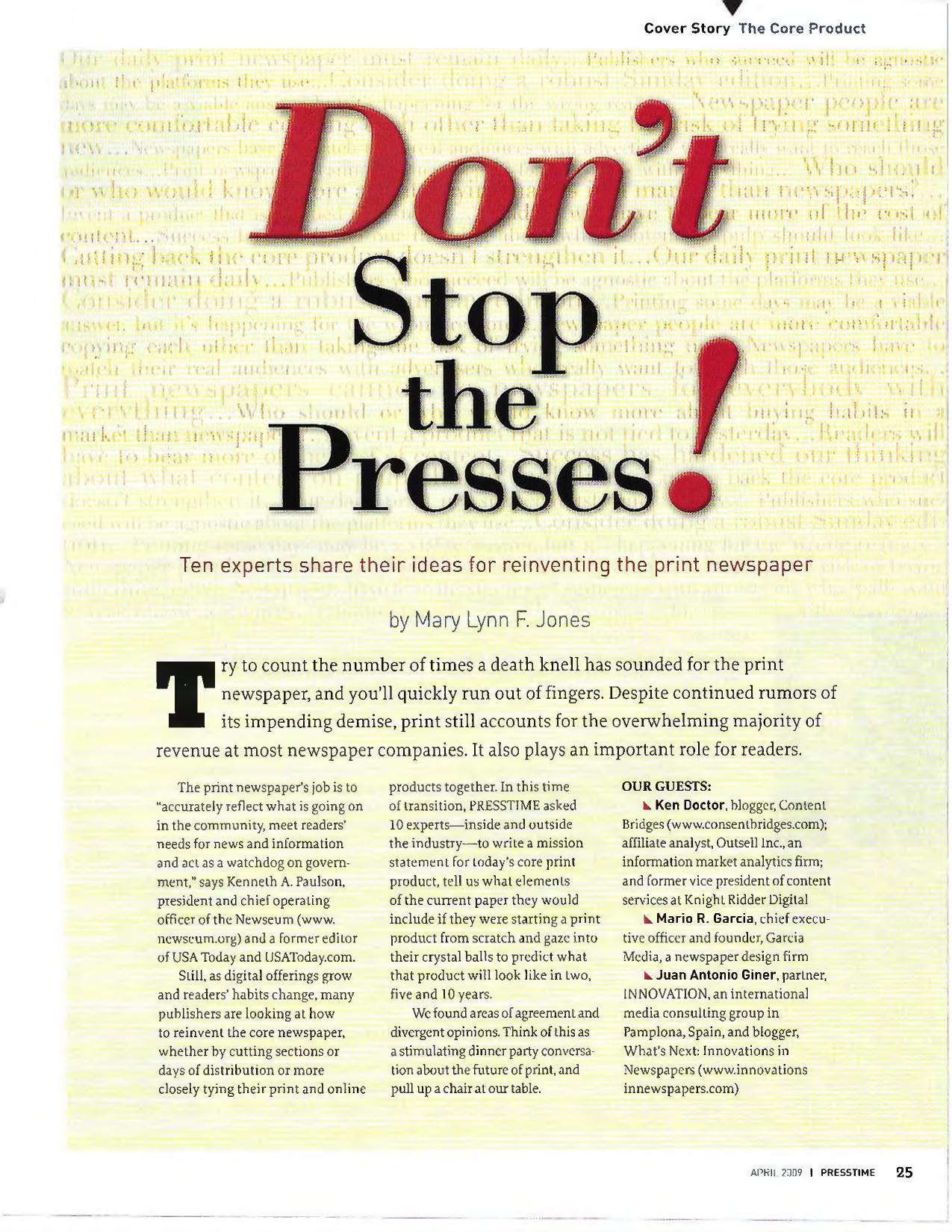
PRESSTIME magazine April 2009 cover story asking 10 experts to reinvent the core print product

Ten Experts Reinvent the Core Print Product, April 2009

The April 2009 cover story in PRESSTIME, the magazine of the Newspaper Association of America, asked 10 experts — inside and outside the industry — to write a mission statement for today’s core print product, say what they would keep if they were starting a print newspaper from scratch, and predict what that product would look like in two, five and 10 years. The piece was written by Mary Lynn F. Jones.

The guest list: Ken Doctor of Content Bridges and Outsell Inc.; Mario R. Garcia of Garcia Media; Juan Antonio Giner of INNOVATION in Pamplona, Spain; Charlotte H. Hall of the Orlando Sentinel and president of the American Society of Newspaper Editors; Alan Jacobson of Brass Tacks Design; Ted Leonsis of Lincoln Holdings LLC and vice chairman emeritus of AOL; Tim J. McGuire of the Walter Cronkite School of Journalism and Mass Communication at Arizona State University; Alan D. Mutter, the blogger behind Reflections of a Newsosaur; Kenneth A. Paulson of the Newseum; and Howard Weaver, formerly vice president of news for The McClatchy Co.

The story opens by noting that despite the repeated death knells, print still generated the overwhelming majority of newspaper company revenue. Paulson defined the print newspaper’s job as one that should

“accurately reflect what is going on in the community, meet readers’ needs for news and information and act as a watchdog on government”

Mutter argued that the framing itself was wrong:

Even though the newspaper generates 90 percent of a typical publisher’s sales, it is a mistake to think of it as the “core product.” The true core products of a newspaper company are its abilities to produce compelling content, build large audiences, sell advertising and make a profit.

On cutting sections and publication days, Doctor coined a term and a warning:

I call it “dayscrapping,” and it needs to be done judiciously. … Let’s not, above all, fool ourselves. Cutting back the core product doesn’t strengthen it. It may be a necessary evil, but pitching a less-is-more approach to readers won’t fool them.

Hall described the relationship between the two platforms in an image that stuck: print “stops the clock once a day,” and

One is the flowing river, changing constantly; the other is the rock on the shore, fixed and solid.

The predictions varied widely. Garcia expected compact and A4 formats inspired by magazines and books; Paulson expected smaller papers, higher single-copy prices and more reliance on circulation revenue; Hall declined to predict past two years. Jacobson was the most blunt:

In less than a year, there will be very few seven-day-a-week newspapers. In less than five years, newspapers will print for Sunday only. In less than 10 years, no newspapers will be printed.

The article notes that an expanded version of the report, including a podcast, was available at www.naa.org/presstime.
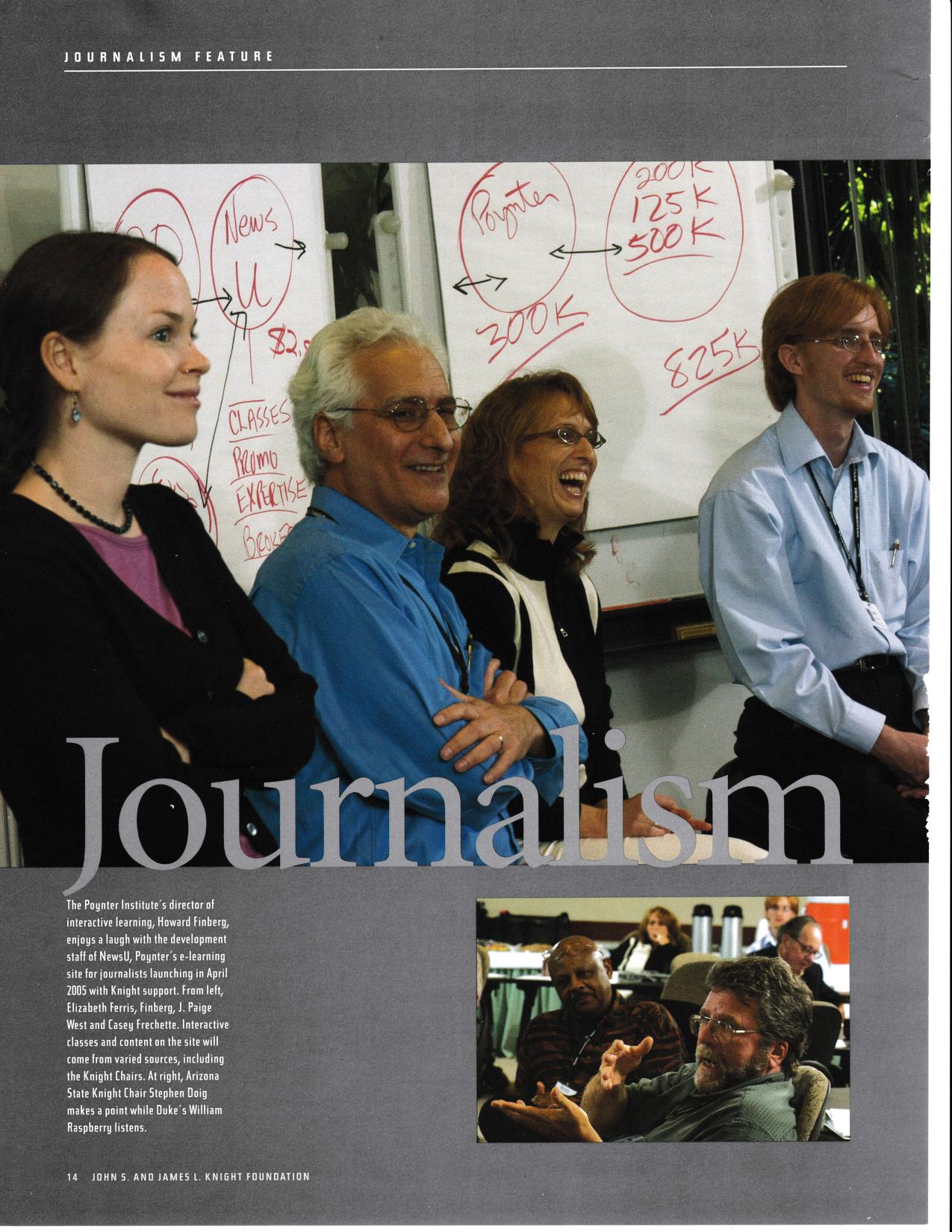
NewsU development staff Elizabeth Ferris, Howard Finberg, J. Paige West and Casey Frechette, pictured in the Knight Foundation report feature on the Knight Chairs in Journalism

‘A World Full of Connections’ — Knight Foundation Report Feature on NewsU

A journalism feature from the John S. and James L. Knight Foundation annual report, looking at how the foundation’s endowed Knight Chairs in Journalism had begun collaborating with each other and with other Knight journalism partners — including The Poynter Institute‘s News University. The piece opens in St. Petersburg and traces the Knight Chair program back to 1990, when then-foundation president Creed Black announced its creation, saying it would strengthen the quality of American journalism education:

“by bolstering core curricular values and encouraging innovation.”

The story lists examples of that collaboration — Rosental Alves in Latin America, Jim Detjen at Michigan State, Charlotte Grimes at Syracuse, Melinda McAdams at Florida, Jacqui Banaszynski at Missouri, and Haynes Johnson’s work on the Knight-funded study Newsroom Training: Where’s the Investment? — before turning to what the report calls the largest gathering ever of Knight Chairs, who traveled to Poynter in 2004 to learn about News University.

a five-year, $2.8 million project to develop an e-learning program for journalists. The program is a partnership between Knight and Poynter, rated the nation’s top journalism training organization by the Where’s the Investment? study.

At the Poynter meeting the chairs brainstormed course ideas — how to analyze government data, how to understand scientific claims — and the article notes that work began immediately with William Gaines, the Knight Chair in Investigative and Enterprise Reporting at the University of Illinois, on an investigative documents class. The individual web sites of the Knight Chairs were to be promoted through the Learning Links page at NewsU.

The feature describes the official launch at the April 2005 American Society of Newspaper Editors convention, designed to make the case that NewsU is not just informative but a fun resource — “like thousands of journalists at a dinner party” — featuring material from 18 Knight Chairs in Journalism, a Lee Hills Chair in Free Press Studies and a Knight Professor in Constitutional Law and First Amendment. Elsewhere in the report, Reznet’s Dennis McAuliffe Jr. describes his own project’s plan to work with NewsU on a distance-learning course.

The photo caption identifies the NewsU development staff at the time — Elizabeth Ferris, Howard Finberg, J. Paige West and Casey Frechette. The story ends with a line that gave the feature its title:

“Journalism,” Finberg said, “is a world full of connections.”

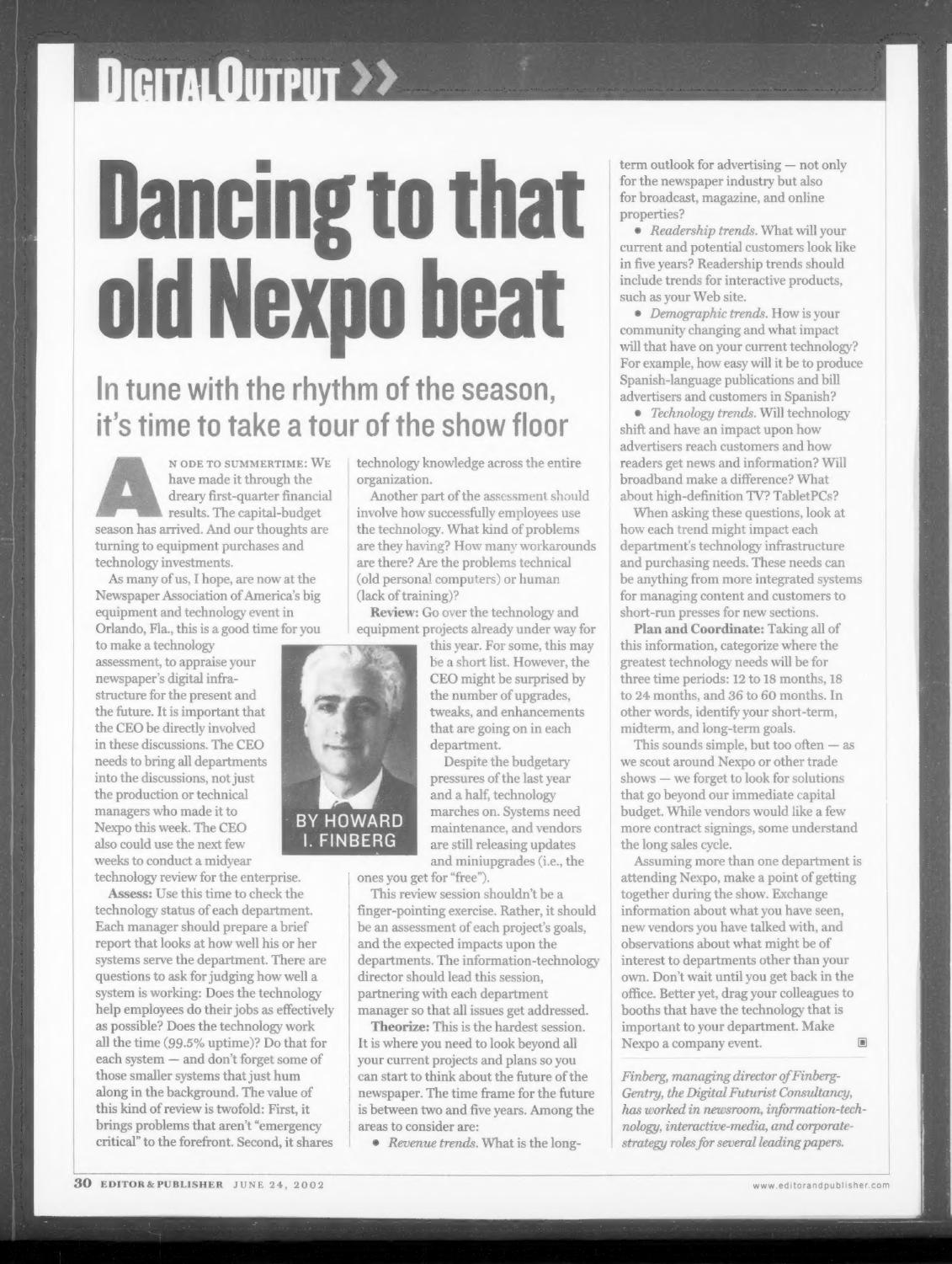
Editor & Publisher column from Nexpo 2002 advising newspaper CEOs to take stock of their digital infrastructure

Dancing To That Old Nexpo Beat

A column for Editor & Publisher, published June 24, 2002, timed to the Newspaper Association of America‘s big equipment and technology show, Nexpo, then under way in Orlando, Fla. The piece argues that the trade-show season is the right moment for a newspaper to take stock of its digital infrastructure — and that the review should not be left to the production and technical managers who happen to be walking the show floor.

It is important that the CEO be directly involved in these discussions. The CEO needs to bring all departments into the discussions, not just the production or technical managers who made it to Nexpo this week.

The column lays out a midyear technology review in four steps. Assess: each manager prepares a brief report on how well the department’s systems are working — including the smaller ones that “just hum along in the background” — and on how successfully employees actually use them, distinguishing technical problems from human ones such as lack of training.

Does the technology help employees do their jobs as effectively as possible? Does the technology work all the time (99.5% uptime)?

Review: go over projects already under way, led by the information-technology director in partnership with each department manager, and not as a finger-pointing exercise. Theorize: look two to five years out at revenue trends, readership trends (including interactive products such as the Web site), demographic trends — the column uses Spanish-language publishing and billing as an example — and technology trends, asking whether broadband, high-definition TV, or TabletPCs will change how advertisers reach customers and how readers get news. Plan and Coordinate: sort the resulting needs into short-term, midterm, and long-term buckets of 12 to 18 months, 18 to 24 months, and 36 to 60 months.

The closing advice is about the show itself: departments attending Nexpo should compare notes while they are still there.

Don’t wait until you get back in the office. Better yet, drag your colleagues to booths that have the technology that is important to your department. Make Nexpo a company event.

The column’s tagline reads: “Finberg, managing director of Finberg-Gentry, the Digital Futurist Consultancy, has worked in newsroom, information-technology, interactive-media, and corporate-strategy roles for several leading papers.”

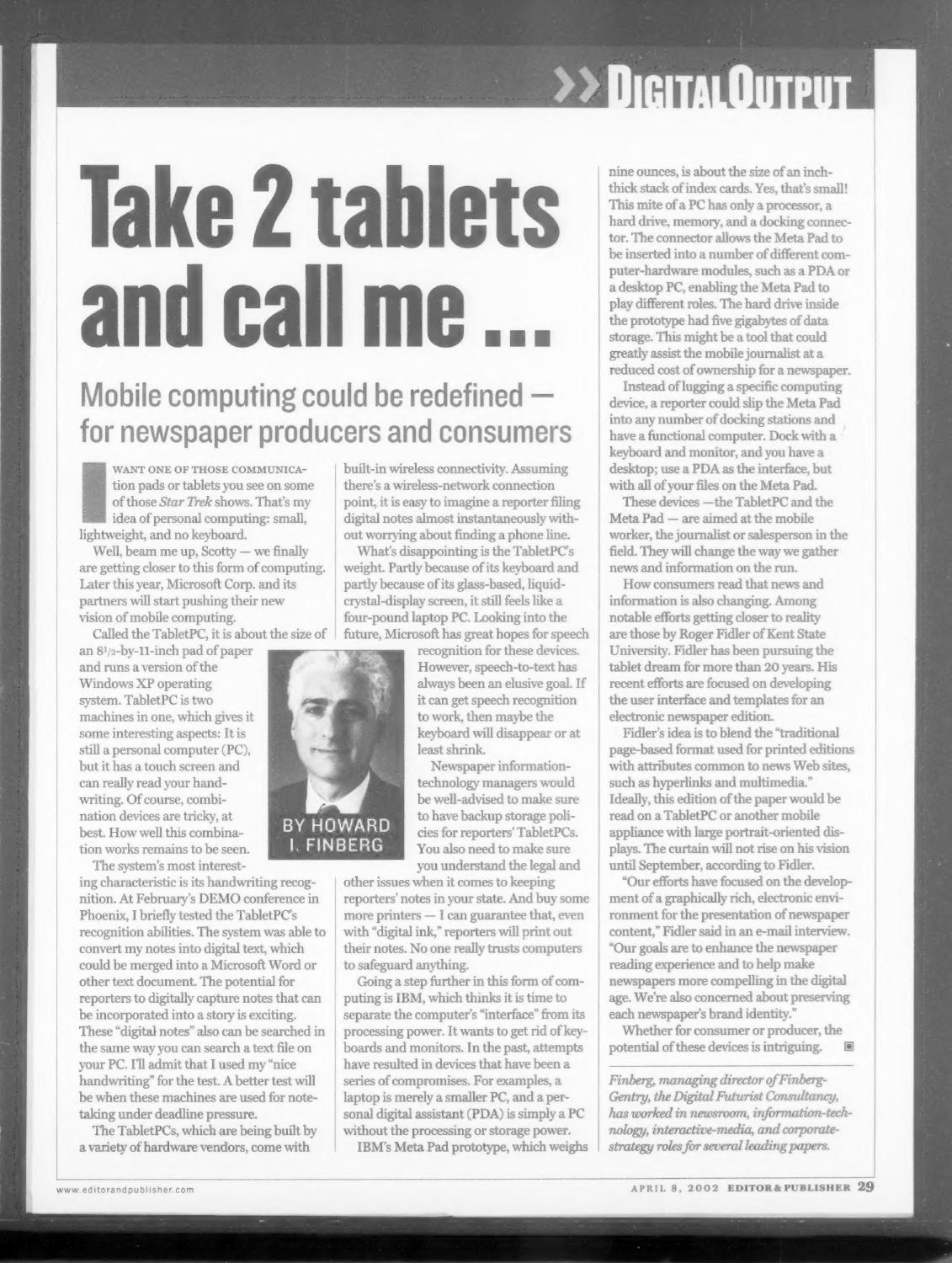
Tablet-style device representing the 2002 promise of mobile computing for newspapers, from an Editor & Publisher column

Take 2 Tablets and Call Me — Mobile Computing, 2002

My column in the April 8, 2002, issue of Editor & Publisher looked at two devices that promised to redefine mobile computing for both newspaper producers and consumers: Microsoft’s forthcoming TabletPC and IBM’s Meta Pad prototype.

The column opens with an admission about where the idea came from:

I want one of those communication pads or tablets you see on some of those Star Trek shows. That’s my idea of personal computing: small, lightweight, and no keyboard.

The TabletPC, about the size of an 8 1/2-by-11-inch pad of paper and running a version of Windows XP, was being built by a variety of hardware vendors with built-in wireless connectivity. I had briefly tested its handwriting recognition at February’s DEMO conference in Phoenix, where the system converted my notes into digital text that could be merged into a Word document. My caveat: I used my “nice handwriting,” and the real test would come with note-taking under deadline pressure. The disappointment was weight — it still felt like a four-pound laptop.

The column also offered practical advice for newspaper information-technology managers: back up reporters’ TabletPCs, understand the legal issues around keeping reporters’ notes in your state, and buy more printers.

No one really trusts computers to safeguard anything.

IBM’s Meta Pad prototype went a different direction — separating the interface from the processing power. At nine ounces and about the size of an inch-thick stack of index cards, it held only a processor, a hard drive, memory, and a docking connector, with five gigabytes of storage. Dock it with a keyboard and monitor and you have a desktop; dock it with a PDA and you have a handheld carrying all your files.

On the consumer side, the column reported on Roger Fidler of Kent State University, who had been pursuing the tablet dream for more than 20 years and was then working on the user interface and templates for an electronic newspaper edition — blending the page-based format of print with hyperlinks and multimedia. Fidler said his work would not be unveiled until September, and told me in an e-mail interview:

Our efforts have focused on the development of a graphically rich, electronic environment for the presentation of newspaper content. Our goals are to enhance the newspaper reading experience and to help make newspapers more compelling in the digital age. We’re also concerned about preserving each newspaper’s brand identity.

The column ran with the standard tagline identifying me as managing director of Finberg-Gentry, the Digital Futurist Consultancy.

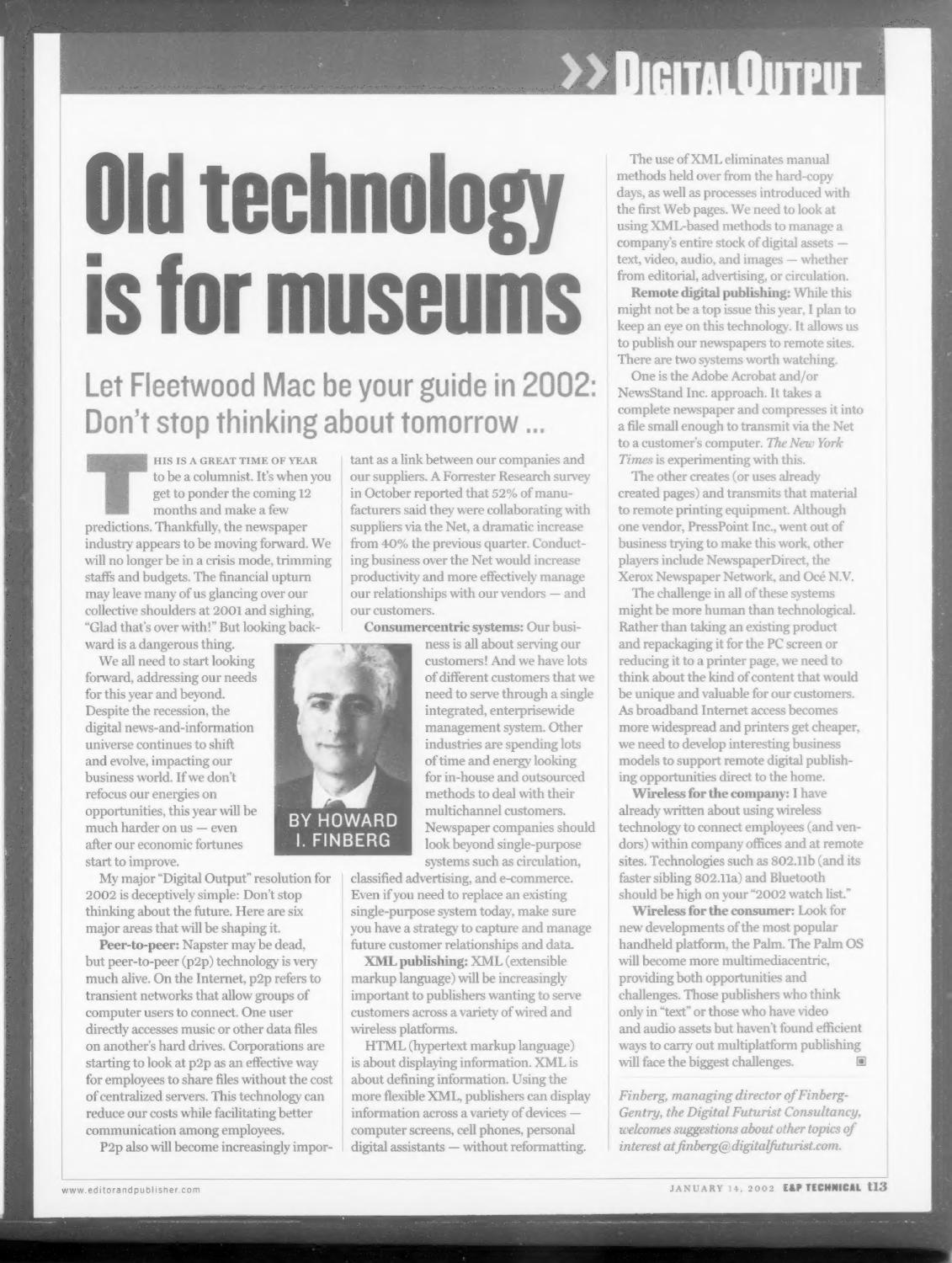
Digital Output column in the Editor & Publisher Technical section, January 14, 2002, on technologies to watch

Old Technology Is for Museums

My “Digital Output” column for Editor & Publisher, published January 14, 2002, in the E&P Technical section. It’s a start-of-the-year prediction column, written as the newspaper industry came out of the budget-and-staff cutting of 2001, and it lays out six technology areas worth watching.

The framing came from Fleetwood Mac — the subhead read “Let Fleetwood Mac be your guide in 2002: Don’t stop thinking about tomorrow …” — and the column’s central point was that the recession was no excuse to stop paying attention to what was coming next.

My major “Digital Output” resolution for 2002 is deceptively simple: Don’t stop thinking about the future.

The six areas: peer-to-peer technology, which I argued was alive well past Napster and would matter both inside companies and as a link to suppliers; consumer-centric systems, urging publishers to look beyond single-purpose circulation, classified, and e-commerce systems toward one integrated, enterprise-wide approach to customer data; XML publishing; remote digital publishing; wireless inside the company; and wireless for the consumer.

On XML, the column drew the distinction plainly:

HTML (hypertext markup language) is about displaying information. XML is about defining information.

The remote digital publishing section looked at two approaches — the Adobe Acrobat and/or NewsStand Inc. model of compressing a complete newspaper for transmission to a customer’s computer, which The New York Times was experimenting with, and transmitting pages to remote printing equipment. PressPoint Inc. had already gone out of business trying to make the second work; other players named were NewspaperDirect, the Xerox Newspaper Network, and Oc
u00e9 N.V. My conclusion about all of it:

The challenge in all of these systems might be more human than technological.

For wireless, 802.11b and 802.11a and Bluetooth were on the “2002 watch list,” and on the consumer side the column pointed to the Palm OS becoming “more multimedia-centric.” The column ran with the standard tagline identifying me as managing director of Finberg-Gentry, the Digital Futurist Consultancy.

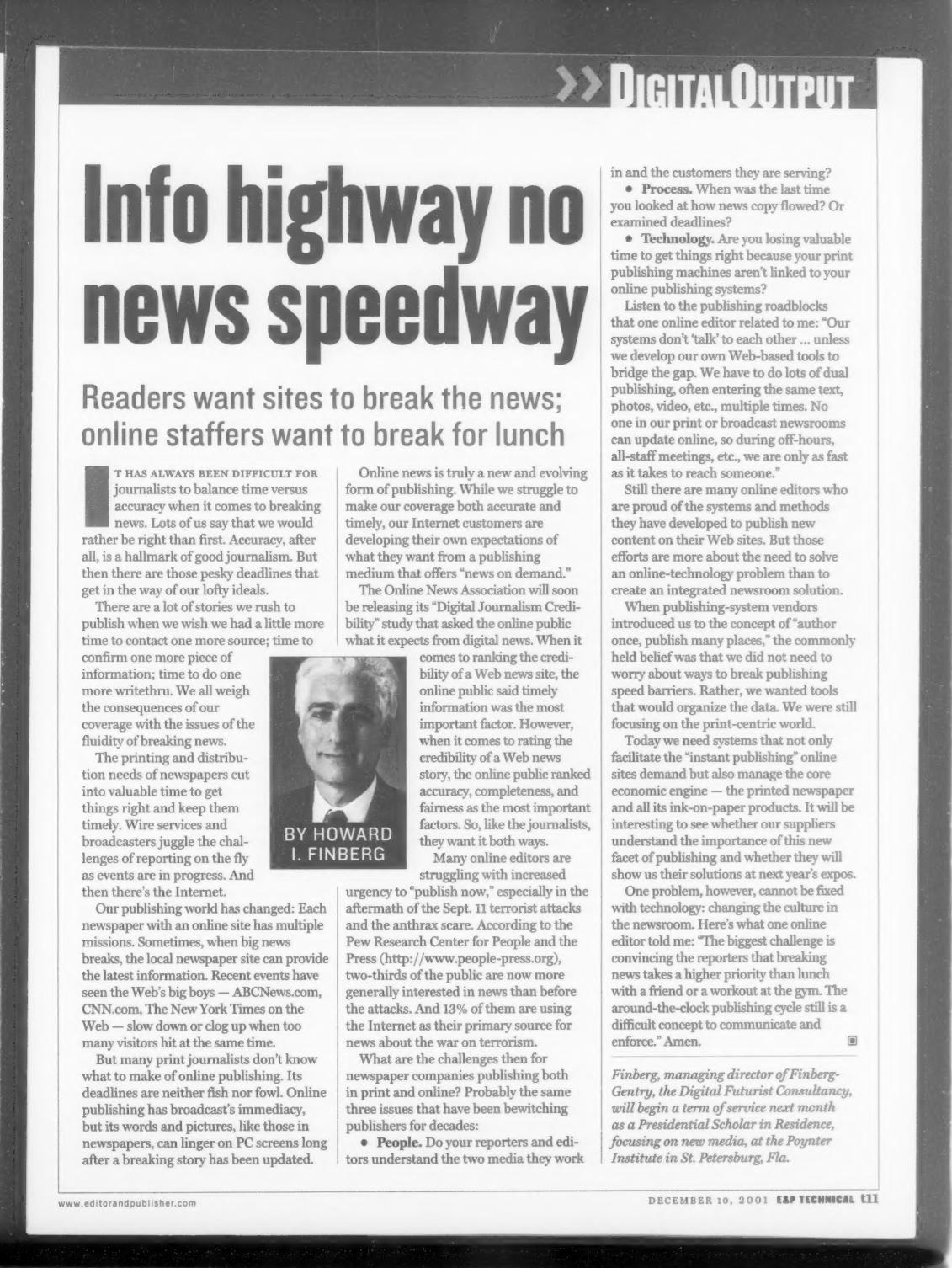
Editor & Publisher column headlined "Info highway no news speedway" from December 10, 2001

Info Highway: No News Speedway

A column I wrote for Editor & Publisher, published December 10, 2001, under the headline “Info highway no news speedway” and the subhead: “Readers want sites to break the news; online staffers want to break for lunch.”

The piece takes up the old tension between speed and accuracy and argues that online publishing has made it harder to resolve, because its deadlines are “neither fish nor fowl” — broadcast immediacy combined with words and pictures that linger on screen the way print does.

It cites the Online News Association‘s forthcoming “Digital Journalism Credibility” study, which found that the online public ranked timely information as the most important factor in judging the credibility of a Web news site, but ranked accuracy, completeness, and fairness first when judging an individual news story:

So, like the journalists, they want it both ways.

The column also notes Pew Research Center for People and the Press findings that two-thirds of the public were more generally interested in news than before the Sept. 11 attacks, and that 13% were using the Internet as their primary source for news about the war on terrorism.

The challenges for companies publishing in both print and online, I wrote, came down to the same three issues that had been “bewitching publishers for decades”: people, process, and technology. One online editor described the roadblocks this way:

Our systems don’t ‘talk’ to each other … unless we develop our own Web-based tools to bridge the gap. We have to do lots of dual publishing, often entering the same text, photos, video, etc., multiple times. No one in our print or broadcast newsrooms can update online, so during off-hours, all-staff meetings, etc., we are only as fast as it takes to reach someone.

The column closes on the one problem technology can’t solve — newsroom culture — quoting another online editor:

The biggest challenge is convincing the reporters that breaking news takes a higher priority than lunch with a friend or a workout at the gym. The around-the-clock publishing cycle still is a difficult concept to communicate and enforce.

The tagline at the end notes that I was then managing director of Finberg-Gentry, the Digital Futurist Consultancy, and would begin a term the following month as a Presidential Scholar in Residence, focusing on new media, at the Poynter Institute in St. Petersburg, Fla.

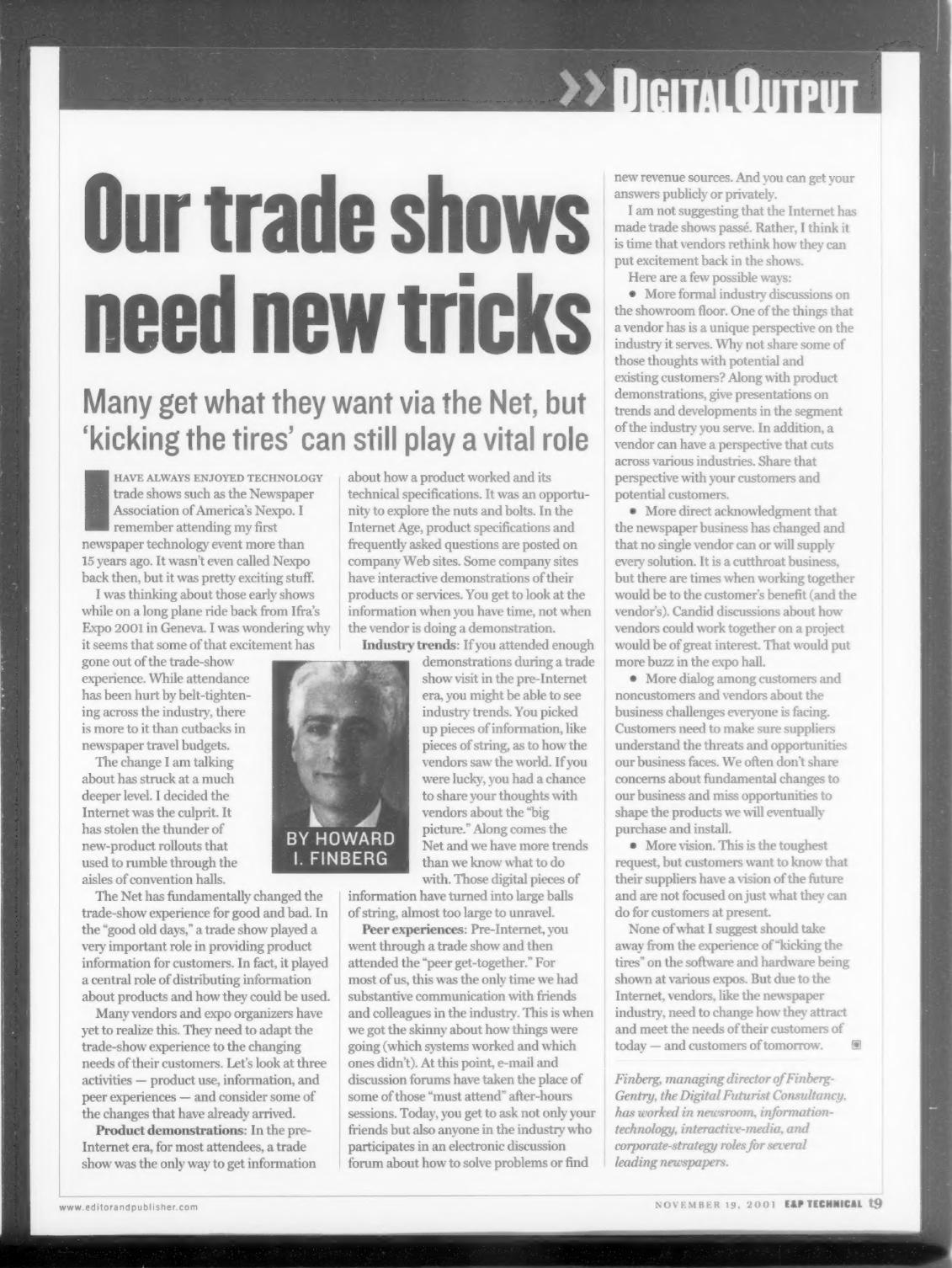
Editor & Publisher column page on newspaper technology trade shows, November 2001

Our Trade Shows Need New Tricks

A column I wrote for Editor & Publisher‘s technical section, published November 19, 2001, arguing that the Internet had drained some of the excitement out of newspaper technology trade shows such as the Newspaper Association of America‘s Nexpo and Ifra‘s Expo 2001 in Geneva.

The piece notes that while attendance had been hurt by industry belt-tightening, the deeper change was elsewhere:

I decided the Internet was the culprit. It has stolen the thunder of new-product rollouts that used to rumble through the aisles of convention halls.

The column looks at three activities — product demonstrations, industry trends, and peer experiences — and how each had already moved online. Product specifications and FAQs were posted on company Web sites, some with interactive demonstrations. Trend-spotting, once assembled from bits of vendor conversation, had become overwhelming:

Those digital pieces of information have turned into large balls of string, almost too large to unravel.

And e-mail and discussion forums had replaced some of the after-hours “peer get-together” sessions where attendees once got “the skinny” on which systems worked and which ones didn’t.

Rather than declaring trade shows finished, the column offers suggestions for vendors: more formal industry discussions on the showroom floor, more direct acknowledgment that no single vendor can supply every solution, more dialog with customers and noncustomers about shared business challenges, and more vision.

None of what I suggest should take away from the experience of “kicking the tires” on the software and hardware being shown at various expos.

The column ran with a note identifying me as managing director of Finbereg-Gentry, the Digital Futurist.

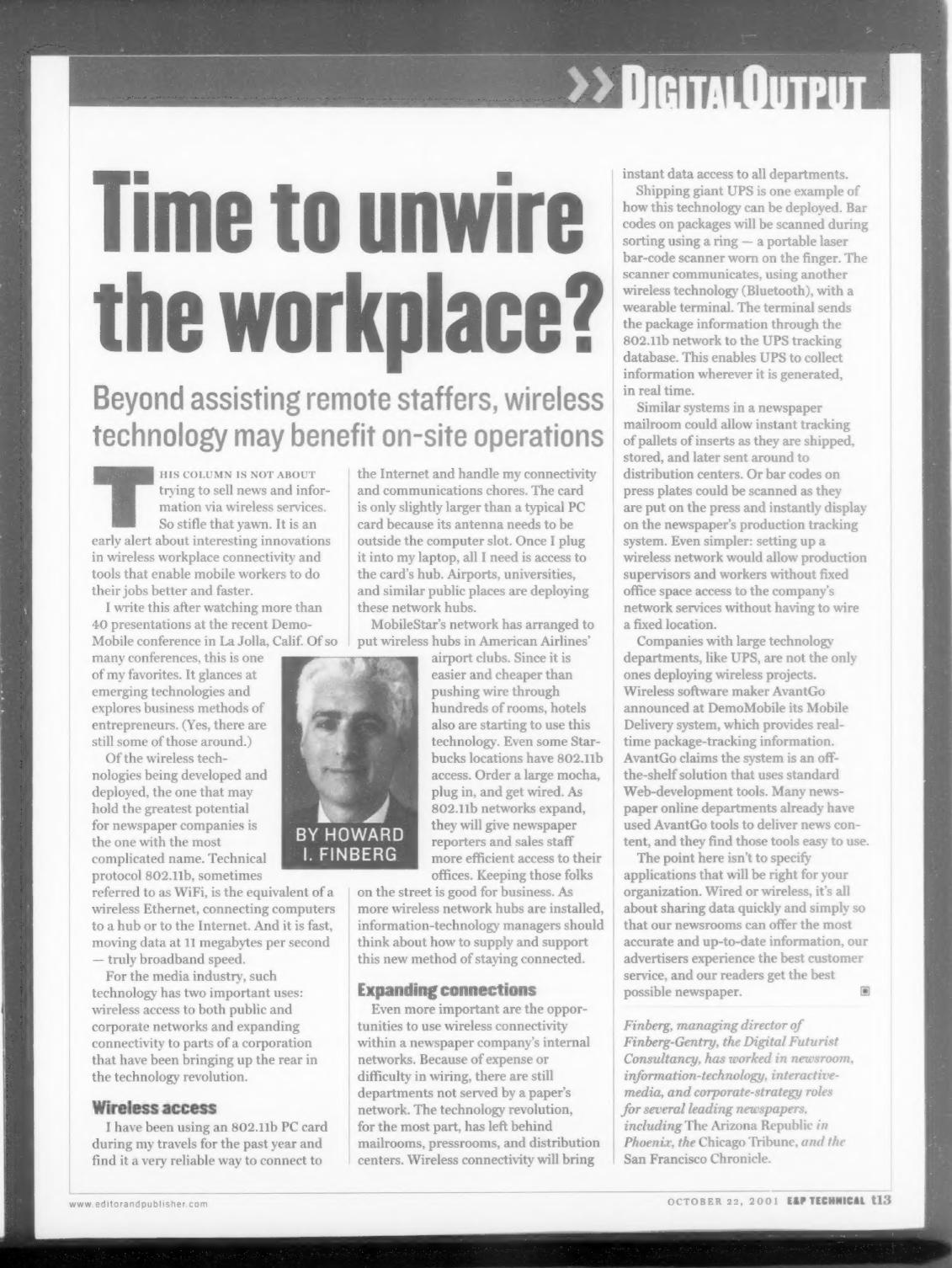
Editor & Publisher technical column from October 22, 2001 about 802.11b WiFi and wireless workplace connectivity

Time to Unwire the Workplace? A 2001 Column on WiFi

This is a column I wrote for Editor & Publisher, published October 22, 2001, in the magazine’s technical section. At the time I was managing director of Finberg-Gentry, the Digital Futurist Consultancy, and the column grew out of a few days spent watching more than 40 product demonstrations at the DemoMobile conference in La Jolla, Calif.

I opened by making clear what the column wasn’t about — selling news to tiny screens, which was the fashionable wireless topic of the moment.

THIS COLUMN IS NOT ABOUT trying to sell news and information via wireless services. So stifle that yawn. It is an early alert about interesting innovations in wireless workplace connectivity and tools that enable mobile workers to do their jobs better and faster.

The technology I singled out was 802.11b — already being called WiFi — which I described as the equivalent of a wireless Ethernet moving data at 11 megabytes per second. I had been carrying an 802.11b PC card on the road for a year, and noted that airports, universities, hotels and even some Starbucks locations were installing hubs. MobileStar had arranged to put hubs in American Airlines’ airport clubs. My advice to newspaper IT managers was to start thinking about how they would supply and support this new way of staying connected for reporters and sales staff.

The second half of the column was the part I cared more about: using wireless inside the building, in the departments that the wiring never reached.

The technology revolution, for the most part, has left behind mailrooms, pressrooms, and distribution centers. Wireless connectivity will bring instant data access to all departments.

I used UPS as the model — finger-worn bar-code scanners talking via Bluetooth to a wearable terminal, which fed the tracking database over an 802.11b network in real time. The newspaper equivalents were easy enough to imagine: tracking pallets of inserts as they moved to distribution centers, scanning bar codes on press plates as they went on the press, or simply giving production supervisors without fixed desks access to company network services. I also mentioned AvantGo, whose Mobile Delivery package-tracking system was announced at DemoMobile, and whose tools a number of newspaper online departments were already using for news content.

The closing point wasn’t really about wireless at all:

Wired or wireless, it’s all about sharing data quickly and simply.

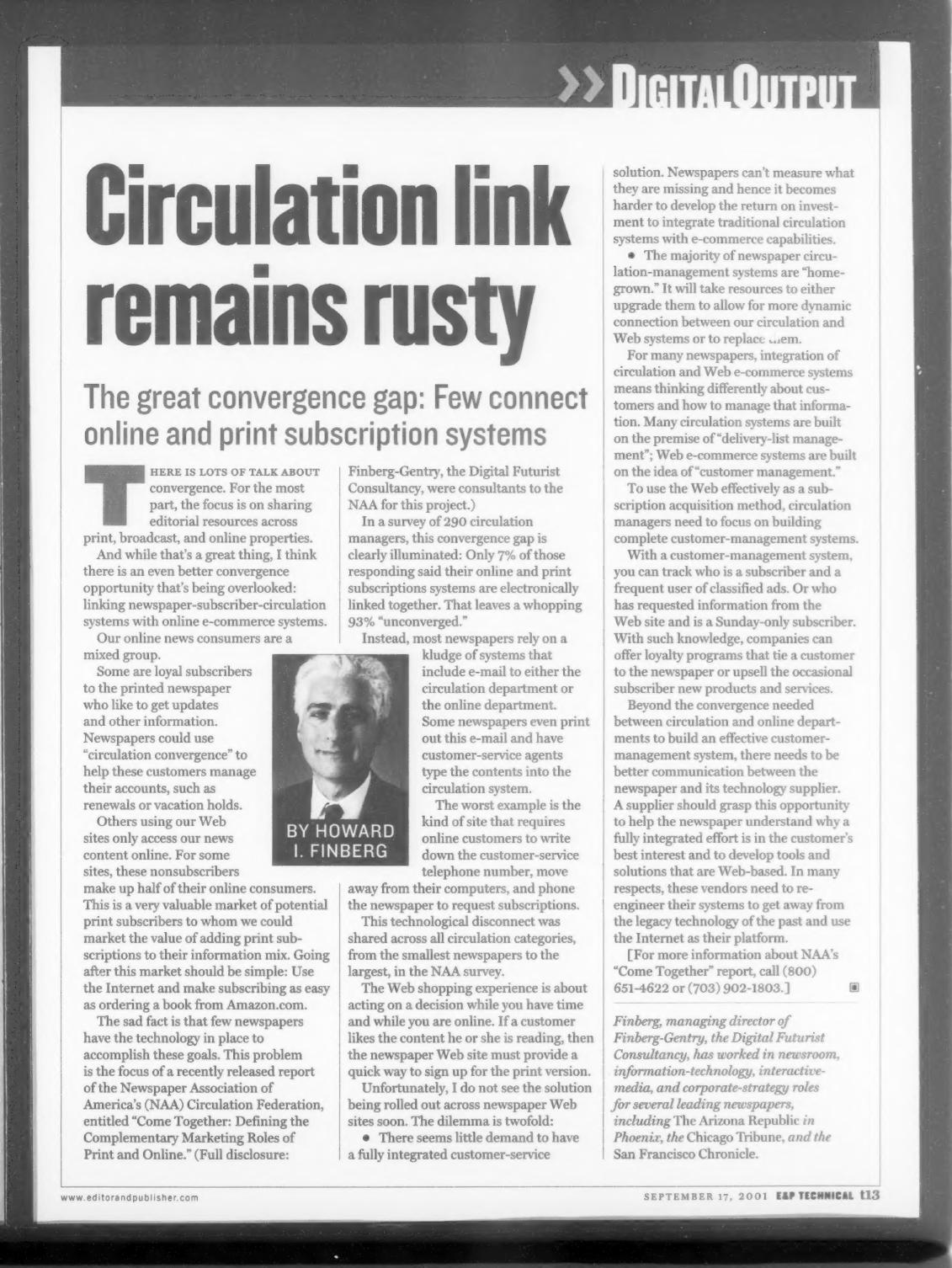
Tearsheet of the September 17, 2001 E&P Technical column headlined "Circulation link remains rusty" about the convergence gap between print and online subscription systems

Circulation-Web Link Remains Rusty, 2001

A column I wrote for E&P Technical, published September 17, 2001, under the headline “Circulation link remains rusty” and the deck “The great convergence gap: Few connect online and print subscription systems.” The argument: while the industry’s convergence conversation was focused on sharing editorial resources across print, broadcast, and online, a bigger opportunity was being ignored — connecting newspaper subscriber-circulation systems to online e-commerce systems.

And while that’s a great thing, I think there is an even better convergence opportunity that’s being overlooked: linking newspaper-subscriber-circulation systems with online e-commerce systems.

The column drew on a then-newly released report from the Newspaper Association of America‘s Circulation Federation, “Come Together: Defining the Complementary Marketing Roles of Print and Online.” As the column disclosed, Finberg-Gentry, the Digital Futurist Consultancy, were consultants to the NAA on the project. A survey of 290 circulation managers supplied the central number:

Only 7% of those responding said their online and print subscriptions systems are electronically linked together. That leaves a whopping 93% “unconverged.”

What newspapers used instead was described as “a kludge of systems” — e-mail to the circulation or online department, sometimes printed out and retyped into the circulation system by customer-service agents. The column singled out one practice as the worst case:

The worst example is the kind of site that requires online customers to write down the customer-service telephone number, move away from their computers, and phone the newspaper to request subscriptions

The disconnect held across all circulation size categories, from the smallest papers to the largest. The column identified a twofold dilemma: little internal demand for a fully integrated customer-service solution (papers “can’t measure what they are missing,” making ROI hard to build), and the fact that most circulation-management systems were “home-grown” and would take resources to upgrade or replace.

The underlying problem was framed as a difference in premise between the two kinds of systems:

Many circulation systems are built on the premise of “delivery-list management”; Web e-commerce systems are built on the idea of “customer management

The recommendation was for circulation managers to build complete customer-management systems — tracking, for example, who is a subscriber and a frequent user of classified ads, or who has requested information from the Web site and is a Sunday-only subscriber — to support loyalty programs and upselling. The column also called for better communication between newspapers and their technology suppliers, arguing vendors needed to re-engineer away from legacy technology and toward the Internet as their platform.

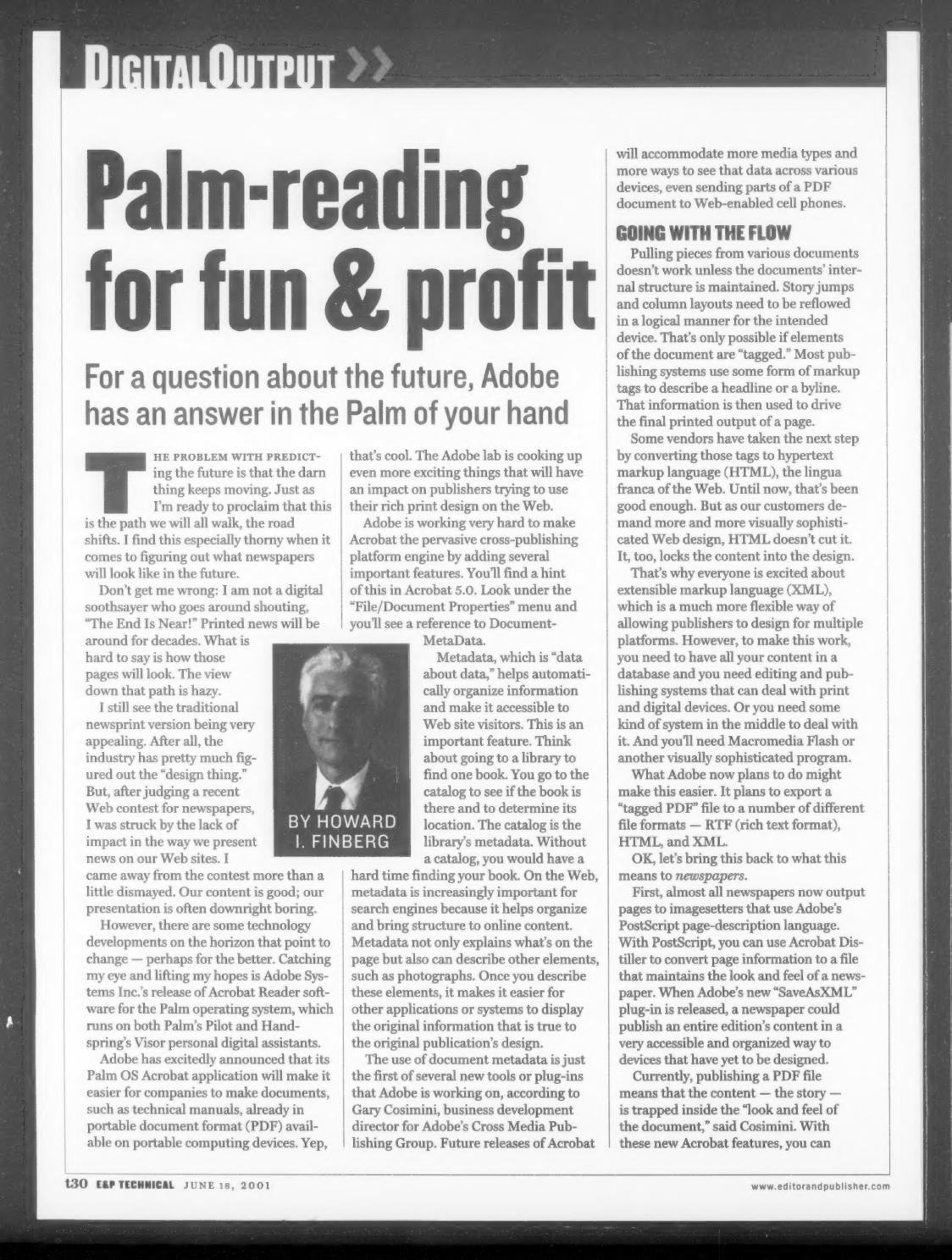
Two ways of looking at an Adobe Acrobat Reader PDF file: on a Palm handheld device and on paper

Palm-Reading for Fun & Profit

A column for Editor & Publisher‘s technical section, published June 15, 2001, under the headline “Palm-reading for fun & profit — For a question about the future, Adobe has an answer in the Palm of your hand.” The subject is Adobe Systems Inc.’s release of Acrobat Reader software for the Palm operating system, which ran on both Palm’s Pilot and Handspring’s Visor personal digital assistants, and what that development might mean for newspaper design across devices.

The problem with predicting the future is that the darn thing keeps moving. Just as I’m ready to proclaim that this is the path we will all walk, the road shifts.

The column argues that printed news will be around for decades, but that newspaper Web presentation was falling short. After judging a recent Web contest for newspapers, the verdict was blunt:

Our content is good; our presentation is often downright boring.

The technical discussion covers tagged documents, the limits of HTML — “It, too, locks the content into the design” — and the promise of extensible markup language (XML) for designing across multiple platforms. Gary Cosimini, business development director for Adobe’s Cross Media Publishing Group, is quoted on the state of PDF at the time, with the content “trapped inside the ‘look and feel of the document.'” The column describes Adobe’s plans to export a “tagged PDF” file to RTF, HTML and XML, and a forthcoming plug-in that would let a newspaper publish an entire edition’s content “to devices that have yet to be designed.”

Under the subhead “The Design Thing,” the column makes the case that publishing skill is itself a newspaper asset:

We know how to communicate by design. We organize and prioritize by design.

It closes by questioning whether the industry and its vendors were ready for a “handle-once” work flow publishing visually rich content across multiple devices, noting that competitors — CNET.com is the example — could run the process in reverse, converting XML- and HTML-formatted documents to PDF for print.

The road just shifted slightly, and there are warning signs ahead

The author’s note identifies Finberg as “a managing director of Finberg-Gentry, The Digital Futurist Consultancy,” with prior roles at The Arizona Republic in Phoenix, the Chicago Tribune, and the San Francisco Chronicle. An accompanying illustration showed “Two ways of looking at an Adobe PDF file: On a Palm device, on paper.”

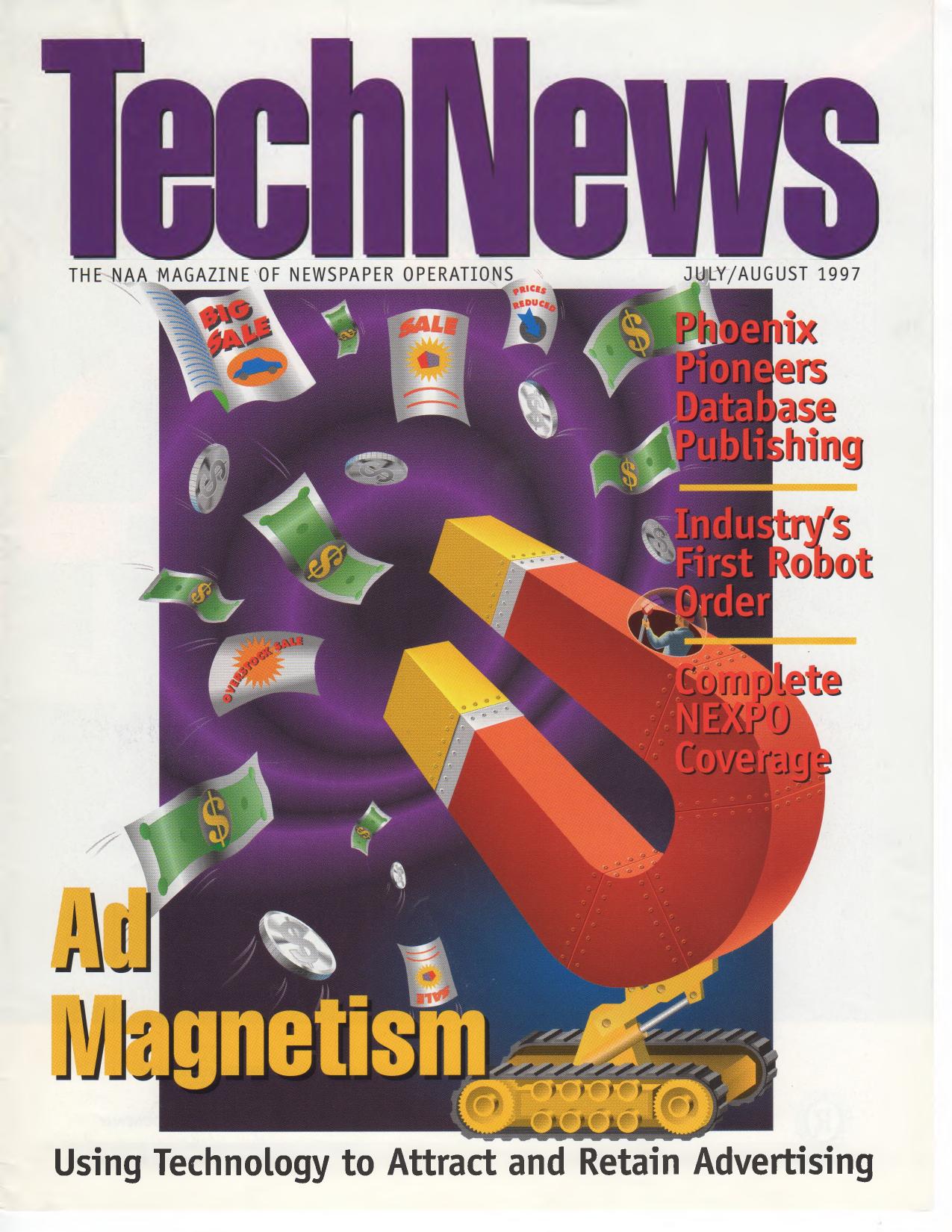
July/August 1997 TechNews magazine article about The Arizona Republic becoming the first North American newspaper produced entirely with a CCI database publishing system

First U.S. Database Publishing System

From the July/August 1997 issue of TechNews, the magazine of newspaper operations published by the Newspaper Association of America published a story about the conversion of The Arizona Republic to a CCI Europe database publishing system. This was work I led as the paper’s director of information technology. The new system replaced the Information International Inc. (Triple-I) pagination system that had made the Republic one of the first metro newspapers in the country to be completely paginated.

The Arizona Republic recently became the first newspaper in North America to be created entirely through “database-system publishing.” The Republic can now gather information once and distribute it in a variety of formats: from ink-on-paper to online, from fax to CD-ROM.

The first phase was completed June 2, 1997. The story notes that Phoenix Newspapers Inc. was doing this while also constructing a new 10-story building, launching Arizona Central, merging The Phoenix Gazette and Republic newsrooms and closing The Gazette, and moving more than 1,000 employees and their computers across the street.

Finberg described the timing of the switch to CCI’s database system as a lot like “changing the engine in an airplane at 35,000 feet. On paper it looks possible, but in your heart you know it will be pretty tricky. It is not something for the fainthearted.”

Dave Seibert, technology-development manager for news and information at PNI, is quoted on the hardest technical problem — getting CCI to talk to the existing SII text-editing system, which took about six months. David Neibergall, team leader for design, points to WYSIWYG editing, and to designers finally leaving the darkened room the staff called “The Cave,” a space required by the low-contrast green screens of the Triple-I system.

At the time of the article, the Republic was paginating more than 1,100 pages a week on CCI, with a common copy-editing and design database due that fall and reporters moving to Windows PCs in 1998. The piece closes on MediaServer and the ambition behind the whole project:

“With a database publishing system, we’ll have the tools to produce not only the newspaper, but also online editions, magazines, and more. The key is effective access to our content—text, photos, audio—regardless of the delivery method.”

Reading this in 2026, the vocabulary has changed but the argument has not. Create the content once, store it in a structured way, and deliver it wherever the audience happens to be. Every content management system and API-driven newsroom workflow in use today rests on that same idea — one we were arguing for, and building, a page at a time in Phoenix.

Editor & Publisher book review column from August 11, 1990 featuring a notice of Visual Editing: A Graphic Guide for Journalists

Editor & Publisher Reviews “Visual Editing”

A book review column from Editor & Publisher for August 11, 1990, written by Hiley Ward. The column paired a review of the revised and abridged Autobiography of William Allen White with a shorter notice of Visual Editing: A Graphic Guide for Journalists, by Howard I. Finberg and Bruce D. Itule (Belmont, Calif.: Wadsworth, 270 pages, paper, $32.50).

Ward’s review credited the book for leading with technology, then acknowledged the practical limits facing editing classes of the day.

This modern editing textbook has its foot in the right place as it early on deals with the new technology — the electronic story, electronic copy editing, electronic photography, electronic everything. Interactive and passive pagination are discussed.

Even then it is still hard to shape up a textbook for the modern editing class. For one thing, a lot of classes are not going to have the capability to do what is discussed. Secondly, a lot of the basics still have to be covered, elements of good design, picture editing, typefaces.

The review noted the chapter sidebar interviews with working professionals — citing Lynn Stanley, editorial design director for the Boston Globe, interviewed in the chapter on “How Art Directors Work” — along with the book’s history of newspaper illustration and its emphasis on information graphics and picture editing.

As it compares front pages, many in color, the book is as appealing for the practitioner as for the novice.

The review closed with the authors’ affiliations at the time:

Finberg is assistant managing editor at the Arizona Republic and Itule teaches at Arizona State University.

Chicago Tribune weather page from April 15, 1983, reproduced in the Society of Newspaper Design journal with outlook, satellite and temperature maps

Weather Page Design: Chicago Tribune and Atlanta

From The Journal of the Society of Newspaper Design, No. 12, a two-part look at newspaper weather packages. My piece describes the rethinking of the Chicago Tribune‘s weather presentation — done while the Sun-Times was redesigning its own weather page and USA Today was about to enter Chicago with a full-color version. The steps: hiring a meteorologist for material beyond what the National Weather Service supplied, rebuilding the page in modular units with carefully measured type blocks, and strengthening the graphics — the outlook map, a satellite photo with an engraving overlay to hold the white state borders, a pollution outlook map, a full-color temperature bands map on the briefing page, and a simple regional temperature map for the Tribune’s eight-state region. The example page reproduced with the article is dated Friday, April 15, 1983. At the time I was the Tribune’s picture/graphics editor.

The pollution index is an example of taking a report that uses only words and defining boundaries to create a graphic display of information.

It takes an artist a few minutes to prepare because all the type has been set in advance.

The facing article is by Joe Coleman, then photo editor of the Atlanta Journal & Constitution, on that paper’s half-page color weather map, developed as part of a redesign of the afternoon Journal. Coleman credits then-managing editor Eddie Sears:

Eddie Sears, had seen the USA Today prototype and found one thing worth stealing — an expanded weather map.

Coleman also describes adding columnist Charles Salter to personalize the data, and lists cautions for anyone building a weather package — designate a person responsible for gathering data, format as much as possible, and be careful about dropping cities:

We got more calls on dropping readers’ home towns or favorite foreign vacation spots than any other changes made over the past ten months.

An interesting twist: Joe Coleman is the same Joe Coleman I would later hire as my photo editor at The Arizona Republic in the late 1980s.