Open-Systems Experts Give Practical/Contradictory Advice, 1993
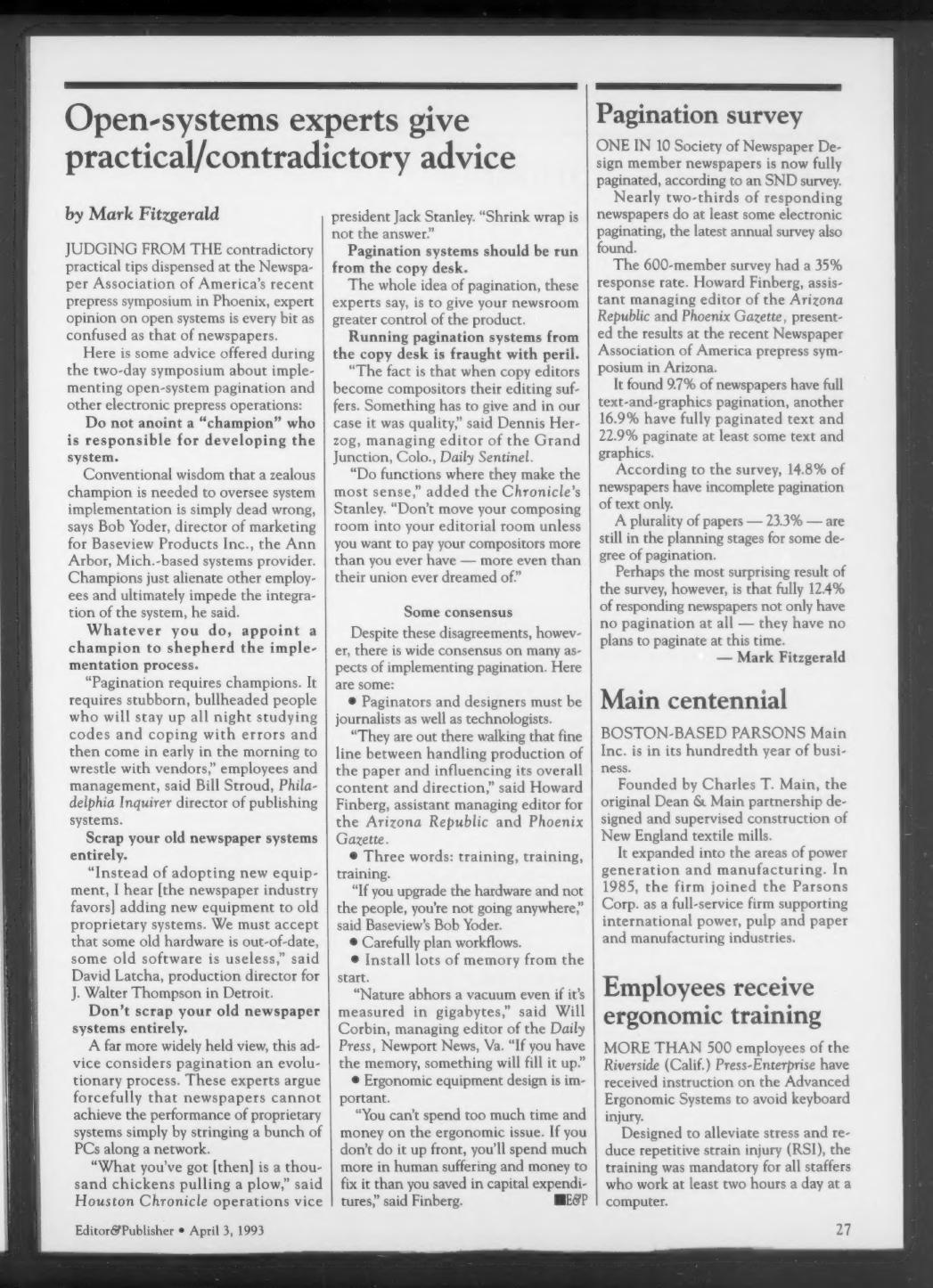
A pair of items by Mark Fitzgerald in the April 3, 1993, issue of Editor & Publisher, both reported out of the Newspaper Association of America‘s pre-press symposium in Phoenix. The first story catalogs the advice dispensed at the two-day symposium about implementing open-system pagination and other electronic prepress operations — and notes that much of it directly contradicted itself.
JUDGING FROM THE contradictory practical tips dispensed at the Newspaper Association of America’s recent pre-press symposium in Phoenix, expert opinion on open systems is every bit as confused as that of newspapers.
The story is built as a set of matched pairs: don’t anoint a “champion” (Bob Yoder, director of marketing for Baseview Products Inc.) versus appoint one (Bill Stroud, Philadelphia Inquirer director of publishing systems); scrap your old systems entirely (David Latcha, production director for J. Walter Thompson in Detroit) versus treat pagination as evolutionary; run pagination from the copy desk versus don’t. Houston Chronicle operations vice president Jack Stanley supplied the line about stringing PCs along a network:
“What you’ve got [then] is a thousand chickens pulling a plow,” said Houston Chronicle operations vice president Jack Stanley. “Shrink wrap is not the answer.”
Under “Some consensus,” the story lists points the speakers agreed on: paginators and designers must be journalists as well as technologists; training, training, training; careful workflow planning; plenty of memory from the start; and ergonomics. I was quoted twice, as assistant managing editor for the Arizona Republic and Phoenix Gazette.
“They are out there walking that fine line between handling production of the paper and influencing its overall content and direction,” said Howard Finberg, assistant managing editor for the Arizona Republic and Phoenix Gazette.
“You can’t spend too much time and money on the ergonomic issue. If you don’t do it up front, you’ll spend much more in human suffering and money to fix it than you saved in capital expenditures,” said Finberg.
The second item, a sidebar headlined “Pagination survey,” reports results from the annual Society of Newspaper Design survey, which I presented at the same symposium. The 600-member survey had a 35% response rate. It found 9.7% of newspapers with full text-and-graphics pagination, 16.9% with fully paginated text, 22.9% paginating at least some text and graphics, and 14.8% with incomplete pagination of text only. A plurality — 23.3% — were still in the planning stages.
Perhaps the most surprising result of the survey, however, is that fully 12.4% of responding newspapers not only have no pagination at all — they have no plans to paginate at this time.