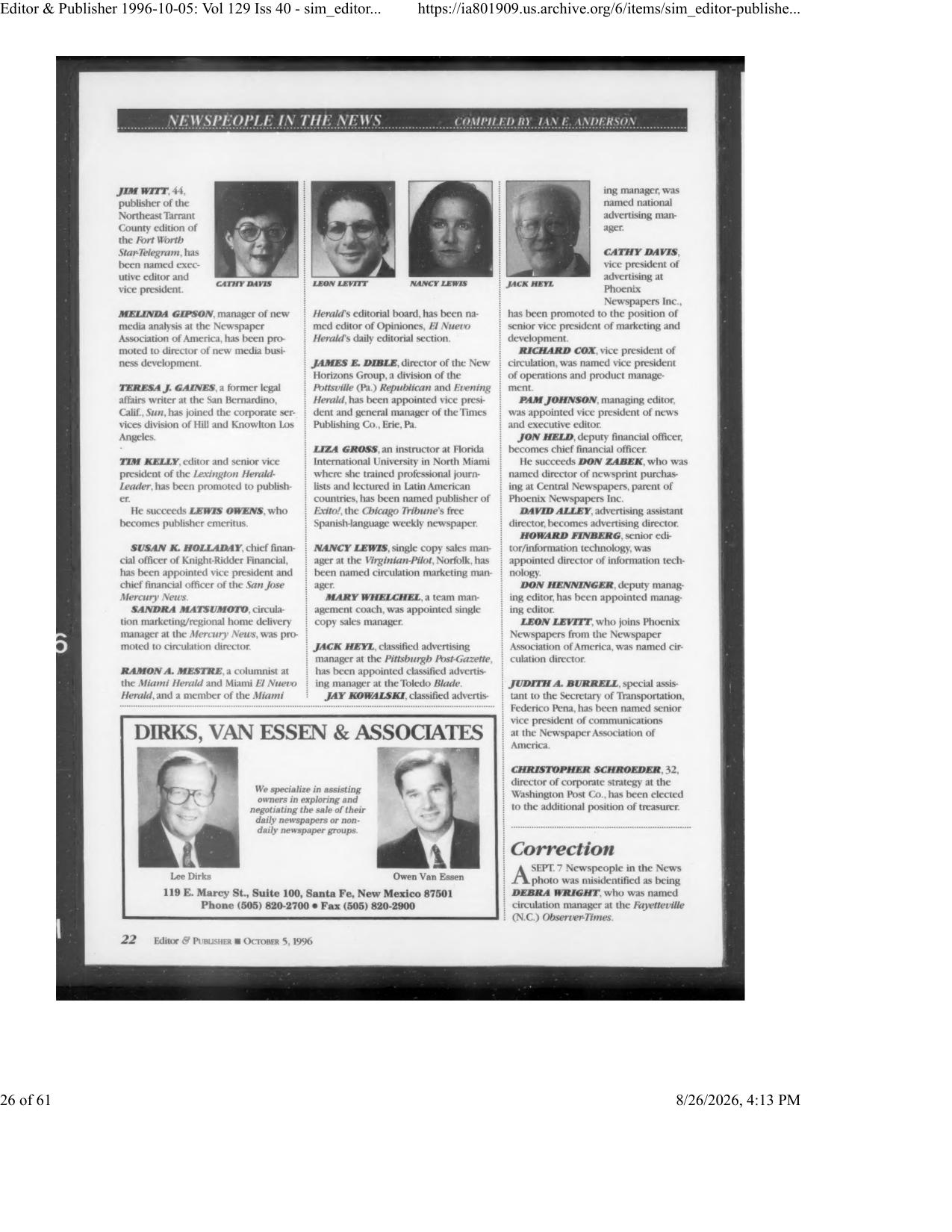
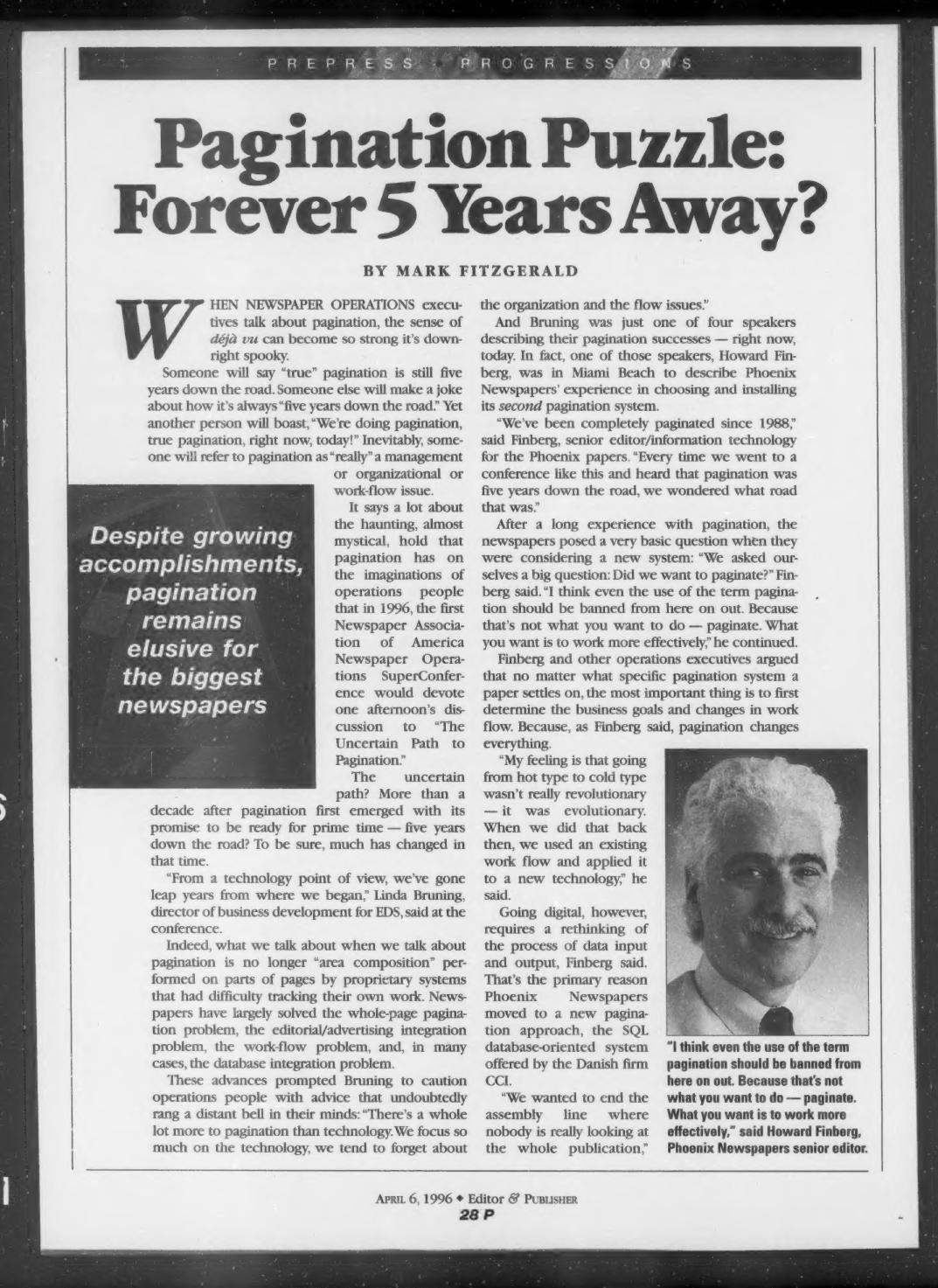
10th Annual Interactive Newspaper Conference

I was a speaker at the Editor & Publisher magazine’s 10th Annual Interactive Newspapers Conference in Atlanta, Ga. My speech was recorded live on February 18, 1999 in Atlanta, Georgia.

Here’s a bit of what I said at the start of my speech:

I made a presentation to our managers at Phoenix Newspapers a couple of weeks ago, and I sort of titled it “Armageddon” and whether, when we lose all, some share of classifieds in the next three years, what impact will that have on the bottom line. And if you look at the latest research from Forrester, they predict, on industry average, a 7% reduction in bottom line figures. If classified continues going the way it’s going then seven percent of us won’t be here next year, unless other things happen.

Another couple of interesting statistics is that in less than a dozen years, in 10 years, everybody under 50 will be computer literate. We’re all basically computer literate here; and obviously, the generations coming behind us are all computer literate. And even scarier is that by 2010, everybody under the age of 21 will not have known a world without the Internet. To us, some grey hairs [old folks] in the room, along with myself, is that we can remember, hot type and cold type and all that. And we remember when the Internet first took off.

This transcript is sometimes hard to read since the transcriber didn’t catch all of the jargon. However, it gives you a taste of what we were talking about in 1999.

Editor & Publisher feature page from May 5, 2003 by Carl Sullivan on spam filters, ad blockers and newspaper pop-up advertising

Spam Filters, Ad Blockers and a 2003 Warning About Pop-ups

This is a feature by Carl Sullivan in the May 5, 2003, issue of Editor & Publisher about a problem that was just coming into focus for newspaper Web sites: the filtering technologies readers were installing to protect themselves from spam and pop-up advertising were also blocking the e-mail and the ads newspapers were sending.

Sullivan opens with the e-mail news alerts newspapers sent when 15-year-old Elizabeth Smart was found near Salt Lake City in March 2003. Words like “teenager,” “kidnapped,” and “girl” tripped spam filters that mistook the alerts for pornography. Ron Currier, chief technology officer of Boulder-based PublishMail, which handled reader e-mail for more than 30 newspapers, described the result:

They bounced like crazy

The other half of the story was ad blocking. Sullivan cites a March 2003 Forrester Research study showing 14% of online consumers were using some form of ad-blocking software, up from about 1% a year earlier — with another 13% saying they hadn’t known such software existed until the pollsters asked, and would now consider installing it. The article quotes a long list of online newspaper executives on pop-ups, pop-unders, blacklists and whitelists, including Jason Krebs of NYTimes.com, Greg Schermer of Lee Enterprises, Ian Murdock of Hearst Newspapers, Ginger Neal of Freedom Orange County Information, and Jeff Webber of USAToday.com.

I was quoted twice, identified as a principal at the Finberg-Gentry consultancy — my partnership with Steve Gentry, also listed in the article as The Digital Futurist Consultancy — and as a faculty member at the Poynter Institute. The first quote follows a mention of our 2001 report for the Newspaper Association of America, which found that many publishers were generating new print subscriptions through pop-up house ads on their own Web sites:

Web publishers have to wean themselves off those or find additional ways to promote the paper. They were effective, but now’s the time to move off of them or to at least supplement them with banner and tile advertising.

Sullivan notes that we were working on a follow-up report about using the Net to promote print subscriptions, expected to be released by NAA that summer. My second quote closes the piece, alongside PowerOne Media’s David Teitler asking whether the Web would end up an advertising-supported medium at all:

Consumers recognize that there’s value in advertising. The real challenge for Web sites is to find the right visual model that conveys the message in an effective way without angering readers.

That challenge didn’t get any easier. The article also points to what became the answer for a while — contextual “sponsored links” served next to editorial content, then being tested at USAToday.com through Applied Semantics, a company Google had just purchased.

Editor & Publisher column from Nexpo 2002 advising newspaper CEOs to take stock of their digital infrastructure

Dancing To That Old Nexpo Beat

A column for Editor & Publisher, published June 24, 2002, timed to the Newspaper Association of America‘s big equipment and technology show, Nexpo, then under way in Orlando, Fla. The piece argues that the trade-show season is the right moment for a newspaper to take stock of its digital infrastructure — and that the review should not be left to the production and technical managers who happen to be walking the show floor.

It is important that the CEO be directly involved in these discussions. The CEO needs to bring all departments into the discussions, not just the production or technical managers who made it to Nexpo this week.

The column lays out a midyear technology review in four steps. Assess: each manager prepares a brief report on how well the department’s systems are working — including the smaller ones that “just hum along in the background” — and on how successfully employees actually use them, distinguishing technical problems from human ones such as lack of training.

Does the technology help employees do their jobs as effectively as possible? Does the technology work all the time (99.5% uptime)?

Review: go over projects already under way, led by the information-technology director in partnership with each department manager, and not as a finger-pointing exercise. Theorize: look two to five years out at revenue trends, readership trends (including interactive products such as the Web site), demographic trends — the column uses Spanish-language publishing and billing as an example — and technology trends, asking whether broadband, high-definition TV, or TabletPCs will change how advertisers reach customers and how readers get news. Plan and Coordinate: sort the resulting needs into short-term, midterm, and long-term buckets of 12 to 18 months, 18 to 24 months, and 36 to 60 months.

The closing advice is about the show itself: departments attending Nexpo should compare notes while they are still there.

Don’t wait until you get back in the office. Better yet, drag your colleagues to booths that have the technology that is important to your department. Make Nexpo a company event.

The column’s tagline reads: “Finberg, managing director of Finberg-Gentry, the Digital Futurist Consultancy, has worked in newsroom, information-technology, interactive-media, and corporate-strategy roles for several leading papers.”

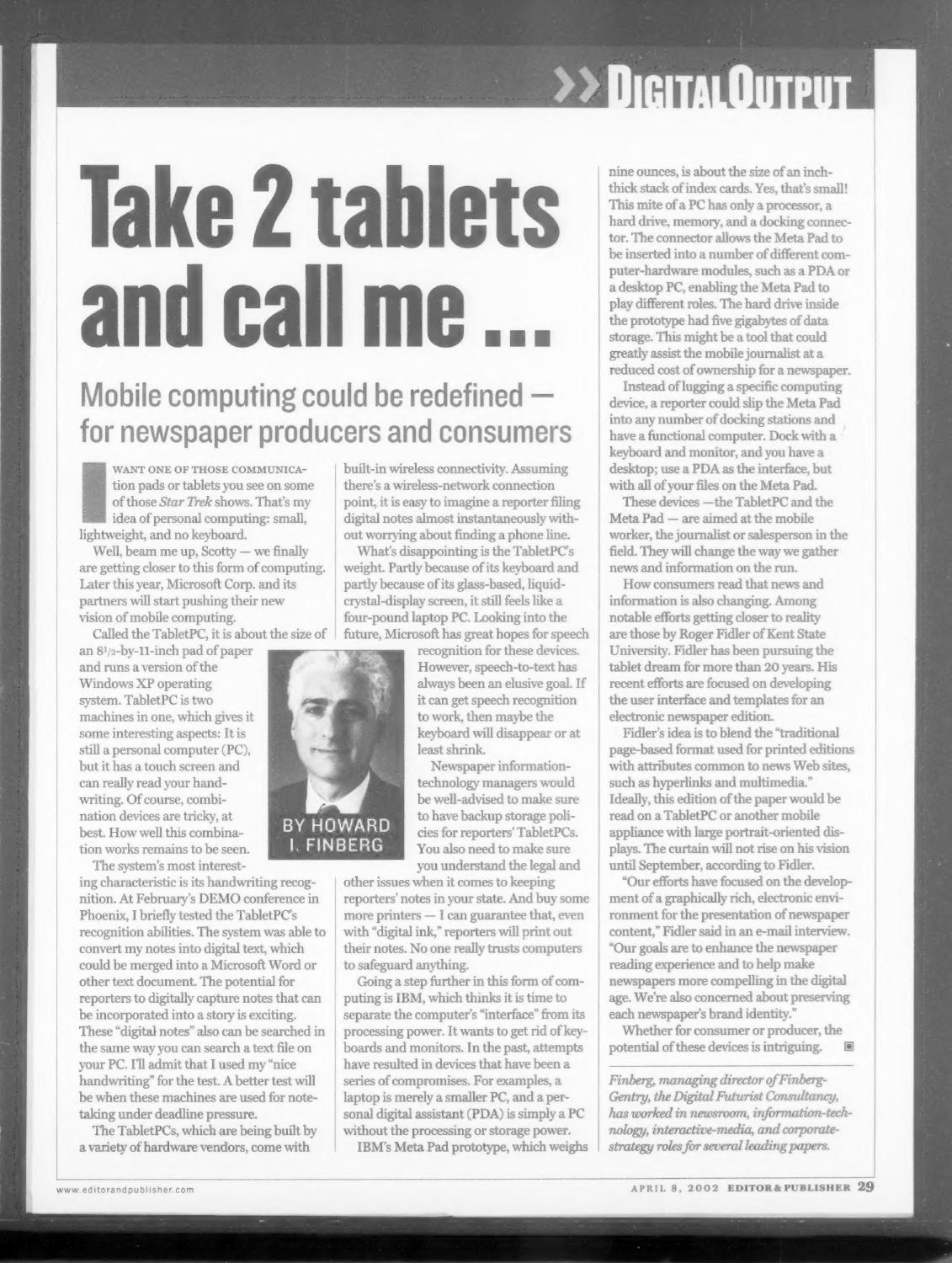
Tablet-style device representing the 2002 promise of mobile computing for newspapers, from an Editor & Publisher column

Take 2 Tablets and Call Me — Mobile Computing, 2002

My column in the April 8, 2002, issue of Editor & Publisher looked at two devices that promised to redefine mobile computing for both newspaper producers and consumers: Microsoft’s forthcoming TabletPC and IBM’s Meta Pad prototype.

The column opens with an admission about where the idea came from:

I want one of those communication pads or tablets you see on some of those Star Trek shows. That’s my idea of personal computing: small, lightweight, and no keyboard.

The TabletPC, about the size of an 8 1/2-by-11-inch pad of paper and running a version of Windows XP, was being built by a variety of hardware vendors with built-in wireless connectivity. I had briefly tested its handwriting recognition at February’s DEMO conference in Phoenix, where the system converted my notes into digital text that could be merged into a Word document. My caveat: I used my “nice handwriting,” and the real test would come with note-taking under deadline pressure. The disappointment was weight — it still felt like a four-pound laptop.

The column also offered practical advice for newspaper information-technology managers: back up reporters’ TabletPCs, understand the legal issues around keeping reporters’ notes in your state, and buy more printers.

No one really trusts computers to safeguard anything.

IBM’s Meta Pad prototype went a different direction — separating the interface from the processing power. At nine ounces and about the size of an inch-thick stack of index cards, it held only a processor, a hard drive, memory, and a docking connector, with five gigabytes of storage. Dock it with a keyboard and monitor and you have a desktop; dock it with a PDA and you have a handheld carrying all your files.

On the consumer side, the column reported on Roger Fidler of Kent State University, who had been pursuing the tablet dream for more than 20 years and was then working on the user interface and templates for an electronic newspaper edition — blending the page-based format of print with hyperlinks and multimedia. Fidler said his work would not be unveiled until September, and told me in an e-mail interview:

Our efforts have focused on the development of a graphically rich, electronic environment for the presentation of newspaper content. Our goals are to enhance the newspaper reading experience and to help make newspapers more compelling in the digital age. We’re also concerned about preserving each newspaper’s brand identity.

The column ran with the standard tagline identifying me as managing director of Finberg-Gentry, the Digital Futurist Consultancy.

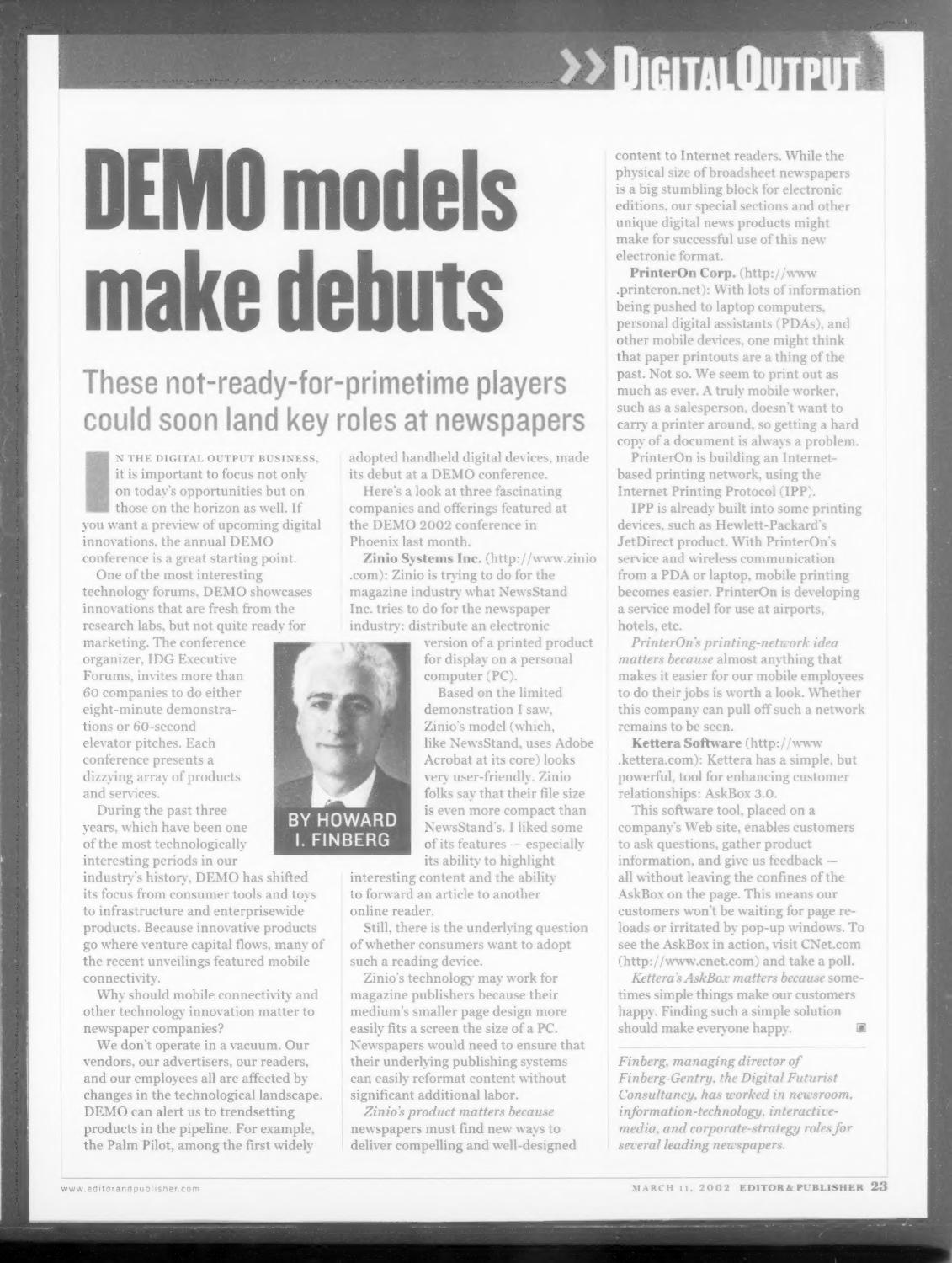
Editor & Publisher "Digital Output" column from March 11, 2002 reviewing products from the DEMO 2002 conference in Phoenix

DEMO Models Make Debuts

My “Digital Output” column from the Tech News section of Editor & Publisher, March 11, 2002. The column previews three products shown the previous month at the DEMO 2002 conference in Phoenix, organized by IDG Executive Forums, and notes that DEMO had shifted its emphasis from consumer tools toward infrastructure, enterprise, and mobile-connectivity products. The deck:

These not-ready-for-primetime players could soon land key roles at newspapers

Zinio Systems Inc. (zinio.com) was building an Adobe Acrobat-based system for distributing electronic magazines — the magazine industry’s counterpart to NewsStand Inc.’s newspaper service — with a more compact file size and features for highlighting content and forwarding articles to other readers.

PrinterOn Corp. (printeron.net) was building an Internet-based mobile printing network using the Internet Printing Protocol, already built into devices such as Hewlett-Packard’s JetDirect, aimed at mobile workers who need a hard copy without carrying a printer, with a planned service model for airports and hotels.

Kettera Software (kettera.com) demonstrated AskBox 3.0, a customer-service Web tool shown live on CNet.com, letting site visitors ask questions, gather product information, and give feedback without leaving the page or waiting for a reload.

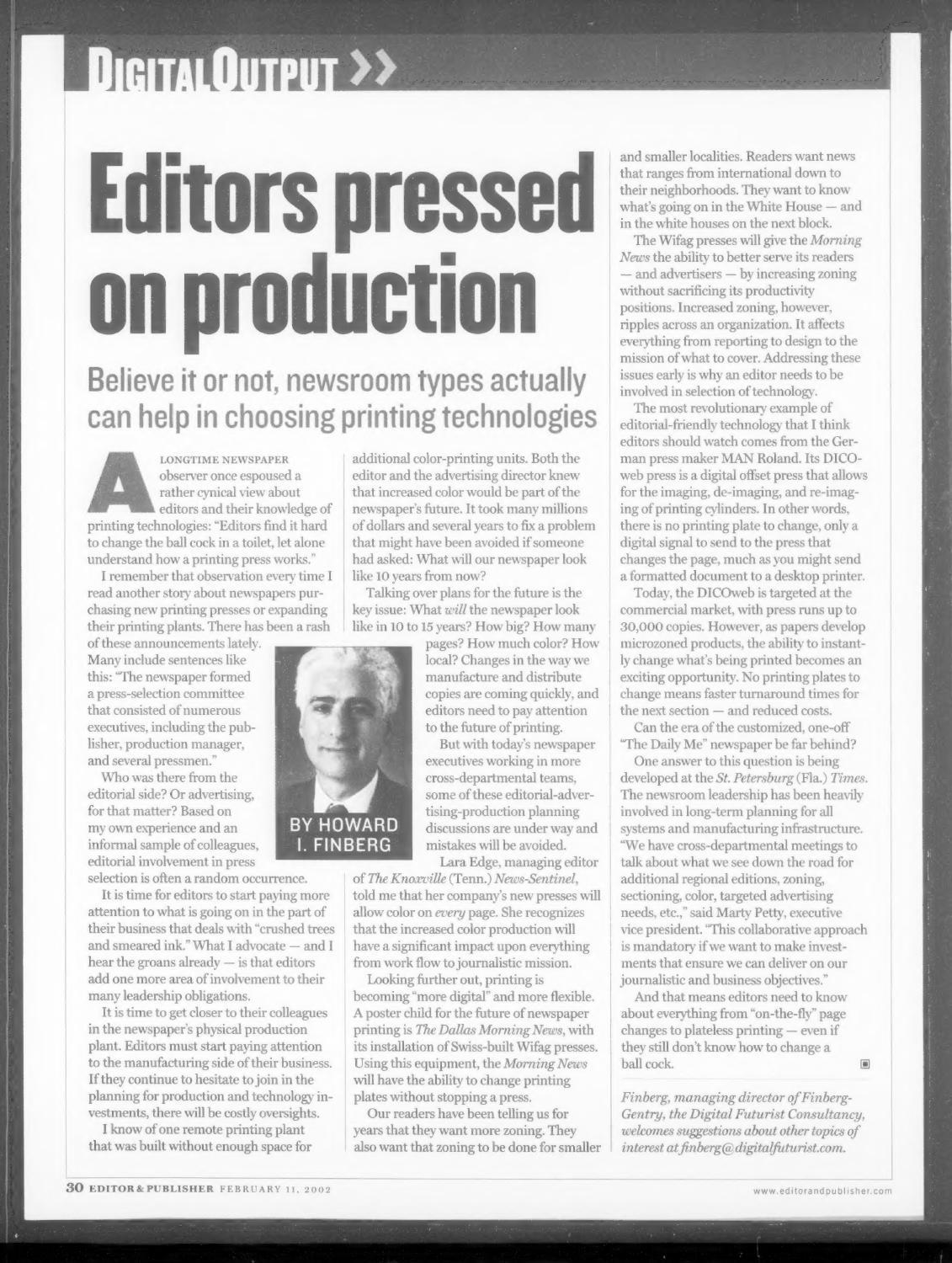
Editor & Publisher "Digital Output" column from February 11, 2002 on editorial involvement in newspaper press selection and printing-plant planning

Editors Pressed on Production

A February 11, 2002 column from my “Digital Output” series in the Tech News section of Editor & Publisher. The subject: editorial involvement — or the lack of it — in newspaper press selection and printing-plant planning. The column opens with a cynical observation from a longtime newspaper observer:

“Editors find it hard to change the ball cock in a toilet, let alone understand how a printing press works.”

The column notes that press-selection committees were typically made up of the publisher, production manager and several pressmen, and that editorial involvement was “often a random occurrence.” It cites a remote printing plant built without enough space for additional color-printing units — a problem that took several years and many millions of dollars to fix. The question editors should be asking: “What will the newspaper look like in 10 to 15 years? How big? How many pages? How much color? How local?”

Examples cited include The Knoxville (Tenn.) News-Sentinel, where managing editor Lara Edge said new presses would allow color on every page; The Dallas Morning News, with Swiss-built Wifag presses able to change printing plates without stopping a press; and MAN Roland’s DICOweb, a digital offset press allowing “the imaging, de-imaging, and re-imaging of printing cylinders.” The column ties these capabilities to reader demand for zoning:

They want to know what’s going on in the White House — and in the white houses on the next block.

The St. Petersburg (Fla.) Times is offered as a model of newsroom involvement in long-term planning for systems and manufacturing infrastructure. Marty Petty, executive vice president, is quoted:

“We have cross-departmental meetings to talk about what we see down the road for additional regional editions, zoning, sectioning, color, targeted advertising needs, etc. This collaborative approach is mandatory if we want to make investments that ensure we can deliver on our journalistic and business objectives.”

The closing line:

And that means editors need to know about everything from “on-the-fly” page changes to plateless printing — even if they still don’t know how to change a ball cock.

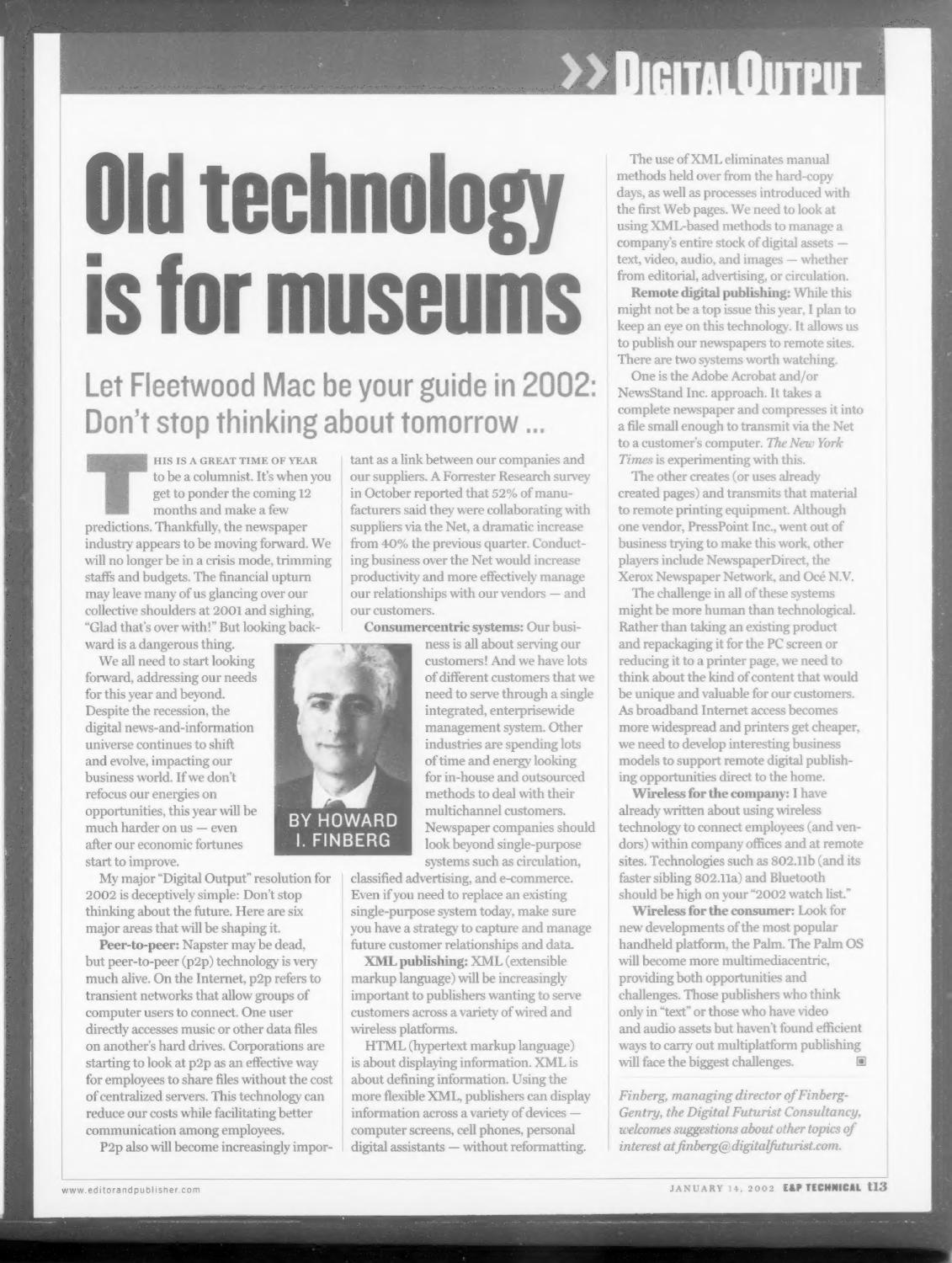
Digital Output column in the Editor & Publisher Technical section, January 14, 2002, on technologies to watch

Old Technology Is for Museums

My “Digital Output” column for Editor & Publisher, published January 14, 2002, in the E&P Technical section. It’s a start-of-the-year prediction column, written as the newspaper industry came out of the budget-and-staff cutting of 2001, and it lays out six technology areas worth watching.

The framing came from Fleetwood Mac — the subhead read “Let Fleetwood Mac be your guide in 2002: Don’t stop thinking about tomorrow …” — and the column’s central point was that the recession was no excuse to stop paying attention to what was coming next.

My major “Digital Output” resolution for 2002 is deceptively simple: Don’t stop thinking about the future.

The six areas: peer-to-peer technology, which I argued was alive well past Napster and would matter both inside companies and as a link to suppliers; consumer-centric systems, urging publishers to look beyond single-purpose circulation, classified, and e-commerce systems toward one integrated, enterprise-wide approach to customer data; XML publishing; remote digital publishing; wireless inside the company; and wireless for the consumer.

On XML, the column drew the distinction plainly:

HTML (hypertext markup language) is about displaying information. XML is about defining information.

The remote digital publishing section looked at two approaches — the Adobe Acrobat and/or NewsStand Inc. model of compressing a complete newspaper for transmission to a customer’s computer, which The New York Times was experimenting with, and transmitting pages to remote printing equipment. PressPoint Inc. had already gone out of business trying to make the second work; other players named were NewspaperDirect, the Xerox Newspaper Network, and Oc
u00e9 N.V. My conclusion about all of it:

The challenge in all of these systems might be more human than technological.

For wireless, 802.11b and 802.11a and Bluetooth were on the “2002 watch list,” and on the consumer side the column pointed to the Palm OS becoming “more multimedia-centric.” The column ran with the standard tagline identifying me as managing director of Finberg-Gentry, the Digital Futurist Consultancy.

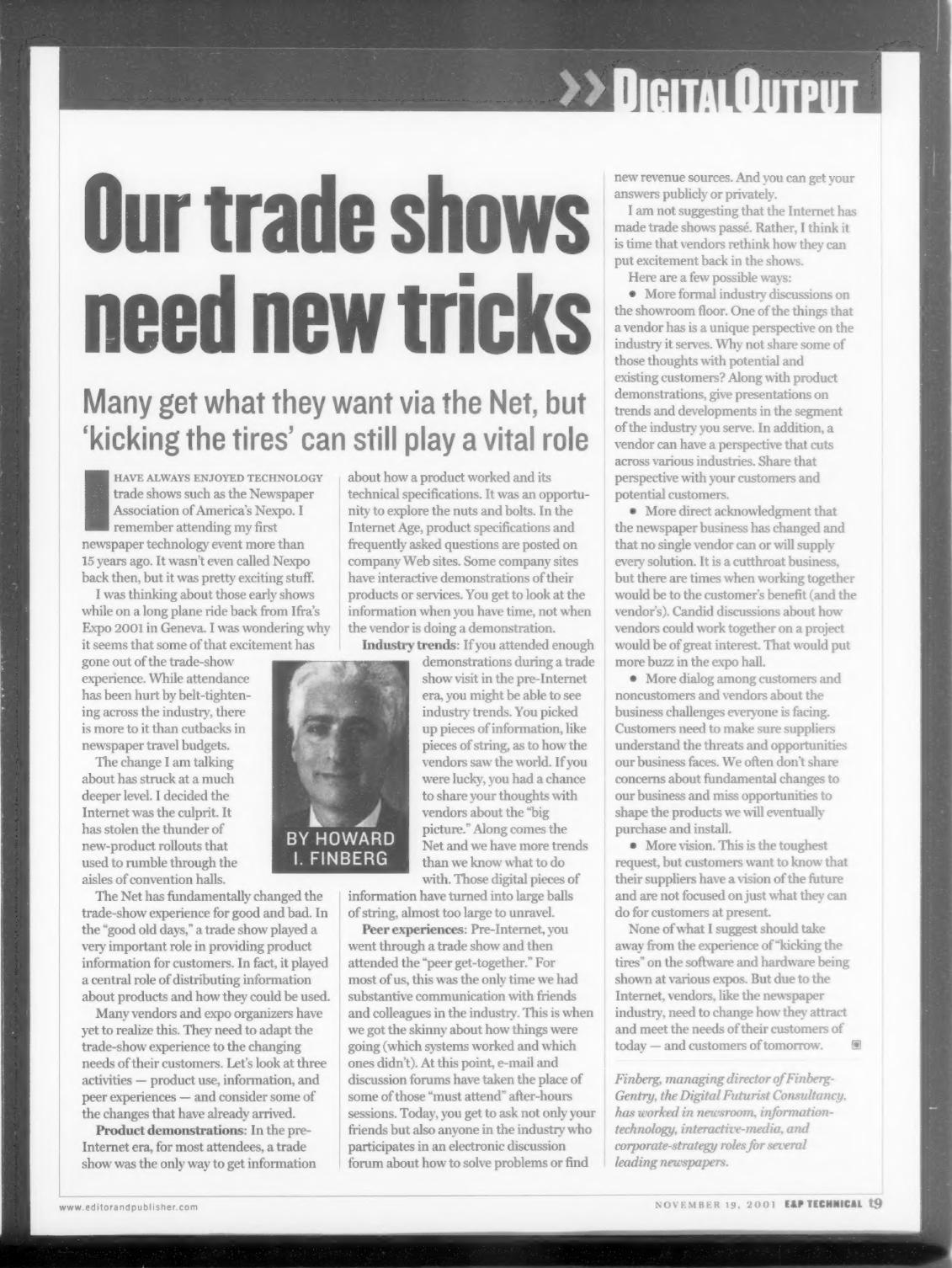
Editor & Publisher column page on newspaper technology trade shows, November 2001

Our Trade Shows Need New Tricks

A column I wrote for Editor & Publisher‘s technical section, published November 19, 2001, arguing that the Internet had drained some of the excitement out of newspaper technology trade shows such as the Newspaper Association of America‘s Nexpo and Ifra‘s Expo 2001 in Geneva.

The piece notes that while attendance had been hurt by industry belt-tightening, the deeper change was elsewhere:

I decided the Internet was the culprit. It has stolen the thunder of new-product rollouts that used to rumble through the aisles of convention halls.

The column looks at three activities — product demonstrations, industry trends, and peer experiences — and how each had already moved online. Product specifications and FAQs were posted on company Web sites, some with interactive demonstrations. Trend-spotting, once assembled from bits of vendor conversation, had become overwhelming:

Those digital pieces of information have turned into large balls of string, almost too large to unravel.

And e-mail and discussion forums had replaced some of the after-hours “peer get-together” sessions where attendees once got “the skinny” on which systems worked and which ones didn’t.

Rather than declaring trade shows finished, the column offers suggestions for vendors: more formal industry discussions on the showroom floor, more direct acknowledgment that no single vendor can supply every solution, more dialog with customers and noncustomers about shared business challenges, and more vision.

None of what I suggest should take away from the experience of “kicking the tires” on the software and hardware being shown at various expos.

The column ran with a note identifying me as managing director of Finbereg-Gentry, the Digital Futurist.

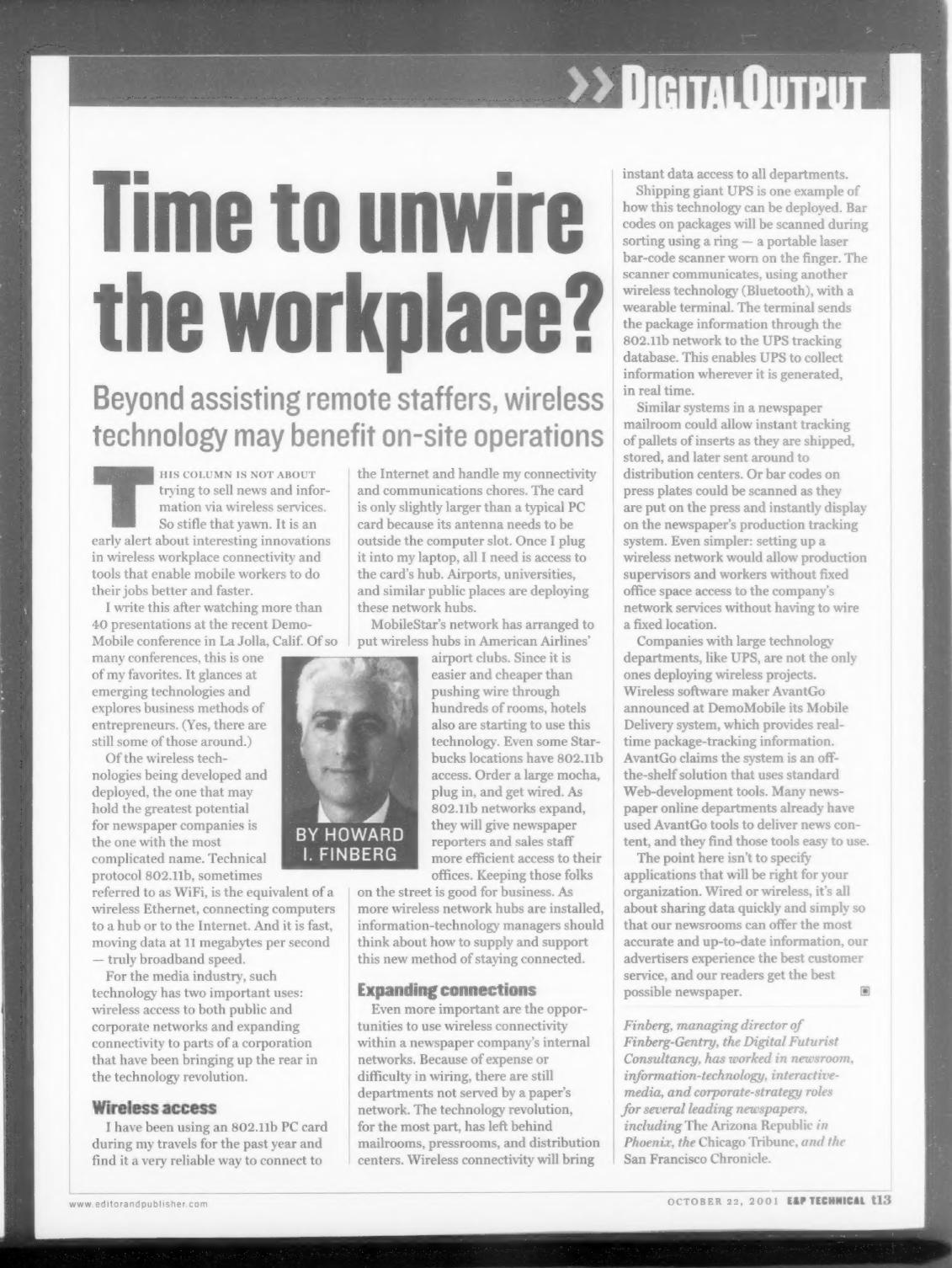
Editor & Publisher technical column from October 22, 2001 about 802.11b WiFi and wireless workplace connectivity

Time to Unwire the Workplace? A 2001 Column on WiFi

This is a column I wrote for Editor & Publisher, published October 22, 2001, in the magazine’s technical section. At the time I was managing director of Finberg-Gentry, the Digital Futurist Consultancy, and the column grew out of a few days spent watching more than 40 product demonstrations at the DemoMobile conference in La Jolla, Calif.

I opened by making clear what the column wasn’t about — selling news to tiny screens, which was the fashionable wireless topic of the moment.

THIS COLUMN IS NOT ABOUT trying to sell news and information via wireless services. So stifle that yawn. It is an early alert about interesting innovations in wireless workplace connectivity and tools that enable mobile workers to do their jobs better and faster.

The technology I singled out was 802.11b — already being called WiFi — which I described as the equivalent of a wireless Ethernet moving data at 11 megabytes per second. I had been carrying an 802.11b PC card on the road for a year, and noted that airports, universities, hotels and even some Starbucks locations were installing hubs. MobileStar had arranged to put hubs in American Airlines’ airport clubs. My advice to newspaper IT managers was to start thinking about how they would supply and support this new way of staying connected for reporters and sales staff.

The second half of the column was the part I cared more about: using wireless inside the building, in the departments that the wiring never reached.

The technology revolution, for the most part, has left behind mailrooms, pressrooms, and distribution centers. Wireless connectivity will bring instant data access to all departments.

I used UPS as the model — finger-worn bar-code scanners talking via Bluetooth to a wearable terminal, which fed the tracking database over an 802.11b network in real time. The newspaper equivalents were easy enough to imagine: tracking pallets of inserts as they moved to distribution centers, scanning bar codes on press plates as they went on the press, or simply giving production supervisors without fixed desks access to company network services. I also mentioned AvantGo, whose Mobile Delivery package-tracking system was announced at DemoMobile, and whose tools a number of newspaper online departments were already using for news content.

The closing point wasn’t really about wireless at all:

Wired or wireless, it’s all about sharing data quickly and simply.

Editor & Publisher clipping by Jim Rosenberg reporting the closing of JForum, the Journalism Forum on CompuServe

JForum Ends: Where the Digital Pioneers Went to School

This is an Editor & Publisher story by Jim Rosenberg, published May 17, 2001, reporting the end of the Journalism Forum on CompuServe. JForum was merged with CompuServe‘s PR Forum into a new service called MediaPro, and the old forum stopped operating.

Rosenberg’s account is a short obituary for something that mattered a great deal to a small number of people. JForum began, as he wrote, on a Radio Shack laptop:

Launched on a Radio Shack laptop in 1985, the then-300-baud journalists’ computer bulletin board eventually served thousands of members worldwide, with job listings and messaging in four languages on a variety of topics.

It was also, the story notes, the first online home of the Society of News Design, the National Press Photographers Association, Investigative Reporters and Editors, and other organizations — and the subject of an early ’90s ruling in which a U.S. judge found CompuServe not responsible for messages it was unaware of that were posted in JForum.

Former NBC News manager Jim Cameron, who started the forum, said he

founded JForum … for the dwindling number of radio news people to share survival tips.

He credited the section leaders and assistants “who really ran JForum as editors.” I was one of them, and Rosenberg quoted me at some length about what made the place work — the effort required to participate at all, and what that effort produced:

You really had to commit to be a member of this community. At that point, you realized the possibility of community was not a geographical issue … It was about shared interest.

And on what its closing meant:

This is a passing of a forefather of a lot of what is going on right now. This was an educational experience for the digital pioneers. This is where we went to school. We learned from each other.

The story closes by noting that Cameron would stay on in an interim capacity, with MediaPro to be operated by PR Forum’s Mike Bayer. Rosenberg was then a senior editor covering newspaper technology for E&P.

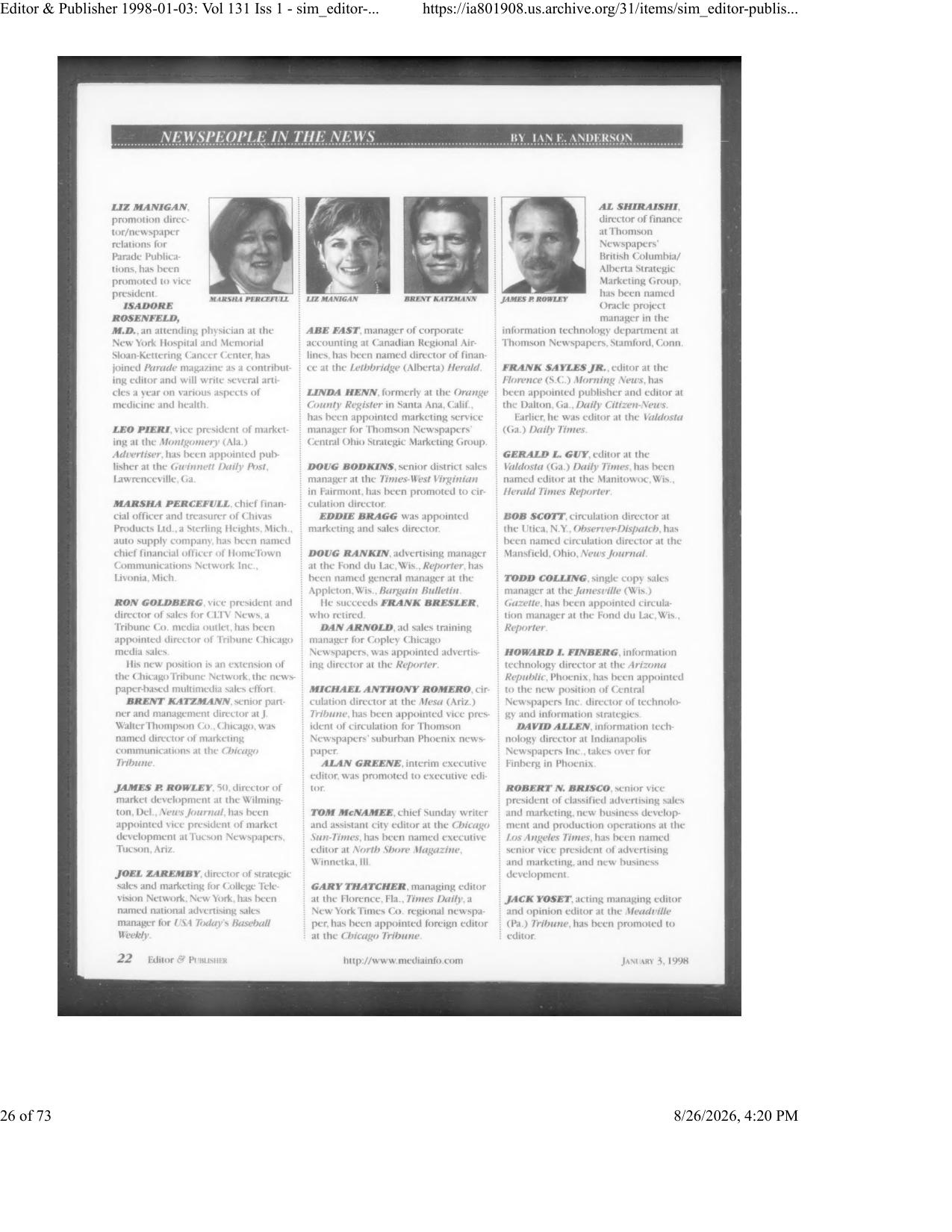
Editor & Publisher Interactive column from January 1998 about New Century Network layoffs and PAFET cutbacks

About New Century Network and PAFET Cutbacks

This is a Steve Outing column written for Editor & Publisher Interactive and posted January 12, 1998. The news hook was two pieces of bad news arriving at about the same time: New Century Network had laid off 10% of its staff and refocused its work away from anything that might compete with its owners’ own Web sites, and PAFET — Partners Affiliated For Exploring Technology — had closed its two-person central office in Dallas at the end of 1997. Outing used both to ask a question that hung over the industry for years:

Can newspapers really work together in cyberspace?

PAFET was a six-company research and development venture — A.H. Belo Corp., Central Newspapers, Cowles Media Co., Freedom Communications, McClatchy Newspapers, and Pulitzer Publishing Co. Executive director Marla McDonald and her assistant were let go on December 31, but, as Chris Hendricks of Nando.net told Outing, the governing committees would keep meeting as before. I was on the operating committee, and I’m quoted throughout the piece downplaying the closing — the organization had looked at what it wanted to accomplish and decided it didn’t need the Dallas operation, and the decision wasn’t a budget decision. With McDonald gone, Outing noted PAFET didn’t really have a “point person,” and I suggested that informal title probably belonged to Joel Kramer, publisher of the Star Tribune in Minneapolis and chairman of the PAFET management committee.

The column is a good description of how PAFET actually worked: strategic investment recommendations that each company acted on individually — Zip2, PointCast, Firefly and Infoseek — and joint projects like the WorkAvenue classified employment site, conceived together but implemented company by company. The thing I was most pleased about, then and now, was the cooperation itself:

“We have learned how to cooperate, and that’s pretty exciting,” Finberg says. “From my perspective, we have to learn how to cooperate with each other. The days of dealing with a newspaper 1,500 miles away as competition are over.”

Outing also collected outside views. Randy Bennett of the Newspaper Association of America called the two stories “apples and oranges” — PAFET was about research shared among members, NCN was trying to build Internet services itself. Eric Meyer of the University of Illinois and Newslink Associates was blunter about the underlying problem of consortia with multiple masters, and about publishers’ attachment to their own brands:

“I don’t think The Associated Press would have been developed with the attitudes of publishers today,” he says.

There’s a personal footnote at the end of the column, in Outing’s “Movin’ On” item: as of January 1 I had become Central Newspapers‘ director of technology and information strategies, a corporate job I held while staying in Phoenix rather than moving to Indianapolis. David Allen, then information technology director at Indianapolis Newspapers, Inc., took over as director of information technology at The Arizona Republic beginning February 2.

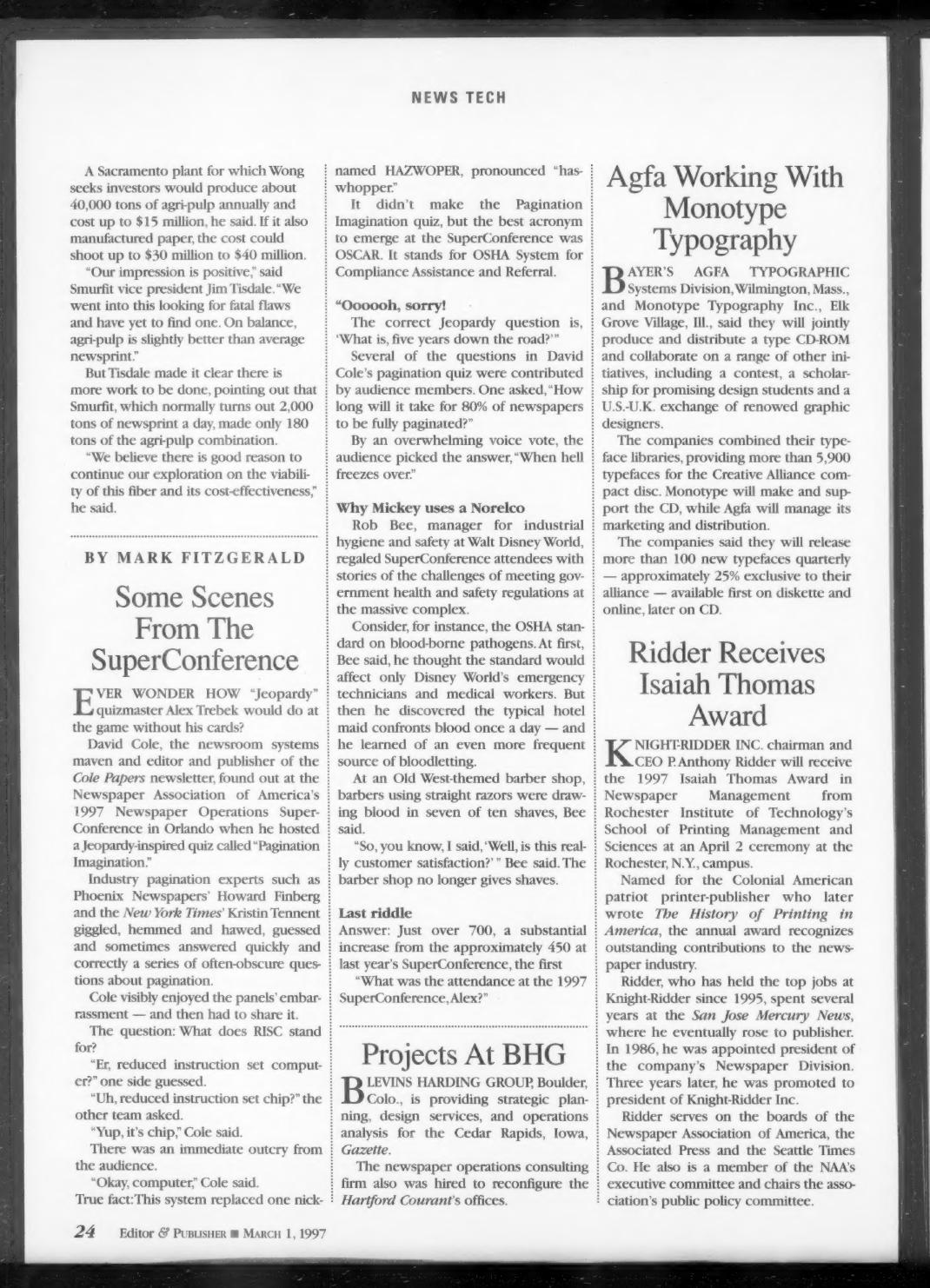
Editor & Publisher News Tech column page from March 1, 1997, reporting on the pagination quiz at the 1997 SuperConference in Orlando

“Pagination Imagination” at the 1997 SuperConference

A News Tech column by Mark Fitzgerald in the March 1, 1997, issue of Editor & Publisher, reporting scenes from the Newspaper Association of America‘s 1997 Newspaper Operations SuperConference in Orlando. The centerpiece: a Jeopardy-inspired quiz hosted by David Cole, described in the column as “the newsroom systems maven and editor and publisher of the Cole Papers newsletter.”

The panel of contestants included me, then at Phoenix Newspapers, and Kristin Tennent of the New York Times.

Industry pagination experts such as Phoenix Newspapers’ Howard Finberg and the New York Times‘ Kristin Tennent giggled, hemmed and hawed, guessed and sometimes answered quickly and correctly a series of often-obscure questions about pagination.

Cole’s answer key did not always survive audience review u2014 asked what RISC stands for, he ruled for “chip” over “computer” until the room objected, at which point: “Okay, computer,” Cole said.

One audience-contributed question asked how long it would take for 80% of newspapers to be fully paginated.

By an overwhelming voice vote, the audience picked the answer, “When hell freezes over.”

The column also noted attendance at the 1997 SuperConference was “just over 700, a substantial increase from the approximately 450 at last year’s SuperConference, the first.” Other items in the same News Tech package covered agri-pulp newsprint testing at Smurfit, Blevins Harding Group projects, an AgfaMonotype typeface alliance, and the 1997 Isaiah Thomas Award to Knight-Ridder‘s P. Anthony Ridder.

April 1996 Editor & Publisher article about the uncertain path to a newspaper pagination system, with a callout quote from the panel

Pagination: Forever Five Years Away?

This is a story by Mark Fitzgerald in Editor & Publisher, published April 6, 1996, about a session called “The Uncertain Path to Pagination” at the first Newspaper Association of America Newspaper Operations SuperConference. I was one of four speakers, in Miami Beach to talk about Phoenix Newspapers’ experience choosing and installing its second pagination system.

Fitzgerald’s framing was the running industry joke that real pagination was always just over the horizon:

Someone will say “true” pagination is still five years down the road. Someone else will make a joke about how it’s always “five years down the road.”

My contribution was to point out that some of us had already made the trip:

“We’ve been completely paginated since 1988,” said Finberg, senior editor/information technology for the Phoenix papers. “Every time we went to a conference like this and heard that pagination was five years down the road, we wondered what road that was.”

The larger point I was trying to make — and the one that got pulled out as the article’s callout quote — was that the word itself had become the problem.

“I think even the use of the term pagination should be banned from here on out. Because that’s not what you want to do — paginate. What you want is to work more effectively.”

The story records my argument that going from hot type to cold type had been evolutionary, not revolutionary, because we simply applied an existing work flow to a new technology. Going digital required rethinking data input and output — which is why Phoenix Newspapers moved to the SQL database-oriented system from the Danish firm CCI. The goal, as I put it in the piece, was “multiple products from the same information,” using the same database for niche publications and Internet publishing. And there was a virtue in the long installation: it forced you to look at work-flow issues first.

“We wanted to end the assembly line where nobody is really looking at the whole publication.”

The other speakers filled out the picture. Linda Bruning of EDS warned that “There’s a whole lot more to pagination than technology.” Mark Francis, president and publisher of the 27,000-circulation Niagara Gazette, described giving every department an equal vote in picking a system, and said his paper was already 100% paginated with all pages going direct to negative film — while still printing on a Goss Mark I letterpress bought in 1949. Mike Schoepke of Paddock Publications described the Daily Herald‘s deliberate, one-element-at-a-time rollout of DewarView.

The skeptics came from the biggest papers. Paul Lynch of the Chicago Tribune said there were still functionality issues. Tom Cusack, prepress director at the Star-Ledger, put his finger on something that would sound familiar to anyone who has ever moved large files around a building:

“The single largest barrier to paginating medium to large circulation papers is the network and communications issues internally.”

Fitzgerald ended the piece the way the industry always ended these conversations — noting that things might change. Down the road, of course.

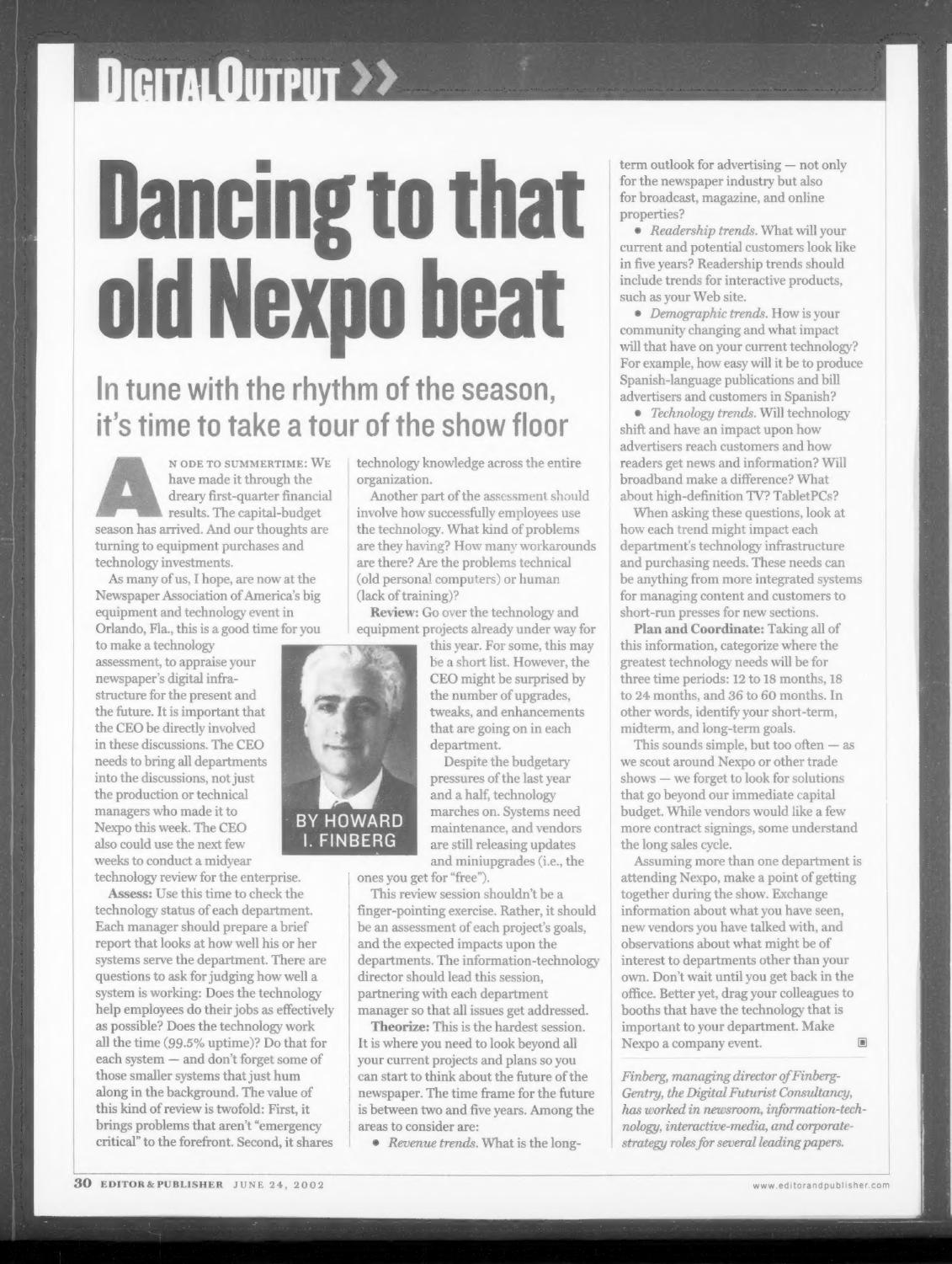
Editor & Publisher syndicates and news services page from April 8, 1995, reporting United Media's World Wide Web site launch

Early Syndicate Efforts on the Web, 1995

A syndicates and news services page from the April 8, 1995, issue of Editor & Publisher, reported by David Astor. The lead story covers United Media‘s April 1 launch of a World Wide Web site at http://www.unitedmedia.com — an in-house operation for the E.W. Scripps Co.-owned syndicate — carrying the work of nine comic creators and 10 editorial cartoonists, along with feature previews, background information, photos, graphics and feedback areas. 

Comics from United Feature Syndicate and Newspaper Enterprise Association were to be collected in a two-week archive and posted online one week after newspaper publication. “The Comic Strip” section included an enhanced “Dilbert Zone” devoted to Scott Adams‘ strip, with biographical material, early sketches, a “tour” of the studio and an interactive map for locating “Dilbert” client newspapers; Adams also maintained a presence on America Online. “The Inkwell” area featured the editorial cartoonists, among them Pulitzer Prize winner Steve Benson of the Arizona Republic.

From United president Doug Stern:

“We are using the digital power of the Internet to reaffirm the awareness of an ageless art form for a new generation. It’s a way for readers to see talented cartoonists that they might not see in their local papers, and a way for us to create even larger followings for those of our strips they read every day.”

Lisa Klem Wilson, United vice president/sales and marketing, framed the audience question:

“We’re reaching a demographic — young, computer-savvy readers, who may not be subscribing to daily newspapers — and pulling them back to comics pages.”

Alma Derricks, United’s director of new media development and head of the Internet project, said the site could eventually add animation, contests, a columns area, licensed product sales and ad sponsorships:

“Six months from now, the Web site could be a much different place. We’re using only 10% of our capacity so far.”

The rest of the page carries shorter items: centennial-of-comics events announced by the Newspaper Features Council, including Sunday night live chat sessions with cartoonists on America Online beginning May 7 with Mort Walker, an AOL centennial area starting May 5, a Library of Congress comics exhibit, U.S. Postal Service cartoon stamps, and an October comic fair in Bryant Park; Universal Press Syndicate‘s new statistics column “Unconventional Wisdom” by Washington Post polling director Richard Morin; Tribune Media Services‘ new panel “True!” by Daryl Cagle; the debut of Tool User Comics, an “online comic book publisher” on the Web; Ray Walker’s promotion to news editor of Knight-Ridder/Tribune News Service; and “Jill Jackson’s Hollywood” from the King Features Weekly Service.

1993 Editor & Publisher article by David Astor on the Philadelphia convention of Sunday and feature editors

Gadgets Are Allies, Not Threats: Feature Editors Meet in Philadelphia

This is a report from Editor & Publisher of Nov. 6, 1993, written by David Astor, covering the American Association of Sunday and Feature Editors convention held the previous month in Philadelphia. The headliner was Matthew Lesko, the New York Times Syndicate columnist behind “Mr. Info,” whose specialty was telling readers how to pry free information out of the federal government. Lesko’s best line was about a federal pasta expert:

I talked to a government expert on pasta who’s been studying pasta for 10 years. No one asks him about it. He’s like the Maytag man! I couldn’t get him off the phone.

Earlier in the convention I moderated a session about feature sections in the 1990s. Astor identified me as an Arizona Republic/Phoenix Gazette news executive — my title at the time. The panel included Leonard Downie Jr., executive editor of the Washington Post; Patrick Yack, managing editor of the Eugene, Ore., Register-Guard; and Jane Amari, managing editor for design and features at the Kansas City Star.

The discussion centered on how the walls between sections were coming down.

The line is blurring between feature and news sections.

Downie noted that news sections were running more feature stories and feature sections were carrying more hard-hitting pieces. Yack said his feature staff wrote regularly for other parts of the paper and often put profiles on the front page. Amari pointed out the flip side: moving feature stories to Page One makes it harder to fill the feature sections. The panel also talked about the difficulties of paginating feature sections, while agreeing that, on balance, pagination was a welcome development.

Technology was the other thread. USA Weekend editor Marcia Bullard urged feature editors to get involved in fax, audiotex and on-line services as a way to build a “power base” at their papers. Downie’s response is the line I’ve remembered:

We have to use and harness these media to take our products to new audiences. Gadgets are allies, not threats. But they shouldn’t take away from intelligent editing and good reporting or we’ll die and there won’t be anything to resell.

He added that readers would soon have access to “tailored” information through new media, but that Newspapers will be the one place with a smorgasbord of everything.

The story closes with AASFE board business. Susan Bischoff of the Houston Chronicle became president, succeeding Sue Smith of the Dallas Morning News. I was listed as one of the regional directors, along with Jane Marshall of the Houston Chronicle and Betsy Moye of the Charleston, S.C., Post and Courier.