Editors Pressed on Production
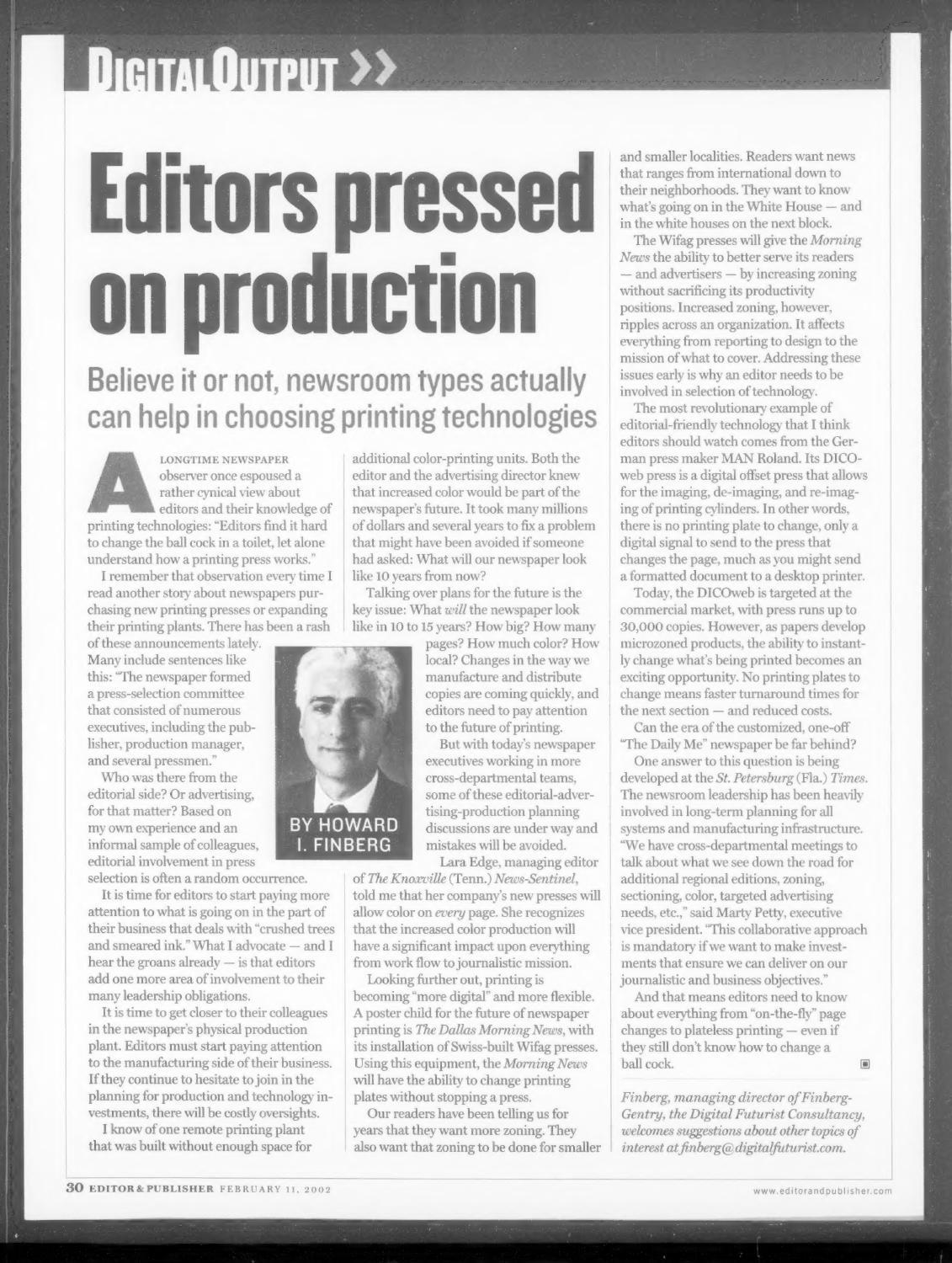
A February 11, 2002 column from my “Digital Output” series in the Tech News section of Editor & Publisher. The subject: editorial involvement — or the lack of it — in newspaper press selection and printing-plant planning. The column opens with a cynical observation from a longtime newspaper observer:
“Editors find it hard to change the ball cock in a toilet, let alone understand how a printing press works.”
The column notes that press-selection committees were typically made up of the publisher, production manager and several pressmen, and that editorial involvement was “often a random occurrence.” It cites a remote printing plant built without enough space for additional color-printing units — a problem that took several years and many millions of dollars to fix. The question editors should be asking: “What will the newspaper look like in 10 to 15 years? How big? How many pages? How much color? How local?”
Examples cited include The Knoxville (Tenn.) News-Sentinel, where managing editor Lara Edge said new presses would allow color on every page; The Dallas Morning News, with Swiss-built Wifag presses able to change printing plates without stopping a press; and MAN Roland’s DICOweb, a digital offset press allowing “the imaging, de-imaging, and re-imaging of printing cylinders.” The column ties these capabilities to reader demand for zoning:
They want to know what’s going on in the White House — and in the white houses on the next block.
The St. Petersburg (Fla.) Times is offered as a model of newsroom involvement in long-term planning for systems and manufacturing infrastructure. Marty Petty, executive vice president, is quoted:
“We have cross-departmental meetings to talk about what we see down the road for additional regional editions, zoning, sectioning, color, targeted advertising needs, etc. This collaborative approach is mandatory if we want to make investments that ensure we can deliver on our journalistic and business objectives.”
The closing line:
And that means editors need to know about everything from “on-the-fly” page changes to plateless printing — even if they still don’t know how to change a ball cock.