1995 Online Service Research Study

In early 1995, PAFET conducted a consumer online market research survey to establish baseline information in order to measure the development of the consumer online market. This document summarizes the goals, approach and results of that study.

[PAFET stands for Partners Affiliated for the Exploration of Technology. In 1994 six media companies [mostly a bunch of newspaper companies] created this research consortium to learn about and evaluate technology that could impact media and support the creation of new businesses and services.]

Some of the highlights of the study:

The level of familiarity with online services among PC owners and online subscribers is lower than expected. Despite online services’ aggressive subscriber acquisition efforts and heavy media attention given to these services, almost 1 of 4 PC owners considers themselves to be “not at all familiar” with online services.
Current online users still represent a niche market, that can be characterized as young, affluent, highly educated, and predominantly male. However, improved presentation of online content (via graphical and multimedia technology), faster transmission speeds, better content and lower prices are attracting more mainstream consumers.
The demographic profile of online subscribers using the Internet and those who do not is very similar.
Accessing or subscribing to multiple online services is not uncommon among current online service users. One of four online service users reported regularly accessing at least two online services.
“News and information” remain the top reason non-online users subscribe to a service. The research results showed that, among current online users, the primary reason they chose their current service was for “news and information.” Among those who canceled a subscription within the past six months, “lack of use” and “lack of information” were cited most often as the reasons for the cancellations.

The study’s questionnaire and research methodology were designed by Maritz Research (Los Angeles, CA), PAFET Operating Committee members, and market research directors and managers at each of the newspapers included in the study.

Also included with this post is the presentation made by Maritz Marketing.
Early Online Experience: JForum on CompuServe

In the mid-1980s, I joined one of the first online services, CompuServe.  [Previously, I had been a member of The Source, but that’s a different post.] One of the reasons I liked CompuServe was its journalism area, called JForum.  Jim Cameron was truly an online pioneer and created a place for journalists to virtually meet and share experiences and questions.

Jim and I started chatting online and eventually I helped bring the Society of Newspaper Design into the JForum fold as special interest group.  Jim also made me a “sysop” which meant I had special online privileges, most of which I have forgotten.  One of the things I did to help JForum was to make slides of various screens.  I used a newly purchased MacPlus to capture the screens.

It is interesting to note that Sam Donaldson, an ABC TV correspondent, was an early adopter of online services.

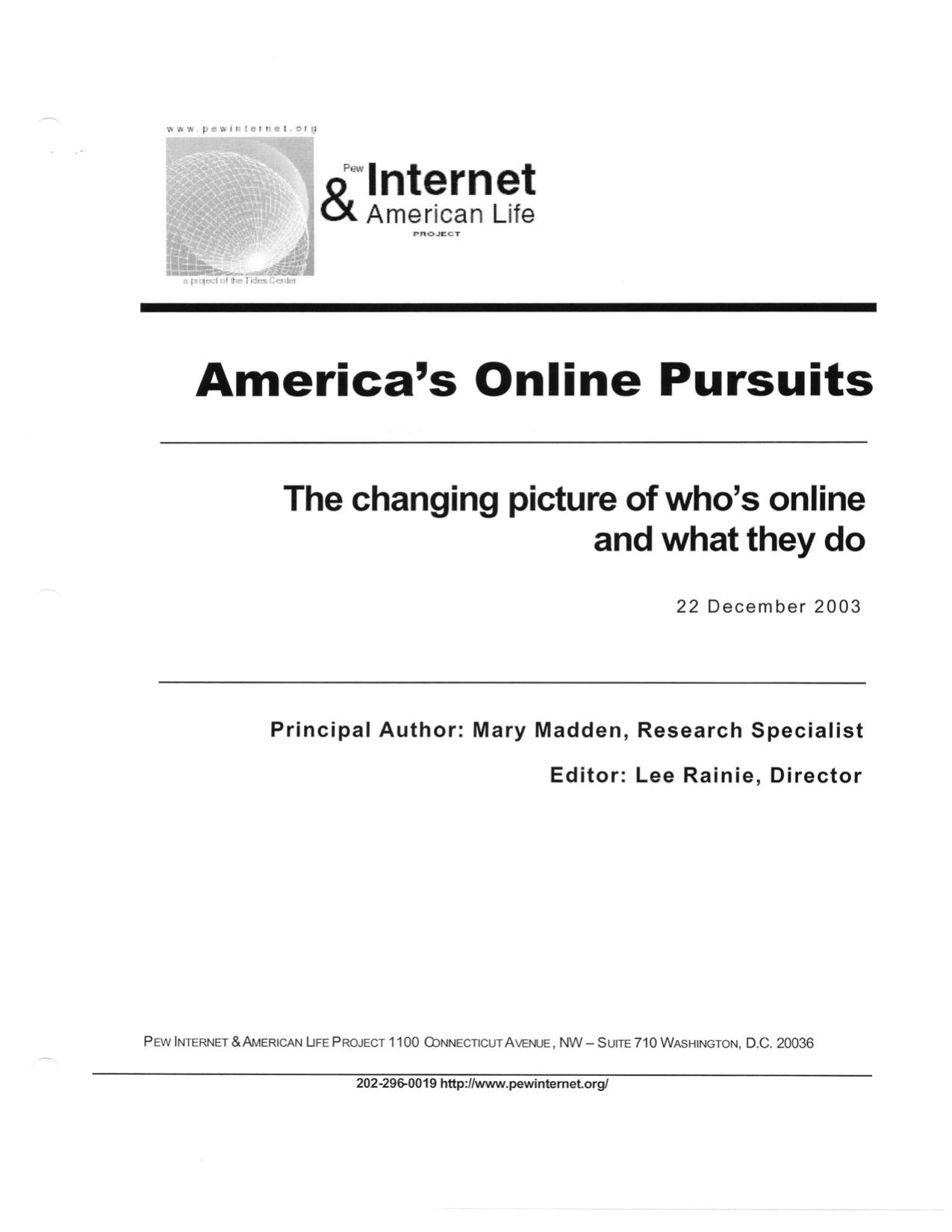
Cover of the Pew Internet & American Life Project report America's Online Pursuits, dated December 22, 2003

America’s Online Pursuits: Pew’s 2003 Snapshot

A December 22, 2003 report from the Pew Internet & American Life Project, pulling together more than three years of tracking survey data into one picture of who was online and what they were doing there. The numbers come from telephone interviews conducted by Princeton Survey Research Associates between March 2000 and December 2002, with additional data from an August 2003 survey.

The headline finding is a plateau. After the rush of the late 1990s, the online population had essentially stopped growing, even as the people already there kept finding more to do.

63% of Americans now go online — last measured in our August 2003 survey.

31% of Internet users who go online from home have broadband as of August 2003.

Email was still the center of gravity, and the report says so plainly. Among the 25 core activities tracked, online banking grew fastest — the kinds of transactions that required people to trust the medium.

Email continues to be the “killer app” of the Internet. More people use email than do any other activity online.

Online banking increased by 127% — more than any other activity about which we asked 2000 and 2002. In March 2000, just 15 million had tried some form of online banking, but by October 2002, 34 million had done so.

For those of us in the news business, the news line is the one worth marking: the online news audience grew 50% between March 2000 and December 2002, from 52 million to 78 million, and Pew credits big events — Campaign 2000, September 11, the run-up to the Iraq war — with each ratcheting the daily audience up a notch and leaving it there.

The conclusion reads as a prediction, and it holds up better than most:

All the trends set out here seem destined to continue, if not evolve, as the technology gets better, the applications become simpler, the appliances that use the Internet become omnipresent, and the technology fades into the background of people’s lives — as powerful, ubiquitous, commonplace, and “invisible” as electricity.

Some 2026 context for the numbers above, which is what makes this document interesting to me: the 63% of American adults online in August 2003 is now in the mid-90s — Pew’s recent tracking puts adult internet use at roughly 95%, which is about as close to universal as survey research gets. 

Home broadband, at 31% of home users in 2003, is now the norm rather than the advantage, and the “dial-up user” category that Pew compares against on nearly every page of this report has effectively vanished. Smartphone ownership, which does not appear in this report at all, now runs around 90% of adults, and a meaningful share of Americans go online only through a phone.

That last point is the real gap between 2003 and now. Pew’s 2003 framework assumed a computer, a connection, and a user who sat down to do a discrete thing — check a score, book a flight, read the news. The report’s own prediction about the technology fading into the background came true, and in doing so it dissolved the categories Pew was counting.

Mary Madden is the principal author; Lee Rainie, the project’s director, is listed as editor.

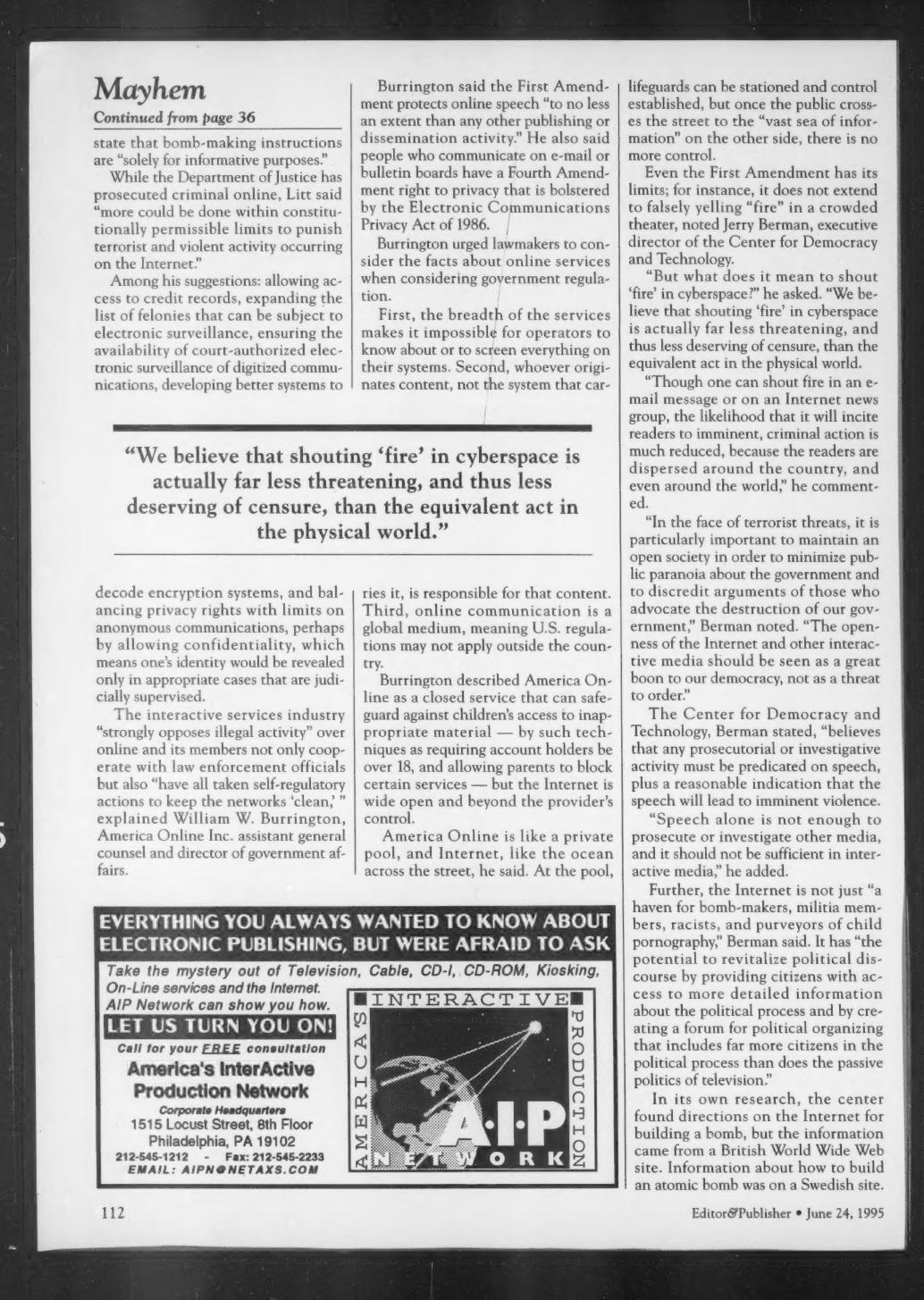
Editor & Publisher clipping by Jim Rosenberg reporting the closing of JForum, the Journalism Forum on CompuServe

JForum Ends: Where the Digital Pioneers Went to School

This is an Editor & Publisher story by Jim Rosenberg, published May 17, 2001, reporting the end of the Journalism Forum on CompuServe. JForum was merged with CompuServe‘s PR Forum into a new service called MediaPro, and the old forum stopped operating.

Rosenberg’s account is a short obituary for something that mattered a great deal to a small number of people. JForum began, as he wrote, on a Radio Shack laptop:

Launched on a Radio Shack laptop in 1985, the then-300-baud journalists’ computer bulletin board eventually served thousands of members worldwide, with job listings and messaging in four languages on a variety of topics.

It was also, the story notes, the first online home of the Society of News Design, the National Press Photographers Association, Investigative Reporters and Editors, and other organizations — and the subject of an early ’90s ruling in which a U.S. judge found CompuServe not responsible for messages it was unaware of that were posted in JForum.

Former NBC News manager Jim Cameron, who started the forum, said he

founded JForum … for the dwindling number of radio news people to share survival tips.

He credited the section leaders and assistants “who really ran JForum as editors.” I was one of them, and Rosenberg quoted me at some length about what made the place work — the effort required to participate at all, and what that effort produced:

You really had to commit to be a member of this community. At that point, you realized the possibility of community was not a geographical issue … It was about shared interest.

And on what its closing meant:

This is a passing of a forefather of a lot of what is going on right now. This was an educational experience for the digital pioneers. This is where we went to school. We learned from each other.

The story closes by noting that Cameron would stay on in an interim capacity, with MediaPro to be operated by PR Forum’s Mike Bayer. Rosenberg was then a senior editor covering newspaper technology for E&P.

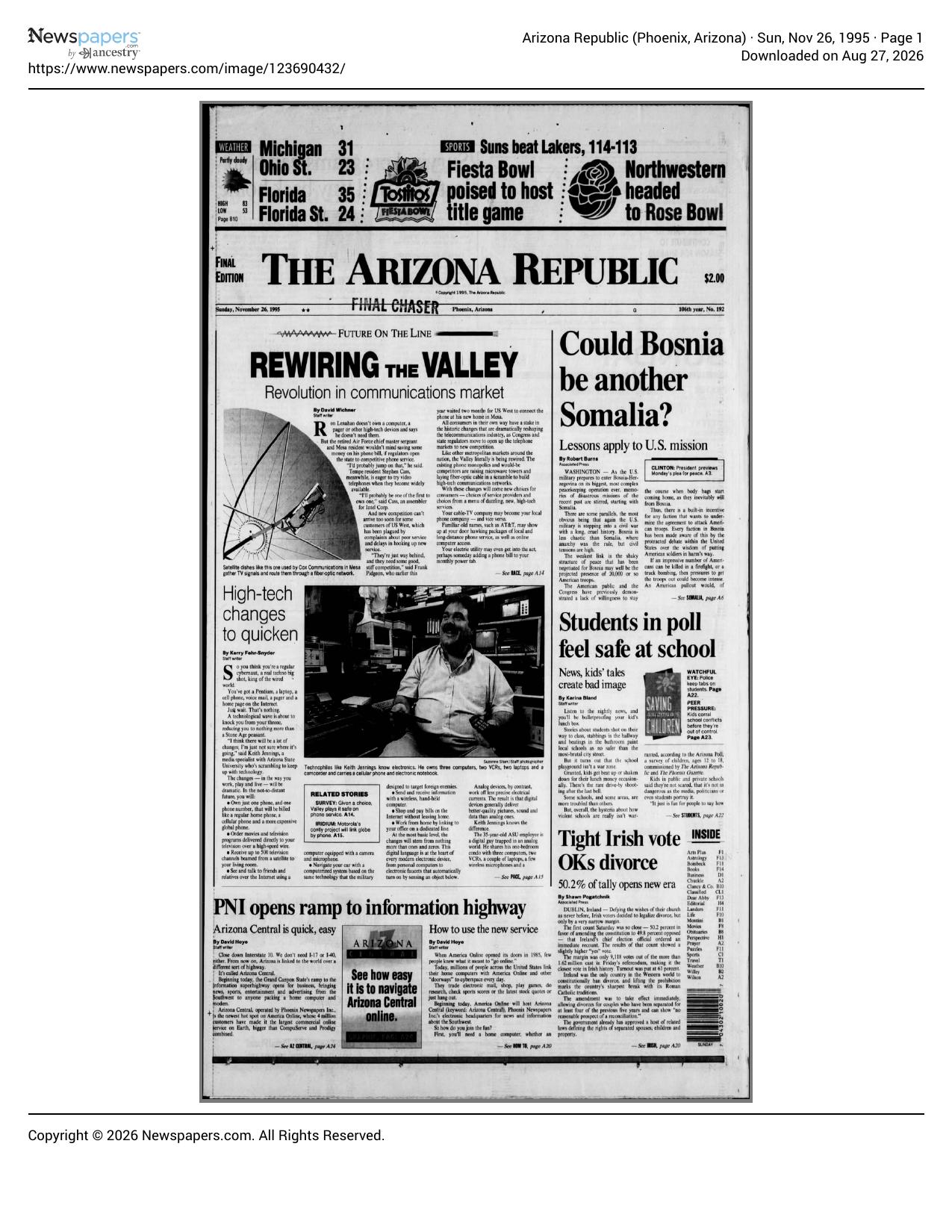
The Arizona Republic front page from November 26, 1995, announcing the Arizona Central online service on America Online and the Web

Arizona Central Opens for Online Business

On Sunday, November 26, 1995, The Arizona Republic told its readers that Phoenix Newspapers Inc. had gone online. The story, by staff writer David Hoye, ran on page one under the headline “PNI opens ramp to information highway,” with a full page inside devoted to explaining what Arizona Central was and how to get to it.

There were two front doors. One was on America Online — at the time, by the paper’s own description, the largest commercial online service on Earth, with 4 million customers, “bigger than CompuServe and Prodigy combined.” The other was on the World Wide Web.

On America Online, type keyword: arizona central

On the Web, http://www.azcentral

The AOL service opened with a set of buttons that would look familiar to anyone who has built a home page since: News/Money, Sports, Destinations, Your Life, At Ease, Sound Off, ALT. and What’s Hot. Sound Off held the columnists, editorials, letters and Steve Benson‘s editorial cartoons. ALT. was aimed at young adults and carried stories written by local students. Elsewhere there were Penelope Corcoran’s restaurant reviews under Taste the Town, interactive TV grids customized to your cable company, a searchable golf-course database, the Pick the Pros contest, a GiftLine for holiday shopping, and a survey button asking readers what they wanted from an online service.

The ambition was larger than shoveling the newspapers onto a screen. As the story put it, Phoenix Newspapers planned “to create nothing less than an online community, where users can learn, communicate, buy and sell and have fun.” The Oasis, Arizona Central’s chat room, was already doing that work — Charles Barkley had spent more than an hour there the week before, taking questions about the 1995-96 Suns season.

John Oppedahl, executive editor of the newspapers, framed it this way:

“Our new effort online is a significant move forward for Phoenix Newspapers Inc.,” said John Oppedahl, executive editor of the newspapers. “I look at this as the beginning of a new era.”

I was quoted as well, in my role at the time:

“It’s instant journalism,” said Howard Finberg, Phoenix Newspapers’ senior editor of information technology. “It’s pretty exciting.”

Worth noting where the launch story sat on that Sunday front page. It shared A1 with a package called “FUTURE ON THE LINE: REWIRING THE VALLEY” — about Congress and state regulators opening the telephone market to competition, cable companies becoming phone companies, and the promise of 500 television channels and video calls over the Internet. The newspaper was covering the coming of the network and joining it on the same day.

The story also made the case to advertisers, with a comparison that has aged into a period piece: online was “the most important new communications medium since Johann Gutenberg‘s experiments with movable type more than 500 years ago.”

Arizona Republic front page from November 26, 1995 announcing Arizona Central, Phoenix Newspapers' new online service on America Online and the Web

Arizona Central Opens for Online Business

On Sunday, November 26, 1995, The Arizona Republic told its readers that Phoenix Newspapers Inc. had gone online. The story, by staff writer David Hoye, ran on page one under the headline “PNI opens ramp to information highway,” with a full page inside devoted to explaining what Arizona Central was and how to get to it.

There were two front doors. One was on America Online — at the time, by the paper’s own description, the largest commercial online service on Earth, with 4 million customers, “bigger than CompuServe and Prodigy combined.” The other was on the World Wide Web.

On America Online, type keyword: arizona central

On the Web, http://www.azcentral.com/

The AOL service opened with a set of buttons that would look familiar to anyone who has built a home page since: News/Money, Sports, Destinations, Your Life, At Ease, Sound Off, ALT. and What’s Hot. Sound Off held the columnists, editorials, letters and Steve Benson‘s editorial cartoons. ALT. was aimed at young adults and carried stories written by local students. Elsewhere there were Penelope Corcoran’s restaurant reviews under Taste the Town, interactive TV grids customized to your cable company, a searchable golf-course database, the Pick the Pros contest, a GiftLine for holiday shopping, and a survey button asking readers what they wanted from an online service.

The ambition was larger than shoveling the newspapers onto a screen. As the story put it, Phoenix Newspapers planned “to create nothing less than an online community, where users can learn, communicate, buy and sell and have fun.” The Oasis, Arizona Central’s chat room, was already doing that work — Charles Barkley had spent more than an hour there the week before, taking questions about the 1995-96 Suns season.

John Oppedahl, executive editor of the newspapers, framed it this way:

“Our new effort online is a significant move forward for Phoenix Newspapers Inc.,” said John Oppedahl, executive editor of the newspapers. “I look at this as the beginning of a new era.”

I was quoted as well, in my role at the time:

“It’s instant journalism,” said Howard Finberg, Phoenix Newspapers’ senior editor of information technology. “It’s pretty exciting.”

Worth noting where the launch story sat on that Sunday front page. It shared A1 with a package called “FUTURE ON THE LINE: REWIRING THE VALLEY” — about Congress and state regulators opening the telephone market to competition, cable companies becoming phone companies, and the promise of 500 television channels and video calls over the Internet. The newspaper was covering the coming of the network and joining it on the same day.

The story also made the case to advertisers, with a comparison that has aged into a period piece: online was “the most important new communications medium since Johann Gutenberg‘s experiments with movable type more than 500 years ago.”

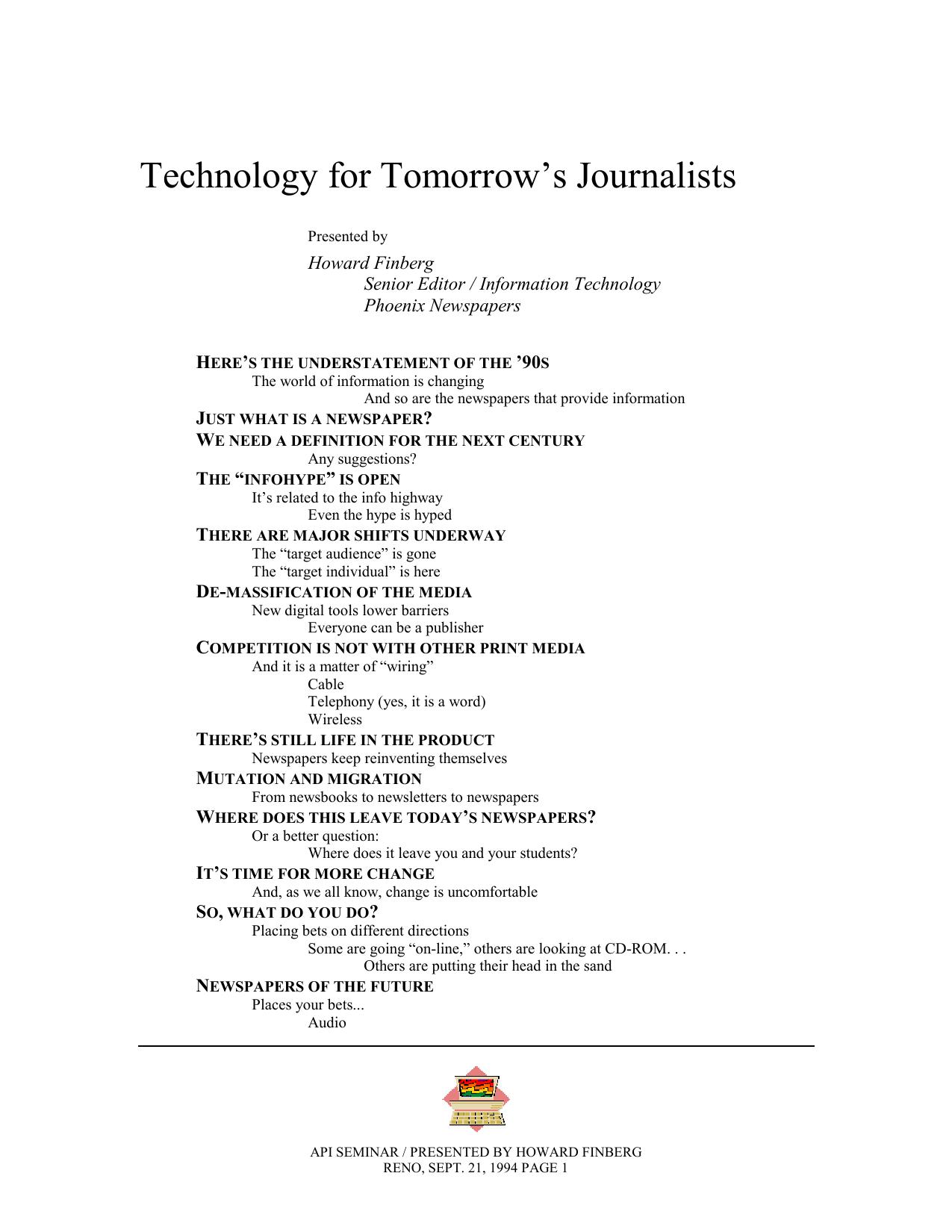
Opening slide from a 1994 American Press Institute seminar presentation for journalism educators in Reno

Technology For Tomorrow’s Journalists — an API Seminar, 1994

This is the slide outline from a presentation I gave at an American Press Institute seminar for journalism educators, in Reno, on September 21, 1994. At the time I was Senior Editor / Information Technology at Phoenix Newspapers, and the assignment was to talk to the people teaching the next generation of journalists about what was coming at them.

The opening slide set the tone with what I called the understatement of the decade:

The world of information is changing
And so are the newspapers that provide information

Then the harder question, which I put back to the room rather than answering it myself:

JUST WHAT IS A NEWSPAPER?
WE NEED A DEFINITION FOR THE NEXT CENTURY
Any suggestions?

Much of the middle of the presentation was a tour of the bets newspapers were placing in 1994 — audio services over the telephone, fax editions, CD-ROM, “electronic newspapers” delivered by e-mail to a portable computer, online services, and PDAs. I was blunt about the state of play: some publishers were going online, some were looking at CD-ROM, and “others are putting their head in the sand.” The framing throughout was gambling — place your bets, and then:

WILL ANY OF THESE BETS PAY OFF?
What happens if you lose?
What happens if you don’t play?

The numbers are a good reminder of how early this all was. My online services slide reported that 34% of homes had a personal computer and 13% had a modem, with a forecast that by 1997 the computer number would reach 40-50% but modems would only reach 20%. The named players were CompuServe, America Online, Prodigy and Delphi; the partnership examples were Mercury Center and Access Atlanta; the “future players” I listed were Microsoft, Ziff and Sony. And a slide on why modem penetration might not matter at all — because of “cable boxes that have a computer chips inside.”

Because the audience was educators, the second half turned to jobs and curriculum. I argued that reporters could no longer treat the process of getting the story onto the doorstep as somebody else’s problem, and that they would be gathering content for multiple products. Some of it was deliberately provocative:

Even “hot” jobs may disappear
Do we really need designers?

Coming from someone whose career had been built in newspaper design, that was meant to land. So was the slide on teaching:

HOW DO YOU TEACH THESE NEW SKILLS?
It won’t be from a textbook

My prescription was more connection — “Newsroom and classroom need to get closer / Classroom needs to get real.” Two decades later I was still working on exactly that problem, with News University at the Poynter Institute, trying to close the same gap with online training instead of slides.

The closing section was what I labeled my “vision thing”: that newspapers don’t just provide content, they provide context, and that dumping data isn’t journalism — “If you want data, try the phone book.” I also made the point that newspapers were already interactive:

Newspapers are already interactive
They push content
Readers push back

And the last two slides hold up best of all, in 1994 and in 2026:

Understand that “cutting edge” means “bleeding edge”
Look at workflow, not hardware

Followed by “TECHNO-EVANGELISM / Lead by example / Take an interest.” Substitute today’s technology of the moment for CD-ROM and PDAs and the advice doesn’t need much editing.

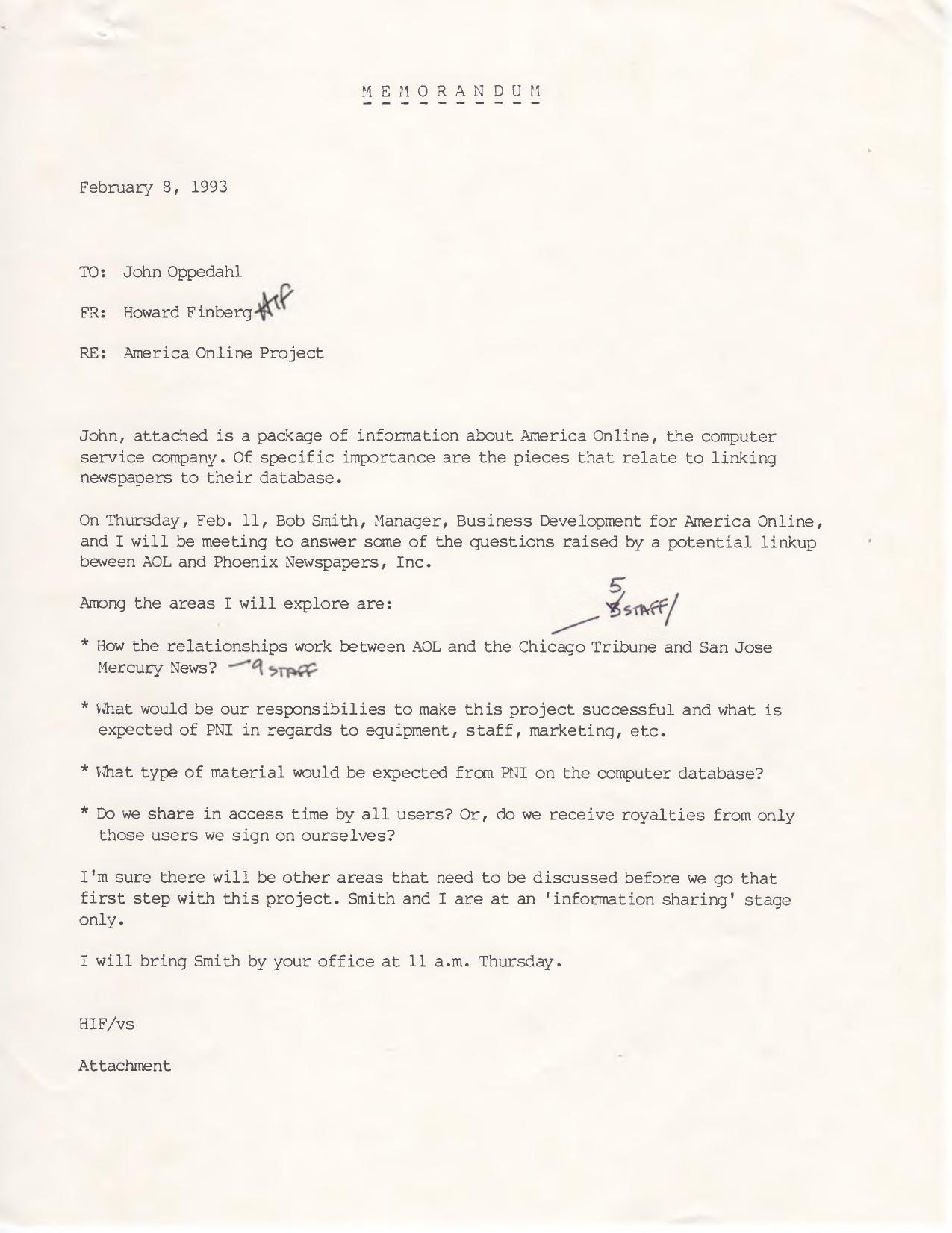
Typed 1993 internal memo to Phoenix Newspapers executive John Oppedahl outlining questions for a meeting with America Online

An Early Look at America Online

This is a short memo I wrote in February 1993 to John Oppedahl, then an executive at Phoenix Newspapers, Inc., about a meeting I had scheduled with America Online. At the time, AOL was signing up newspapers to put content into its database, and I wanted to understand what such a partnership would mean for PNI before anyone committed to anything.

John, attached is a package of information about America Online, the computer service company. Of specific importance are the pieces that relate to linking newspapers to their database.

The meeting was set for Thursday, Feb. 11, with Bob Smith, Manager, Business Development for America Online. The questions I planned to ask were the basic ones any newspaper should have been asking in 1993 — and, honestly, the ones many didn’t ask carefully enough:

* How the relationships work between AOL and the Chicago Tribune and San Jose Mercury News?

* What would be our responsibilities to make this project successful and what is expected of PNI in regards to equipment, staff, marketing, etc.

* What type of material would be expected from PNI on the computer database?

* Do we share in access time by all users? Or, do we receive royalties from only those users we sign on ourselves?

That last question — who gets paid, and for whose audience — turned out to be the one the industry spent the next decade arguing about.

I was careful to keep expectations modest:

I’m sure there will be other areas that need to be discussed before we go that first step with this project. Smith and I are at an ‘information sharing’ stage only.

The memo closes with the smallest of logistical notes: I would bring Smith by Oppedahl’s office at 11 a.m. Thursday.

Postscript: Phoenix Newspapers did sign an agreement with America Online.