This 1988 flyer from the American Press Institute outlines its seminar offerings for newspaper professionals. API, based in Reston, VA, offered immersive, topic-specific programs ranging from editorial leadership and design to marketing, technology, and HR. The flyer highlights seminar structure, costs, admission criteria, and a robust schedule for continuing education in journalism and media management.
“American Press Institute” Items
Membership, Instructions and More for API Design 2000 Seminar
I’ve uploaded a collection of memos about the American Press Institute’s J. Montgomery Curtis Memorial Seminar on the future of newspaper design. The collection starts with the invite / acceptance letter in April 1988.
On July 21, API sent out the important information about the seminar — a memo outlining a task for each seminar participant: design a front page of the future.
Each member is being asked to create a front page of the future, including content mix and design elements. These front pages (which will become a part of this year’s post-seminar publication) will be analyzed in advance by Roger Black, one of the most active and acclaimed publication designers in the United States, and discussed during the program.
There is also a schedule of events and information about discussion groups and the final round-table.
Here’s a look at the seminar schedule:
- Monday, September 12:
- 8:30 – 10:00 – “Newspapers in a Visual Society11
Speaker: John Lees, Partner, Herman and Lees Associates, Inc., Cambridge, Mass.- 10:15 – 12:15 – “The Front Page”
Speaker: Roger Black, President, Roger Black Inc., New York, N.Y.- 2:00 – 3:30 – Study I: “The Future for Newspaper Graphics”
Speaker: Howard Finberg, Assistant Managing Editor, Arizona Republic, Phoenix, Ariz.- 3:45 – 5:15 – Study II: “Color”
Speaker: Nanette Bisher, Assistant Art Director, U.S. News and World Report, Washington, DC.- Tuesday, September 13:
- 8:30 – 10:00 – Study III: “The Impact of Technology”
Speaker: David Gray, Managing Editor/Graphics, Providence Journal Company, Providence, RI.- 10:15 – 11:45 – Study IV: “The Role of Tomorrow’s Newspaper Designer”
Speaker: Marty Petty, Vice President/Deputy Executive Editor, Hartford Courant, Hartford, Conn.- 12:00 – 1:30 – The membership will be broken into small groups to discuss in greater detail specific issues raised during the seminar.
- 1:45 – 3:30 – The membership will return to the API Round-Table to hear reports from each group detailing observations and any conclusion.
One other important document: the discussion leaders biographies.
The end product of this seminar can be seen in this slideshow.
Presstime Magazine Covers 2000 Design Project
The industry publication Presstime covered the results of the API’s design seminar in its October, 1988 edition. The article’s lede:
Two dozen movers and shakers in the field of newspaper design pondered the substance and form of 21st century newspapers at the American Press Institute’s annual J. Montgomery Curtis Memorial Seminar.
The round-table seminar, conducted at the institute in Reston, Va., Sept. 11-13, used as a focal point hypothetical front pages dated 2000 and beyond that were designed by participants and posted on the walls of the seminar room.
Ironic, isn’t it: “posted on the walls…”
I got a mention for my presentation on the future of graphics:
Howard I. Finberg, assistant managing editor of The Arizona Republic, said the overwhelming majority of editors he questioned predicted graphics will play a greater part in newspapers in the year 2000. But this priority seems to shrink when talk turns to money: The editors told Finberg they would spend 70 percent of any extra funds for reporting and editing, and only 10 percent for graphics.
Sad and not surprising. Given the visual nature of the Internet, would newspapers be in a better position today if they had invested in something other than words? Just wondering.
API Design 2000 Seminar. The 1988 Invitation
In 1988, the American Press Institute invited a group of designers and editors to the J. Montgomery Curtis Memorial Seminar on the future of newspaper design. Here’s what the seminar leader, John G. Finneman, wrote to participants:
- We will have a total of 22 invited members, along with API executive staff, at the conference table.
- API will pay tuition, room and board for participants. You will have to take care of travel expenses.
- All members will be asked to create a front page for the year 2000, so there will be a little advance work for everyone.
In your case, however, you will be taking on an even heavier responsibility. As I explained, we plan to have four studies presented during this program:
- the future of informational graphics;
- color
- people
- technology.
Each of the four persons taking on studies will be asked to make brief oral presentations during the seminar to go with printed results which will be incorporated into a post-seminar publication.
I took on the report about the future of informational graphics. It is included in the report / book from the seminar.
Future of Design Survey. What 2020 Looks Like in 1999
This is a copy of a presentation I did at the American Press Institute in 1999 for a seminar about the future of newspaper design. We looked at the future of design in 20 years.
Design 2000 Seminar at API: Presenter and Attendee
I was a presenter and an attendee at the American Press Institute’s Design 2000 and Beyond seminar.
Twenty-two leading U.S. and Canadian newspaper designers/editors were invited to API to discuss “newspapers at the turn of the century, from a design standpoint. What would newspapers look like and how would they evolve?”
Here’s a slide show of the book that produced from the seminar: https://www.digitalfuturist.com/memo-collection/design-2000-an-american-press-institute-project/design-2000-a-view-of-the-future-from-1988/
Training that Changes Your Life: API Seminar
In early 1991 John Oppedahl, The Arizona Republic’s managing editor, nominated me to attend the American Press Institute seminar for Managing Editors [newspapers over 77,000 circulation] in Reston, VA. That seminar did two things: 1. Strengthened some of my leadership skills and confidence and 2. Created some life-long friends.
Like most API [and Poynter] seminars there was lots of “homework” and instructions ranging from accommodations to laundry. From the acceptance letter:
So your nominee may arrive thoroughly prepared, and for your newspaper to derive maximum benefit for the outlay of training dollars, may I respectfully suggest a day be set aside from regular duties so homework assignments can be completed.
Before members return home, I urge them to sift through the many materials collected while at Reston, with a view to conducting a mini-seminar for fellow staffers so the entire department many benefit from their API experience. I hope you’ll consider giving the process a try, assuming you don’t already have it in place.
Of course, I don’t remember getting too much time off from regular duties but it didn’t really matter. It was fun and always best to be prepared.
ASNE-API Leadership Survey, July 2011
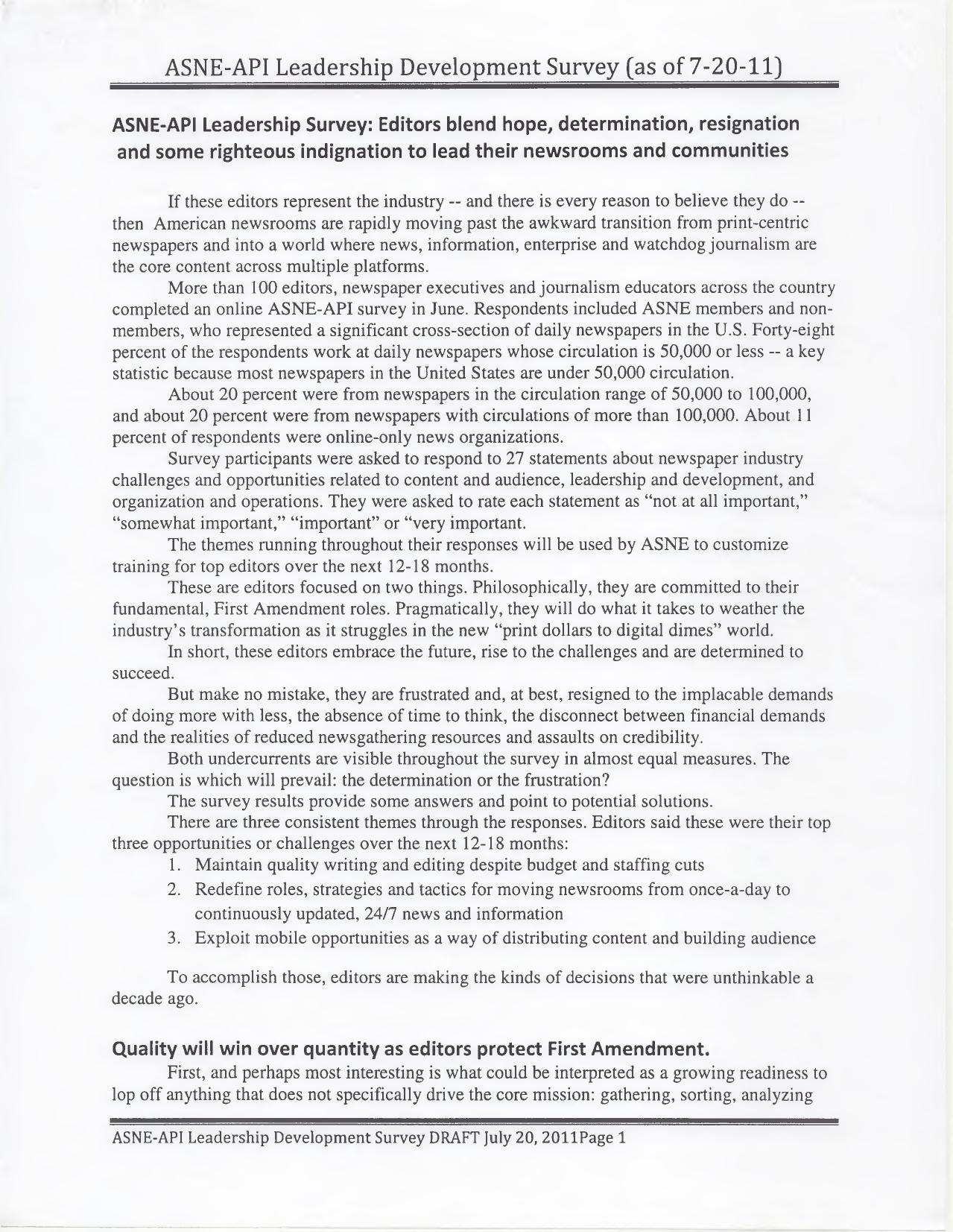
This is the draft report of a joint survey by the American Society of News Editors and the American Press Institute, dated July 20, 2011. Invitations went to 1,830 editors at about 1,400 daily newspapers, 50 online-only news sites and the deans of 100 accredited journalism schools. One hundred five people responded — nearly half of them from papers with circulations of 50,000 or less, which is where most American dailies live. Respondents rated 27 statements about content and audience, leadership and development, and organization and operations. ASNE planned to use the findings to shape training for top editors over the following 12 to 18 months, beginning with a regional workshop in Lexington, Ky., in October.
The framing of the report is a tension the authors return to again and again — editors who are determined and editors who are worn down:
These are editors focused on two things. Philosophically, they are committed to their fundamental, First Amendment roles. Pragmatically, they will do what it takes to weather the industry’s transformation as it struggles in the new “print dollars to digital dimes” world.
The three top-ranked opportunities or challenges: maintain quality writing and editing despite budget and staffing cuts (83.8 percent called it “very important”); redefine roles, strategies and tactics for moving newsrooms from once-a-day publishing to continuously updated, 24/7 news; and exploit mobile opportunities to distribute content and build audience.
What gives the document its bite are the unattributed editor comments:
“It’s time,” wrote one editor, “for newsrooms to focus on finding ways to do fewer things well, instead of doing everything poorly.”
“Too many interruptions, distractions,” wrote one editor. “Not able to put together a stretch of time that’s long enough to focus and complete anything that can’t be accomplished in five minutes. … I can get a lot of things started, but it’s becoming harder and harder to see them through to successful completion.”
“We are all in this same leaky boat together and it’s time to let go of our old ideas about labor and management. We all need to start building a new ship — and fast.”
The draft press release attached to the report quotes Linda Grist Cunningham, vice chair of ASNE’s Leadership Committee; Carol Ann Riordan, interim executive director of the American Press Institute; and Mizell Stewart III, editor of the Evansville (Ind.) Courier & Press and chair of the Leadership Committee.
“The affirmation that editors can stay focused on good journalism as they wrestle with spreadsheets and new technology isn’t unexpected,” said Linda Grist Cunningham … “But it certainly is reassuring.”
The report ends with the question it can’t answer:
The question remains: Which will prevail? The determination to succeed, to beat back the naysayers? Or the resignation that comes with fear, inertia and a mourning of the loss of the past?
Reading this in 2026 — fifteen years later — the survey is a useful marker of where newsroom leadership thinking stood at the start of the mobile era. The priorities the editors named are no longer strategic questions; they were settled by events. What remains strikingly current is the complaint that there is no time to think, and the one editor who predicted the tablet future and wrote, “This is the generation of transition.”

Is There a Disconnect Here Someplace?
This is a transcript section from an American Press Institute seminar held in October 1999, where I presented the results of a design and visuals survey I coordinated. It was a follow-up to the survey we did for the 1988 J. Montgomery Curtis seminar, Newspaper Design: 2000 and beyond, with a nod to the survey the Society of Newspaper Design did in 1992. We reused a lot of the same questions so we could see what had changed.
This just goes to show you that if you volunteer to do something, you get to do it again.
The numbers: 628 responses in 1988; a little over 1,200 in 1999, about 200 of those from a Web site we built for the project. Sixty percent came from designers, 40 percent from editors. Ninety percent worked at dailies, and about 45 percent at papers over 100,000 circulation. One notable difference from 1988 — we didn’t ask about color or the use of computers. By 1999 those were givens.
We organized the discussion around five areas: the importance of design, the importance of visual elements, people, the relationship between online and print (new that year), and where all of this material was going to fit in the future.
As for the importance of design, the survey showed that it remains strong in the opinion of both editors and designers. And as for visuals, we’re also optimistic. And that’s the good news. The bad news is there appears to be a big disconnect between editors and designers in how they view the world.
Some of that disconnect showed up in the self-scoring. Asked to rate the quality of newspaper design across the industry on a 1-to-10 scale, 13 percent gave the industry an 8 to 10 and 71 percent put it in the 5-to-7 range. Asked about their own newspapers, more than half rated themselves 8 to 10. As I said at the time: the industry sucks, but we’re doing okay at our own newspaper.
Warren Watson of API‘s staff took the results to some 50 publishers, editors, designers and educators for reaction, and it wasn’t flattering. Terry Quinn of Thomson Newspapers called the 1980s an infatuation period with design. Darrell Moen said design had simply become institutionalized — not special anymore. Around the table, Mr. Sutton put a sharper point on it:
I do think most editors see design simply as layout, and I believe there is a design backlash, because some visual journalists have too much of a “make it pretty” mentality.
The section on informational graphics was the one that stung. As a former graphics editor who toiled in that vineyard when we had nothing but rocks and stumps, I wondered aloud whether informational graphics had just been a fad. Others weren’t ready to concede that. Marty Petty argued that graphics still engage readers and that the failure was in execution — chasing the big, sexy stuff instead of the basic maps and charts that inform. Mr. Curtis tied it to incentives:
Today, editors don’t value them highly anymore because they aren’t rewarded for them, and if you aren’t rewarded, you don’t do it.
On people — which I said then, and still believe, is the greatest challenge — 80 percent of respondents found hiring qualified visual journalists either very difficult or about as hard as it had always been, and the survey said it was getting worse. Asked where they’d put additional staff money, respondents put reporting first at 53 percent, design at 37 percent, online at 30 percent, graphics at 28 percent, photography at 27 percent and illustration at 13 percent. Roger Fidler noted that at Kent State most of the better students were looking at the Web and electronic publishing, and saw newspapers as passé.
The online results astounded me. Only 10 percent thought it highly important that a newspaper’s Web site look like the printed newspaper; 50 percent said it wasn’t important at all. So much for brand. And on leveraging print journalists online, the responses split roughly in thirds — including a third who thought it wasn’t very important at all.
Then there was space. Sixty percent said they had more room for visual packages than five years earlier, and looking ahead, everybody expected still more — this with the 50-inch web coming at the industry.
Everybody thinks they’re going to have more space in the future…what planet were these people on when they answered this question.
Two quotes from the session have stayed with me. Juan Antonio Giner, relayed by Warren: “newspaper design is dead; news design is alive.” And Mr. Lockwood, closing the argument with the Bauhaus:
Laszlo Maholy-Nagy said years and years ago from the Bauhaus that design isn’t a profession; it is an attitude. It is an attitude about information.
I ended on a deliberately hopeful note, pointing out that in Blade Runner — one of the darker visions of the late 20th century — our hero waits for his dinner while reading a printed newspaper. Reading this back now, well past the 2020 horizon we were asked to imagine, the survey’s optimism about space looks even more misplaced, and the disconnect between editors and designers turned out to be the least of the industry’s problems. But the argument about whether visual work is content or decoration never really got settled. It just moved to a different screen.
An Invitation To Imagine Newspaper Design: 2020
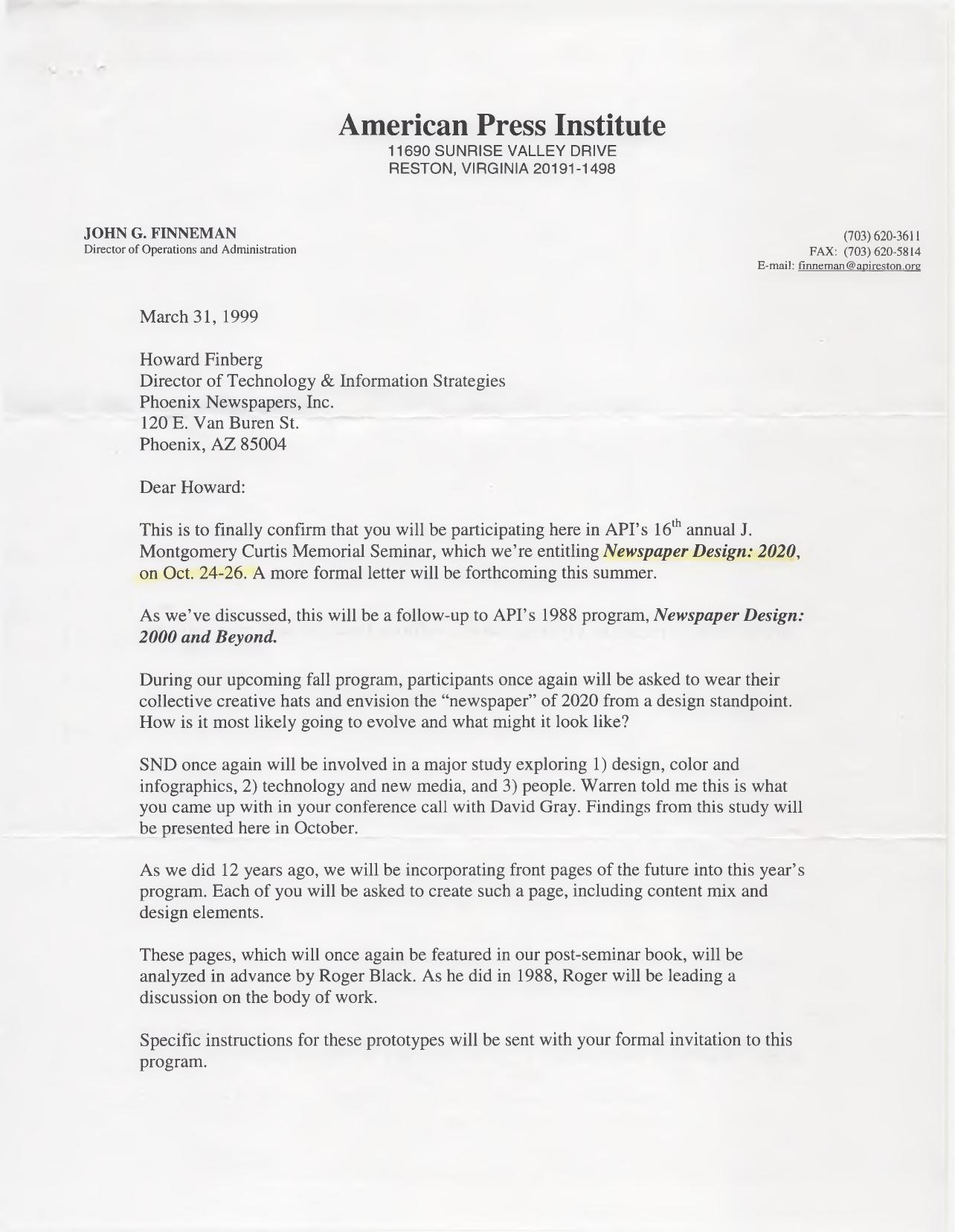
Eleven years after API’s Newspaper Design: 2000 and Beyond u2014 the 1988 seminar I’ve already posted documents about elsewhere on this site u2014 the American Press Institute decided to run the exercise again, this time looking two decades out. In the spring of 1999, John G. Finneman, API’s director of operations and administration, wrote to confirm that I’d be part of the 16th annual J. Montgomery Curtis Memorial Seminar in Reston.
This is to finally confirm that you will be participating here in API’s 16″ annual J. Montgomery Curtis Memorial Seminar, which we’re entitling Newspaper Design: 2020, on Oct. 24-26.
The letter is explicit about the lineage, and it’s worth reading alongside the 1988 material in the timeline:
As we’ve discussed, this will be a follow-up to API’s 1988 program, Newspaper Design: 2000 and Beyond.
At the time I was director of technology and information strategies at Phoenix Newspapers, Inc. u2014 a title that says something about how far the conversation had moved from the drafting table since the first seminar. The assignment, though, was the same one: put on the collective creative hat.
During our upcoming fall program, participants once again will be asked to wear their collective creative hats and envision the “newspaper” of 2020 from a design standpoint. How is it most likely going to evolve and what might it look like?
The quotation marks around “newspaper” are Finneman’s, and they do a lot of work.
The Society of News Design was again a partner, with a study organized around three buckets u2014 design, color and infographics; technology and new media; and people. Finneman credits the framing to a conference call I’d had with David Gray:
Warren told me this is what you came up with in your conference call with David Gray.
The signature element of the 1988 program came back as well. Each participant would build a front page of the future, content mix and all, for analysis and a post-seminar book.
These pages, which will once again be featured in our post-seminar book, will be analyzed in advance by Roger Black. As he did in 1988, Roger will be leading a discussion on the body of work.
The seminar was underwritten by API’s J. Montgomery Curtis Fund, which covered tuition, room and meals at the Hyatt Dulles, plus the production of the book. Participants paid their own way there. And, in a detail that dates the letter as surely as anything else in it, I was asked to send along a glossy photo and a biographical sketch.
Looking at this from 2026, the target year has come and gone u2014 and then some. What strikes me is that the 1988 group was asked to imagine 2000 largely as a printed artifact, while the 1999 group was being asked about 2020 with the web already reshaping the question. Whether any of us got it right is a matter for the front pages themselves.
Technology For Tomorrow’s Journalists — an API Seminar, 1994
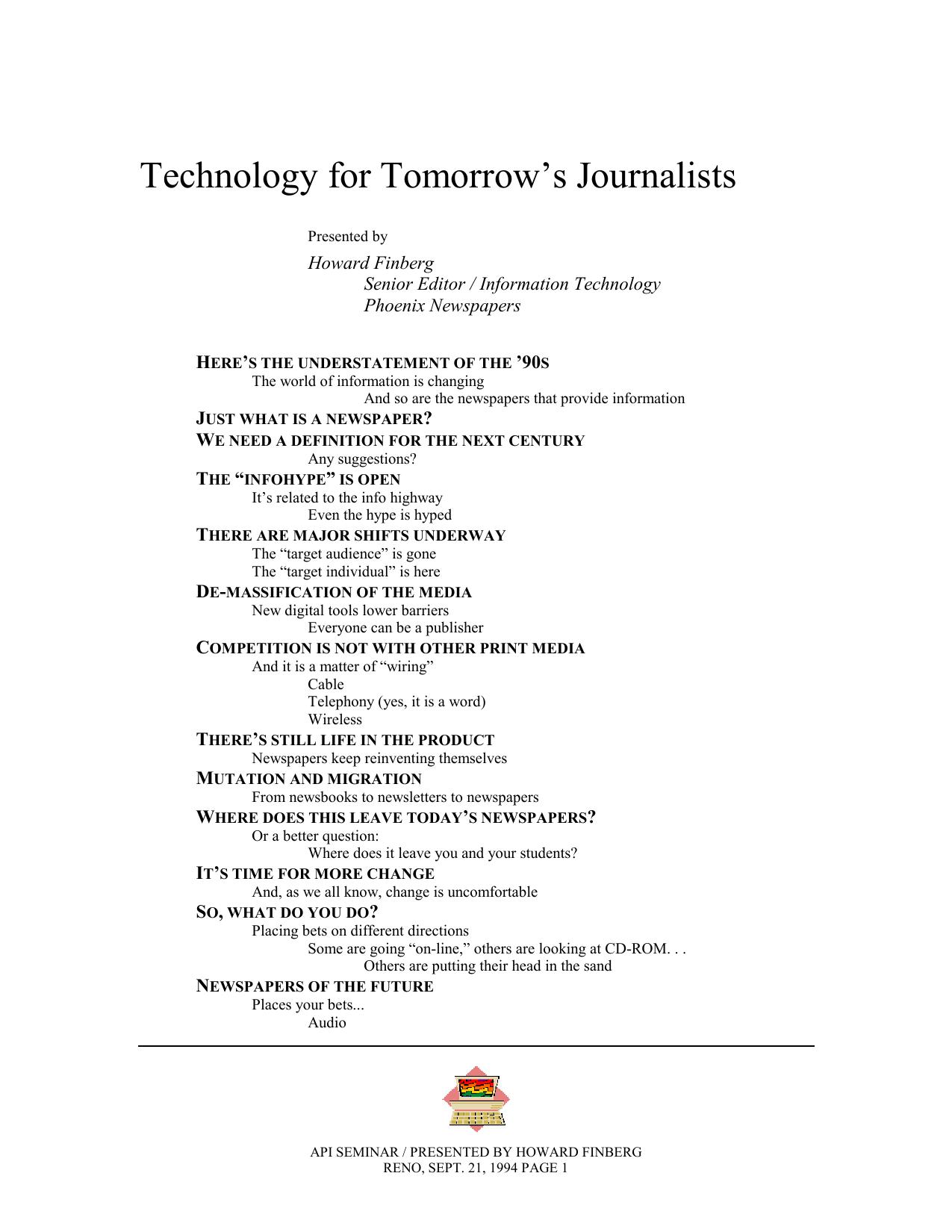
This is the slide outline from a presentation I gave at an American Press Institute seminar for journalism educators, in Reno, on September 21, 1994. At the time I was Senior Editor / Information Technology at Phoenix Newspapers, and the assignment was to talk to the people teaching the next generation of journalists about what was coming at them.
The opening slide set the tone with what I called the understatement of the decade:
The world of information is changing
And so are the newspapers that provide information
Then the harder question, which I put back to the room rather than answering it myself:
JUST WHAT IS A NEWSPAPER?
WE NEED A DEFINITION FOR THE NEXT CENTURY
Any suggestions?
Much of the middle of the presentation was a tour of the bets newspapers were placing in 1994 — audio services over the telephone, fax editions, CD-ROM, “electronic newspapers” delivered by e-mail to a portable computer, online services, and PDAs. I was blunt about the state of play: some publishers were going online, some were looking at CD-ROM, and “others are putting their head in the sand.” The framing throughout was gambling — place your bets, and then:
WILL ANY OF THESE BETS PAY OFF?
What happens if you lose?
What happens if you don’t play?
The numbers are a good reminder of how early this all was. My online services slide reported that 34% of homes had a personal computer and 13% had a modem, with a forecast that by 1997 the computer number would reach 40-50% but modems would only reach 20%. The named players were CompuServe, America Online, Prodigy and Delphi; the partnership examples were Mercury Center and Access Atlanta; the “future players” I listed were Microsoft, Ziff and Sony. And a slide on why modem penetration might not matter at all — because of “cable boxes that have a computer chips inside.”
Because the audience was educators, the second half turned to jobs and curriculum. I argued that reporters could no longer treat the process of getting the story onto the doorstep as somebody else’s problem, and that they would be gathering content for multiple products. Some of it was deliberately provocative:
Even “hot” jobs may disappear
Do we really need designers?
Coming from someone whose career had been built in newspaper design, that was meant to land. So was the slide on teaching:
HOW DO YOU TEACH THESE NEW SKILLS?
It won’t be from a textbook
My prescription was more connection — “Newsroom and classroom need to get closer / Classroom needs to get real.” Two decades later I was still working on exactly that problem, with News University at the Poynter Institute, trying to close the same gap with online training instead of slides.
The closing section was what I labeled my “vision thing”: that newspapers don’t just provide content, they provide context, and that dumping data isn’t journalism — “If you want data, try the phone book.” I also made the point that newspapers were already interactive:
Newspapers are already interactive
They push content
Readers push back
And the last two slides hold up best of all, in 1994 and in 2026:
Understand that “cutting edge” means “bleeding edge”
Look at workflow, not hardware
Followed by “TECHNO-EVANGELISM / Lead by example / Take an interest.” Substitute today’s technology of the moment for CD-ROM and PDAs and the advice doesn’t need much editing.