Crisis at San Francisco State: Instant Book

Going to school at San Francisco State University was a great and unusual journalism education.  What made it special was not the classroom work, which was good.  The real training was in covering the drama in the hallways, the excitement on the campus commons and the turmoil on the streets.  My journalism education was attending a college that saw the longest campus strike in United States history.  Here’s how the SFSU describes the strike, some forty years later:

…the five-month event defined the University’s core values of equity and social justice, laid the groundwork for establishment of the College of Ethnic Studies, and inspired the establishment of ethnic studies classes and programs at other universities throughout the country.

The Black Student Union and a coalition of other student groups known as the Third World Liberation Front (TWLF) led the strike, which began Nov. 6, 1968 and ended March 20, 1969. Clashes between the strikers and San Francisco Police tactical squads made national news. Students, faculty and community activists demanded equal access to public higher education, more senior faculty of color and a new curriculum that would embrace the history and culture of all people including ethnic minorities.

Those clashes between strikers and police were covered by professional and student journalists.  For students it was a great training ground, as you could compare your work against the professionals.  After the strike, a number of journalism students, most of whom worked on the journalism department’s newspaper Phoenix, wanted to publish a more interpretive look at events.

We decided to publish a magazine or “instant book”.  I was the publisher and editor.  But one of driving forces was Steve Toomajian.  His writing and hard work helped make the concept a reality.

We called the publication “Crisis at SF State.”  We got some money from a distributor, found a printer and published in the summer of 1969 [I think]. Actual dates have been lost. The book is still in a few libraries, but the publication mostly lost in the dustbin of history.  Here’s Stanford University’s library record:

Cover title: An interpretive look at San Francisco State College crisis… A collection of articles, essays, interviews, and photographs on the student strikes at San Francisco State College, 1968-1969.

I also put a copy in the library at The Poynter Institute. And I’ve posted a copy on this site.
Great Honor for a Student Journalist: Kilgore Award

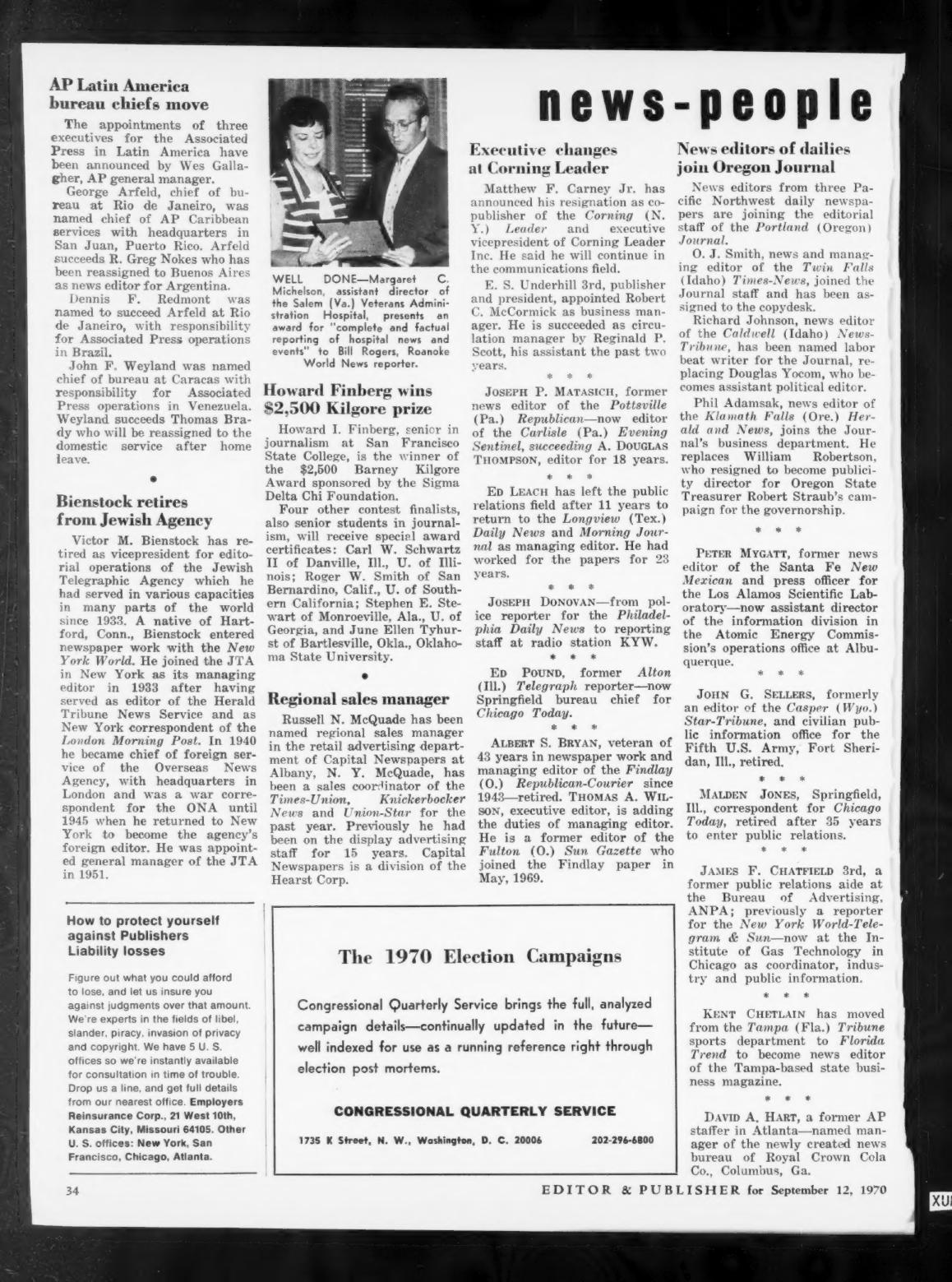
In late summer, I received notice that I had won the  Barney Kilgore Award sponsored by the Sigma Delta Chi Foundation [later renamed as the Society of Professional Journalists Foundation].  The award included $2,500, which would be presented at the SDX national convention in November in Chicago.  The convention would present an opportunity that would change my life. Learn more about Barney Kilgore here.

In a statement of journalistic philosophy that accompanied my entry, I wrote “a good newsman and a good newspaper will provide the news with creativity, honesty and integrity.”  I also said:

A good newspaper must be aware of the changes in its community.  It must be able to present facts without fear or bias and interpret the news so that its readers can understand their every-changing and complex world.

Those words still work, 45 years later.  I also wrote:

For some people, newspapers are the only to government.

Sadly, too many people in too many cities have no daily newspapers and hence little access or oversight of their government officials.


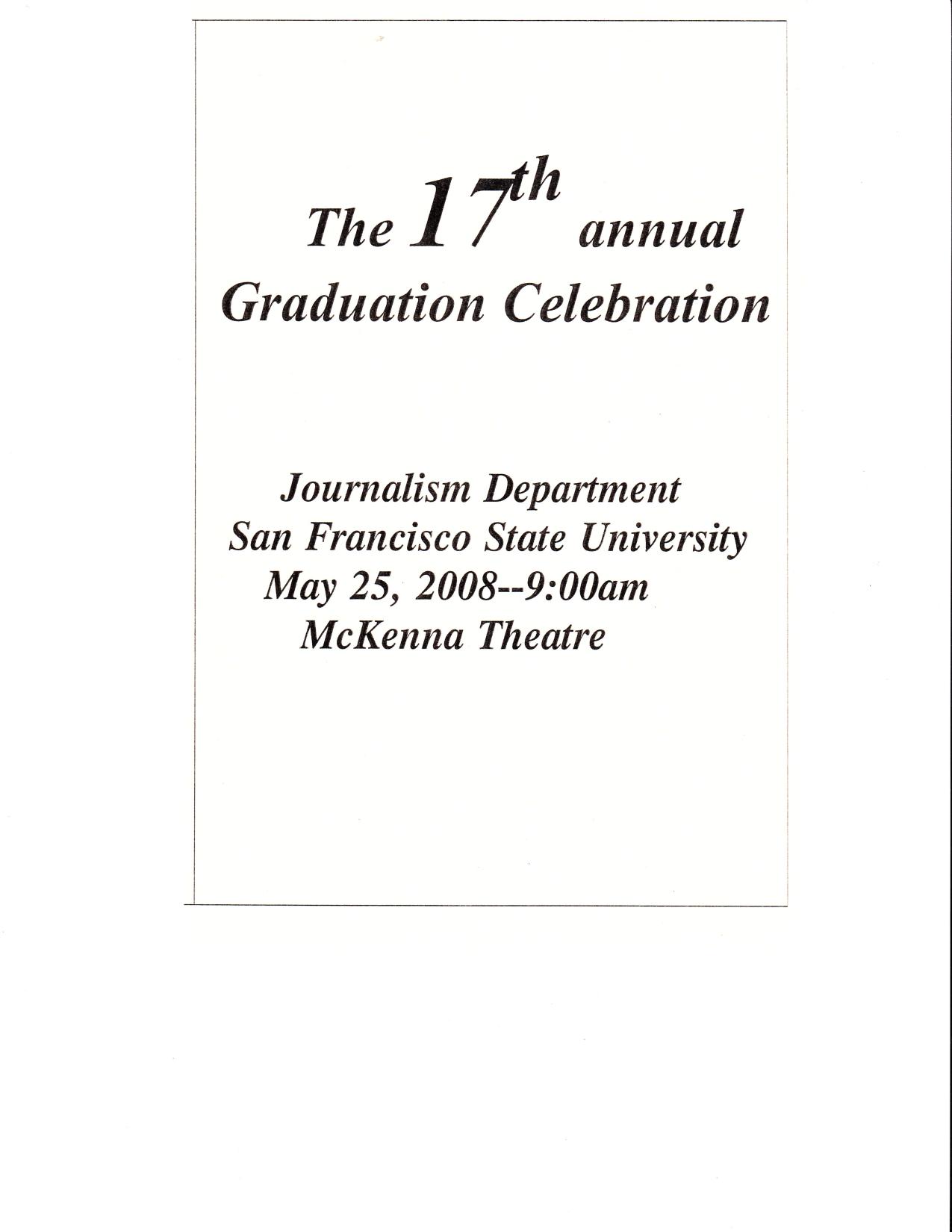
Printed 2008 San Francisco State journalism graduation program and typed pages of the Distinguished Journalism Alumnus speech

Adding a Sixth W: My 2008 SF State Speech

On May 25, 2008, I went back to where I started. The Journalism Department at San Francisco State University held its annual Graduation Celebration at 9 a.m. in McKenna Theatre, and I was on the program as Distinguished Journalism Alumnus, introduced by Jon Funabiki. Venise Wagner, the department chair, opened the morning. Martin Reynolds was named Journalism Alumnus of Year, introduced by Austin Long-Scott. Khari Johnson was the Class Honors Student, introduced by Cristina Azocar, and Christine Joy Ferrer was the Class Speaker, introduced by John Burks. The ceremony closed with a World Press Pass send-off by the journalism faculty.

The two documents here are the printed program
ed u2014 with the full list of graduates u2014 and my speaking text, marked 22, 2008. Speaking to a room full of new journalism graduates in the spring of 2008 meant speaking into a very bad news cycle for the news business, and I decided not to pretend otherwise.

This is a wonderful time to be a journalist. This is also a lousy time to be at a traditional journalism-based media company.

The rest of the talk was an argument for flexibility, built out of my own ru00e9sumu00e9. I told them I left school with one goal u2014 to become a news editor at a newspaper u2014 and never got there.

That was my career dream. It was a good goal, but I never reached it. I went around it. I went through it. I went over it.

Instead I counted seven careers: copy editor at the San Francisco Examiner and the Chicago Tribune; graphics and picture editor at the Chicago Tribune and The New York Times; newsroom leader at the San Francisco Chronicle and the Arizona Republic; head of information technology at The Arizona Republic; online strategist at Central Newspapers; new media consultant; and educator, trainer and director of interactive learning at The Poynter Institute. My journalism education, I told them, had prepared me for maybe two of those jobs. My wife, Kate, has her own diagnosis for this pattern u2014 she calls me a u201cpioneer addict,u201d someone who is happy only when he creates something new, and she is right that pioneers are easy to spot by the lost look and the absence of a map.

The heart of the speech was a small piece of advice dressed up as journalism 101. Everyone in that theatre already knew the 5Ws. I suggested they add one more.

What you need to add is another W, a 6th W: the u201cWhat Ifu201d.

I framed 2008 as an inflection point u2014 the moment when an industry, a company or a person has to choose between protecting the old or jumping into a future where the rules are unclear. The railroads didnu2019t make that leap. Newspapers, I argued, could have decided in the 1980s that their business was helping people make sense of the world around them, u201cand not just crushing trees and smearing ink.u201d I warned the graduates they would witness the failure of some well-known newspaper and television companies during their careers, and also the birth of new forms of journalism, including nonprofit-supported experiments then under way in Minneapolis and Washington, D.C.

I also reminded them that they were the first truly digital generation u2014 born about when Tim Berners-Lee created the World Wide Web, in fifth grade when the first Palm Pilot shipped, in ninth grade when Napster arrived and took the music industryu2019s business model with it, in high school for Skype, in college for YouTube. My generation still marvels at the Internet; theirs would treat it the way we treat electricity, without noticing the lights are on.

It is your responsibility to think about what the future might hold. It is your responsibility to shape the future. Do you think that you arenu2019t ready for that responsibility? Sorry. Too late. You already have the job.

Rereading this in 2026, the predictions hold up better than I would like. Well-known newspaper companies did fail. Nonprofit newsrooms did grow into a real part of the ecosystem. The one line that makes me smile is my hope for an innovator who would combine the Wii with journalism u2014 a very 2008 way of asking a question that AI and immersive storytelling are now answering in ways I couldnu2019t have named then. The advice underneath it, though, is the same advice I spent the next decade acting on at Poynter, building News University to give working journalists a way to keep learning after the diploma. Formal education can only take you to the starting line. Preparation, as I told the class of 2008, comes from within.

A Telegram From Washington: Named a 1971 Sears Congressional Journalism Intern

In 1970, big news arrived on paper, delivered to your door. Not email, not a phone call, not a text message — a Western Union telegram, all capital letters, punctuation spelled out or dropped, and the sender paying by the word. This one came to my parents’ house on Ortega Street in San Francisco while I was a journalism student at San Francisco State.

THE AWARDS COMMITTEE HAS NAMED YOU A 1971 SEARS CONGRESSIONAL JOURNALISM INTERN AND IS ARRANGING FOR YOUR APPOINTMENT TO A CONGRESSIONAL OFFICE STAFF, FULL DETAILS WILL FOLLOW BY LETTER IN MID-JUNE, PLEASE SEND IMMEDIATELY YOUR SUMMER ADDRESS AND TELEPHONE NUMBER ROTH AT RESIDENCE AND PLACE OF EMPLOYMENT. CONGRATULATIONSS

The telegram is dated May 20, 1970, and it is signed by:

JOHN L WHEELER, VICE PRESIDENT, GOVERNMENTAL AFFAIRS, SEARS, ROEBUCK AND CO, 1211 CONNECTICUT AVENLE WASHINGTON, D.C. 20056

Note the address: the telegram was sent by a corporate executive in Washington, D.C. The awards committee named the interns; the details — where you would actually be working, and for whom — would follow by letter in mid-June. In other words, you were told you had won before anyone could tell you what you had won.

The image itself is a reminder of how these documents were made. The routing codes across the top, the operator’s marks, the transmission time stamps, the form number at the bottom — all of it printed around a message that a machine typed out at the receiving end. The optical character reader stumbles over parts of it, which is fair; so does the eye. “BOTH” became “ROTH.” “AVENUE” became “AVENLE.”

Looking at it now, more than fifty years on, what strikes me is that a piece of news that changed the direction of a young journalist’s year came as a fragile sheet of paper with a glued-on tape of type. Today the same message would be an email, or a notification on a phone, gone from view in a week and unfindable in a year. The telegram survived because it was an object, and because I thought it was worth keeping. That is a decent argument for archives, and part of why these documents are here.

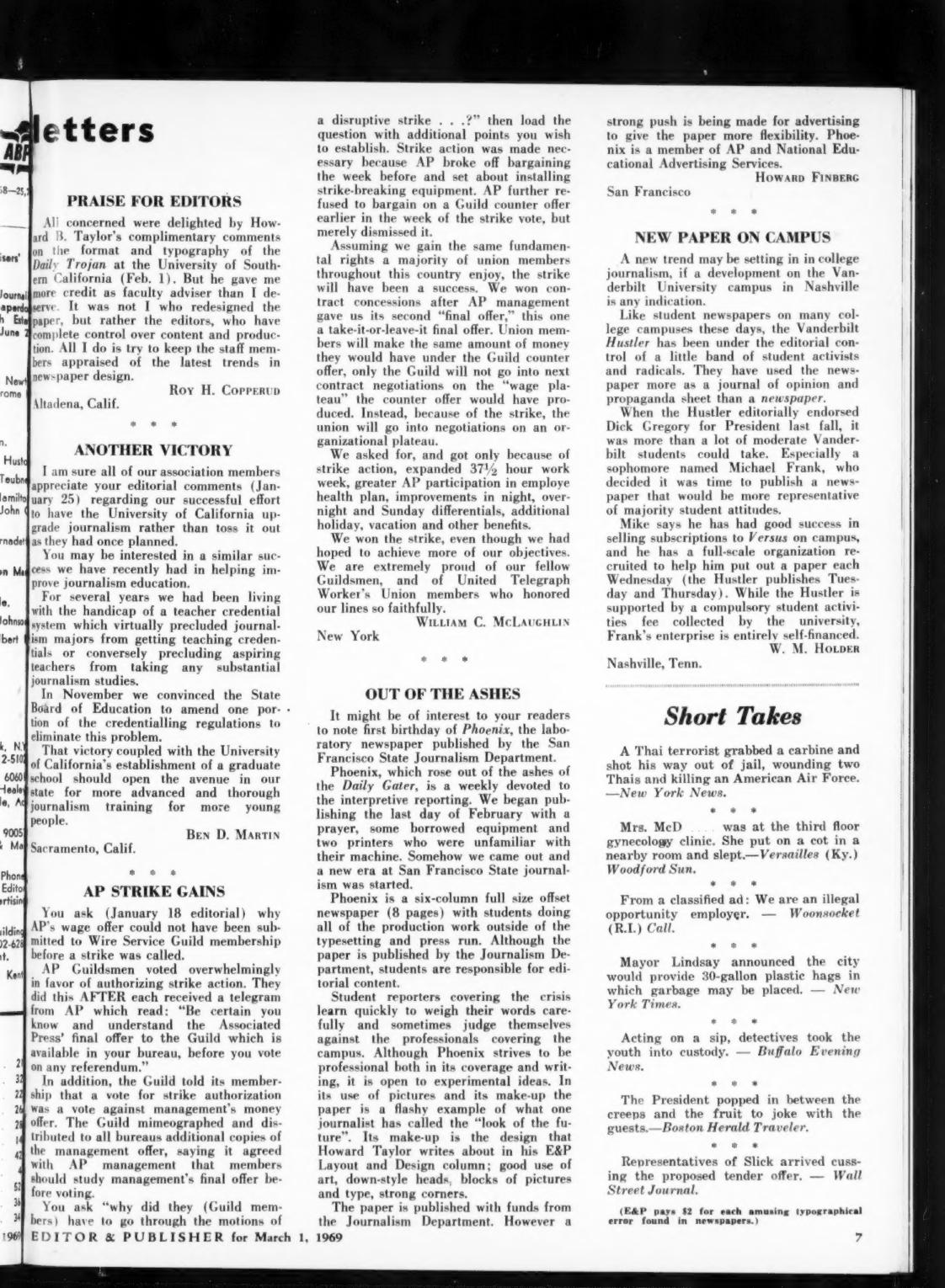
Editor & Publisher letters column from March 1, 1969, printing a letter about Phoenix, the San Francisco State laboratory newspaper

Out of the Ashes: A Letter to Editor & Publisher About the Phoenix

This is a letter of mine that ran in the letters column of Editor & Publisher for March 1, 1969. I was a journalism student at San Francisco State, and what I wanted the trade press to know was that our laboratory newspaper had made it through its first year.

It might be of interest to your readers to note the first birthday of Phoenix, the laboratory newspaper published by the San Francisco State Journalism Department.

The name was not subtle, and it wasn’t meant to be. The Phoenix came after the Daily Gater, and the letter says so plainly, along with a fairly honest account of how the first issue got out the door.

Phoenix, which rose out of the ashes of the Daily Gater, is a weekly devoted to interpretive reporting. We began publishing the last day of February with a prayer, some borrowed equipment and two printers (typesetters) who were unfamiliar with their machine. Somehow we came out and a new era in San Francisco State journalism was started.

What I described was a six-column, full-size offset paper, eight pages, with students doing all of the production work outside of the typesetting and the press run. The Journalism Department published it and paid for it, but, as I was careful to point out, students were responsible for the editorial content. We were pushing for advertising to give the paper more flexibility. The Phoenix was a member of AP and of National Educational Advertising Services.

The part of the letter I still think holds up is the paragraph about what it was like to be a student reporter on that campus, at that moment, with the professionals working the same story.

Student reporters covering the crisis learn quickly to weigh their words carefully and sometimes judge themselves against the professionals covering the campus.

And then, because even at that age I couldn’t resist talking about design, I spent a good chunk of a letter about a student newspaper describing its typography.

In its use of pictures and its make-up the paper is a flashy example of what one journalist has called the “look of the future.” Its make-up is the design that Howard Taylor writes about in his E&P Layout and Design column; good use of art, down-style heads, blocks of pictures and type, strong corners.

There’s a nice coincidence on the same page. The letter at the top of the column, from Roy H. Copperud of Altadena, Calif., is also responding to Howard Taylor’s design coverage — this time about the Daily Trojan at USC — and makes a point I would hear again and again in the years that followed about who actually does the work:

It was not I who redesigned the paper, but rather the editors, who have complete control over content and production.

A page of letters about student newspapers, journalism education in California, and the Wire Service Guild’s strike against the AP — and tucked in among them, a college student telling the industry’s trade magazine that the future would look a certain way on the page. The scan garbles my byline into “Howarp FInBerc,” which feels about right for a 1969 hot-type artifact making its way through a 21st-century scanner.