Technology Shifting, a View from 1999

In February 1999, I presented a forward-looking view of how technology could reshape the media industry. Speaking at the Interactive Newspapers Conference in Atlanta, I emphasized strategic use of technology, organizational culture, and evolving audience behaviors over hype or novelty. More than two decades later, many of my insights still resonate. This was the second of two speech I gave at the conference.  [The first can be found here.]

Here’s a summary of the technology speech transcript, created by AI

Content Strategy: “Author Once, Publish Many”

Finberg introduced a philosophy that still guides media workflows today: create content once and distribute it across multiple platforms. At Central Newspapers (CNI), this approach was powered by a database-driven system that fed content to print, web, fax, and even early mobile devices. The goal was efficiency and flexibility in an increasingly fragmented media landscape.

This strategy formed the foundation for today’s multi-platform publishing models, where newsrooms serve content to websites, apps, newsletters, and social media from a central source.

Technology as a Cultural Change Agent

Finberg argued that technology alone doesn’t transform organizations—culture does. For CNI, success meant not only installing systems, but also ensuring physical and digital infrastructure enabled collaboration. He pointed out how simple disconnects, like incompatible email systems, often held back real innovation.

His approach highlights a lasting truth: real transformation requires internal alignment and thoughtful change management.

Building Engagement with “Sticky” Applications

Rather than simply counting clicks, CNI aimed to boost engagement through what Finberg called “sticky apps”—features that encouraged users to return. Examples included personalized job agents, deep local sports coverage, and cobranding partnerships with other news outlets.

The idea was to deliver lasting value to users, moving beyond raw traffic to deeper loyalty and longer visits—metrics that are now standard in digital newsrooms.

Classifieds in Decline, Innovation in Response

Finberg was frank about the threat facing newspaper classifieds: “We operate on the principle that Classifieds is going away.” In response, CNI developed alternative digital products such as Work Avenue, Virtual Job Fairs, and HomeFair.com—each built around services and user experience rather than traditional advertising.

This proactive shift toward diversified, digital-first revenue streams foreshadowed the industry’s broader pivot in the 2000s.

Local Strength Through Strategic Partnerships

Finberg also emphasized the power of collaboration. He highlighted niche content sites, like “Indiana’s Game” for basketball fans, that partnered with other local papers for shared content and branding. Likewise, Arizona Central’s joint tourism site with the state showed how media organizations could pool resources to better serve users.

These partnerships created richer experiences and extended reach—long before “content syndication” became a digital norm.

Search as a Guided Experience

In a beta project with WaveShift, Finberg previewed a curated search engine that prioritized relevant, editor-approved results. The tool allowed users to explore external content without leaving the publisher’s site—supporting both user satisfaction and retention.

This approach reflected an early understanding of user-centered design and editorial curation, still central to quality digital journalism today.

A Forward-Facing Mindset

Finberg concluded his talk with a mix of humor and urgency. His key message: success depends on delivering real value to users while staying agile in the face of disruption. Technology should serve strategy—not the other way around.

Even now, as media organizations continue to evolve, his 1999 roadmap remains a reminder that the fundamentals—audience, content, culture—still matter most.
Coming Media Industry Storm, 1999 Speech

In February 1999, I gave a speech at the 10th Annual Interactive Newspapers Conference in Atlanta. At that time, the newspaper industry was still clinging to its traditional revenue pillars—print circulation, display ads, and, most crucially, classifieds. However, to me, there was no doubt that those pillars were now built upon shifting sands.

I gave the speech in my role as Director of Technology and Information Strategies for Central Newspapers. I wanted to issue a warning that time was short to hope that changes were evolutionary not revolutionary. Looking back, I’m particularly proud that I said that the internet was a fundamentally a different medium, not an extension of an existing medium.

I asked Chat GPT to read the transcript of the speech and write a post. [The full transcript is available here.] This is what AI wrote:

Drawing from his experience launching online ventures like ArizonaCentral.com and HomeFair.com, Howard Finberg projected a not-so-distant future in which classifieds—the cash cow for local papers—would erode significantly. Industry research was already signaling a potential 7% loss in bottom-line revenue. “Look around the room,” Finberg said. “Seven percent of us won’t be here next year unless other things happen.”

What followed was a clear-eyed, sometimes humorous, always practical exploration of how newspapers needed to reinvent themselves—organizationally, culturally, and strategically—for the internet era.

A New Business, Not a New Department

Finberg’s core message was that digital wasn’t just an add-on. It was a fundamentally different medium with different economics, content, and user behavior. Drawing a comparison to how early television mimicked radio before finding its own identity, he urged media leaders to stop thinking of the web as an “extension of print.”

Instead, he proposed a hybrid model he called Integrated Independence. The idea was to combine centralized resources (like shared technology platforms and content services) with localized control. Local newsrooms would have the freedom to tailor digital strategies to their communities while benefiting from corporate-level efficiencies. “Nobody knows the local markets better than the local publishers,” Finberg reminded the audience.

Breaking the Assembly Line

Finberg also called for deep structural and cultural change within newsrooms. The traditional assembly-line workflow—where one department handed off content to another in rigid steps—wasn’t going to cut it. He advocated for flatter hierarchies, shared knowledge, and team-driven processes where journalists were empowered to collaborate, experiment, and respond to audience needs in real-time.

One visual metaphor stood out: the future journalist not as a solitary reporter with a notebook, but a nimble, multi-skilled “first-on-the-scene” storyteller—equipped with audio, video, and digital tools, capturing stories from the ground up.

Talent, Risk, and Retention

Finberg was equally blunt about the staffing crisis on the horizon. Starting salaries in journalism couldn’t compete with emerging web companies offering equity and entrepreneurial freedom. “We face a real brain drain,” he warned. His solution? Pay strategically for “Hot Jobs,” break HR molds when needed, and—most importantly—offer employees the chance to learn, move, and grow. “We (must) reward failure,” he said, “by not penalizing it—and by encouraging the next try.”

A Call to Look Beyond

Perhaps the most striking element of Finberg’s talk was his push for the industry to stop looking only inward. “We need to start attending conferences outside our field,” he said. “Broadcasting, cable, tech—we have to see what others are doing.” It was a call for curiosity, humility, and horizon scanning—a mindset that still resonates today.

More than two decades later, many of the ideas in this talk—content re-usability (“author once, publish many”), cross-platform journalism, digital-first thinking, and agile teams—have become core to modern media strategy. But in 1999, this was revolutionary thinking.

Finberg’s presentation wasn’t just a roadmap. It was a challenge. A reminder that digital disruption wasn’t just coming—it had already arrived.

Digital Credibility, IFRA Presentation

In my 2002 presentation at the IFRA Asia Conference, held in Bangkok, I addressed the critical topic of credibility in online journalism, highlighting its significant impact on media brands and their audiences. As Managing Director of the Digital Futurist Consultancy, I shared insights from the Digital Journalism Credibility Study, sponsored by the Online News Association and funded by the John S. and James L. Knight Foundation. [This is a summary  from my presentation slides.]

In our research, we explored how consumers and media professionals perceive credibility online, identifying four key types of credibility:

1. Presumed Credibility: Assumptions based on domain names, web traffic, and update frequency.
2. Reputed Credibility: Influenced by third-party recommendations or references.
3. Surface Credibility: Based on first impressions of a site’s professional appearance and navigability.
4. Experienced Credibility: Derived from ongoing user experience, ease of navigation, and perceived content accuracy.

Key insights from our survey revealed that the public had not yet firmly decided on the credibility of online news, presenting an opportunity for media organizations to differentiate themselves through credible reporting practices. Factors such as accuracy, completeness, fairness, and timeliness strongly influence credibility perceptions. Additionally, I emphasized the essential need for a clear separation between editorial and advertising content to maintain consumer trust.

Ultimately, I concluded that the debate on digital credibility remains open, offering both challenges and opportunities for media companies aiming to establish or reinforce their reputation online. Credibility, I argued, is a business imperative in the evolving digital landscape.

The full report is on this site.

Understanding Online Credibility. An ONA Project

One of the more interesting and challenging project I undertook as a consultant was as a co-author on a study of online credibility for the Online News Association, which was funded by the Knight Foundation. The purpose of the study was outlined in the press release from ONA:

The study will work to develop and promote principles and guidelines for online journalism focusing on proper relationships between editorial content, advertising and e-commerce; the development of ethical standards and avoidance of conflicts of interest; and appropriate use of hyperlinking in a journalistic environment.

It was a big project and a great learning opportunity about putting together a research project with a level of academic rigor.   My co-author was Martha Stone, another consultant.

“The results generated from ONA panel discussions and research will provide a foundation for the ongoing discussions regarding credibility in this very new medium. It is a chance to help shape solid journalistic practices early,” said Howard Finberg, co-director.

The project was announced by ONA via Business Wire release.

Cover of the Pew Internet & American Life Project report America's Online Pursuits, dated December 22, 2003

America’s Online Pursuits: Pew’s 2003 Snapshot

A December 22, 2003 report from the Pew Internet & American Life Project, pulling together more than three years of tracking survey data into one picture of who was online and what they were doing there. The numbers come from telephone interviews conducted by Princeton Survey Research Associates between March 2000 and December 2002, with additional data from an August 2003 survey.

The headline finding is a plateau. After the rush of the late 1990s, the online population had essentially stopped growing, even as the people already there kept finding more to do.

63% of Americans now go online — last measured in our August 2003 survey.

31% of Internet users who go online from home have broadband as of August 2003.

Email was still the center of gravity, and the report says so plainly. Among the 25 core activities tracked, online banking grew fastest — the kinds of transactions that required people to trust the medium.

Email continues to be the “killer app” of the Internet. More people use email than do any other activity online.

Online banking increased by 127% — more than any other activity about which we asked 2000 and 2002. In March 2000, just 15 million had tried some form of online banking, but by October 2002, 34 million had done so.

For those of us in the news business, the news line is the one worth marking: the online news audience grew 50% between March 2000 and December 2002, from 52 million to 78 million, and Pew credits big events — Campaign 2000, September 11, the run-up to the Iraq war — with each ratcheting the daily audience up a notch and leaving it there.

The conclusion reads as a prediction, and it holds up better than most:

All the trends set out here seem destined to continue, if not evolve, as the technology gets better, the applications become simpler, the appliances that use the Internet become omnipresent, and the technology fades into the background of people’s lives — as powerful, ubiquitous, commonplace, and “invisible” as electricity.

Some 2026 context for the numbers above, which is what makes this document interesting to me: the 63% of American adults online in August 2003 is now in the mid-90s — Pew’s recent tracking puts adult internet use at roughly 95%, which is about as close to universal as survey research gets. 

Home broadband, at 31% of home users in 2003, is now the norm rather than the advantage, and the “dial-up user” category that Pew compares against on nearly every page of this report has effectively vanished. Smartphone ownership, which does not appear in this report at all, now runs around 90% of adults, and a meaningful share of Americans go online only through a phone.

That last point is the real gap between 2003 and now. Pew’s 2003 framework assumed a computer, a connection, and a user who sat down to do a discrete thing — check a score, book a flight, read the news. The report’s own prediction about the technology fading into the background came true, and in doing so it dissolved the categories Pew was counting.

Mary Madden is the principal author; Lee Rainie, the project’s director, is listed as editor.

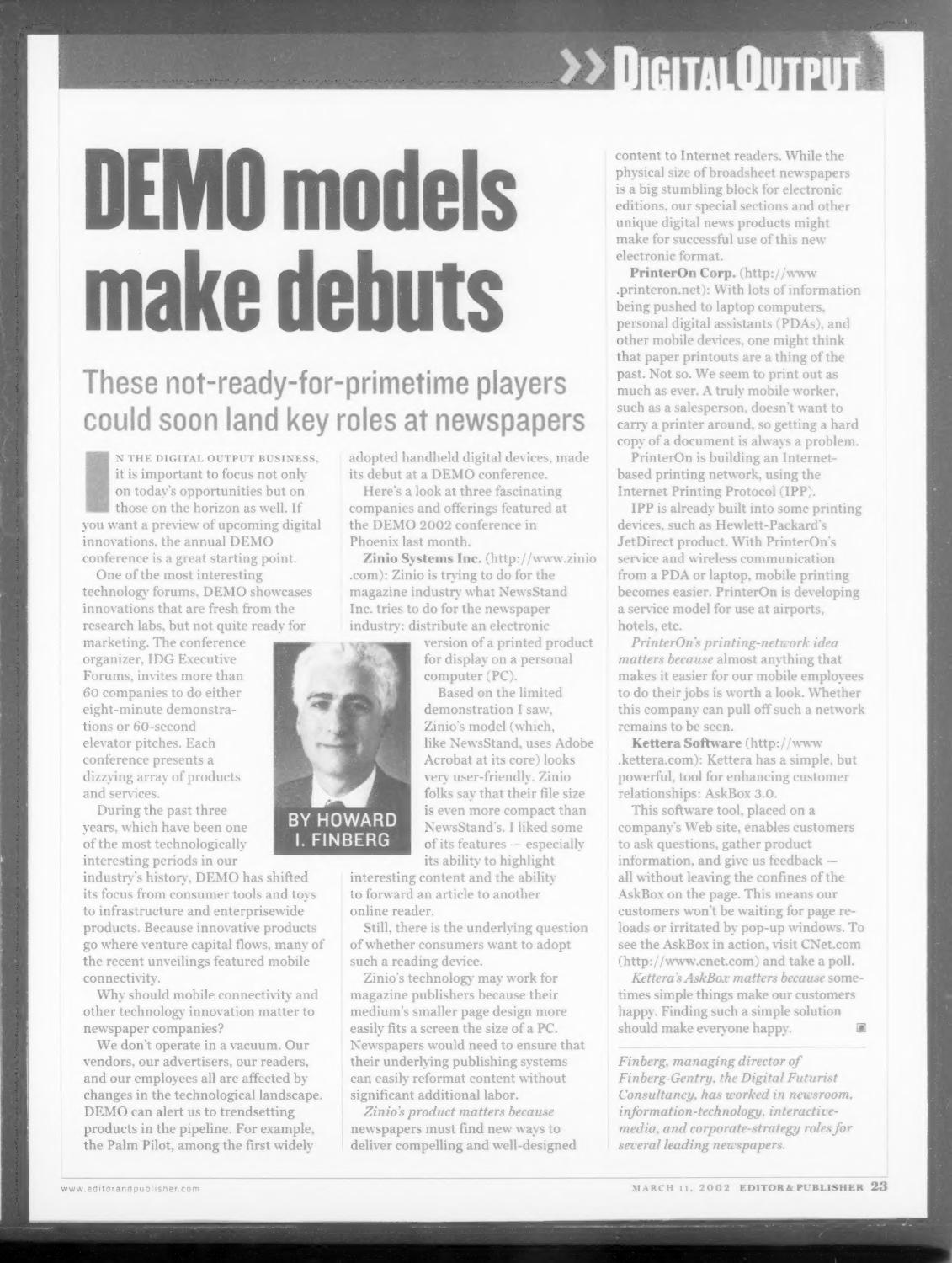
Editor & Publisher "Digital Output" column from March 11, 2002 reviewing products from the DEMO 2002 conference in Phoenix

DEMO Models Make Debuts

My “Digital Output” column from the Tech News section of Editor & Publisher, March 11, 2002. The column previews three products shown the previous month at the DEMO 2002 conference in Phoenix, organized by IDG Executive Forums, and notes that DEMO had shifted its emphasis from consumer tools toward infrastructure, enterprise, and mobile-connectivity products. The deck:

These not-ready-for-primetime players could soon land key roles at newspapers

Zinio Systems Inc. (zinio.com) was building an Adobe Acrobat-based system for distributing electronic magazines — the magazine industry’s counterpart to NewsStand Inc.’s newspaper service — with a more compact file size and features for highlighting content and forwarding articles to other readers.

PrinterOn Corp. (printeron.net) was building an Internet-based mobile printing network using the Internet Printing Protocol, already built into devices such as Hewlett-Packard’s JetDirect, aimed at mobile workers who need a hard copy without carrying a printer, with a planned service model for airports and hotels.

Kettera Software (kettera.com) demonstrated AskBox 3.0, a customer-service Web tool shown live on CNet.com, letting site visitors ask questions, gather product information, and give feedback without leaving the page or waiting for a reload.

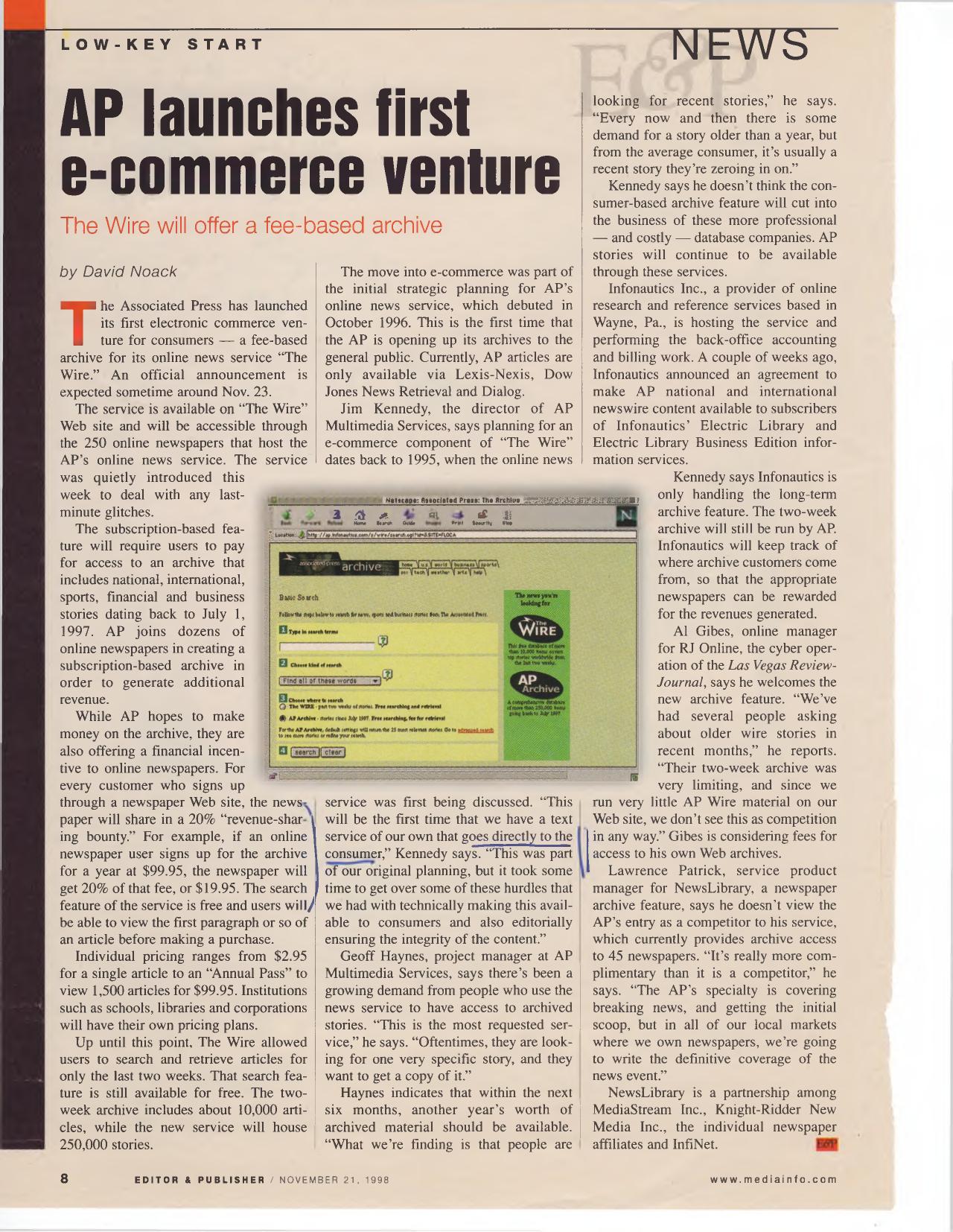
Clipping of David Noack's November 1998 Editor & Publisher article on the AP's fee-based news archive for The Wire

AP Launches Its First Consumer E-Commerce Venture

This November 21, 1998 article from Editor & Publisher, written by David Noack, reports on the Associated Press launching its first electronic commerce venture aimed at consumers: a fee-based archive for its online news service, “The Wire.” The service was available through The Wire’s Web site and the 250 online newspapers that hosted the AP’s online news service, with an official announcement expected around Nov. 23.

The subscription archive covered national, international, sports, financial and business stories dating back to July 1, 1997 — a big jump from the free two-week search, which held about 10,000 articles versus the new service’s 250,000. Individual pricing ran from $2.95 for a single article to a $99.95 “Annual Pass” for 1,500 articles, with a 20% revenue-sharing arrangement for newspapers that signed up customers.

Jim Kennedy, director of AP Multimedia Services, said the e-commerce component had been in the plans since 1995:

“This will be the first time that we have a text service of our own that goes directly to the consumer.”

“This was part of our original planning, but it took some time to get over some of these hurdles that we had with technically making this available to consumers and also editorially ensuring the integrity of the content.”

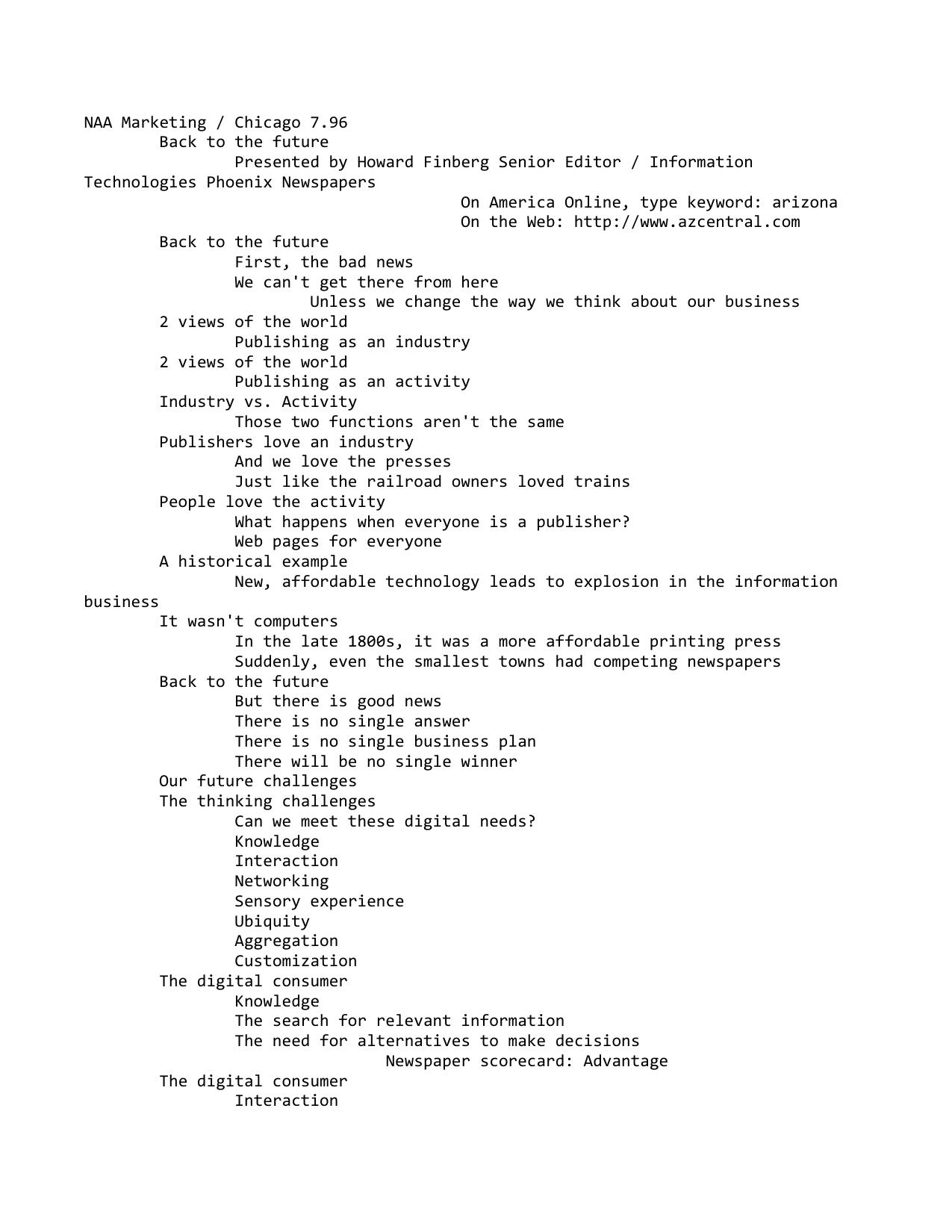
Title slide reading "Back to the future" from a July 1996 NAA marketing and technology meeting presentation in Chicago

Back to the Future: A 1996 Presentation to NAA Marketing

In July 1996 I presented “Back to the future” at an NAA marketing and technology business meeting in Chicago. At the time I was Senior Editor / Information Technologies at Phoenix Newspapers

The argument started with the bad news:

We can’t get there from here
Unless we change the way we think about our business

That change meant seeing the difference between publishing as an industry and publishing as an activity. Publishers love the industry — and the presses — “Just like the railroad owners loved trains.” But people love the activity. My historical example wasn’t computers at all: in the late 1800s a more affordable printing press gave even the smallest towns competing newspapers.

The heart of the talk was a scorecard, rating newspapers against seven digital consumer needs — knowledge, interaction, networking, sensory experience, ubiquity, aggregation and customization. The tally: two advantages, three neutrals, two disadvantages.

I also warned against the era’s favorite word:

Don’t “repurpose” content
Repurpose our role

And about the delivery debate: “It isn’t about dead trees OR live wires.” Forget online, forget the Web, forget about the wires — focus on information value.

Two outside voices made the point better than I could. Mark Hauptschein, director of strategy and business development at Ameritech:

“The old way of throwing advertising – spraying and praying – will weaken over time. Marketing will become a form of content.”

And Eric Berg, Price Waterhouse director of technology:

“In the late 1990s, getting access to information will no longer be an issue. The real issue will be avoiding information. We’re going to need new technology which will enable us to filter, sort and extract the information which is relevant to us.”

The process section covered the questions we were all avoiding — what is news, what are the jobs, what kind of organization — plus the return of the 24-hour newsroom and a caveat I still like: going from hot type to cold type is evolutionary; going digital is revolutionary. Make sure the paradigm really shifts.

There was good news, too. No new technology has yet replaced an older one, and information providers have always found a way, from newsbooks to newsletters to newspapers. I closed with Darwin — survival belongs to the most adaptable — and with people:

Give them information
Give them tools
Give them training
Give them room