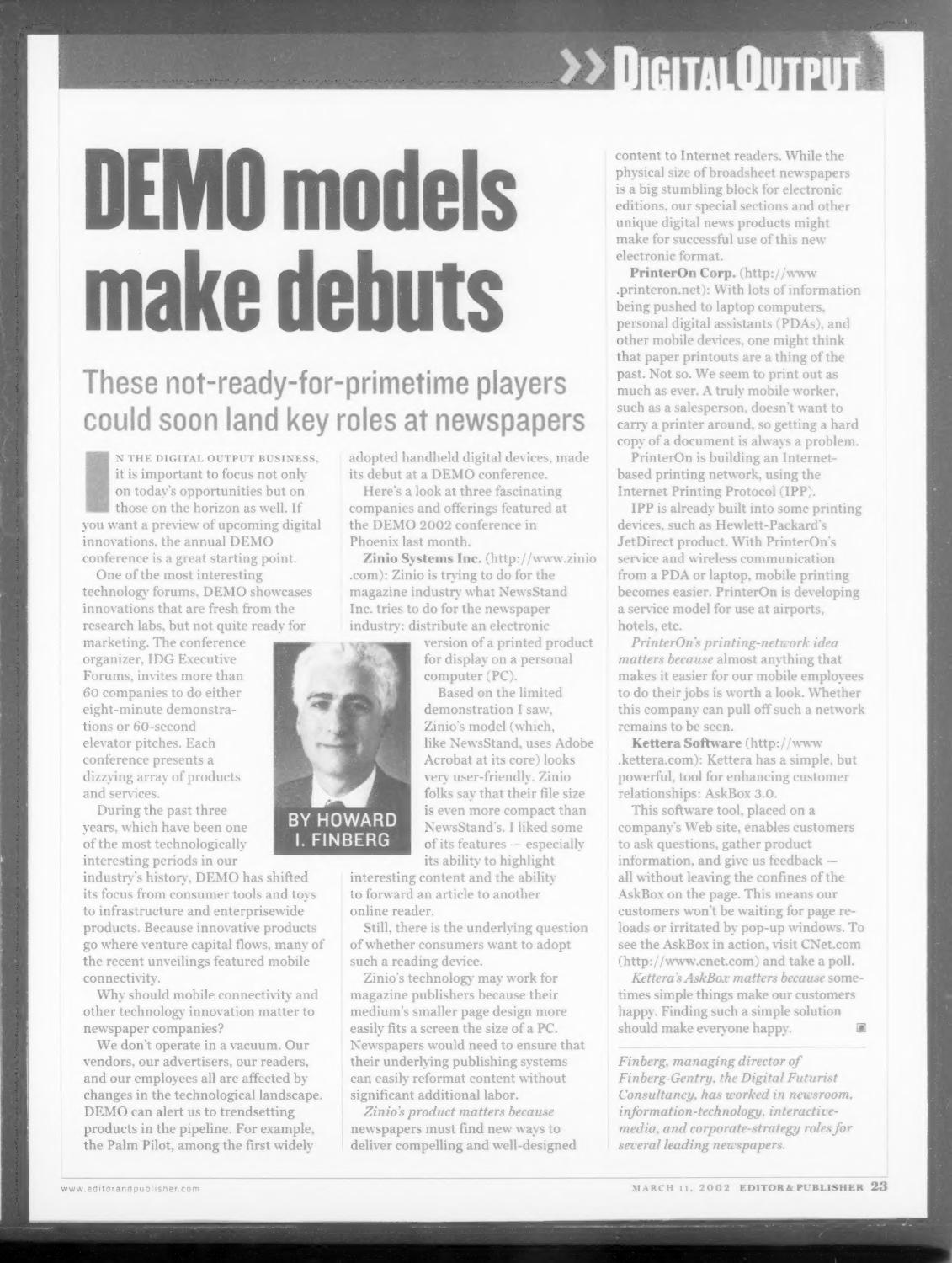
Editor & Publisher "Digital Output" column from March 11, 2002 reviewing products from the DEMO 2002 conference in Phoenix

DEMO Models Make Debuts

My “Digital Output” column from the Tech News section of Editor & Publisher, March 11, 2002. The column previews three products shown the previous month at the DEMO 2002 conference in Phoenix, organized by IDG Executive Forums, and notes that DEMO had shifted its emphasis from consumer tools toward infrastructure, enterprise, and mobile-connectivity products. The deck:

These not-ready-for-primetime players could soon land key roles at newspapers

Zinio Systems Inc. (zinio.com) was building an Adobe Acrobat-based system for distributing electronic magazines — the magazine industry’s counterpart to NewsStand Inc.’s newspaper service — with a more compact file size and features for highlighting content and forwarding articles to other readers.

PrinterOn Corp. (printeron.net) was building an Internet-based mobile printing network using the Internet Printing Protocol, already built into devices such as Hewlett-Packard’s JetDirect, aimed at mobile workers who need a hard copy without carrying a printer, with a planned service model for airports and hotels.

Kettera Software (kettera.com) demonstrated AskBox 3.0, a customer-service Web tool shown live on CNet.com, letting site visitors ask questions, gather product information, and give feedback without leaving the page or waiting for a reload.
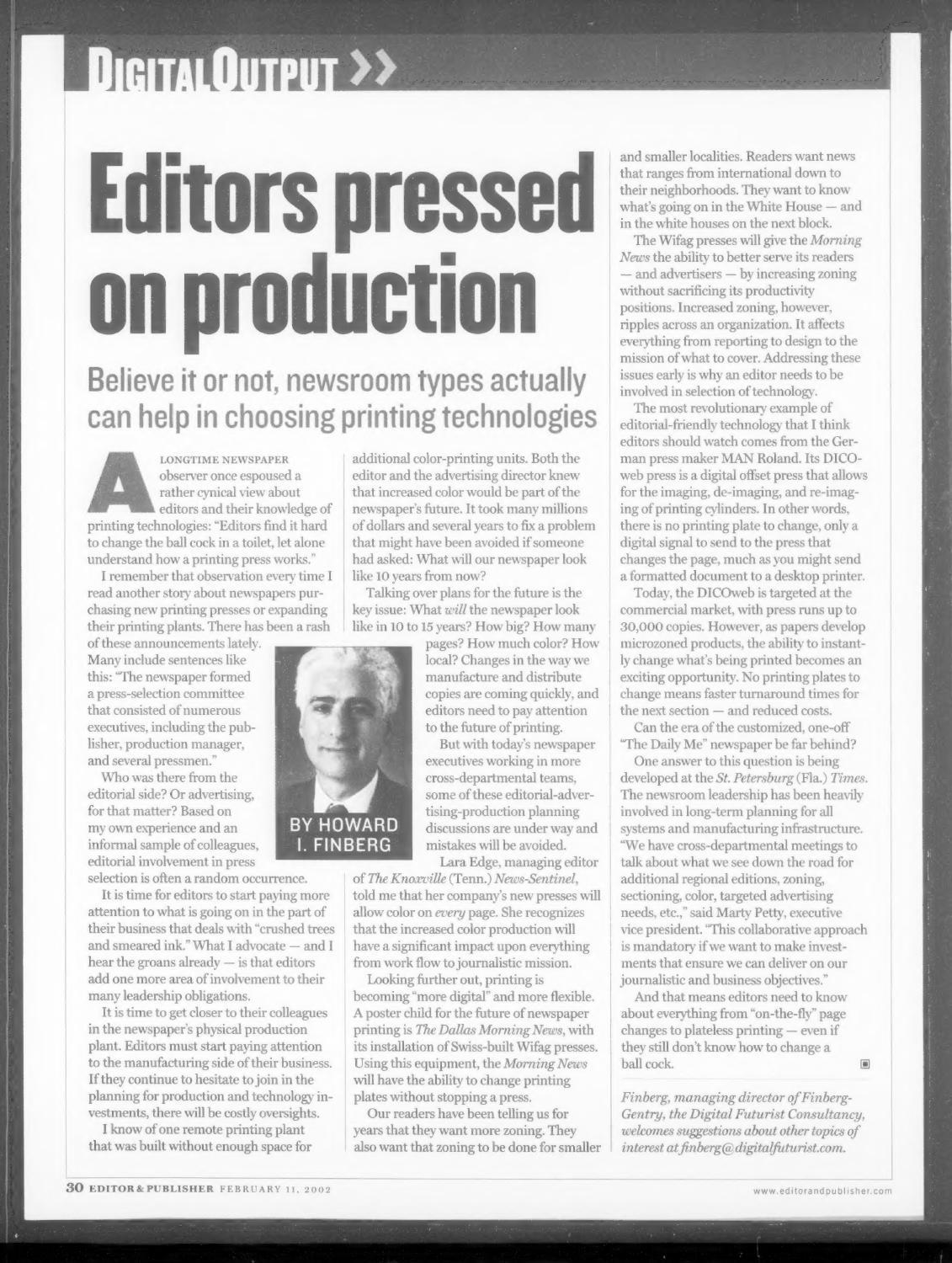
Editor & Publisher "Digital Output" column from February 11, 2002 on editorial involvement in newspaper press selection and printing-plant planning

Editors Pressed on Production

A February 11, 2002 column from my “Digital Output” series in the Tech News section of Editor & Publisher. The subject: editorial involvement — or the lack of it — in newspaper press selection and printing-plant planning. The column opens with a cynical observation from a longtime newspaper observer:

“Editors find it hard to change the ball cock in a toilet, let alone understand how a printing press works.”

The column notes that press-selection committees were typically made up of the publisher, production manager and several pressmen, and that editorial involvement was “often a random occurrence.” It cites a remote printing plant built without enough space for additional color-printing units — a problem that took several years and many millions of dollars to fix. The question editors should be asking: “What will the newspaper look like in 10 to 15 years? How big? How many pages? How much color? How local?”

Examples cited include The Knoxville (Tenn.) News-Sentinel, where managing editor Lara Edge said new presses would allow color on every page; The Dallas Morning News, with Swiss-built Wifag presses able to change printing plates without stopping a press; and MAN Roland’s DICOweb, a digital offset press allowing “the imaging, de-imaging, and re-imaging of printing cylinders.” The column ties these capabilities to reader demand for zoning:

They want to know what’s going on in the White House — and in the white houses on the next block.

The St. Petersburg (Fla.) Times is offered as a model of newsroom involvement in long-term planning for systems and manufacturing infrastructure. Marty Petty, executive vice president, is quoted:

“We have cross-departmental meetings to talk about what we see down the road for additional regional editions, zoning, sectioning, color, targeted advertising needs, etc. This collaborative approach is mandatory if we want to make investments that ensure we can deliver on our journalistic and business objectives.”

The closing line:

And that means editors need to know about everything from “on-the-fly” page changes to plateless printing — even if they still don’t know how to change a ball cock.

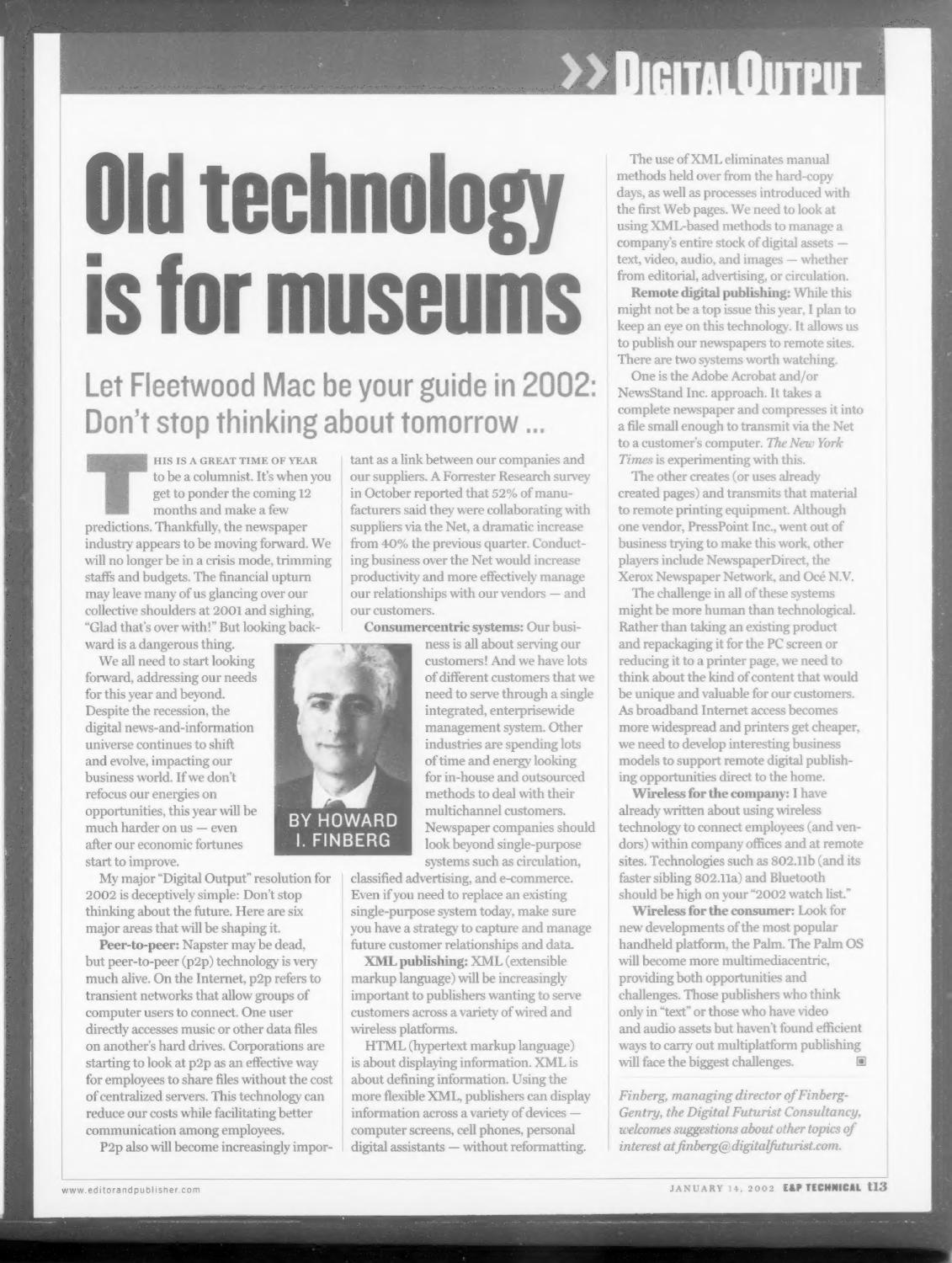
Digital Output column in the Editor & Publisher Technical section, January 14, 2002, on technologies to watch

Old Technology Is for Museums

My “Digital Output” column for Editor & Publisher, published January 14, 2002, in the E&P Technical section. It’s a start-of-the-year prediction column, written as the newspaper industry came out of the budget-and-staff cutting of 2001, and it lays out six technology areas worth watching.

The framing came from Fleetwood Mac — the subhead read “Let Fleetwood Mac be your guide in 2002: Don’t stop thinking about tomorrow …” — and the column’s central point was that the recession was no excuse to stop paying attention to what was coming next.

My major “Digital Output” resolution for 2002 is deceptively simple: Don’t stop thinking about the future.

The six areas: peer-to-peer technology, which I argued was alive well past Napster and would matter both inside companies and as a link to suppliers; consumer-centric systems, urging publishers to look beyond single-purpose circulation, classified, and e-commerce systems toward one integrated, enterprise-wide approach to customer data; XML publishing; remote digital publishing; wireless inside the company; and wireless for the consumer.

On XML, the column drew the distinction plainly:

HTML (hypertext markup language) is about displaying information. XML is about defining information.

The remote digital publishing section looked at two approaches — the Adobe Acrobat and/or NewsStand Inc. model of compressing a complete newspaper for transmission to a customer’s computer, which The New York Times was experimenting with, and transmitting pages to remote printing equipment. PressPoint Inc. had already gone out of business trying to make the second work; other players named were NewspaperDirect, the Xerox Newspaper Network, and Oc
u00e9 N.V. My conclusion about all of it:

The challenge in all of these systems might be more human than technological.

For wireless, 802.11b and 802.11a and Bluetooth were on the “2002 watch list,” and on the consumer side the column pointed to the Palm OS becoming “more multimedia-centric.” The column ran with the standard tagline identifying me as managing director of Finberg-Gentry, the Digital Futurist Consultancy.