Learning Culinary Confidence

And now for something completely different. 

During the “sectional revolution” at the Chicago Tribune, there was an opportunity for those with a little extra time and some energy to write articles for the paper’s new feature sections.  Since I liked food, I offered a couple of different stories, including a review of  high-end hamburgers.  I also got an opportunity to write about a newly developed passion for cooking and took a cooking class.

Like most Americans, I was raised on a steady diet of meat and potatoes, all cooked in the same basic manner: unexciting. It wasn’t until I opened the doors to a variety of food palaces here and in San Francisco that I began to enjoy food, even look forward to it! But eating out  puts  a cramp on the  budget.

So confronted with bankruptcy or more meat and potatoes, I took up ethnic cooking and soon discovered that all knowledge does not come from a cookbook. I decided it ’twas time for a cooking class.

It was a fun class and lessons learned are still applied today.  And it was a fun assignment to write about my experiences.

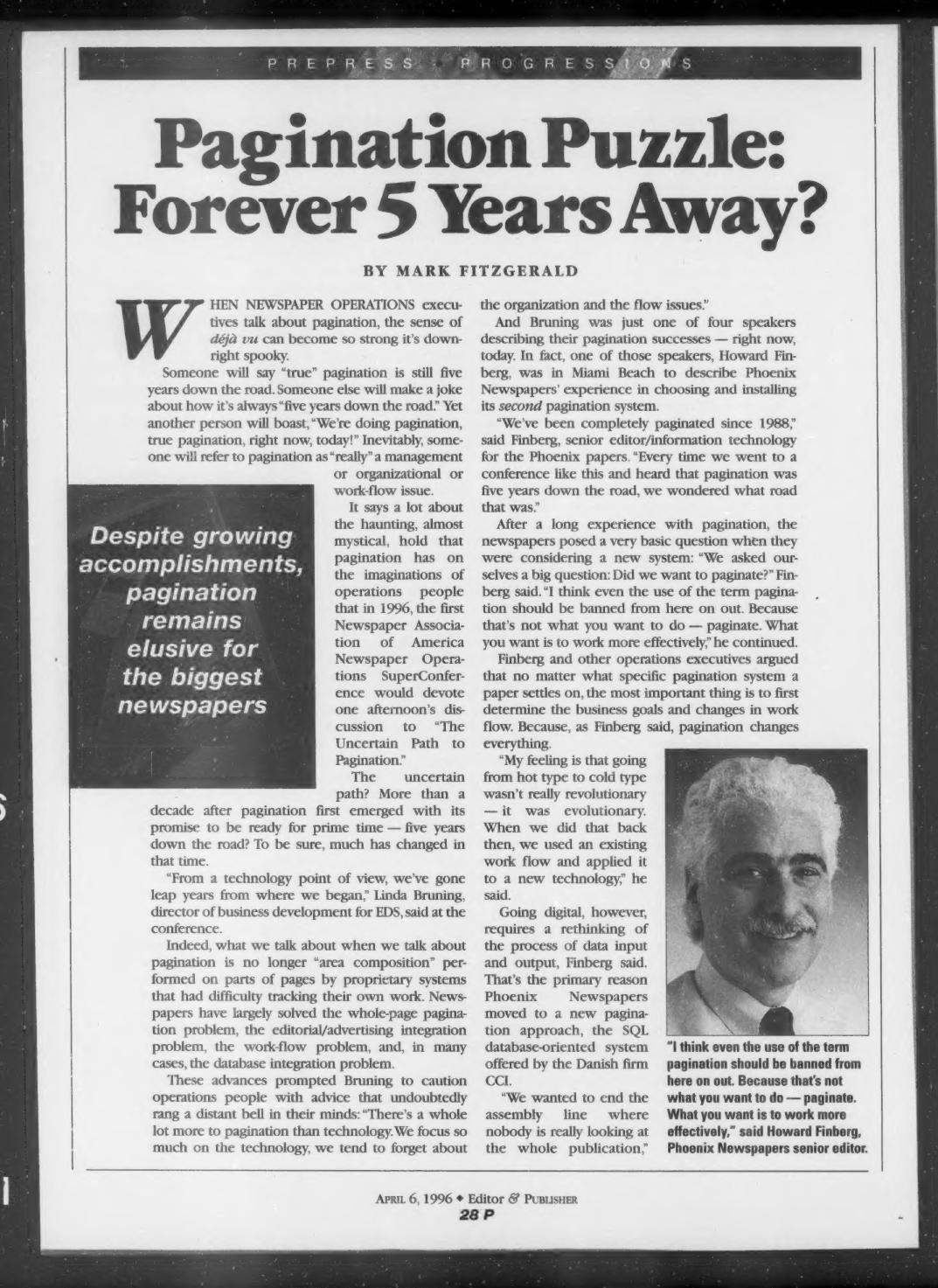
Printed 2008 San Francisco State journalism graduation program and typed pages of the Distinguished Journalism Alumnus speech

Adding a Sixth W: My 2008 SF State Speech

On May 25, 2008, I went back to where I started. The Journalism Department at San Francisco State University held its annual Graduation Celebration at 9 a.m. in McKenna Theatre, and I was on the program as Distinguished Journalism Alumnus, introduced by Jon Funabiki. Venise Wagner, the department chair, opened the morning. Martin Reynolds was named Journalism Alumnus of Year, introduced by Austin Long-Scott. Khari Johnson was the Class Honors Student, introduced by Cristina Azocar, and Christine Joy Ferrer was the Class Speaker, introduced by John Burks. The ceremony closed with a World Press Pass send-off by the journalism faculty.

The two documents here are the printed program
ed u2014 with the full list of graduates u2014 and my speaking text, marked 22, 2008. Speaking to a room full of new journalism graduates in the spring of 2008 meant speaking into a very bad news cycle for the news business, and I decided not to pretend otherwise.

This is a wonderful time to be a journalist. This is also a lousy time to be at a traditional journalism-based media company.

The rest of the talk was an argument for flexibility, built out of my own ru00e9sumu00e9. I told them I left school with one goal u2014 to become a news editor at a newspaper u2014 and never got there.

That was my career dream. It was a good goal, but I never reached it. I went around it. I went through it. I went over it.

Instead I counted seven careers: copy editor at the San Francisco Examiner and the Chicago Tribune; graphics and picture editor at the Chicago Tribune and The New York Times; newsroom leader at the San Francisco Chronicle and the Arizona Republic; head of information technology at The Arizona Republic; online strategist at Central Newspapers; new media consultant; and educator, trainer and director of interactive learning at The Poynter Institute. My journalism education, I told them, had prepared me for maybe two of those jobs. My wife, Kate, has her own diagnosis for this pattern u2014 she calls me a u201cpioneer addict,u201d someone who is happy only when he creates something new, and she is right that pioneers are easy to spot by the lost look and the absence of a map.

The heart of the speech was a small piece of advice dressed up as journalism 101. Everyone in that theatre already knew the 5Ws. I suggested they add one more.

What you need to add is another W, a 6th W: the u201cWhat Ifu201d.

I framed 2008 as an inflection point u2014 the moment when an industry, a company or a person has to choose between protecting the old or jumping into a future where the rules are unclear. The railroads didnu2019t make that leap. Newspapers, I argued, could have decided in the 1980s that their business was helping people make sense of the world around them, u201cand not just crushing trees and smearing ink.u201d I warned the graduates they would witness the failure of some well-known newspaper and television companies during their careers, and also the birth of new forms of journalism, including nonprofit-supported experiments then under way in Minneapolis and Washington, D.C.

I also reminded them that they were the first truly digital generation u2014 born about when Tim Berners-Lee created the World Wide Web, in fifth grade when the first Palm Pilot shipped, in ninth grade when Napster arrived and took the music industryu2019s business model with it, in high school for Skype, in college for YouTube. My generation still marvels at the Internet; theirs would treat it the way we treat electricity, without noticing the lights are on.

It is your responsibility to think about what the future might hold. It is your responsibility to shape the future. Do you think that you arenu2019t ready for that responsibility? Sorry. Too late. You already have the job.

Rereading this in 2026, the predictions hold up better than I would like. Well-known newspaper companies did fail. Nonprofit newsrooms did grow into a real part of the ecosystem. The one line that makes me smile is my hope for an innovator who would combine the Wii with journalism u2014 a very 2008 way of asking a question that AI and immersive storytelling are now answering in ways I couldnu2019t have named then. The advice underneath it, though, is the same advice I spent the next decade acting on at Poynter, building News University to give working journalists a way to keep learning after the diploma. Formal education can only take you to the starting line. Preparation, as I told the class of 2008, comes from within.

Editor & Publisher feature page from May 5, 2003 by Carl Sullivan on spam filters, ad blockers and newspaper pop-up advertising

Spam Filters, Ad Blockers and a 2003 Warning About Pop-ups

This is a feature by Carl Sullivan in the May 5, 2003, issue of Editor & Publisher about a problem that was just coming into focus for newspaper Web sites: the filtering technologies readers were installing to protect themselves from spam and pop-up advertising were also blocking the e-mail and the ads newspapers were sending.

Sullivan opens with the e-mail news alerts newspapers sent when 15-year-old Elizabeth Smart was found near Salt Lake City in March 2003. Words like “teenager,” “kidnapped,” and “girl” tripped spam filters that mistook the alerts for pornography. Ron Currier, chief technology officer of Boulder-based PublishMail, which handled reader e-mail for more than 30 newspapers, described the result:

They bounced like crazy

The other half of the story was ad blocking. Sullivan cites a March 2003 Forrester Research study showing 14% of online consumers were using some form of ad-blocking software, up from about 1% a year earlier — with another 13% saying they hadn’t known such software existed until the pollsters asked, and would now consider installing it. The article quotes a long list of online newspaper executives on pop-ups, pop-unders, blacklists and whitelists, including Jason Krebs of NYTimes.com, Greg Schermer of Lee Enterprises, Ian Murdock of Hearst Newspapers, Ginger Neal of Freedom Orange County Information, and Jeff Webber of USAToday.com.

I was quoted twice, identified as a principal at the Finberg-Gentry consultancy — my partnership with Steve Gentry, also listed in the article as The Digital Futurist Consultancy — and as a faculty member at the Poynter Institute. The first quote follows a mention of our 2001 report for the Newspaper Association of America, which found that many publishers were generating new print subscriptions through pop-up house ads on their own Web sites:

Web publishers have to wean themselves off those or find additional ways to promote the paper. They were effective, but now’s the time to move off of them or to at least supplement them with banner and tile advertising.

Sullivan notes that we were working on a follow-up report about using the Net to promote print subscriptions, expected to be released by NAA that summer. My second quote closes the piece, alongside PowerOne Media’s David Teitler asking whether the Web would end up an advertising-supported medium at all:

Consumers recognize that there’s value in advertising. The real challenge for Web sites is to find the right visual model that conveys the message in an effective way without angering readers.

That challenge didn’t get any easier. The article also points to what became the answer for a while — contextual “sponsored links” served next to editorial content, then being tested at USAToday.com through Applied Semantics, a company Google had just purchased.

Opening slide from the 2002 Journalism & Technology, Linked Forever presentation greeting a Danish audience with "God Eftermiddag"

Journalism & Technology, Linked Forever Presentation

This is a presentation I gave to the Centre for Journalism and Further Education on Sept. 23, 2002. The opening slide greets the audience with “God Eftermiddag,” so I was clearly speaking to a Danish room. At the time I was Managing Director of Finberg-Gentry, the Digital Futurist Consultancy, a Presidential Scholar at The Poynter Institute and a Senior Fellow at the American Press Institute’s Media Center.

The purpose, as I laid it out early on, was to help the audience think about the future: how journalism is shaped by technology, how consumers drive technology, and how journalists need to position themselves regarding technology. My argument was that journalists could no longer treat technology as somebody else’s department.

For decades, journalists had little reason to pay attention to technology… The pace of change was slow. 50 years between innovations. Hot type to cold type. Letterpress to offset. Today, the pace is much faster. 20 years or shorter…

I split the disruption into two buckets. Internal: how we do business. External: what is our business. And I was blunt that the external questions mattered more, because our industry was at what I called an “inflection point.” I leaned on the Marshall McLuhan line that has never stopped being useful:

“We see the world through a rear-view mirror. We march backwards into the future.”

Much of the middle of the talk was a tour of devices and delivery: broadband going mainstream in the U.S. and accelerating in Western Europe, information devices wired and wireless, the smart phone as “a telephone with an operating system,” the first generation of reading devices — Softbook, E-Reader, RocketBook — plus NewsStand and Zinio, the coming TabletPC from “those fun folks up in Redmond, Wash.,” home gateways, personal video recorders, IBM’s MetaPad, the OQO, E-Ink displays and IBM’s e-newspaper mockup. I also included my caveat that not all technological changes are valuable, and that convergence might be an example of value that isn’t clearly understood.

Woven through the slides were five questions for the audience, and the third one is the one I’d still ask today:

While the paper might not disappear from newspaper, what happens if those who read it on paper disappear?

The last third of the presentation was the part I cared most about: a method for deciding what to do. The Technology Prioritization Matrix, copyrighted by The Digital Futurist Consultancy, simplified the decision to two criteria — consumer value, and expense and effort — with a list of internal questions (productivity, training, skills alignment, probability of success) and external ones (revenue potential, market share, customer adoption). The point was that not every project with a “gee whiz” factor returns value to the consumer or the company, and that there would be no single leap to the new world. I closed with four technology rules, including one I’ve repeated many times since:

Experiments cost money; doing nothing costs even more

Reading this in 2026, the specific hardware is a museum tour — most of those reading devices are gone, and the ones that survived didn’t look much like the mockups. But the framing held up better than the gadgets: consumers drove the fundamental changes, adoption took longer than predicted, and the newsrooms that waited for certainty paid the higher price.

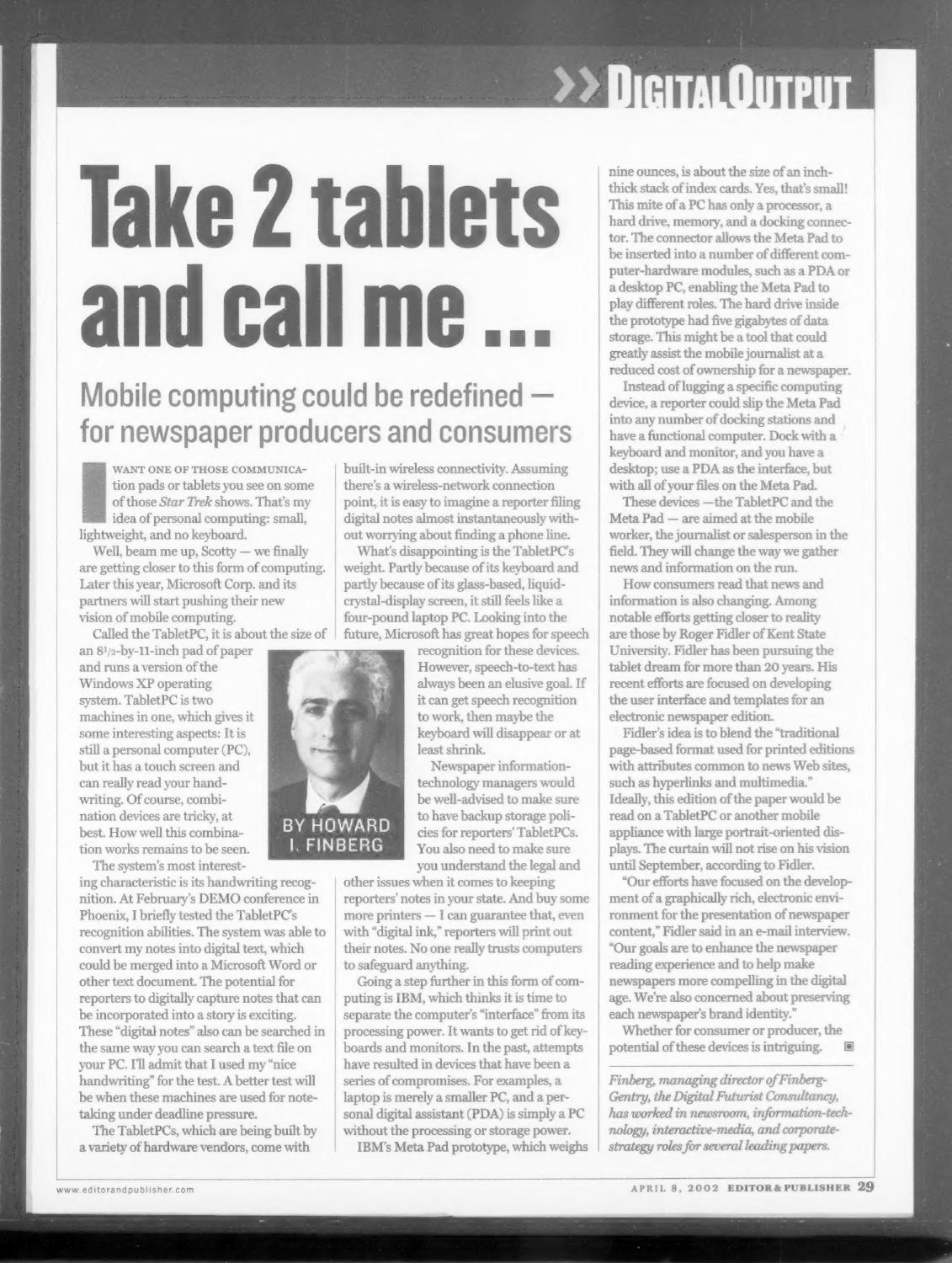
Tablet-style device representing the 2002 promise of mobile computing for newspapers, from an Editor & Publisher column

Take 2 Tablets and Call Me — Mobile Computing, 2002

My column in the April 8, 2002, issue of Editor & Publisher looked at two devices that promised to redefine mobile computing for both newspaper producers and consumers: Microsoft’s forthcoming TabletPC and IBM’s Meta Pad prototype.

The column opens with an admission about where the idea came from:

I want one of those communication pads or tablets you see on some of those Star Trek shows. That’s my idea of personal computing: small, lightweight, and no keyboard.

The TabletPC, about the size of an 8 1/2-by-11-inch pad of paper and running a version of Windows XP, was being built by a variety of hardware vendors with built-in wireless connectivity. I had briefly tested its handwriting recognition at February’s DEMO conference in Phoenix, where the system converted my notes into digital text that could be merged into a Word document. My caveat: I used my “nice handwriting,” and the real test would come with note-taking under deadline pressure. The disappointment was weight — it still felt like a four-pound laptop.

The column also offered practical advice for newspaper information-technology managers: back up reporters’ TabletPCs, understand the legal issues around keeping reporters’ notes in your state, and buy more printers.

No one really trusts computers to safeguard anything.

IBM’s Meta Pad prototype went a different direction — separating the interface from the processing power. At nine ounces and about the size of an inch-thick stack of index cards, it held only a processor, a hard drive, memory, and a docking connector, with five gigabytes of storage. Dock it with a keyboard and monitor and you have a desktop; dock it with a PDA and you have a handheld carrying all your files.

On the consumer side, the column reported on Roger Fidler of Kent State University, who had been pursuing the tablet dream for more than 20 years and was then working on the user interface and templates for an electronic newspaper edition — blending the page-based format of print with hyperlinks and multimedia. Fidler said his work would not be unveiled until September, and told me in an e-mail interview:

Our efforts have focused on the development of a graphically rich, electronic environment for the presentation of newspaper content. Our goals are to enhance the newspaper reading experience and to help make newspapers more compelling in the digital age. We’re also concerned about preserving each newspaper’s brand identity.

The column ran with the standard tagline identifying me as managing director of Finberg-Gentry, the Digital Futurist Consultancy.

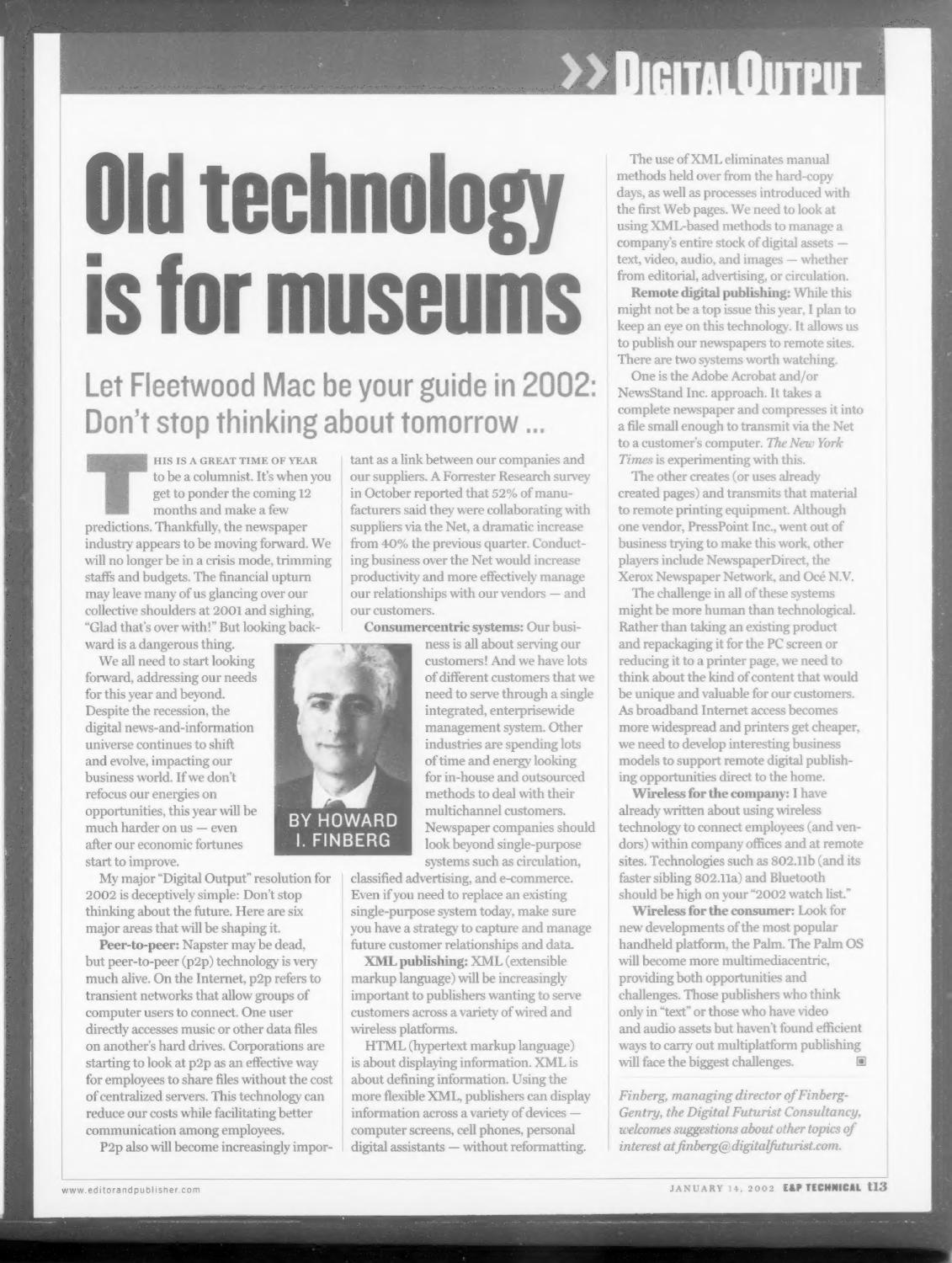
Digital Output column in the Editor & Publisher Technical section, January 14, 2002, on technologies to watch

Old Technology Is for Museums

My “Digital Output” column for Editor & Publisher, published January 14, 2002, in the E&P Technical section. It’s a start-of-the-year prediction column, written as the newspaper industry came out of the budget-and-staff cutting of 2001, and it lays out six technology areas worth watching.

The framing came from Fleetwood Mac — the subhead read “Let Fleetwood Mac be your guide in 2002: Don’t stop thinking about tomorrow …” — and the column’s central point was that the recession was no excuse to stop paying attention to what was coming next.

My major “Digital Output” resolution for 2002 is deceptively simple: Don’t stop thinking about the future.

The six areas: peer-to-peer technology, which I argued was alive well past Napster and would matter both inside companies and as a link to suppliers; consumer-centric systems, urging publishers to look beyond single-purpose circulation, classified, and e-commerce systems toward one integrated, enterprise-wide approach to customer data; XML publishing; remote digital publishing; wireless inside the company; and wireless for the consumer.

On XML, the column drew the distinction plainly:

HTML (hypertext markup language) is about displaying information. XML is about defining information.

The remote digital publishing section looked at two approaches — the Adobe Acrobat and/or NewsStand Inc. model of compressing a complete newspaper for transmission to a customer’s computer, which The New York Times was experimenting with, and transmitting pages to remote printing equipment. PressPoint Inc. had already gone out of business trying to make the second work; other players named were NewspaperDirect, the Xerox Newspaper Network, and Oc
u00e9 N.V. My conclusion about all of it:

The challenge in all of these systems might be more human than technological.

For wireless, 802.11b and 802.11a and Bluetooth were on the “2002 watch list,” and on the consumer side the column pointed to the Palm OS becoming “more multimedia-centric.” The column ran with the standard tagline identifying me as managing director of Finberg-Gentry, the Digital Futurist Consultancy.

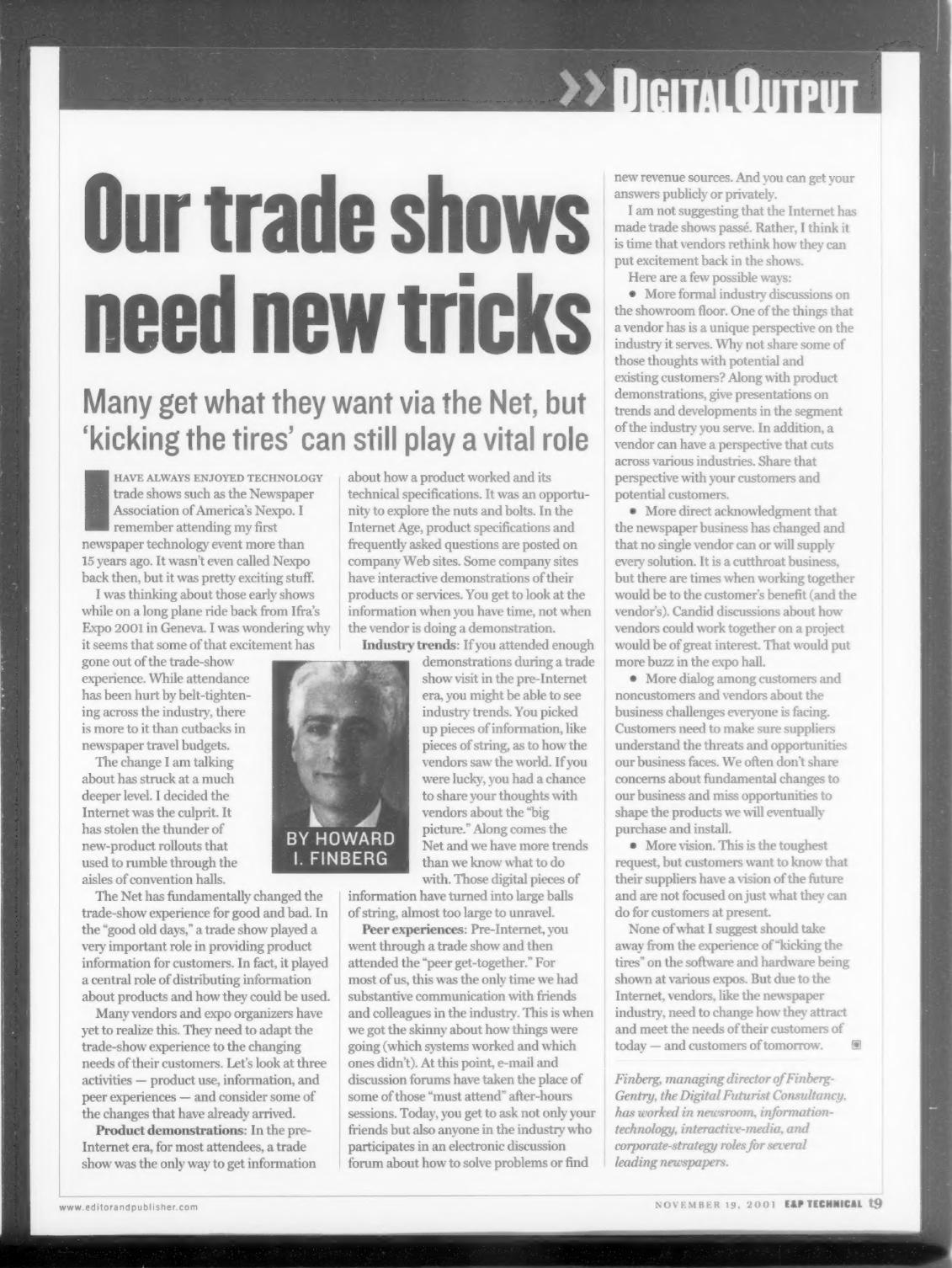
Editor & Publisher column page on newspaper technology trade shows, November 2001

Our Trade Shows Need New Tricks

A column I wrote for Editor & Publisher‘s technical section, published November 19, 2001, arguing that the Internet had drained some of the excitement out of newspaper technology trade shows such as the Newspaper Association of America‘s Nexpo and Ifra‘s Expo 2001 in Geneva.

The piece notes that while attendance had been hurt by industry belt-tightening, the deeper change was elsewhere:

I decided the Internet was the culprit. It has stolen the thunder of new-product rollouts that used to rumble through the aisles of convention halls.

The column looks at three activities — product demonstrations, industry trends, and peer experiences — and how each had already moved online. Product specifications and FAQs were posted on company Web sites, some with interactive demonstrations. Trend-spotting, once assembled from bits of vendor conversation, had become overwhelming:

Those digital pieces of information have turned into large balls of string, almost too large to unravel.

And e-mail and discussion forums had replaced some of the after-hours “peer get-together” sessions where attendees once got “the skinny” on which systems worked and which ones didn’t.

Rather than declaring trade shows finished, the column offers suggestions for vendors: more formal industry discussions on the showroom floor, more direct acknowledgment that no single vendor can supply every solution, more dialog with customers and noncustomers about shared business challenges, and more vision.

None of what I suggest should take away from the experience of “kicking the tires” on the software and hardware being shown at various expos.

The column ran with a note identifying me as managing director of Finbereg-Gentry, the Digital Futurist.

Two ways of looking at an Adobe Acrobat Reader PDF file: on a Palm handheld device and on paper

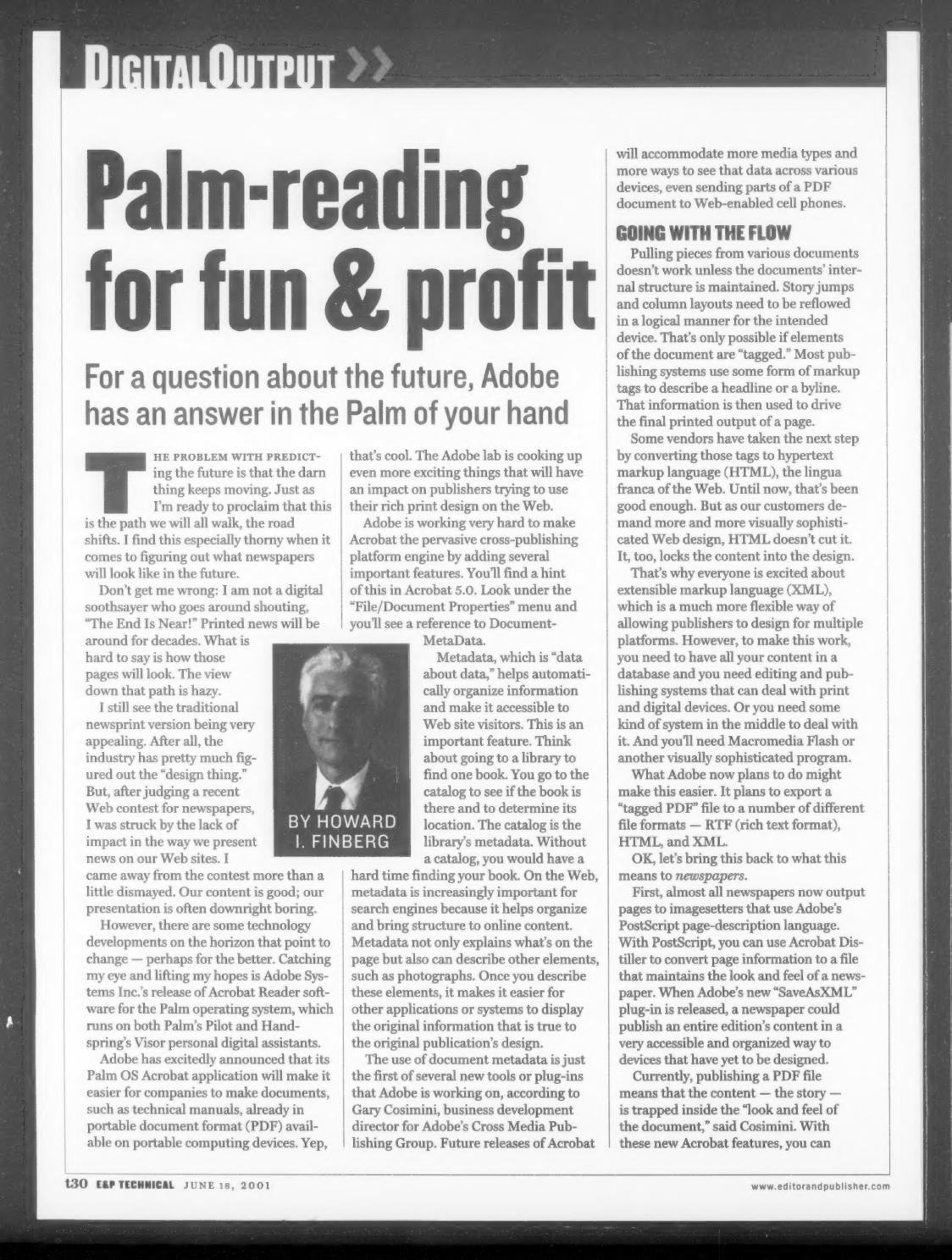
Palm-Reading for Fun & Profit

A column for Editor & Publisher‘s technical section, published June 15, 2001, under the headline “Palm-reading for fun & profit — For a question about the future, Adobe has an answer in the Palm of your hand.” The subject is Adobe Systems Inc.’s release of Acrobat Reader software for the Palm operating system, which ran on both Palm’s Pilot and Handspring’s Visor personal digital assistants, and what that development might mean for newspaper design across devices.

The problem with predicting the future is that the darn thing keeps moving. Just as I’m ready to proclaim that this is the path we will all walk, the road shifts.

The column argues that printed news will be around for decades, but that newspaper Web presentation was falling short. After judging a recent Web contest for newspapers, the verdict was blunt:

Our content is good; our presentation is often downright boring.

The technical discussion covers tagged documents, the limits of HTML — “It, too, locks the content into the design” — and the promise of extensible markup language (XML) for designing across multiple platforms. Gary Cosimini, business development director for Adobe’s Cross Media Publishing Group, is quoted on the state of PDF at the time, with the content “trapped inside the ‘look and feel of the document.'” The column describes Adobe’s plans to export a “tagged PDF” file to RTF, HTML and XML, and a forthcoming plug-in that would let a newspaper publish an entire edition’s content “to devices that have yet to be designed.”

Under the subhead “The Design Thing,” the column makes the case that publishing skill is itself a newspaper asset:

We know how to communicate by design. We organize and prioritize by design.

It closes by questioning whether the industry and its vendors were ready for a “handle-once” work flow publishing visually rich content across multiple devices, noting that competitors — CNET.com is the example — could run the process in reverse, converting XML- and HTML-formatted documents to PDF for print.

The road just shifted slightly, and there are warning signs ahead

The author’s note identifies Finberg as “a managing director of Finberg-Gentry, The Digital Futurist Consultancy,” with prior roles at The Arizona Republic in Phoenix, the Chicago Tribune, and the San Francisco Chronicle. An accompanying illustration showed “Two ways of looking at an Adobe PDF file: On a Palm device, on paper.”

Scanned pages of The Digital Edge's December 2000 article "Just Learning to Walk," with the Digital Futurist Consultancy website from that year

Learning to Walk: 2000 Look Back at Five Years Online

In December 2000, The Digital Edge, the online publication of the Newspaper Association of America‘s New Media Federation, marked the fifth anniversary of newspapers on the Web by asking seven veterans of the industry’s digital efforts to reflect on what they’d learned. The article, “Just Learning to Walk,” was written by Rob Runett, NAA Manager of Electronic Media Analysis. I was one of the seven, described in the piece as:

Howard I. Finberg, former vice president of Central Newspapers‘ CNI Ventures and CNI’s director of technology and information strategies. (He’s now sharing his wisdom as director of Tempe, Ariz.-based Digital Futurist Consultancy).

The others were Lisa DeSisto of boston.com, Todd Engdahl of DenverPost.com, John Granatino of Belo Interactive, Chris Jennewein of KnightRidder.com, Joe Michaud of MaineToday.com and Chris Morrill of the Hartford Courant’s ctnow.com.

Runett’s framing was that five years is nothing in the life of a medium, but felt like several lifetimes to the people who lived it. The questions ranged from proudest moment to biggest regret, and the answers were candid in a way industry panels rarely are.

My toughest hurdle was not technology. It was classified advertising:

The hardest challenge or hurdle we faced was getting the classified department to understand that that the company needed to move quickly or we’ll lose in the online marketplace. This was early in the development of the site [azcentral.com] and all we really knew was that our readers/customers wanted classifieds. And they wanted them for free, something that went to the opposite of the teachings at classified managers school. We didn’t have a business model, just a business “gut feeling” in 1996.

On business models, I argued that it was far too early to declare winners — and that interactive media was something genuinely new, not simply print extended:

Heck, we aren’t even walking yet and you want us to declare a college major?

Interactive, a.k.a. online, media truly is a new form of communication; it is less of an extension of our existing businesses or business models. Hey, that doesn’t mean we can’t learn from our forefathers. Interactive media should share the best traits of its “parents” and then move out of the house quickly.

Asked what I would undo, I picked the pace of the Web build-out at azcentral — and the pull of an easier revenue stream:

I resisted the temptation and probably should have moved quicker to have the team build out more Web features and spent fewer resources on AOL. But AOL was sending us money every month.

The “most important lesson in two lines or less” question produced the best writing in the piece. Morrill: “The user comes first. The user comes first. The user comes first.” Engdahl: “This isn’t a sprint, it’s a marathon.” Jennewein reminded everyone that traffic, advertising and low costs are Business 101, “but many of us lost sight of this during the dot-com boom.” I failed to follow the rules:

The basics, however, still matter: Quality. Accuracy. Fairness. Fun. Service. To do less is to fail the customer. I have also learned that I probably could never sum up in “two lines or less.”

The same December issue carried a column by New Media Federation President Gordon Borrell, vice president/new media at Landmark Communications, titled “Recommit or Pull the Plug.” Borrell noted that the Arizona Republic had cut 28 new-media positions in November and that Tribune Interactive had terminated 24 online positions in October — and listed me among those on the conference speaking circuit who had found themselves jobless since early summer. He quoted me on how I read the shakeout:

During the next year, the strong will get stronger; the weak will struggle. Those companies that recognize that the Internet is a new medium and not an extension of existing print models will do the best… What dot-com and traditional media businesses need to do is roll up their sleeves and get to work. No one said it would be easy — that’s why they call it work.

Borrell closed his column by agreeing: the 1990s were the years of experimentation and innovation, and what lay ahead was the real work.

Scanned along with these pages is a snapshot of the Digital Futurist Consultancy site as it existed in December 2000 — the biography, the scouting reports from DRUPA and the Jupiter conference, the Arizona Republic “learning journey,” and the 2020 Southwest Republic prototype done for the American Press Institute. Also included is the NAA press release announcing that year’s Digital Edge Awards, which named me the New Media Federation’s New Media Pioneer for 2000.

Reading these predictions now is instructive. DeSisto’s five-year forecast for boston.com included being on Palms, on cell phones and streaming headlines to LCD screens on taxicab roofs — and, she added, the Red Sox winning the World Series. She was right about the Red Sox in 2004, and right about the phones, though not in the way anyone in 2000 expected. Jennewein predicted that newspapers would dominate the local Internet space “with the specter of competition from dot-com startups long dissipated.” That one didn’t age as well.

What holds up, I think, is the thing I kept insisting on: that this was a new medium, not an extension of print. Twenty-five years later, that argument is still being relitigated in newsrooms — and the industry is still, in some important ways, just learning to walk. For others, they have been stopped in their tracks.
January 2000 Editor & Publisher clipping announcing that Central Newspapers created CNI Ventures for internet and technology investments

Central Newspapers Creates CNI Ventures

In January 2000, Editor & Publisher ran a short item announcing that Central Newspapers Inc. had created a new business unit to handle its investments in internet and technology companies. The story was only a few paragraphs, but it marked a real shift in how the company — publisher of The Arizona Republic and The Indianapolis Star — thought about where the future of news and information might be built.

Central Newspapers Inc. (CNI), publisher of The Arizona Republic and Indianapolis Star, has created a new business unit – CNI Ventures – to handle the company’s investments in the Internet and technology sectors. CNI Ventures will focus primarily on investments that develop delivery methods for news and information.

The distinction E&P drew was an important one inside the company. The existing newspaper websites were not going into the new unit; they stayed with the newspapers, where they belonged as part of the core business.

Central’s existing newspaper Web sites, such as Arizona Central and StarNews.com, will not become a part of the Ventures division, but remain a part of Central’s core business.

The investments that did move under the Ventures umbrella were a good snapshot of what looked promising at the turn of the century: BrightStreet, described as a provider of online promotions management solutions; E Ink, a developer of electronic display technology; Event411, a creator of online event-planning tools; and WaveShift, a creator of systems and software for new media. Incpad, the company’s high-tech job site — until recently called Westech Virtual Job Fair, as the item notes — stayed with the main internet activities alongside the newspaper sites.

E Ink is the one that still makes me smile. In 2000, electronic display technology was an article of faith, a bet on a future device that would carry news and information without paper. It took a while, but that one worked out.

And then the last paragraph, which is why this clipping is in my files:

Howard I. Finberg, director of technology and information strategies, has been given the added responsibility of vice president at CNI Ventures in order to coordinate the investment committee.

Coordinating the investment committee was a different kind of work than anything I’d done in a newsroom. The timing, of course, is part of the story — January 2000 was very near the top of the market for this sort of enthusiasm. The idea behind the fund was sound: newspaper companies needed to understand and have a stake in the technologies that would deliver news next. The trick, then as now, was picking correctly.

Editor & Publisher Interactive column from January 1998 about New Century Network layoffs and PAFET cutbacks

About New Century Network and PAFET Cutbacks

This is a Steve Outing column written for Editor & Publisher Interactive and posted January 12, 1998. The news hook was two pieces of bad news arriving at about the same time: New Century Network had laid off 10% of its staff and refocused its work away from anything that might compete with its owners’ own Web sites, and PAFET — Partners Affiliated For Exploring Technology — had closed its two-person central office in Dallas at the end of 1997. Outing used both to ask a question that hung over the industry for years:

Can newspapers really work together in cyberspace?

PAFET was a six-company research and development venture — A.H. Belo Corp., Central Newspapers, Cowles Media Co., Freedom Communications, McClatchy Newspapers, and Pulitzer Publishing Co. Executive director Marla McDonald and her assistant were let go on December 31, but, as Chris Hendricks of Nando.net told Outing, the governing committees would keep meeting as before. I was on the operating committee, and I’m quoted throughout the piece downplaying the closing — the organization had looked at what it wanted to accomplish and decided it didn’t need the Dallas operation, and the decision wasn’t a budget decision. With McDonald gone, Outing noted PAFET didn’t really have a “point person,” and I suggested that informal title probably belonged to Joel Kramer, publisher of the Star Tribune in Minneapolis and chairman of the PAFET management committee.

The column is a good description of how PAFET actually worked: strategic investment recommendations that each company acted on individually — Zip2, PointCast, Firefly and Infoseek — and joint projects like the WorkAvenue classified employment site, conceived together but implemented company by company. The thing I was most pleased about, then and now, was the cooperation itself:

“We have learned how to cooperate, and that’s pretty exciting,” Finberg says. “From my perspective, we have to learn how to cooperate with each other. The days of dealing with a newspaper 1,500 miles away as competition are over.”

Outing also collected outside views. Randy Bennett of the Newspaper Association of America called the two stories “apples and oranges” — PAFET was about research shared among members, NCN was trying to build Internet services itself. Eric Meyer of the University of Illinois and Newslink Associates was blunter about the underlying problem of consortia with multiple masters, and about publishers’ attachment to their own brands:

“I don’t think The Associated Press would have been developed with the attitudes of publishers today,” he says.

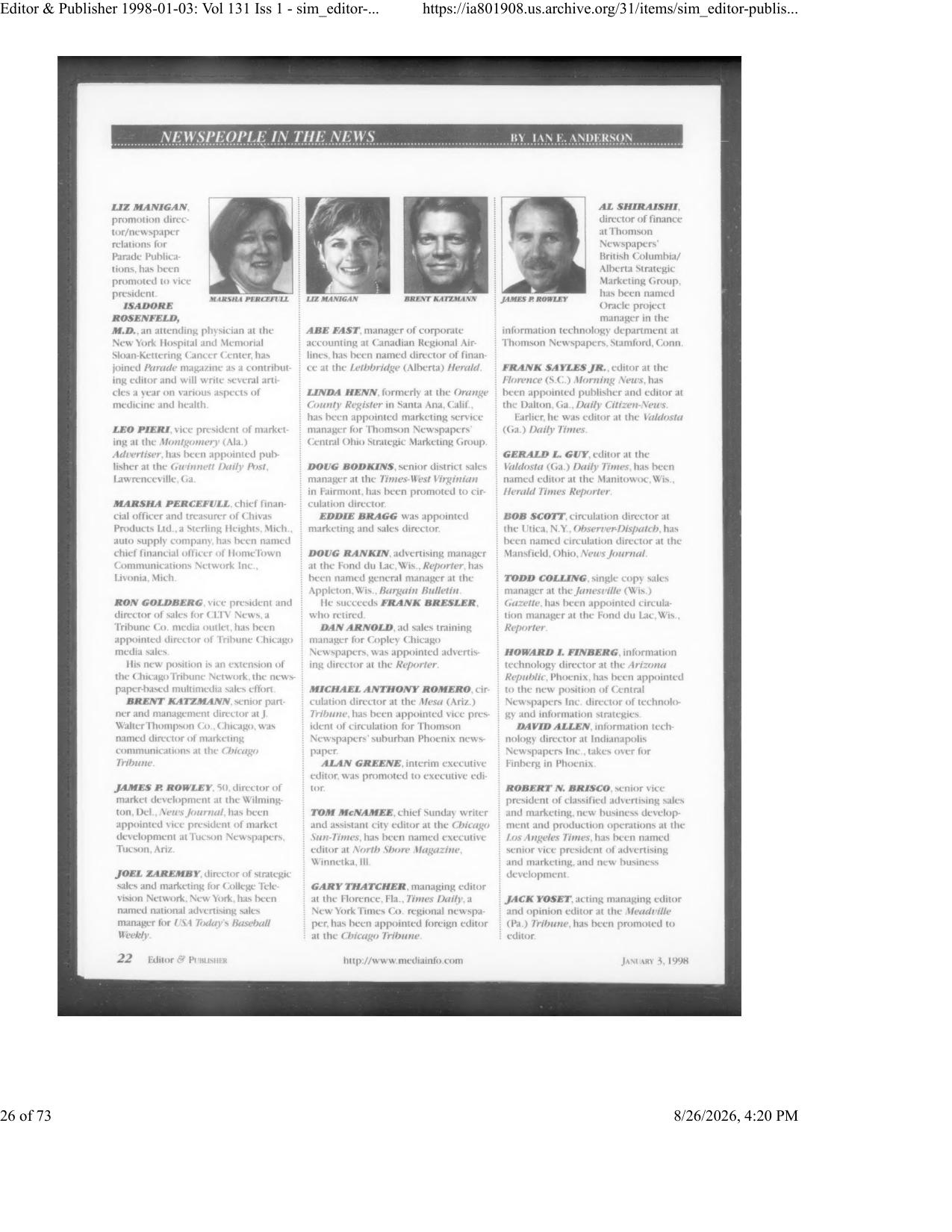
There’s a personal footnote at the end of the column, in Outing’s “Movin’ On” item: as of January 1 I had become Central Newspapers‘ director of technology and information strategies, a corporate job I held while staying in Phoenix rather than moving to Indianapolis. David Allen, then information technology director at Indianapolis Newspapers, Inc., took over as director of information technology at The Arizona Republic beginning February 2.

Editor & Publisher people column from June 1997 listing Arizona Republic appointments, including Howard Finberg directing the information services department

Second Job: Information Services at The Republic

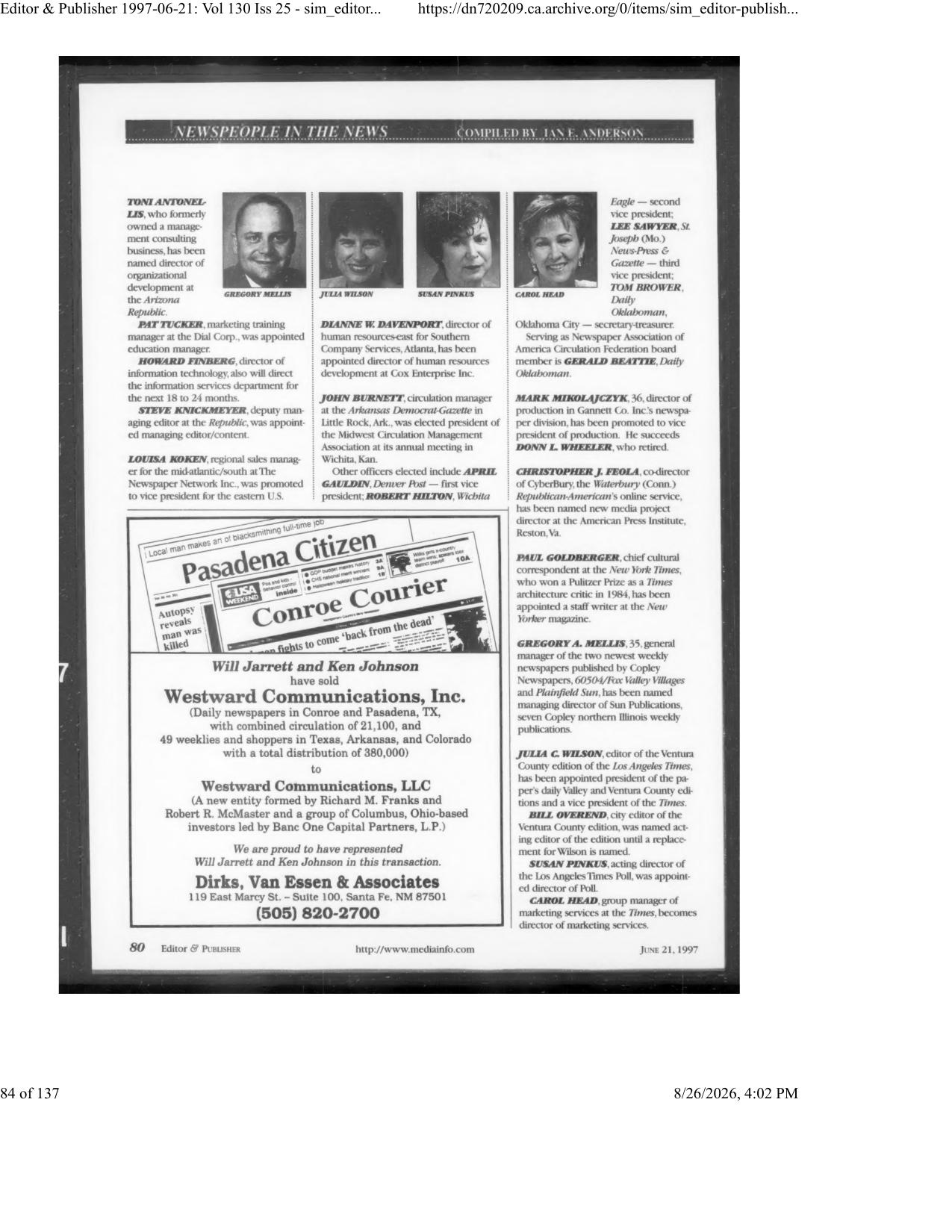
Editor & Publisher’s people column for June 21, 1997, included a short run of appointments at The Arizona Republic — and one of them was mine.

HOWARD FINBERG, director of information technology, also will direct the information services department for the next 18 to 24 months.

Two jobs, with a stated expiration date. The same column noted other changes at the Republic, including Toni Antonellis as director of organizational development, Pat Tucker as education manager, and this one:

STEVE KNICKMEYER, deputy managing editor at the Republic, was appointed managing editor/content

A reminder that in 1997 “information technology” and “information services” were still two separate things inside a newspaper — and that somebody had to bridge them.

April 1996 Editor & Publisher article about the uncertain path to a newspaper pagination system, with a callout quote from the panel

Pagination: Forever Five Years Away?

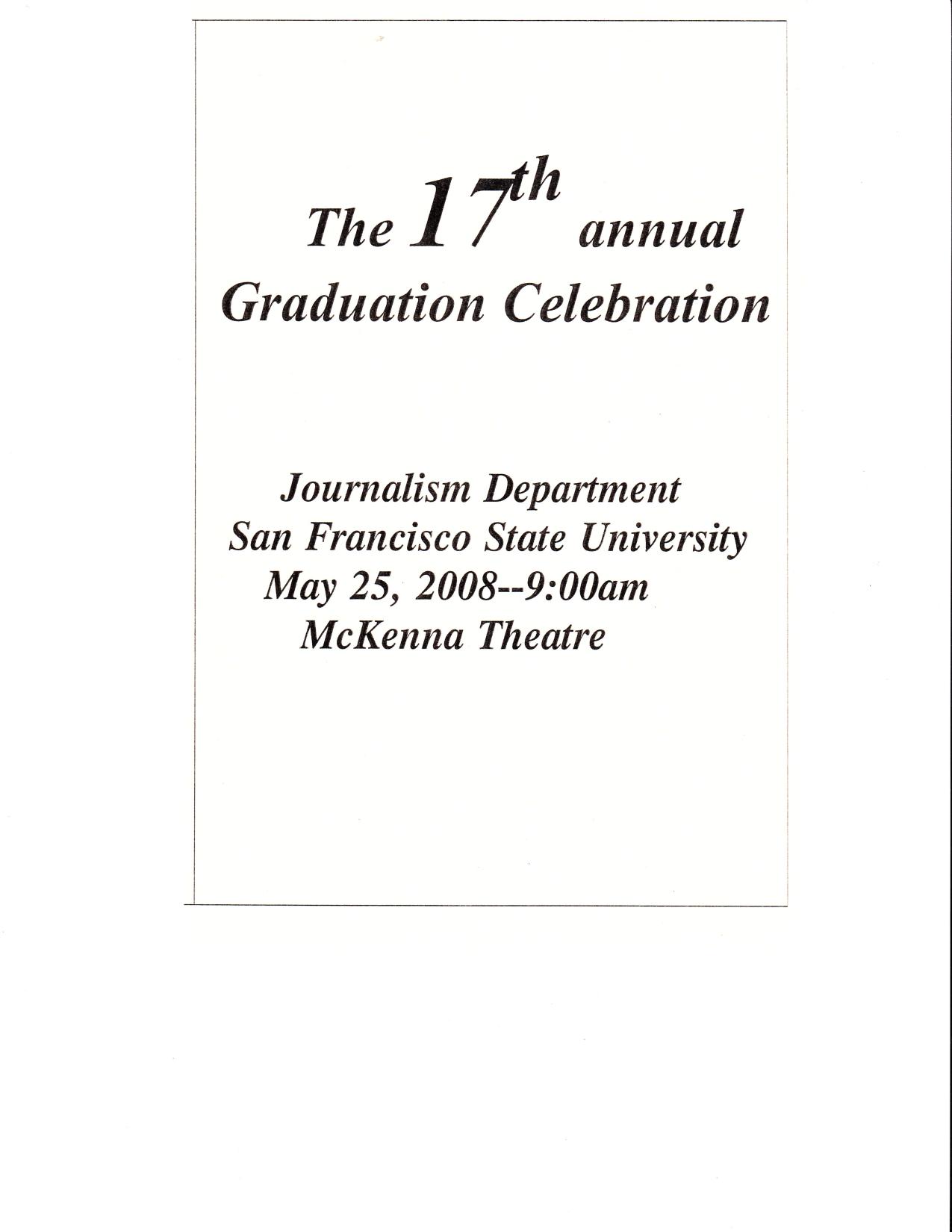
This is a story by Mark Fitzgerald in Editor & Publisher, published April 6, 1996, about a session called “The Uncertain Path to Pagination” at the first Newspaper Association of America Newspaper Operations SuperConference. I was one of four speakers, in Miami Beach to talk about Phoenix Newspapers’ experience choosing and installing its second pagination system.

Fitzgerald’s framing was the running industry joke that real pagination was always just over the horizon:

Someone will say “true” pagination is still five years down the road. Someone else will make a joke about how it’s always “five years down the road.”

My contribution was to point out that some of us had already made the trip:

“We’ve been completely paginated since 1988,” said Finberg, senior editor/information technology for the Phoenix papers. “Every time we went to a conference like this and heard that pagination was five years down the road, we wondered what road that was.”

The larger point I was trying to make — and the one that got pulled out as the article’s callout quote — was that the word itself had become the problem.

“I think even the use of the term pagination should be banned from here on out. Because that’s not what you want to do — paginate. What you want is to work more effectively.”

The story records my argument that going from hot type to cold type had been evolutionary, not revolutionary, because we simply applied an existing work flow to a new technology. Going digital required rethinking data input and output — which is why Phoenix Newspapers moved to the SQL database-oriented system from the Danish firm CCI. The goal, as I put it in the piece, was “multiple products from the same information,” using the same database for niche publications and Internet publishing. And there was a virtue in the long installation: it forced you to look at work-flow issues first.

“We wanted to end the assembly line where nobody is really looking at the whole publication.”

The other speakers filled out the picture. Linda Bruning of EDS warned that “There’s a whole lot more to pagination than technology.” Mark Francis, president and publisher of the 27,000-circulation Niagara Gazette, described giving every department an equal vote in picking a system, and said his paper was already 100% paginated with all pages going direct to negative film — while still printing on a Goss Mark I letterpress bought in 1949. Mike Schoepke of Paddock Publications described the Daily Herald‘s deliberate, one-element-at-a-time rollout of DewarView.

The skeptics came from the biggest papers. Paul Lynch of the Chicago Tribune said there were still functionality issues. Tom Cusack, prepress director at the Star-Ledger, put his finger on something that would sound familiar to anyone who has ever moved large files around a building:

“The single largest barrier to paginating medium to large circulation papers is the network and communications issues internally.”

Fitzgerald ended the piece the way the industry always ended these conversations — noting that things might change. Down the road, of course.

Interactive Newspapers conference program page listing the Pafet consortium panel and its six newspaper company representatives

Pafet Goes Public at Interactive Newspapers Conference

The conference program for the interactive newspapers gathering — built around The Kelsey Group’s and Editor & Publisher’s Sixth Annual Interactive Newspapers Survey — put the Pafet consortium on the Tuesday morning agenda, with a representative from each of the six member companies on stage.

AN INTERVIEW WITH PAFET
10:30-12:00
A discussion with representatives from the six newspaper companies comprising the Pafet consortium. These newspaper professionals will talk candidly about their plans to evaluate opportunities emerging from developments in technology and to focus on those related to their core competencies.

I was there for Phoenix Newspapers, one of six panelists listed:

Martha Duckert, Planning & Process Leader, Cowles Media Company
Howard Finberg, Senior Editor, Information Technology, Phoenix Newspapers, Inc.
Jim Galli, Manager of Business Development, A.H. Belo Corporation
Chris Hendricks, Manager of Technology, McClatchy Newspapers, Inc.
David Lipman, Chairman/Pulitzer 2000, Pulitzer Publishing Company
Mike Weaver, Vice President New Media, Freedom Communications, Inc.

The rest of the program is a nice snapshot of what the industry was worried about at the time: international interactivity, digital advertising, database marketing, and a keynote from Louis Boccardi, President & CEO of the Associated Press, on what he called the editorial perspective. My favorite session title on the page: “MAIN STREET U.S.A MEETS THE INFOBAHN.”

February 1993 memo to Pam Johnson proposing a new approach to The Arizona Republic's Saturday edition

Rethinking the Saturday Republic

A February 1993 memo to Pam Johnson about the Saturday edition of The Arizona Republic. It grew out of a conversation with John Oppedahl and the paper’s latest readership research, which suggested Saturday didn’t behave like the rest of the week.

For too long, many newspapers, including this one, have looked at Saturday as an extension of the weekday (Monday through Friday). While our readers (myself included) see Saturday more as an prelude to Sunday.

The research point that mattered most: one in four readers said they spent more time with the Saturday paper than with a typical weekday edition — and those readers tended to have children under 18 at home and two or more people employed in the household.

Understanding and responding to that difference is the opportunity and challenge facing the paper.

I proposed a small working group — the right mix of “thinkers” and “doers” — naming Phil Hennessy, Susan Love, Bill Hill, Amy Carlile, Vinton Supplee, Judy Nichols and Diana Shantic. Among the content ideas: a Saturday centerpiece much like Sunday’s, a week in review feature, color comics, a feature for parents and kids to read together, home and garden and auto packages, personal finance, and health or fitness.

Attached was a timetable running from committee selection in February through research, prototypes, focus groups and marketing, with a launch of a new kind of Saturday newspaper by October or November.