Pagination Into Database Publishing

As Phoenix Newspapers installed its new pagination system from its European vendor, CCI, I became increasingly interested in the human factors of installing new technology.  And while I didn’t get it all right, even at our company, we did see some of the changes that would be facing the production of newspapers in an ever-increasing digital world.

Pagination is an ‘old” technology. More importantly, pagination will not heip a newspaper in the “new media’ landscape of today. What’s really important are the opportunities of a publication database system.

We can develop all the online, fax, and other new media products in the world, but unless we are lucky enough to be hiring dozens of new employees over the next ten years, we need to figure out better ways of using our existing resources of staff and equipment.

I gave a speech about the topic at the 1996 Seybold Conference.  From that speech I wrote an article for The American Editor, the publication of the American Society of Newspaper Editors, which was published in October, 1996

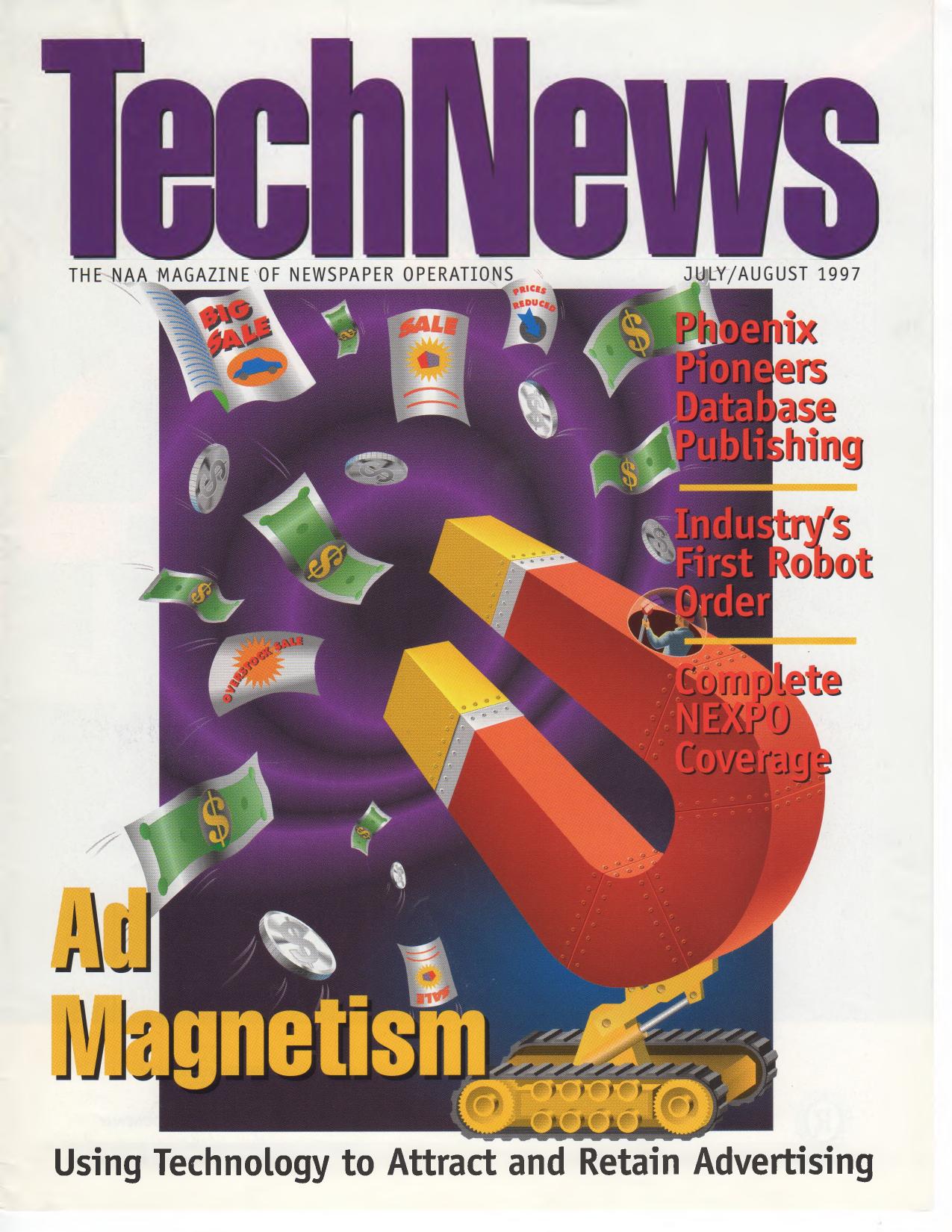
July/August 1997 TechNews magazine article about The Arizona Republic becoming the first North American newspaper produced entirely with a CCI database publishing system

First U.S. Database Publishing System

From the July/August 1997 issue of TechNews, the magazine of newspaper operations published by the Newspaper Association of America published a story about the conversion of The Arizona Republic to a CCI Europe database publishing system. This was work I led as the paper’s director of information technology. The new system replaced the Information International Inc. (Triple-I) pagination system that had made the Republic one of the first metro newspapers in the country to be completely paginated.

The Arizona Republic recently became the first newspaper in North America to be created entirely through “database-system publishing.” The Republic can now gather information once and distribute it in a variety of formats: from ink-on-paper to online, from fax to CD-ROM.

The first phase was completed June 2, 1997. The story notes that Phoenix Newspapers Inc. was doing this while also constructing a new 10-story building, launching Arizona Central, merging The Phoenix Gazette and Republic newsrooms and closing The Gazette, and moving more than 1,000 employees and their computers across the street.

Finberg described the timing of the switch to CCI’s database system as a lot like “changing the engine in an airplane at 35,000 feet. On paper it looks possible, but in your heart you know it will be pretty tricky. It is not something for the fainthearted.”

Dave Seibert, technology-development manager for news and information at PNI, is quoted on the hardest technical problem — getting CCI to talk to the existing SII text-editing system, which took about six months. David Neibergall, team leader for design, points to WYSIWYG editing, and to designers finally leaving the darkened room the staff called “The Cave,” a space required by the low-contrast green screens of the Triple-I system.

At the time of the article, the Republic was paginating more than 1,100 pages a week on CCI, with a common copy-editing and design database due that fall and reporters moving to Windows PCs in 1998. The piece closes on MediaServer and the ambition behind the whole project:

“With a database publishing system, we’ll have the tools to produce not only the newspaper, but also online editions, magazines, and more. The key is effective access to our content—text, photos, audio—regardless of the delivery method.”

Reading this in 2026, the vocabulary has changed but the argument has not. Create the content once, store it in a structured way, and deliver it wherever the audience happens to be. Every content management system and API-driven newsroom workflow in use today rests on that same idea — one we were arguing for, and building, a page at a time in Phoenix.

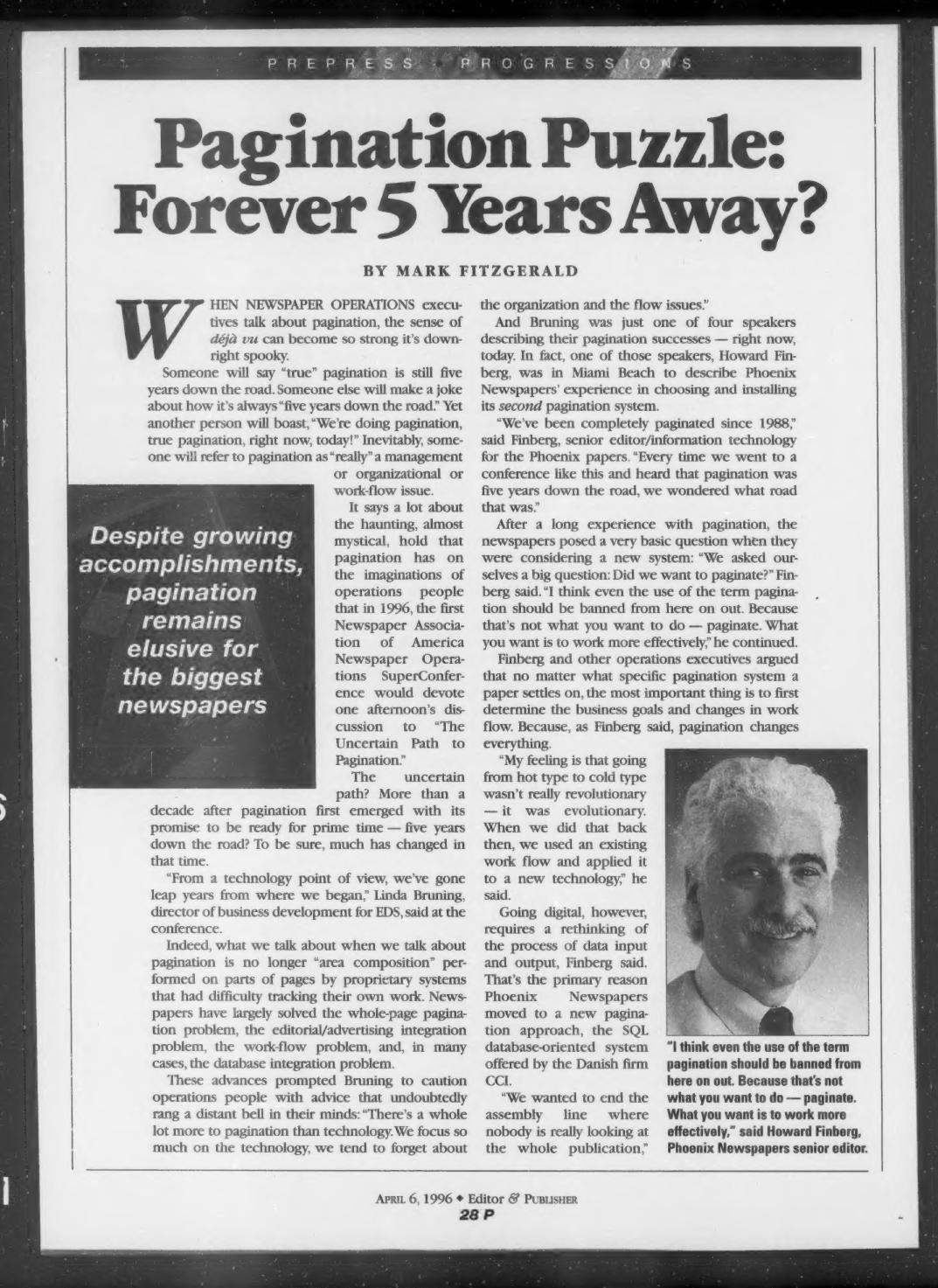
April 1996 Editor & Publisher article about the uncertain path to a newspaper pagination system, with a callout quote from the panel

Pagination: Forever Five Years Away?

This is a story by Mark Fitzgerald in Editor & Publisher, published April 6, 1996, about a session called “The Uncertain Path to Pagination” at the first Newspaper Association of America Newspaper Operations SuperConference. I was one of four speakers, in Miami Beach to talk about Phoenix Newspapers’ experience choosing and installing its second pagination system.

Fitzgerald’s framing was the running industry joke that real pagination was always just over the horizon:

Someone will say “true” pagination is still five years down the road. Someone else will make a joke about how it’s always “five years down the road.”

My contribution was to point out that some of us had already made the trip:

“We’ve been completely paginated since 1988,” said Finberg, senior editor/information technology for the Phoenix papers. “Every time we went to a conference like this and heard that pagination was five years down the road, we wondered what road that was.”

The larger point I was trying to make — and the one that got pulled out as the article’s callout quote — was that the word itself had become the problem.

“I think even the use of the term pagination should be banned from here on out. Because that’s not what you want to do — paginate. What you want is to work more effectively.”

The story records my argument that going from hot type to cold type had been evolutionary, not revolutionary, because we simply applied an existing work flow to a new technology. Going digital required rethinking data input and output — which is why Phoenix Newspapers moved to the SQL database-oriented system from the Danish firm CCI. The goal, as I put it in the piece, was “multiple products from the same information,” using the same database for niche publications and Internet publishing. And there was a virtue in the long installation: it forced you to look at work-flow issues first.

“We wanted to end the assembly line where nobody is really looking at the whole publication.”

The other speakers filled out the picture. Linda Bruning of EDS warned that “There’s a whole lot more to pagination than technology.” Mark Francis, president and publisher of the 27,000-circulation Niagara Gazette, described giving every department an equal vote in picking a system, and said his paper was already 100% paginated with all pages going direct to negative film — while still printing on a Goss Mark I letterpress bought in 1949. Mike Schoepke of Paddock Publications described the Daily Herald‘s deliberate, one-element-at-a-time rollout of DewarView.

The skeptics came from the biggest papers. Paul Lynch of the Chicago Tribune said there were still functionality issues. Tom Cusack, prepress director at the Star-Ledger, put his finger on something that would sound familiar to anyone who has ever moved large files around a building:

“The single largest barrier to paginating medium to large circulation papers is the network and communications issues internally.”

Fitzgerald ended the piece the way the industry always ended these conversations — noting that things might change. Down the road, of course.

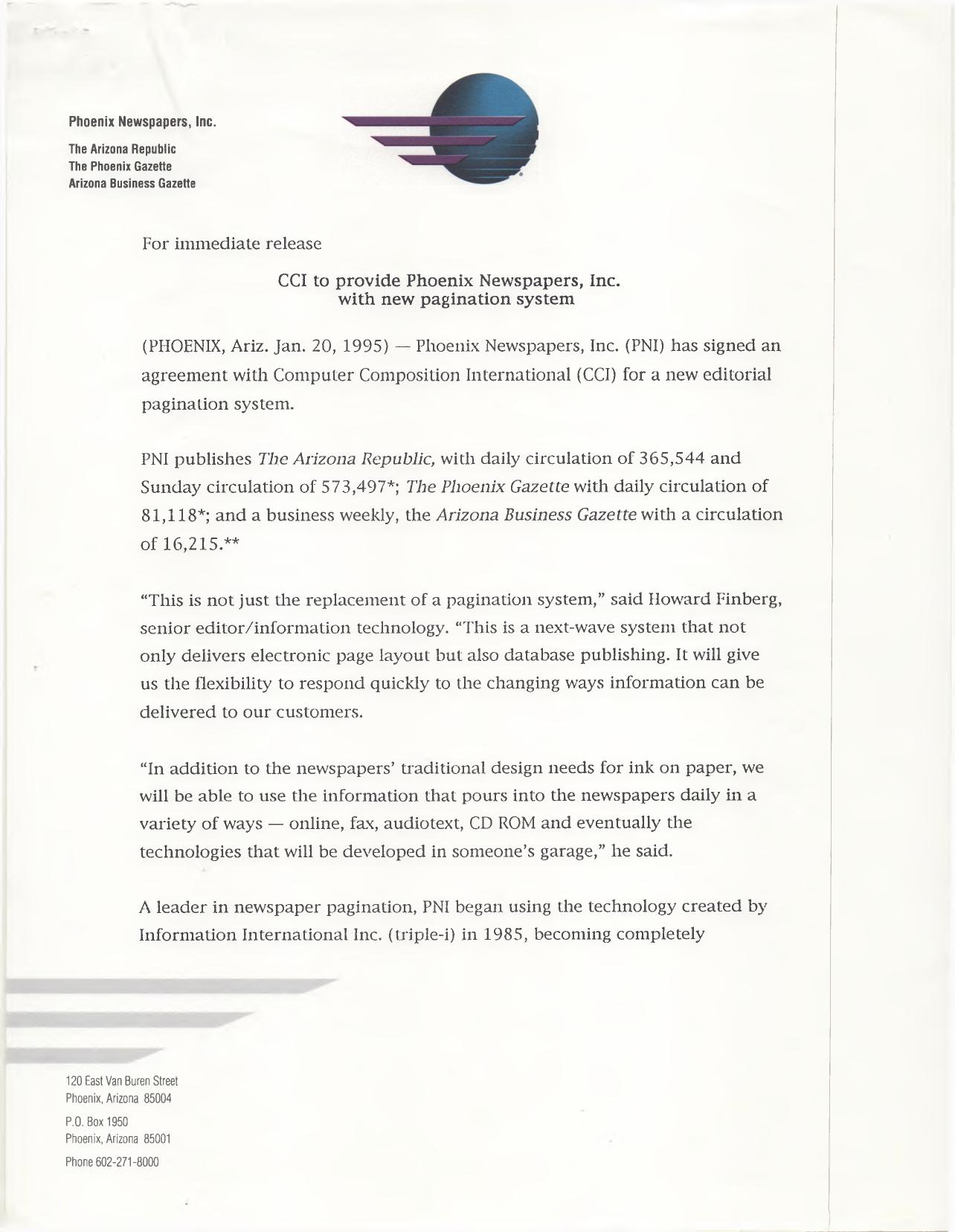
Phoenix Newspapers press release dated January 20, 1995, announcing the CCI pagination system contract

Announcing the CCI Pagination at Phoenix Newspapers

This is the press release Phoenix Newspapers, Inc. issued on January 20, 1995, announcing that PNI had signed with Computer Composition International for a new editorial pagination system. I was senior editor/information technology at the time, and this was the project I led in Phoenix. I also helped other newspapers think through database publishing.

The point I wanted to make in the announcement wasn’t about replacing aging equipment. It was about what a publishing database could do beyond the printed page.

“This is not just the replacement of a pagination system,” said Howard Finberg, senior editor/information technology. “This is a next-wave system that not only delivers electronic page layout but also database publishing. It will give us the flexibility to respond quickly to the changing ways information can be delivered to our customers.”

And on where that information might go:

“In addition to the newspapers’ traditional design needs for ink on paper, we will be able to use the information that pours into the newspapers daily in a variety of ways online, fax, audiotext, CD ROM and eventually the technologies that will be developed in someone’s garage,” he said.

The garage line was a bit of a joke at the time, since Apple Computers started in a garage. Looking back from 2026, it holds up better than the list that preceded it u2014 fax and audiotext are gone, CD ROM is a museum piece, and the things built in garages turned out to be the whole story.

PNI was not new to pagination. The release notes the newspapers began using Information International Inc. (triple-i) technology in 1985 and were completely paginated in 1987, with The Republic, The Gazette and the Arizona Business Gazette paginating roughly 2,000 pages a week. That history mattered: the CCI installation had to coexist with the triple-i pagesetters at the Deer Valley and Mesa production centers and with the triple-i scanners.

What strikes me rereading it is how much of the release is given over to the people who would actually use the system. Johnny Thoegersen of CCI made the WYSIWYG argument u2014 that the same designer could do more pages in the same amount of time, thanks to templates and automatic features u2014 and described the database as a central information repository accessible across departments. But the better quotes came from inside the building.

Dave Seibert, a pagination project team leader at PNI, said the CCI system “will let us pull up data and link photos easily. And the designers won’t have to work in a cavelike, low-light atmosphere anymore. They’ll be able to see a headline in color in their screens, something they can’t do now.”

Jenny Ignaszewski, a Gazette page designer, is looking forward to the new system because “it will make it easier to do wraps, illustrations and typography. We’ll have the capability of doing feature page design more easily under deadline.”

Mike Wilson, project team leader from Information Services, called CCI “the best system on the market today” and flagged the real engineering challenge u2014 the interfaces back to the existing triple-i equipment. The CCI server was to live in the computer room on the third floor of the Phoenix Center. Where the page design system itself would go was, as of the announcement, still undecided.

Installation was scheduled to begin that summer, with the first phase completed in late 1995.

One last artifact worth noting: the contact block at the bottom lists a fax number and an e-mail address, hfinberg@pni.com. In early 1995, listing both was still a hedge.