Pagination: Forever Five Years Away?
This is a story by Mark Fitzgerald in Editor & Publisher, published April 6, 1996, about a session called “The Uncertain Path to Pagination” at the first Newspaper Association of America Newspaper Operations SuperConference. I was one of four speakers, in Miami Beach to talk about Phoenix Newspapers’ experience choosing and installing its second pagination system.
Fitzgerald’s framing was the running industry joke that real pagination was always just over the horizon:
Someone will say “true” pagination is still five years down the road. Someone else will make a joke about how it’s always “five years down the road.”
My contribution was to point out that some of us had already made the trip:
“We’ve been completely paginated since 1988,” said Finberg, senior editor/information technology for the Phoenix papers. “Every time we went to a conference like this and heard that pagination was five years down the road, we wondered what road that was.”
The larger point I was trying to make — and the one that got pulled out as the article’s callout quote — was that the word itself had become the problem.
“I think even the use of the term pagination should be banned from here on out. Because that’s not what you want to do — paginate. What you want is to work more effectively.”
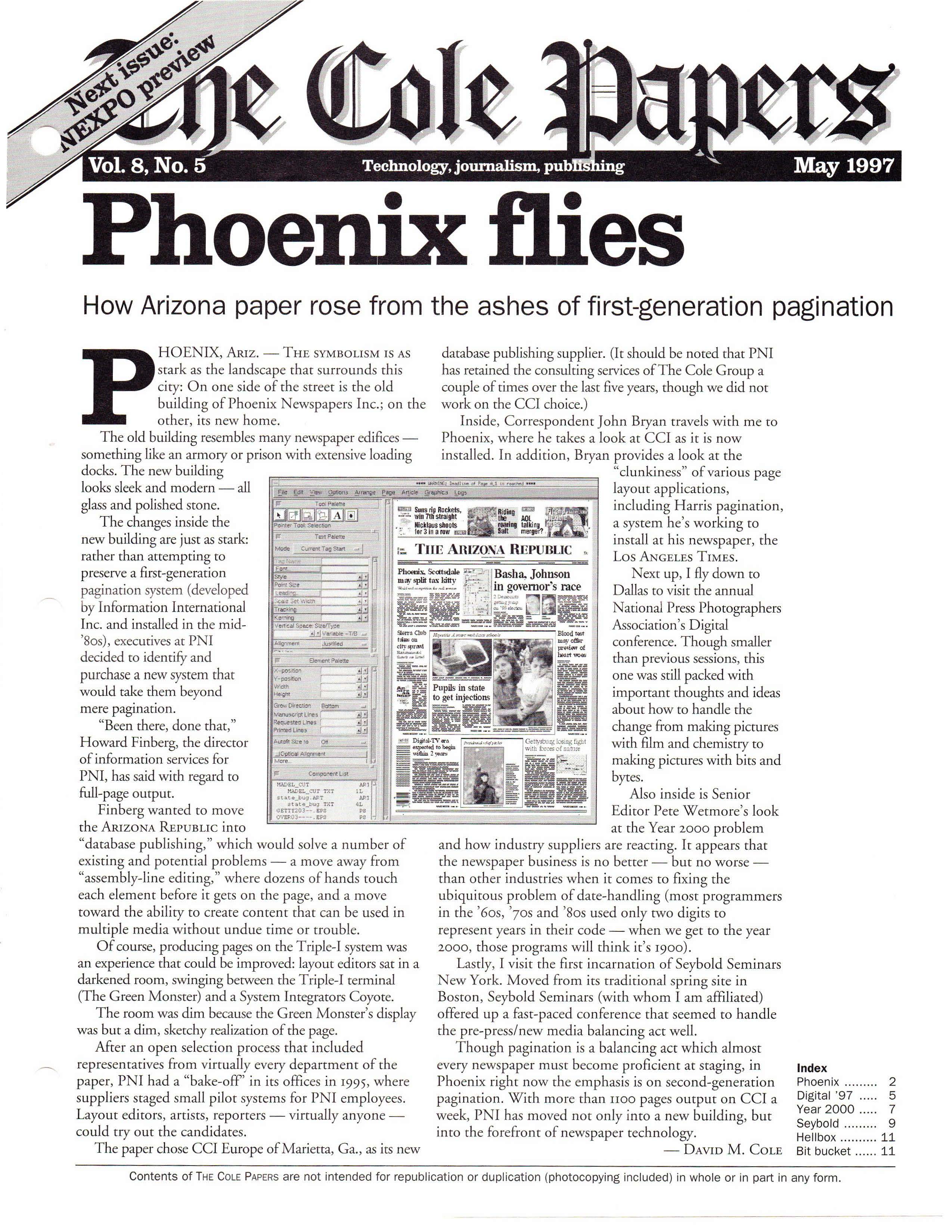
The story records my argument that going from hot type to cold type had been evolutionary, not revolutionary, because we simply applied an existing work flow to a new technology. Going digital required rethinking data input and output — which is why Phoenix Newspapers moved to the SQL database-oriented system from the Danish firm CCI. The goal, as I put it in the piece, was “multiple products from the same information,” using the same database for niche publications and Internet publishing. And there was a virtue in the long installation: it forced you to look at work-flow issues first.
“We wanted to end the assembly line where nobody is really looking at the whole publication.”
The other speakers filled out the picture. Linda Bruning of EDS warned that “There’s a whole lot more to pagination than technology.” Mark Francis, president and publisher of the 27,000-circulation Niagara Gazette, described giving every department an equal vote in picking a system, and said his paper was already 100% paginated with all pages going direct to negative film — while still printing on a Goss Mark I letterpress bought in 1949. Mike Schoepke of Paddock Publications described the Daily Herald‘s deliberate, one-element-at-a-time rollout of DewarView.
The skeptics came from the biggest papers. Paul Lynch of the Chicago Tribune said there were still functionality issues. Tom Cusack, prepress director at the Star-Ledger, put his finger on something that would sound familiar to anyone who has ever moved large files around a building:
“The single largest barrier to paginating medium to large circulation papers is the network and communications issues internally.”
Fitzgerald ended the piece the way the industry always ended these conversations — noting that things might change. Down the road, of course.