Editor's Note page from Journalism & Mass Communication Educator citing Poynter research on core journalism skills

Reasons for Optimism in Journalism, Education

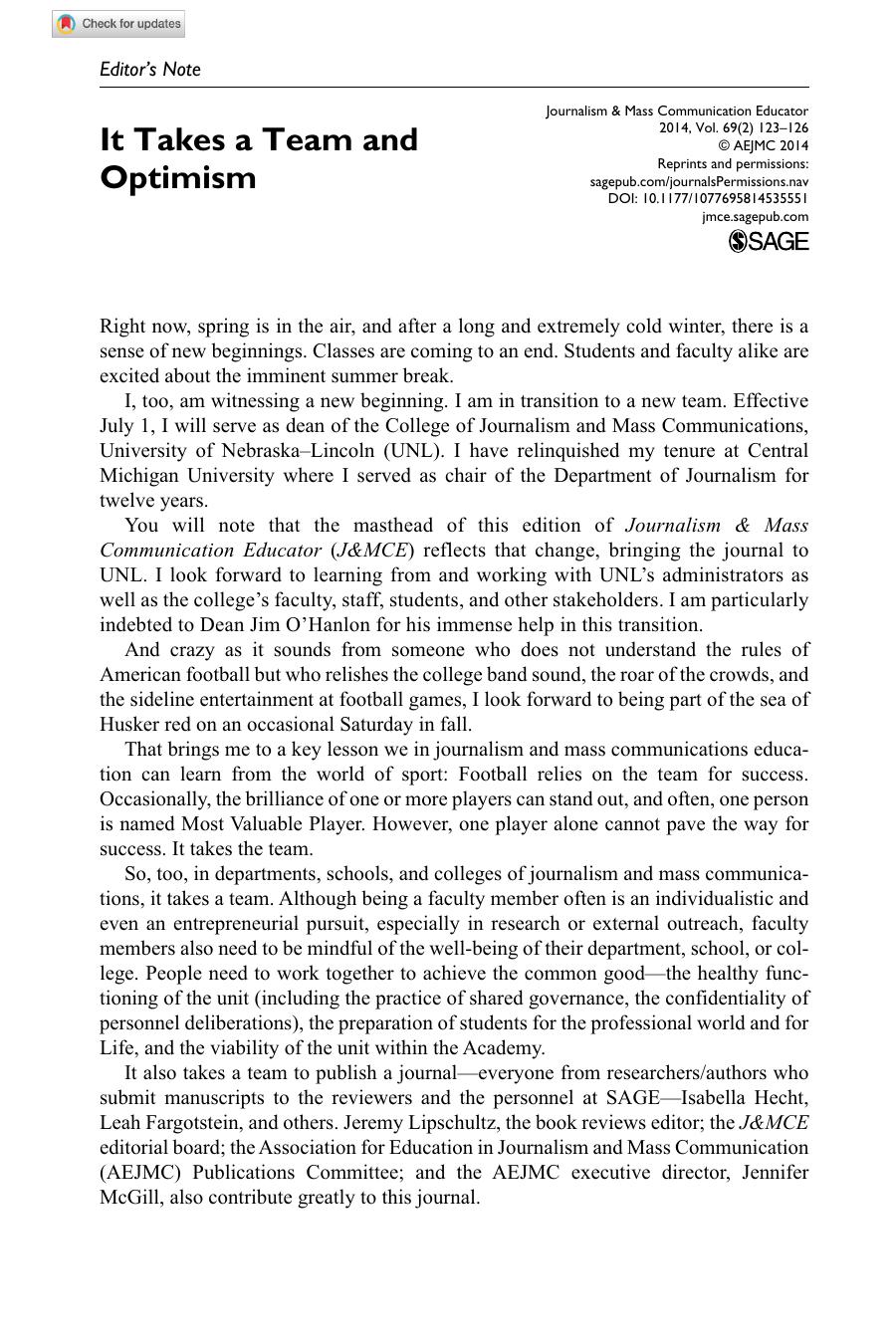
This is an Editor’s Note from Journalism & Mass Communication Educator, written by Maria B. Marron, who was announcing her move to become dean of the College of Journalism and Mass Communications at the University of Nebraska–Lincoln. Most of the piece is about teams — how departments, schools and journals all depend on people working together rather than on a single star player. Then it turns to optimism, and that is where my work shows up.

Marron cited two sources for her optimism about the future of journalism and journalism education. The first was Marty Baron, then editor of The Washington Post, from his keynote at the fifteenth International Symposium on Online Journalism at the University of Texas–Austin:

There is no acceptable alternative to optimism.

The second was my writing about The Core Skills for the Future of Journalism report, which Poynter released on April 9, 2014. The report was research I did with my co-author, Lauren Klinger. Marron quoted my summary of what we found:

shows a wide divergence between professionals and educators in their thinking on the importance of core journalism skills, especially those skills that are essential for mastering new methods of gathering and delivering news and information.

The survey behind the report identified thirty-seven skills, attributes and knowledge areas judged important “for a beginning journalist as he/she looks toward his/her career in the digital/mobile age.” The widest gaps were in multimedia. Marron laid out the numbers: 76 percent of educators versus 46 percent of professionals rated “shoot and edit video” as important; 80 percent versus 52 percent on the “ability to tell stories with design and visuals”; 79 percent versus 53 percent on shooting and editing photographs; and 72 percent versus 38 percent on recording and editing audio. Coding was the outlier in a different direction — students rated the ability to work with HTML or another computer language highly, while only 41 percent of educators and 28 percent of professionals and managers did.

What interests me is how she read those gaps. Lauren and I had framed the divergence as a problem for the industry. Marron read the same data as evidence that educators were ahead of the professionals:

educators are serving as leaders for the industry, not as followers.

That is a more generous interpretation than the one we offered, and it is a fair one. The Core Skills research grew out of years of thinking about training at Poynter’s News University, where the question was always the same: what does a journalist actually need to know, and who is responsible for teaching it? The 2014 answer was that educators, students and freelancers largely agreed with each other, and newsroom professionals were somewhere else entirely.

Reading this in 2026, the specific skills have shifted — the argument now is about AI tools rather than shooting video — but the underlying gap between what the academy teaches and what newsrooms say they value has not gone away. Neither, I hope, has the optimism.
Future of Journnalism Education Speech

I gave keynote speech at European Journalism Centre 20th Anniversary celebration in Maastricht, Netherlands, thanks to the director of the EJC’s director, Wilfried Rutten. The speech [PDF link] gave me an opportunity to build upon remarks I made the previous year at the “Picnic” conference.  I was part of a panel that addressed the future of journalism. I also wrote an article for Poynter Online about the topic.  I must admit that I love this line: “Journalism education can’t teach its way to the future.”

Here’s the start of the Poynter Online article that captures the spirit of the speech:

As we think about the changes whipping through the media industry, there is a nearby storm about to strike journalism education.

The future of journalism education will be a very different and difficult future, a future that is full of innovation and creative disruption. And, I believe, we will see an evolution and uncoupling between the value of a journalism education and a journalism degree.

When we think about the future, there’s not a single future. The future for a 20-year-old is clearly very different than the future of a 60-year-old. Each will bring a very different perspective.

The future of journalism education is linked to the future of journalism itself. Each is caught within the other’s vortex, both spinning within today’s turmoil of change.

There is a video of the speech on YouTube.

The reaction to both the speech and the article were very good, although it was part of a swirl of postings and speeches about the topic.  With the encouragement of my colleague, Vicki Krueger, I decided that this topic needed continued study and that will lead to other reports and writing.

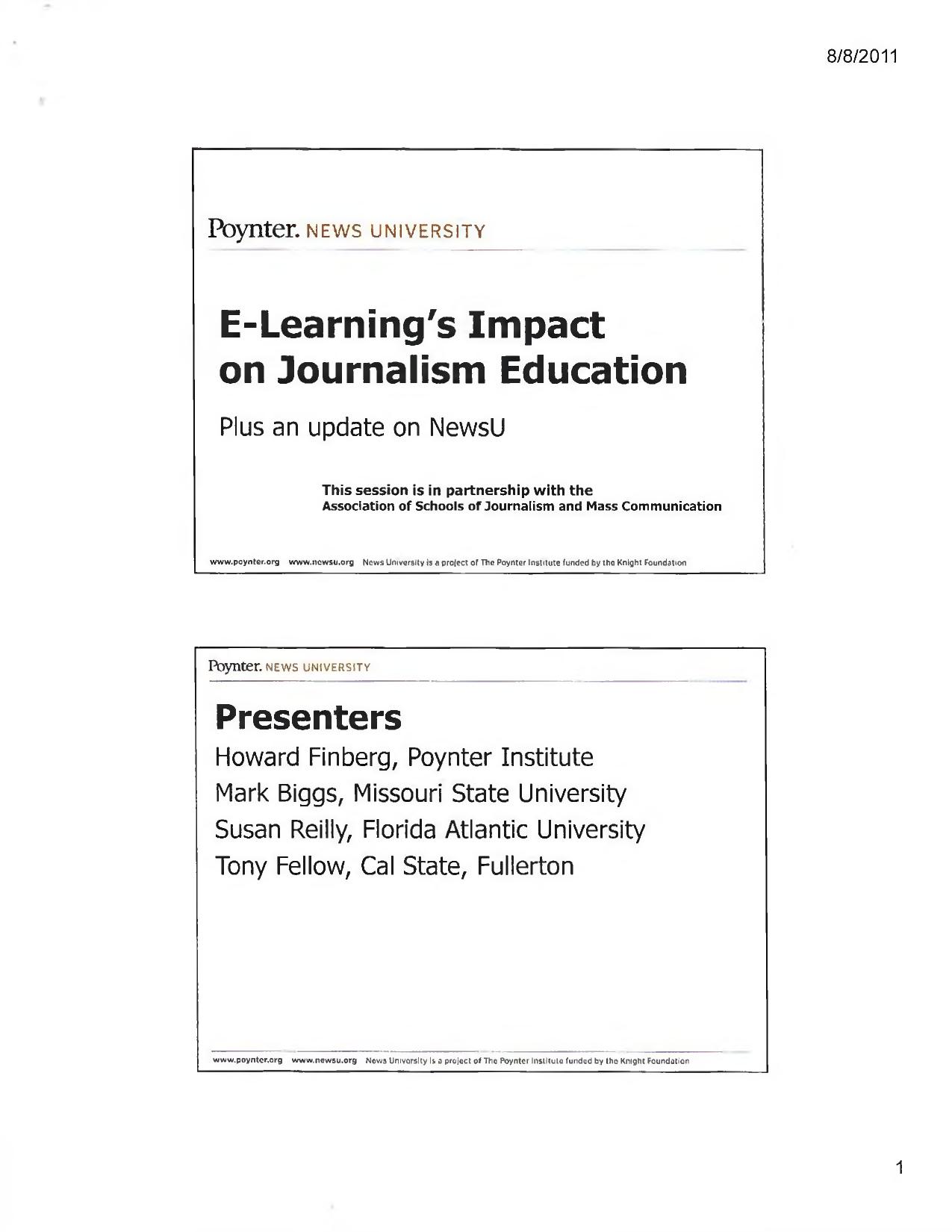
Title slide from a 2011 Poynter NewsU presentation on e-learning and journalism education, noting the partnership with the Association of Schools of Journalism and Mass Communication

E-Learning’s Impact on Journalism Education

These are the slides I used for a presentation about e-learning, given on August 8, 2011. The session was run under the NewsU banner and, as the title slide notes, was done in partnership with the journalism education association:

This session is in partnership with the Association of Schools of Journalism and Mass Communication

I wasn’t alone on the platform. The presenters slide lists:

Howard Finberg, Poynter Institute
Mark Biggs, Missouri State University
Susan Reilly, Florida Atlantic University
Tony Fellow, Cal State, Fullerton

The first half of the deck is about the J101 Project — an attempt to take NewsU‘s self-directed modules and online group seminars and build them into a semester-long introduction to journalism course taught in partnership with universities. The background slide describes the idea as leveraging self-directed modules plus online group seminars, working with schools on journalism education quality, intersecting with Carnegie Corporation interests, and running as a pilot program grant.

What made J101 different was the weekly rhythm. The “How it works” slide lays it out:

Read two essays • Self-directed course(s) and other Virtual Textbook materials • Tuesday Live Lecture or the replay • Study Group Work assignment • Study Group discussion • Thursday Live Chat • Weekly quiz

Several slides show the course itself — a 16-week virtual textbook running from “Who Is News?” and “Intro to Reporting” through interviewing, alternative story forms, dealing with diversity, style, rewriting, libel and privacy, news-gathering legality, and the business of journalism. There are pre- and post-assessments, weekly assessments drawn from a randomized pool of questions taken from the NewsU modules, the live lecture and the weekly readings, and a 50-question final exam scheduled for December.

The instructor dashboard got its own pair of slides, and for good reason. We were tracking logins and time spent in both the main course and each related self-directed module, weekly assessment scores, class participation and discussion posts, attendance at the weekly Live Lecture and Live Chat, and the final exam score. As the slide says plainly:

We are tracking lots of data

Our goals slide was less about the mechanics and more about the ambition — a unique educational experience leveraging the expertise of Poynter, closer relationships with universities, and a marriage of online group seminars, webinars and self-directed training. The second goals slide is the one I’d still stand behind:

Create lifelong learners • Increase the understanding of the role of journalism – No matter what students choose as their profession • Work more closely with universities

Partners for the pilot were Florida Atlantic University, Missouri State University and California State University, Fullerton, and we used the session to recruit partners for Spring and Fall 2012.

The second half of the deck is the NewsU stakeholders report. At our core was self-directed training, with more than 70 modules. New courses launched or launching that August included Sports Reporting: Beat Basics, Producing for TV & Web, Sourcing & Verification, Journalism Fundamentals, Introduction to Reporting and Covering Islam. We had just done our 100th webinar, ran a 10-session Writing Webinar Series in 2011, offered certificate programs in journalism basics, reporting and writing basics and multimedia basics, and were piloting a “Course Pack” with USF reporting classes — five modules with assessments worth 15% of a student’s grade. The Syllabus Exchange had drawn 200+ uploads and 900+ downloads.

And then the number, as of 6 a.m. the morning of the talk:

186,667 registered users

We were counting to 200,000, with a “Make Your Story Count” contest asking users to tell us how NewsU had helped them do better journalism. The deck closes with the next frontier: NewsU International, in partnership with ICFJ, launching in Persian and Russian, with 15% of NewsU users already outside North America.

Printed 2008 San Francisco State journalism graduation program and typed pages of the Distinguished Journalism Alumnus speech

Adding a Sixth W: My 2008 SF State Speech

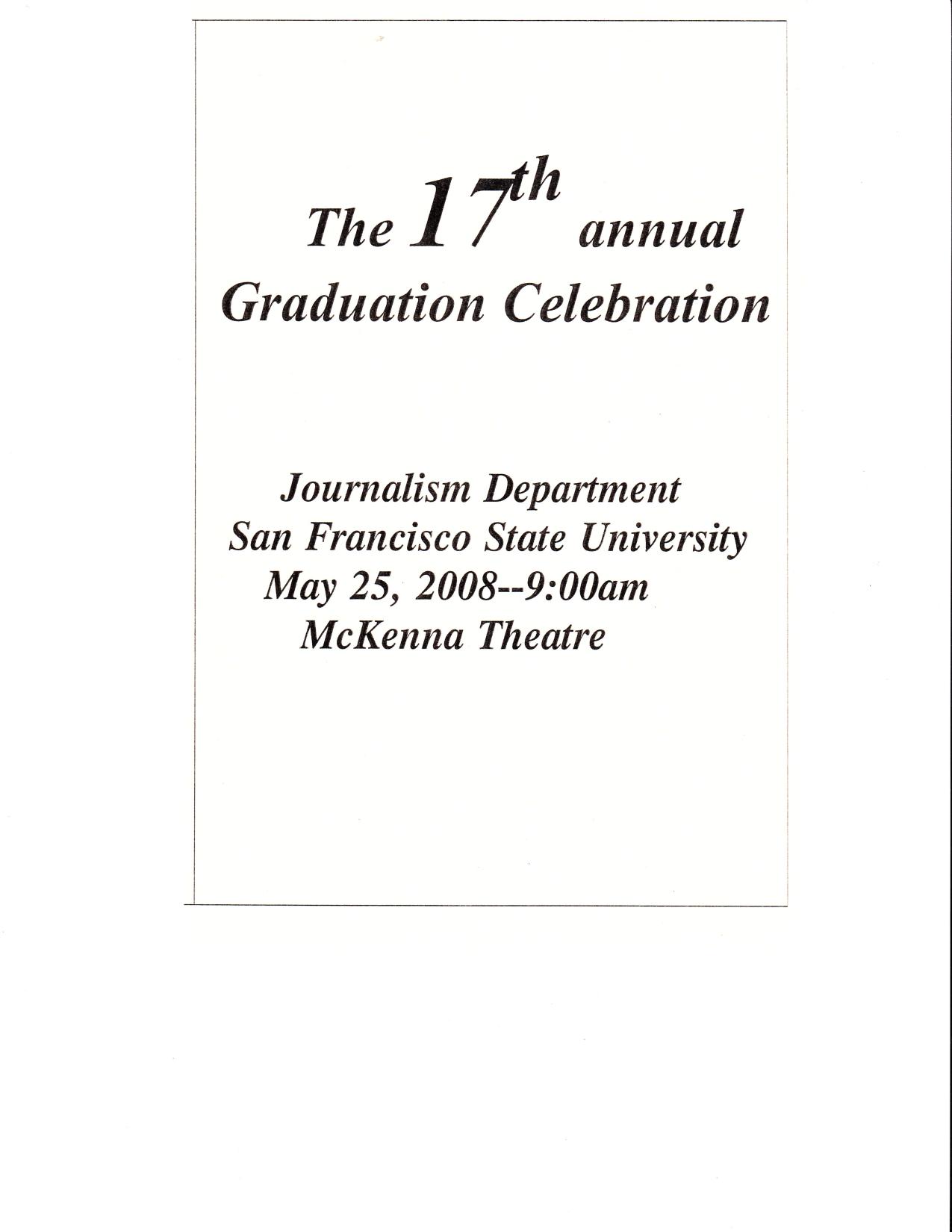
On May 25, 2008, I went back to where I started. The Journalism Department at San Francisco State University held its annual Graduation Celebration at 9 a.m. in McKenna Theatre, and I was on the program as Distinguished Journalism Alumnus, introduced by Jon Funabiki. Venise Wagner, the department chair, opened the morning. Martin Reynolds was named Journalism Alumnus of Year, introduced by Austin Long-Scott. Khari Johnson was the Class Honors Student, introduced by Cristina Azocar, and Christine Joy Ferrer was the Class Speaker, introduced by John Burks. The ceremony closed with a World Press Pass send-off by the journalism faculty.

The two documents here are the printed program
ed u2014 with the full list of graduates u2014 and my speaking text, marked 22, 2008. Speaking to a room full of new journalism graduates in the spring of 2008 meant speaking into a very bad news cycle for the news business, and I decided not to pretend otherwise.

This is a wonderful time to be a journalist. This is also a lousy time to be at a traditional journalism-based media company.

The rest of the talk was an argument for flexibility, built out of my own ru00e9sumu00e9. I told them I left school with one goal u2014 to become a news editor at a newspaper u2014 and never got there.

That was my career dream. It was a good goal, but I never reached it. I went around it. I went through it. I went over it.

Instead I counted seven careers: copy editor at the San Francisco Examiner and the Chicago Tribune; graphics and picture editor at the Chicago Tribune and The New York Times; newsroom leader at the San Francisco Chronicle and the Arizona Republic; head of information technology at The Arizona Republic; online strategist at Central Newspapers; new media consultant; and educator, trainer and director of interactive learning at The Poynter Institute. My journalism education, I told them, had prepared me for maybe two of those jobs. My wife, Kate, has her own diagnosis for this pattern u2014 she calls me a u201cpioneer addict,u201d someone who is happy only when he creates something new, and she is right that pioneers are easy to spot by the lost look and the absence of a map.

The heart of the speech was a small piece of advice dressed up as journalism 101. Everyone in that theatre already knew the 5Ws. I suggested they add one more.

What you need to add is another W, a 6th W: the u201cWhat Ifu201d.

I framed 2008 as an inflection point u2014 the moment when an industry, a company or a person has to choose between protecting the old or jumping into a future where the rules are unclear. The railroads didnu2019t make that leap. Newspapers, I argued, could have decided in the 1980s that their business was helping people make sense of the world around them, u201cand not just crushing trees and smearing ink.u201d I warned the graduates they would witness the failure of some well-known newspaper and television companies during their careers, and also the birth of new forms of journalism, including nonprofit-supported experiments then under way in Minneapolis and Washington, D.C.

I also reminded them that they were the first truly digital generation u2014 born about when Tim Berners-Lee created the World Wide Web, in fifth grade when the first Palm Pilot shipped, in ninth grade when Napster arrived and took the music industryu2019s business model with it, in high school for Skype, in college for YouTube. My generation still marvels at the Internet; theirs would treat it the way we treat electricity, without noticing the lights are on.

It is your responsibility to think about what the future might hold. It is your responsibility to shape the future. Do you think that you arenu2019t ready for that responsibility? Sorry. Too late. You already have the job.

Rereading this in 2026, the predictions hold up better than I would like. Well-known newspaper companies did fail. Nonprofit newsrooms did grow into a real part of the ecosystem. The one line that makes me smile is my hope for an innovator who would combine the Wii with journalism u2014 a very 2008 way of asking a question that AI and immersive storytelling are now answering in ways I couldnu2019t have named then. The advice underneath it, though, is the same advice I spent the next decade acting on at Poynter, building News University to give working journalists a way to keep learning after the diploma. Formal education can only take you to the starting line. Preparation, as I told the class of 2008, comes from within.

AEJMC News article page from November 2007 featuring educator testimonials on what e-learning can do through Poynter's News University

Beyond the Hype: What E-Learning Can Do for You

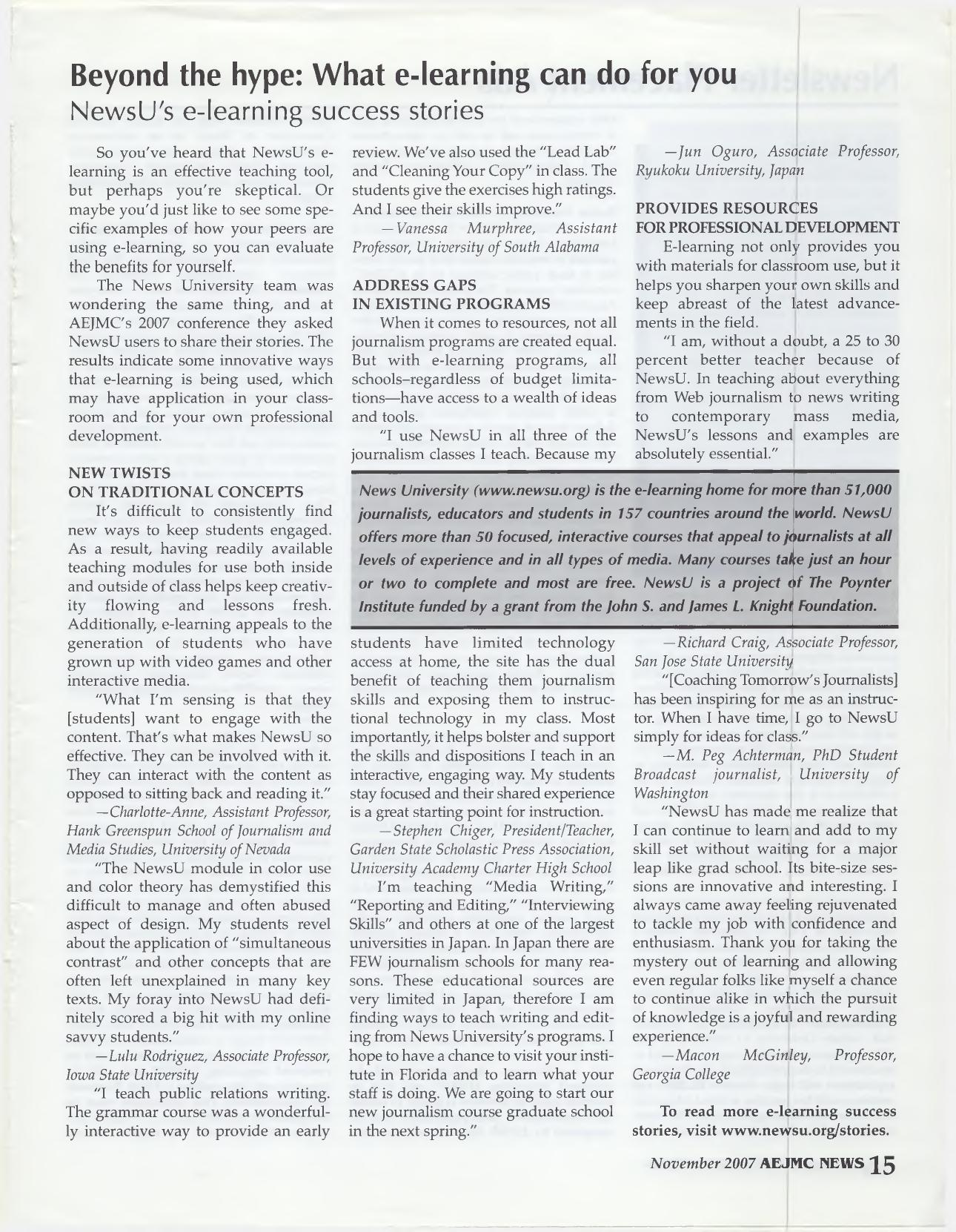
This is a piece that ran in the November 2007 issue of AEJMC News, built around testimonials the News University team collected from NewsU users at AEJMC’s 2007 conference. The idea was simple: rather than tell journalism educators that e-learning worked, let their peers say it.

The examples range from filling classroom gaps to sharpening the instructors’ own skills. A few that stood out:

“What I’m sensing is that they [students] want to engage with the content. That’s what makes NewsU so effective. They can be involved with it. They can interact with the content as opposed to sitting back and reading it.” —Charlotte-Anne, Assistant Professor, Hank Greenspun School of Journalism and Media Studies, University of Nevada

“The NewsU module in color use and color theory has demystified this difficult to manage and often abused aspect of design. My students revel about the application of “simultaneous contrast” and other concepts that are often left unexplained in many key texts.” —Lulu Rodriguez, Associate Professor, Iowa State University

“I am, without a doubt, a 25 to 30 percent better teacher because of NewsU. In teaching about everything from Web journalism to news writing to contemporary mass media, NewsU’s lessons and examples are absolutely essential.” —Richard Craig, Associate Professor, San Jose State University

One comment came from Jun Oguro, an associate professor at Ryukoku University in Japan, who noted that “In Japan there are FEW journalism schools for many reasons,” and that he was using News University’s programs to teach writing and editing.

The sidebar captures where NewsU stood at that point:

News University (www.newsu.org) is the e-learning home for [more] than 51,000 journalists, educators and students in 157 countries around the world. NewsU offers more than 50 focused, interactive courses that appeal to journalists at all levels of experience and in all types of media. Many courses take just an hour or two to complete and most are free. NewsU is a project of The Poynter Institute funded by a grant from the John S. and James L. Knight Foundation.

Fifty courses and 51,000 registered users was a milestone worth bragging about in 2007. By the time I left Poynter, both numbers had grown well beyond that. What strikes me reading this now, nearly two decades later, is how much of the skepticism we were answering — can online learning really teach anything? — has simply evaporated. That argument was settled by circumstance, not persuasion.

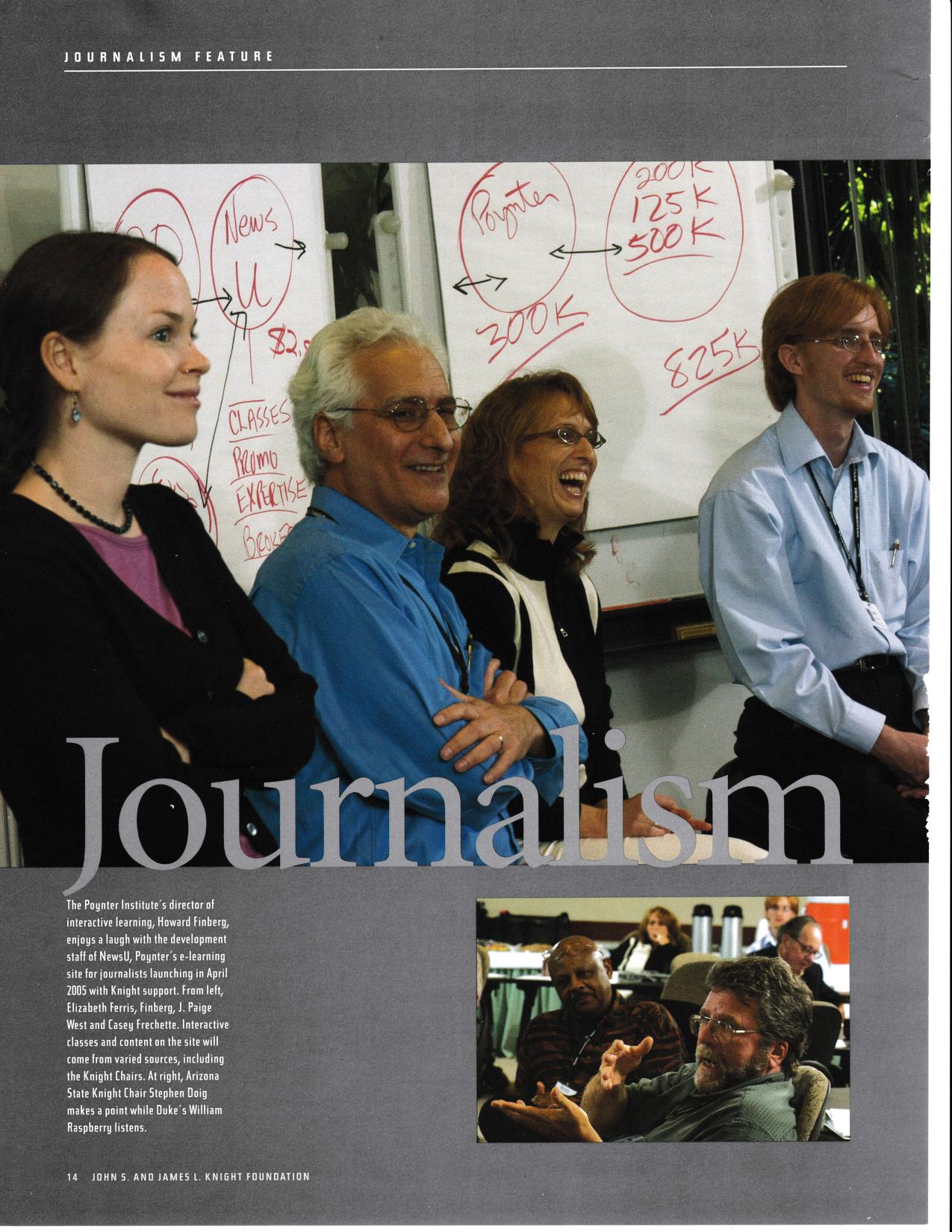
NewsU development staff Elizabeth Ferris, Howard Finberg, J. Paige West and Casey Frechette, pictured in the Knight Foundation report feature on the Knight Chairs in Journalism

‘A World Full of Connections’ — Knight Foundation Report Feature on NewsU

A journalism feature from the John S. and James L. Knight Foundation annual report, looking at how the foundation’s endowed Knight Chairs in Journalism had begun collaborating with each other and with other Knight journalism partners — including The Poynter Institute‘s News University. The piece opens in St. Petersburg and traces the Knight Chair program back to 1990, when then-foundation president Creed Black announced its creation, saying it would strengthen the quality of American journalism education:

“by bolstering core curricular values and encouraging innovation.”

The story lists examples of that collaboration — Rosental Alves in Latin America, Jim Detjen at Michigan State, Charlotte Grimes at Syracuse, Melinda McAdams at Florida, Jacqui Banaszynski at Missouri, and Haynes Johnson’s work on the Knight-funded study Newsroom Training: Where’s the Investment? — before turning to what the report calls the largest gathering ever of Knight Chairs, who traveled to Poynter in 2004 to learn about News University.

a five-year, $2.8 million project to develop an e-learning program for journalists. The program is a partnership between Knight and Poynter, rated the nation’s top journalism training organization by the Where’s the Investment? study.

At the Poynter meeting the chairs brainstormed course ideas — how to analyze government data, how to understand scientific claims — and the article notes that work began immediately with William Gaines, the Knight Chair in Investigative and Enterprise Reporting at the University of Illinois, on an investigative documents class. The individual web sites of the Knight Chairs were to be promoted through the Learning Links page at NewsU.

The feature describes the official launch at the April 2005 American Society of Newspaper Editors convention, designed to make the case that NewsU is not just informative but a fun resource — “like thousands of journalists at a dinner party” — featuring material from 18 Knight Chairs in Journalism, a Lee Hills Chair in Free Press Studies and a Knight Professor in Constitutional Law and First Amendment. Elsewhere in the report, Reznet’s Dennis McAuliffe Jr. describes his own project’s plan to work with NewsU on a distance-learning course.

The photo caption identifies the NewsU development staff at the time — Elizabeth Ferris, Howard Finberg, J. Paige West and Casey Frechette. The story ends with a line that gave the feature its title:

“Journalism,” Finberg said, “is a world full of connections.”

Cover page of the 2004 American Society of Newspaper Editors report Journalism Education: An Editors' Agenda

Journalism Education: An Editors’ Agenda, 2004

This is the American Society of Newspaper Editors report Journalism Education: An Editors’ Agenda, published in 2004 by the ASNE Education for Journalism Committee. Jerry Ceppos of Knight Ridder chaired the committee and wrote the report; I served on the committee representing The Poynter Institute, along with Jennie Buckner, Judy Pace Christie, Richard S. Holden, Saundra E. Keyes, Maryanne B. McNellis, Annette Jo Procter, Susanne Shaw, George Thottam and Kenneth M. Winter.

The report summarizes a February 2004 survey of ASNE members, conducted mostly by e-mail, with a 33 percent response rate — about 180 members, though the number varied by question. The survey was inspired by a suggestion from Susanne Shaw of the University of Kansas and by earlier research from Lee Stinnett, the former ASNE executive director.

The finding, as Ceppos put it, was not subtle:

Journalism schools can’t provide too much practical, skills-based learning, according to ASNE members.

Editors were tough graders. Two-thirds mostly disagreed that today’s graduates had a better grasp of the English language than graduates five years earlier. Less than two percent strongly agreed that graduates had a broad-enough range of knowledge across subjects. Only one percent strongly agreed that graduates think more analytically. The bright spots: more than eight in 10 agreed graduates better understood the importance of diversity, and six in 10 agreed they better understood journalism ethics.

The open-ended answers carried the report. A sampling:

“MAKE EVERYONE WRITE MORE!! I think a journalism major should have to write in every class, every week! I am disheartened when I see how little some journalism students actually write. I would not like to be operated on by a surgeon who’d had as little practice in cutting as some journalism graduates have had in writing.” — Bob Haiman, The Freedom Forum

“More required hands-on production of news: publishing articles, photos, page layout, headlines, writing editorials and producing news Web pages.” — Gilbert Bailon, Dallas Morning News

Educators pushed back, or at least complicated the picture. Tom Kunkel, then dean at the University of Maryland, described the squeeze:

“But keeping that focus is more challenging by the year, as we’re expected to stay current with the industry’s technological advances and offer more courses on, say, ethics, and yet still not exceed the number of credit hours students can take in the major. Too often and at too many places, I fear, it’s the core skills that get shorted.”

Ceppos closed by naming the contradiction in his own data — editors said schools were best at teaching the basics, and also that the basics weren’t good enough:

My interpretation of the apparent conflict: Editors want more teaching of the basics and believe that it’s what journalism schools do best–but they still expect students to do even better.

A personal note on why this document matters to me. I was sitting on this committee at exactly the moment Poynter was building News University, the online training effort I would go on to lead. The editors answering this survey were, in effect, describing the demand: more writing, more reporting, more hands-on practice, more of it available to people already in newsrooms and to students who weren’t getting enough of it in class. NewsU was one answer to that demand — self-paced, low-cost, scalable in a way a week-long seminar in St. Petersburg could never be.

Reading it now, in 2026, the complaint is remarkably durable. Every generation of editors has told every generation of educators to teach more writing and more reporting, and that argument outlived most of the newsrooms that were hiring in 2004. What has changed is the technology gap: in this survey, “producing news Web pages” was the forward-looking ask. Today the same conversation is about generative AI in the classroom and in the newsroom. But the underlying question the committee was chasing — what should a journalism graduate actually be able to do on day one — hasn’t changed at all.

Scanned pages of Stephen Quinn's paper "Media convergence: Implications for journalism education" from Australian Studies in Journalism, 2001-02

Media Convergence and Journalism Education, 2002

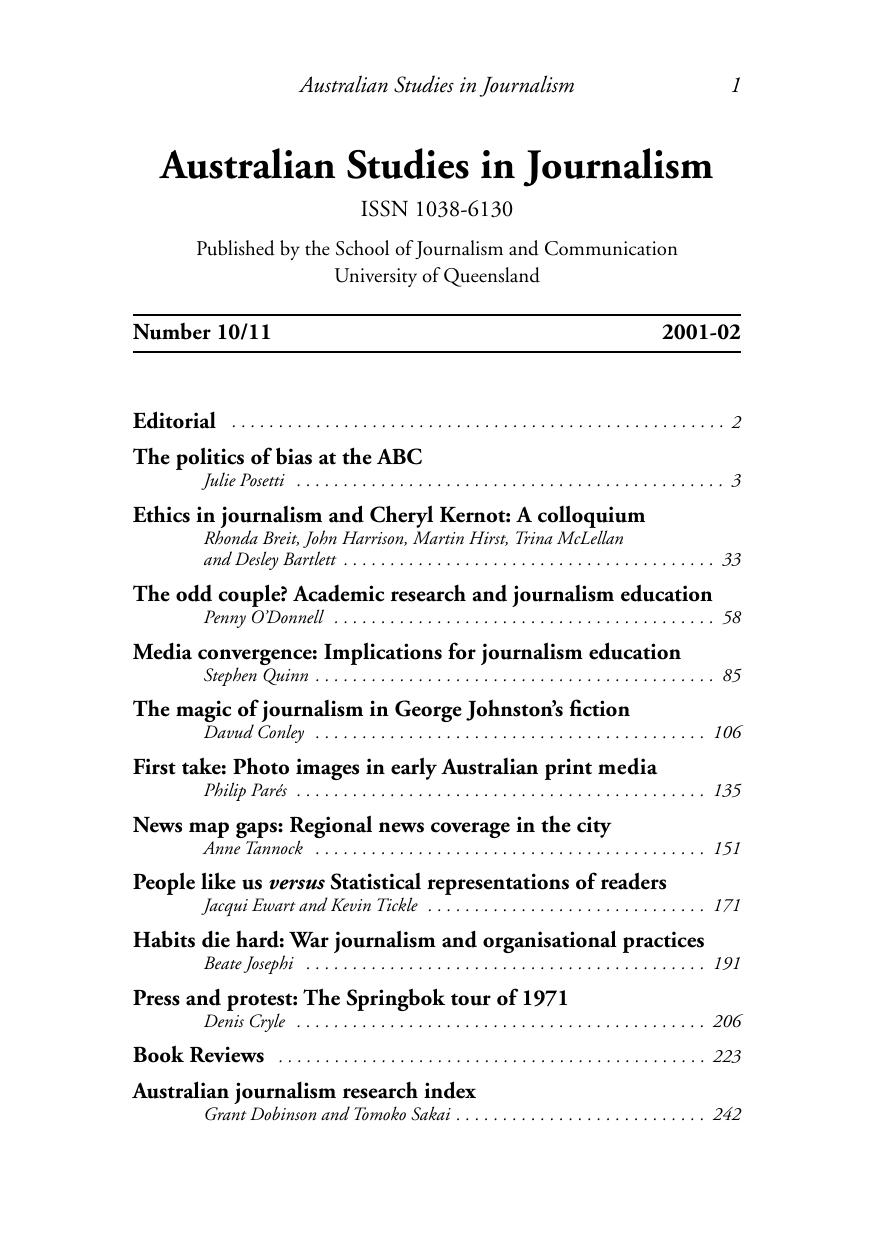
This is Stephen Quinn’s paper “Media convergence: Implications for journalism education,” published in Australian Studies in Journalism, Number 10/11, 2001-02, from the School of Journalism and Communication at the University of Queensland. Quinn was then director of the Center for Media Training and Research at Zayed University in Dubai, and he surveys what was, at the time, the newest idea in the newspaper business: the notion that one reporter’s work should appear in print, on the Web, on radio and television, and eventually on a mobile phone.

The paper takes its starting point from the IFRA/WAN “Beyond the Printed Word” conference in Amsterdam in October 2000 — a gathering of nearly 500 senior newspaper managers from more than 40 countries. I was one of the two conference chairs, which is how I turn up in the text and in the references.

The other conference chairperson, Howard Finberg, pointed out the publishing industry’s strength was its staff, and these people would be “called on more and more in this multimedia, multi-task newsroom” (Finberg 2000).

The bibliography entry is a small pleasure to find in a scanned journal two decades later:

Finberg, Howard (2000), The Digital Futurist Consultancy <www.digitalfuturist.com>. [Finberg’s paper was “Classified: Cannibalism or growth impetus”.]

Much of the paper is case studies: the Tribune Company’s three models of “multiple-journalism” at the Chicago Tribune, the Orlando Sentinel and the Tampa Tribune, as described by IFRA’s Kerry Northrup; the Turun Sanomat operation in Finland; Ming Pao in Hong Kong; Singapore Press Holdings; and the Australian cross-media ownership debate. Quinn also gives space to the skeptics, including Walter Kiechel of the Harvard Business Review, who argued news was far more “medium-specific” than the convergence enthusiasts believed.

The section that has aged best is the one on education. Northrup frames the problem as a chicken-and-egg relationship between the schools and the industry:

“Do you train journalism students for the jobs that exist today so that when they graduate they can be employed? Or do you train people for the skills that they’re going to need in the news organisation tomorrow so that when the newspapers come along and say ‘we need a new generation of journalists’ they have people to pick from?”

And John Pavlik, then executive director of the Center for New Media at Columbia’s Graduate School of Journalism, argues that most American journalism programs were still organized along “early twentieth-century technological lines”:

“Rather than learning to be newspaper, magazine, television, radio or online reporters, they should simply be taught to be journalists working in a digital age” (Pavlik 1998).

Quinn’s conclusion is blunt — “Convergence is inevitable” — and his prescription is training, on the theory that news organizations would have to spend money teaching their own staffs, and that journalists would need to embrace what he calls lifelong learning.

That last point is why I’ve kept this one. The training gap described here is precisely the problem I spent the following decade working on at the Poynter Institute, building News University as a way to deliver journalism training online, affordably, to people who were never going to get to a week-long seminar in Reston or St. Petersburg. The industry’s appetite for paying for that training turned out to be a lot smaller than the industry’s appetite for talking about convergence.

Reading this in 2026, the vocabulary is what dates it. Nobody says “convergence” or “multiple-journalism” anymore, because the argument is over — every newsroom is multi-platform, every reporter shoots video, and the mobile phone Quinn treats as an emerging distribution channel is now the primary one. What did not get settled is the harder question underneath: who pays to teach people the work, and whether journalism schools train for the job that exists or the one that’s coming. Substitute “AI” for “XML” in these pages and the debate reads as current.

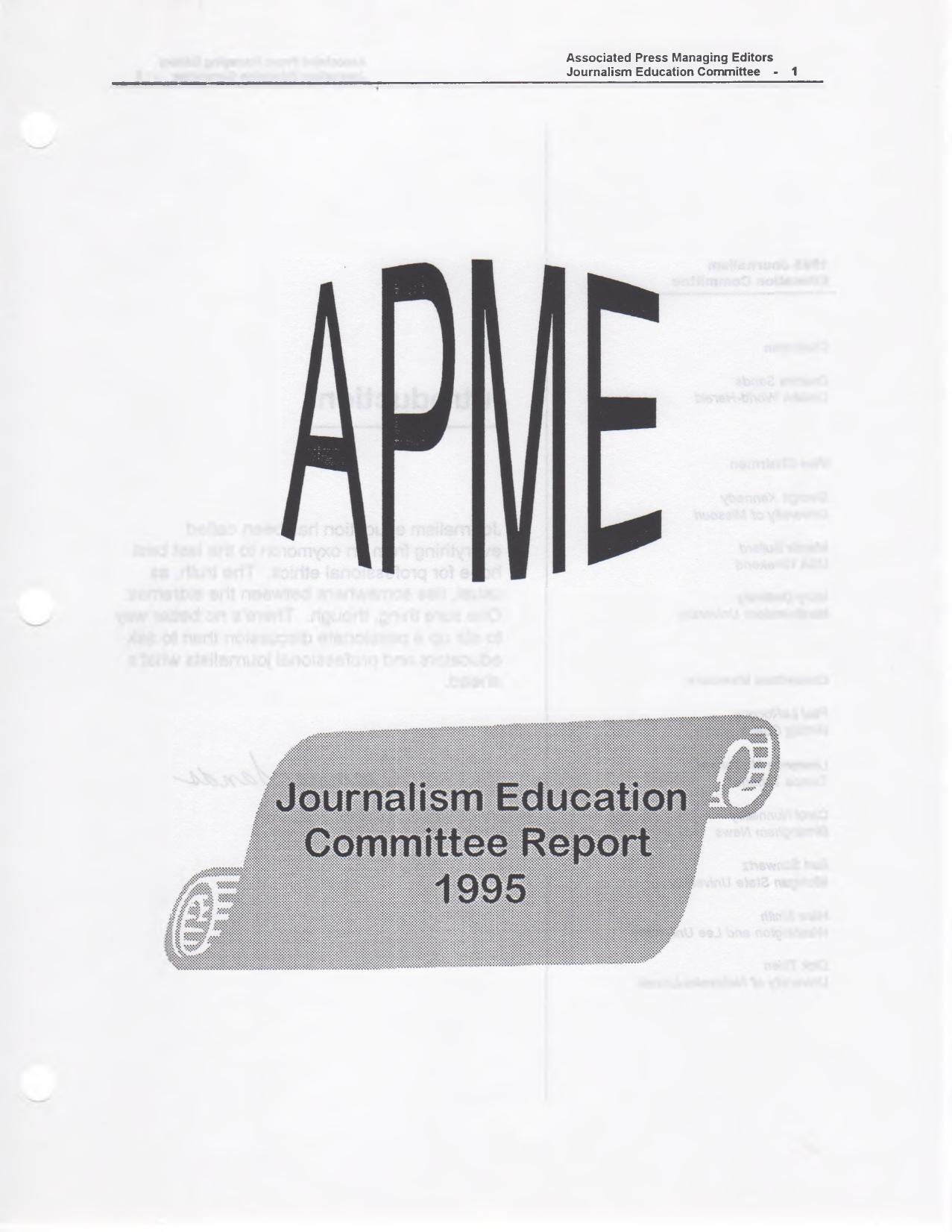
Cover pages of the Associated Press Managing Editors 1995 committee report on journalism education

APME’s 1995 Report on Journalism Education

The 1995 Journalism Education Committee of the Associated Press Managing Editors set itself a straightforward assignment: go back to the committee’s own 1984 study of journalism schools and see how it had held up. Ham Smith of Washington and Lee University, who wrote the lead section, answered in five words — “Mostly, it seems, not much has changed.” The committee was chaired by Deanna Sands of the Omaha World-Herald, with vice chairmen George Kennedy of the University of Missouri, Marcia Bullard of USA Weekend and Mary Dedinsky of Northwestern.

The report opens with a line that still describes the terrain pretty well:

Journalism education has been called everything from an oxymoron to the last best hope for professional ethics. The truth, as usual, lies somewhere between the extremes. One sure thing, though. Thereu2019s no better way to stir up a passionate discussion than to ask educators and professional journalists whatu2019s ahead.

Smith lays out the structural mismatch between newsrooms and J-schools: about 80 percent of entry-level daily newspaper jobs went to journalism majors, while fewer than 20 percent of journalism students were in the news-editorial sequence. Small papers wanted graduates who could work the first day; big papers wanted an education and hired five years later from the small papers. Paul LaRocque reports on a survey the committee mailed to 202 journalism schools, accredited and non-accredited, which drew 128 responses u2014 a 63 percent return u2014 measuring schools against the 1984 recommendations.

The sharpest material is about accreditation. Bob Giles, then editor and publisher of The Detroit News and president of the accrediting council, had told a February gathering of deans at the University of Maryland something the American Journalism Review called an extraordinary statement:

u201cJournalism education still seems to fall uncomfortably between universities and the industry. Neither has embraced journalism education. Too many universities seem more comfortable with the idea of mass communications as a research-based discipline, while the industry wants graduates who can do journalism, but is not willing to make a full commitment of support.u201d

u201cAs the number of accredited programs has increased … it is clear that we can no longer give that assurance.u201d

George Kennedy’s chapter tracks the fight over Giles’ proposal to recognize merit beyond the minimum standards u2014 first framed as a u201ctwo-tier system,u201d a phrase quickly abandoned. Florida A&M Dean Robert Ruggles: u201cYouu2019re either accredited or youu2019re not. Degrees of accreditation make no sense.u201d Jerry Ceppos of the San Jose Mercury News, APME’s representative on the council, was on the other side: u201cAny time you can get journalism education to raise standards, thatu2019s a good thing.u201d Maryland’s Reese Cleghorn had advice for editors who wanted to help u2014 get to know the programs, support the good ones, u201cAnd increase starting salaries.u201d

Berl Schwartz of Michigan State interviews Giles at length. Carol Nunnelley of The Birmingham News profiles the University of Alabama’s Institute for Communication Research, whose biggest customer was Southern Progress Corp. And Dick Thien of Nebraska closes the report with u201cA Dangling Conversation,u201d a bus ride in which an editor and an educator answer for each other’s sins without knowing they are seated side by side. It ends with both of them giving the same answer to the same question:

u201cI love it u2014 and if I do it right I can make a difference.u201d

Two passages date the document usefully. Lawrence McConnell of the Tampa Tribune, whose paper u201cled Media Generalu2019s leap into cyberspace with Tampa Bay Online on Prodigy,u201d says flatly: u201cIf there is such a thing as journalism school graduates prepared for this field today, I have yet to meet them.u201d And John Driscoll, retired from The Boston Globe, notes that ASNE offered a videotape on the future of journalism at cost, $10, hoping it would spark curriculum discussions. u201cAlas, only 70 were sold.u201d

I keep this one because the argument in it never ended. A decade later I was at Poynter building News University, and much of that work was aimed squarely at the gap this committee was describing u2014 professionals who wanted training and educators who wanted respect, with not much traffic between them. Reading it in 2026, with journalism programs still being merged, renamed or closed, and with AI now doing to the newsroom what the Internet was doing in 1995, the committee’s central finding holds up better than anyone should want it to.

Opening slide from a 1994 American Press Institute seminar presentation for journalism educators in Reno

Technology For Tomorrow’s Journalists — an API Seminar, 1994

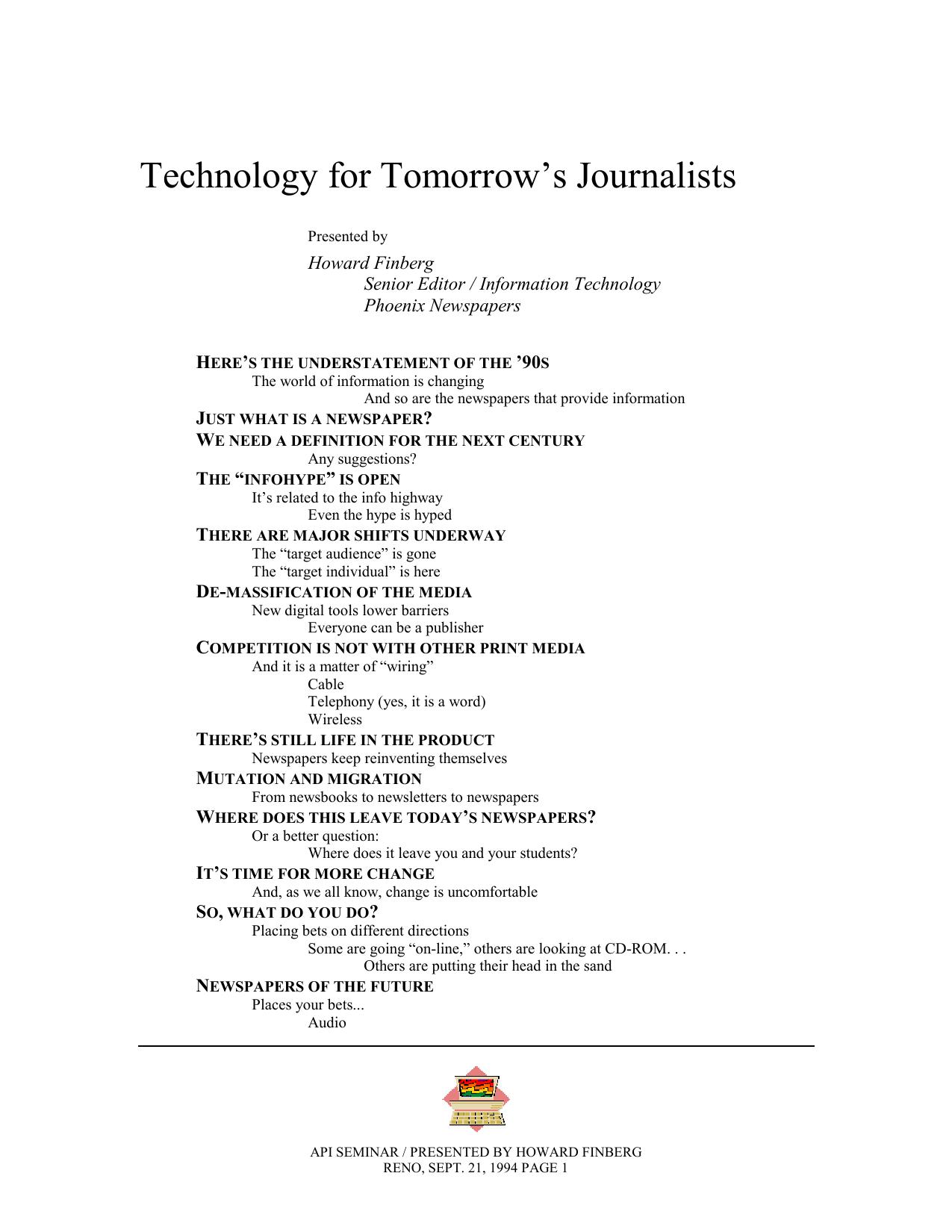
This is the slide outline from a presentation I gave at an American Press Institute seminar for journalism educators, in Reno, on September 21, 1994. At the time I was Senior Editor / Information Technology at Phoenix Newspapers, and the assignment was to talk to the people teaching the next generation of journalists about what was coming at them.

The opening slide set the tone with what I called the understatement of the decade:

The world of information is changing
And so are the newspapers that provide information

Then the harder question, which I put back to the room rather than answering it myself:

JUST WHAT IS A NEWSPAPER?
WE NEED A DEFINITION FOR THE NEXT CENTURY
Any suggestions?

Much of the middle of the presentation was a tour of the bets newspapers were placing in 1994 — audio services over the telephone, fax editions, CD-ROM, “electronic newspapers” delivered by e-mail to a portable computer, online services, and PDAs. I was blunt about the state of play: some publishers were going online, some were looking at CD-ROM, and “others are putting their head in the sand.” The framing throughout was gambling — place your bets, and then:

WILL ANY OF THESE BETS PAY OFF?
What happens if you lose?
What happens if you don’t play?

The numbers are a good reminder of how early this all was. My online services slide reported that 34% of homes had a personal computer and 13% had a modem, with a forecast that by 1997 the computer number would reach 40-50% but modems would only reach 20%. The named players were CompuServe, America Online, Prodigy and Delphi; the partnership examples were Mercury Center and Access Atlanta; the “future players” I listed were Microsoft, Ziff and Sony. And a slide on why modem penetration might not matter at all — because of “cable boxes that have a computer chips inside.”

Because the audience was educators, the second half turned to jobs and curriculum. I argued that reporters could no longer treat the process of getting the story onto the doorstep as somebody else’s problem, and that they would be gathering content for multiple products. Some of it was deliberately provocative:

Even “hot” jobs may disappear
Do we really need designers?

Coming from someone whose career had been built in newspaper design, that was meant to land. So was the slide on teaching:

HOW DO YOU TEACH THESE NEW SKILLS?
It won’t be from a textbook

My prescription was more connection — “Newsroom and classroom need to get closer / Classroom needs to get real.” Two decades later I was still working on exactly that problem, with News University at the Poynter Institute, trying to close the same gap with online training instead of slides.

The closing section was what I labeled my “vision thing”: that newspapers don’t just provide content, they provide context, and that dumping data isn’t journalism — “If you want data, try the phone book.” I also made the point that newspapers were already interactive:

Newspapers are already interactive
They push content
Readers push back

And the last two slides hold up best of all, in 1994 and in 2026:

Understand that “cutting edge” means “bleeding edge”
Look at workflow, not hardware

Followed by “TECHNO-EVANGELISM / Lead by example / Take an interest.” Substitute today’s technology of the moment for CD-ROM and PDAs and the advice doesn’t need much editing.

Editor & Publisher letters column from March 1, 1969, printing a letter about Phoenix, the San Francisco State laboratory newspaper

Out of the Ashes: A Letter to Editor & Publisher About the Phoenix

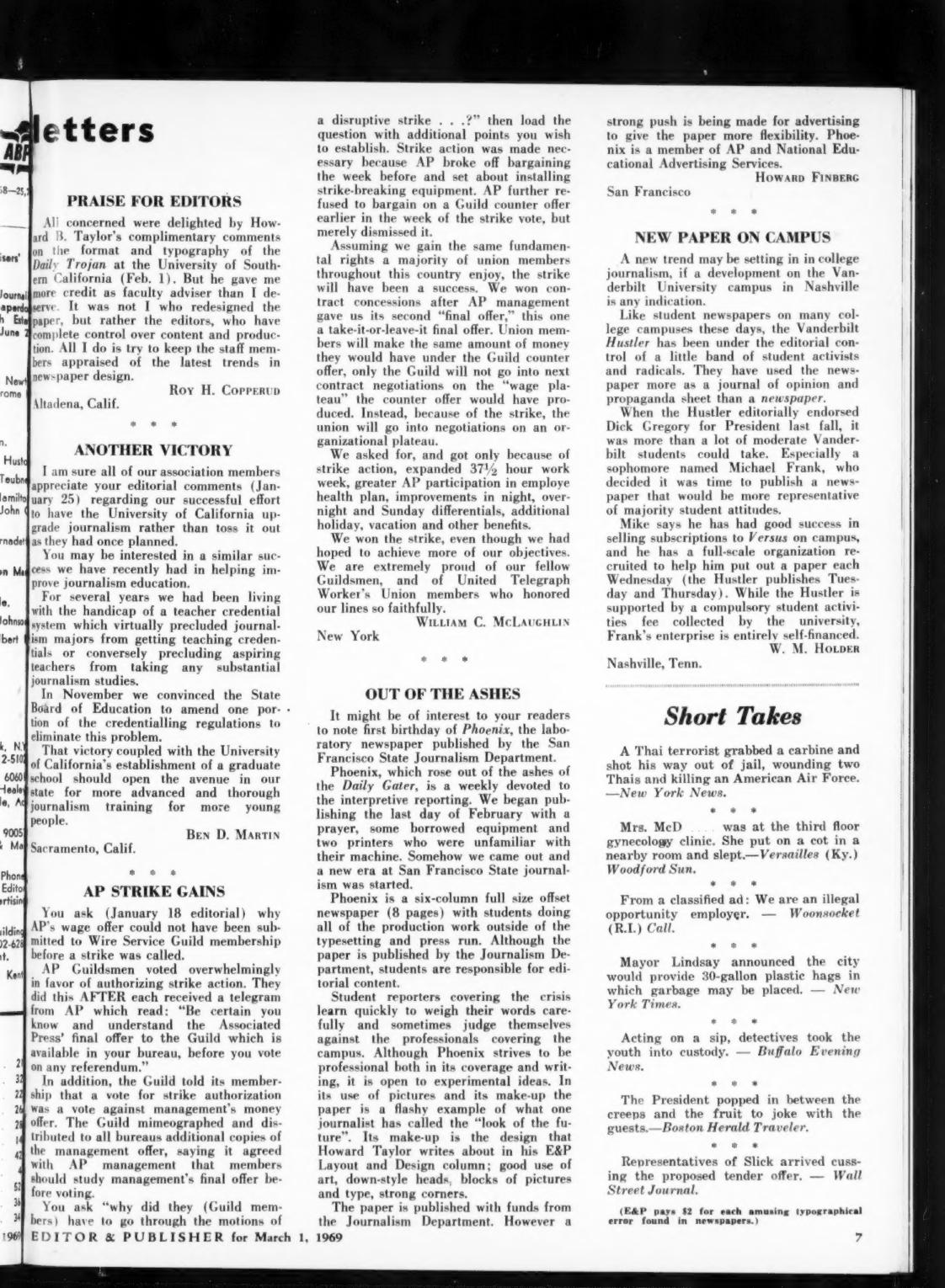
This is a letter of mine that ran in the letters column of Editor & Publisher for March 1, 1969. I was a journalism student at San Francisco State, and what I wanted the trade press to know was that our laboratory newspaper had made it through its first year.

It might be of interest to your readers to note the first birthday of Phoenix, the laboratory newspaper published by the San Francisco State Journalism Department.

The name was not subtle, and it wasn’t meant to be. The Phoenix came after the Daily Gater, and the letter says so plainly, along with a fairly honest account of how the first issue got out the door.

Phoenix, which rose out of the ashes of the Daily Gater, is a weekly devoted to interpretive reporting. We began publishing the last day of February with a prayer, some borrowed equipment and two printers (typesetters) who were unfamiliar with their machine. Somehow we came out and a new era in San Francisco State journalism was started.

What I described was a six-column, full-size offset paper, eight pages, with students doing all of the production work outside of the typesetting and the press run. The Journalism Department published it and paid for it, but, as I was careful to point out, students were responsible for the editorial content. We were pushing for advertising to give the paper more flexibility. The Phoenix was a member of AP and of National Educational Advertising Services.

The part of the letter I still think holds up is the paragraph about what it was like to be a student reporter on that campus, at that moment, with the professionals working the same story.

Student reporters covering the crisis learn quickly to weigh their words carefully and sometimes judge themselves against the professionals covering the campus.

And then, because even at that age I couldn’t resist talking about design, I spent a good chunk of a letter about a student newspaper describing its typography.

In its use of pictures and its make-up the paper is a flashy example of what one journalist has called the “look of the future.” Its make-up is the design that Howard Taylor writes about in his E&P Layout and Design column; good use of art, down-style heads, blocks of pictures and type, strong corners.

There’s a nice coincidence on the same page. The letter at the top of the column, from Roy H. Copperud of Altadena, Calif., is also responding to Howard Taylor’s design coverage — this time about the Daily Trojan at USC — and makes a point I would hear again and again in the years that followed about who actually does the work:

It was not I who redesigned the paper, but rather the editors, who have complete control over content and production.

A page of letters about student newspapers, journalism education in California, and the Wire Service Guild’s strike against the AP — and tucked in among them, a college student telling the industry’s trade magazine that the future would look a certain way on the page. The scan garbles my byline into “Howarp FInBerc,” which feels about right for a 1969 hot-type artifact making its way through a 21st-century scanner.