Journalism Education: An Editors’ Agenda, 2004
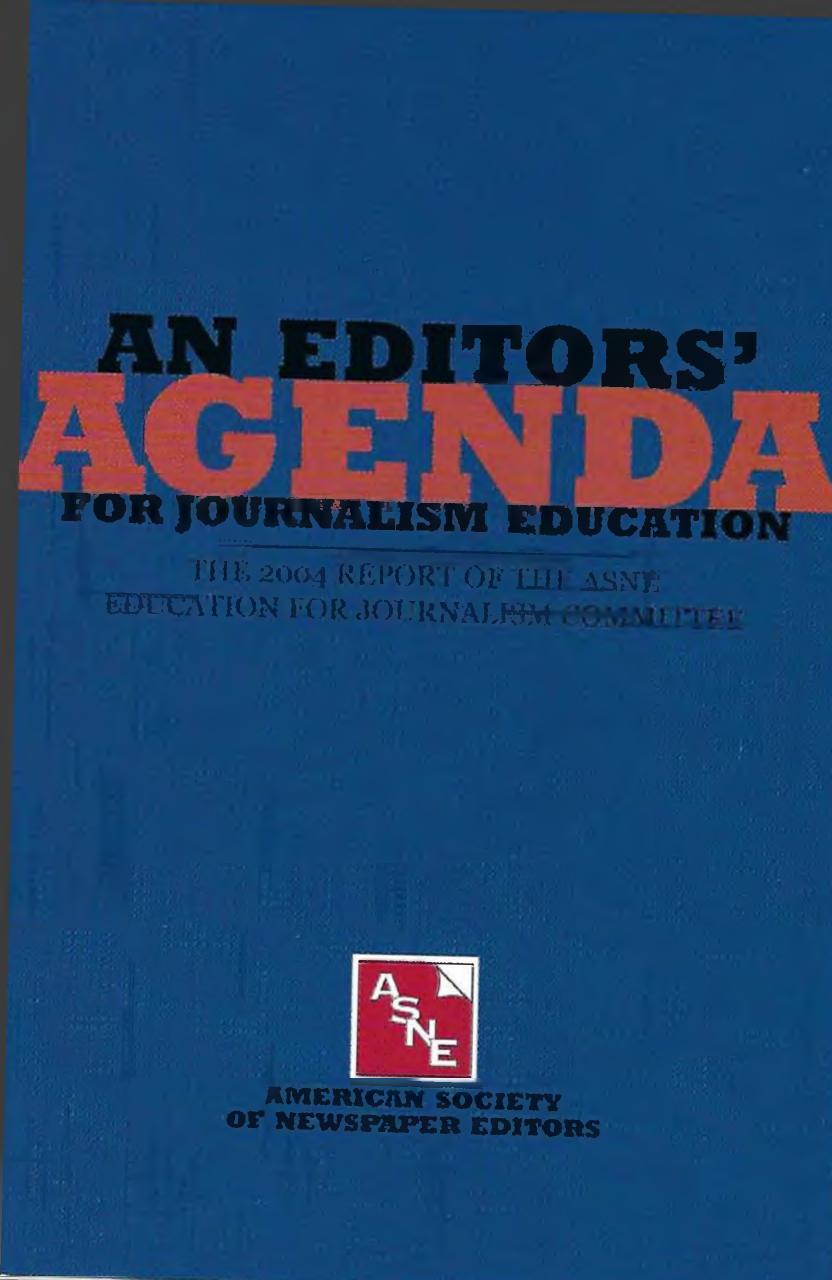
This is the American Society of Newspaper Editors report Journalism Education: An Editors’ Agenda, published in 2004 by the ASNE Education for Journalism Committee. Jerry Ceppos of Knight Ridder chaired the committee and wrote the report; I served on the committee representing The Poynter Institute, along with Jennie Buckner, Judy Pace Christie, Richard S. Holden, Saundra E. Keyes, Maryanne B. McNellis, Annette Jo Procter, Susanne Shaw, George Thottam and Kenneth M. Winter.
The report summarizes a February 2004 survey of ASNE members, conducted mostly by e-mail, with a 33 percent response rate — about 180 members, though the number varied by question. The survey was inspired by a suggestion from Susanne Shaw of the University of Kansas and by earlier research from Lee Stinnett, the former ASNE executive director.
The finding, as Ceppos put it, was not subtle:
Journalism schools can’t provide too much practical, skills-based learning, according to ASNE members.
Editors were tough graders. Two-thirds mostly disagreed that today’s graduates had a better grasp of the English language than graduates five years earlier. Less than two percent strongly agreed that graduates had a broad-enough range of knowledge across subjects. Only one percent strongly agreed that graduates think more analytically. The bright spots: more than eight in 10 agreed graduates better understood the importance of diversity, and six in 10 agreed they better understood journalism ethics.
The open-ended answers carried the report. A sampling:
“MAKE EVERYONE WRITE MORE!! I think a journalism major should have to write in every class, every week! I am disheartened when I see how little some journalism students actually write. I would not like to be operated on by a surgeon who’d had as little practice in cutting as some journalism graduates have had in writing.” — Bob Haiman, The Freedom Forum
“More required hands-on production of news: publishing articles, photos, page layout, headlines, writing editorials and producing news Web pages.” — Gilbert Bailon, Dallas Morning News
Educators pushed back, or at least complicated the picture. Tom Kunkel, then dean at the University of Maryland, described the squeeze:
“But keeping that focus is more challenging by the year, as we’re expected to stay current with the industry’s technological advances and offer more courses on, say, ethics, and yet still not exceed the number of credit hours students can take in the major. Too often and at too many places, I fear, it’s the core skills that get shorted.”
Ceppos closed by naming the contradiction in his own data — editors said schools were best at teaching the basics, and also that the basics weren’t good enough:
My interpretation of the apparent conflict: Editors want more teaching of the basics and believe that it’s what journalism schools do best–but they still expect students to do even better.
A personal note on why this document matters to me. I was sitting on this committee at exactly the moment Poynter was building News University, the online training effort I would go on to lead. The editors answering this survey were, in effect, describing the demand: more writing, more reporting, more hands-on practice, more of it available to people already in newsrooms and to students who weren’t getting enough of it in class. NewsU was one answer to that demand — self-paced, low-cost, scalable in a way a week-long seminar in St. Petersburg could never be.
Reading it now, in 2026, the complaint is remarkably durable. Every generation of editors has told every generation of educators to teach more writing and more reporting, and that argument outlived most of the newsrooms that were hiring in 2004. What has changed is the technology gap: in this survey, “producing news Web pages” was the forward-looking ask. Today the same conversation is about generative AI in the classroom and in the newsroom. But the underlying question the committee was chasing — what should a journalism graduate actually be able to do on day one — hasn’t changed at all.