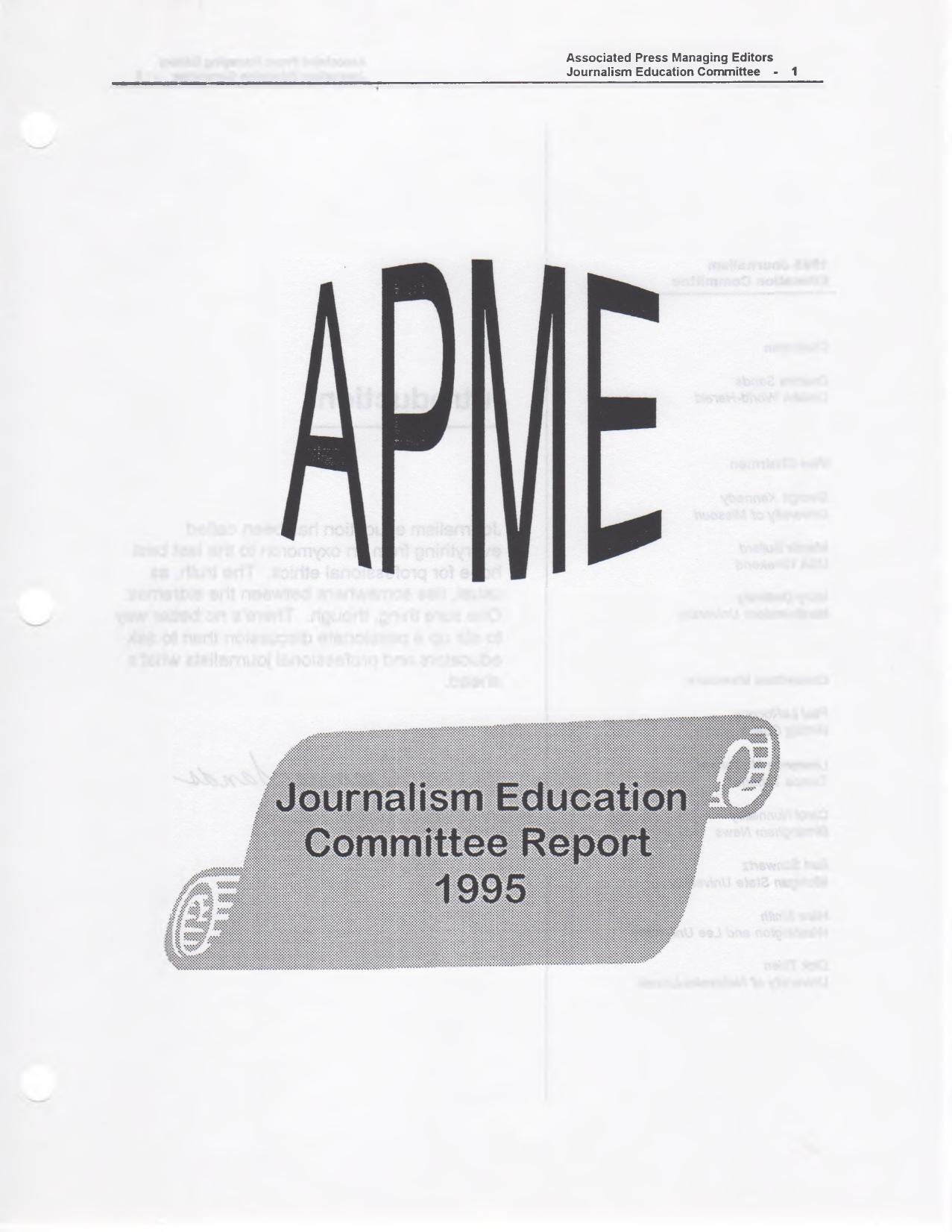
The 1995 Journalism Education Committee of the Associated Press Managing Editors set itself a straightforward assignment: go back to the committee’s own 1984 study of journalism schools and see how it had held up. Ham Smith of Washington and Lee University, who wrote the lead section, answered in five words — “Mostly, it seems, not much has changed.” The committee was chaired by Deanna Sands of the Omaha World-Herald, with vice chairmen George Kennedy of the University of Missouri, Marcia Bullard of USA Weekend and Mary Dedinsky of Northwestern.
The report opens with a line that still describes the terrain pretty well:
Journalism education has been called everything from an oxymoron to the last best hope for professional ethics. The truth, as usual, lies somewhere between the extremes. One sure thing, though. Thereu2019s no better way to stir up a passionate discussion than to ask educators and professional journalists whatu2019s ahead.
Smith lays out the structural mismatch between newsrooms and J-schools: about 80 percent of entry-level daily newspaper jobs went to journalism majors, while fewer than 20 percent of journalism students were in the news-editorial sequence. Small papers wanted graduates who could work the first day; big papers wanted an education and hired five years later from the small papers. Paul LaRocque reports on a survey the committee mailed to 202 journalism schools, accredited and non-accredited, which drew 128 responses u2014 a 63 percent return u2014 measuring schools against the 1984 recommendations.
The sharpest material is about accreditation. Bob Giles, then editor and publisher of The Detroit News and president of the accrediting council, had told a February gathering of deans at the University of Maryland something the American Journalism Review called an extraordinary statement:
u201cJournalism education still seems to fall uncomfortably between universities and the industry. Neither has embraced journalism education. Too many universities seem more comfortable with the idea of mass communications as a research-based discipline, while the industry wants graduates who can do journalism, but is not willing to make a full commitment of support.u201d
u201cAs the number of accredited programs has increased … it is clear that we can no longer give that assurance.u201d
George Kennedy’s chapter tracks the fight over Giles’ proposal to recognize merit beyond the minimum standards u2014 first framed as a u201ctwo-tier system,u201d a phrase quickly abandoned. Florida A&M Dean Robert Ruggles: u201cYouu2019re either accredited or youu2019re not. Degrees of accreditation make no sense.u201d Jerry Ceppos of the San Jose Mercury News, APME’s representative on the council, was on the other side: u201cAny time you can get journalism education to raise standards, thatu2019s a good thing.u201d Maryland’s Reese Cleghorn had advice for editors who wanted to help u2014 get to know the programs, support the good ones, u201cAnd increase starting salaries.u201d
Berl Schwartz of Michigan State interviews Giles at length. Carol Nunnelley of The Birmingham News profiles the University of Alabama’s Institute for Communication Research, whose biggest customer was Southern Progress Corp. And Dick Thien of Nebraska closes the report with u201cA Dangling Conversation,u201d a bus ride in which an editor and an educator answer for each other’s sins without knowing they are seated side by side. It ends with both of them giving the same answer to the same question:
u201cI love it u2014 and if I do it right I can make a difference.u201d
Two passages date the document usefully. Lawrence McConnell of the Tampa Tribune, whose paper u201cled Media Generalu2019s leap into cyberspace with Tampa Bay Online on Prodigy,u201d says flatly: u201cIf there is such a thing as journalism school graduates prepared for this field today, I have yet to meet them.u201d And John Driscoll, retired from The Boston Globe, notes that ASNE offered a videotape on the future of journalism at cost, $10, hoping it would spark curriculum discussions. u201cAlas, only 70 were sold.u201d
I keep this one because the argument in it never ended. A decade later I was at Poynter building News University, and much of that work was aimed squarely at the gap this committee was describing u2014 professionals who wanted training and educators who wanted respect, with not much traffic between them. Reading it in 2026, with journalism programs still being merged, renamed or closed, and with AI now doing to the newsroom what the Internet was doing in 1995, the committee’s central finding holds up better than anyone should want it to.