Becoming a Better Online Editor, 2006

Presented at Journalism in a 24/7 World: Decision-making for the Online Editor
Knight New Media Center, October 2006

Generated by AI, Edited by Human

This presentation by Howard Finberg, then Director of Interactive Learning at The Poynter Institute, addressed the challenges of online journalism in a real-time environment. The focus was on ethical judgment, editorial roles, and the structural change necessary to support online decision-making.

The guiding idea: “Our real product is credibility.”

Slide-by-Slide Summary of Core Points
Journalism’s True Business
  • Begins with the question: “What business are we in?”
  • Answer: Not news, but credibility—the audience must trust the institution.
Public Expectations and Perceptions
  • Addresses the decline in public trust in journalism.
  • Readers expect speed and accuracy; failure in either undermines credibility.
Ethical Decision-Making in Real Time
  • Introduces the Online Credibility Gap.
  • Highlights the lack of established ethical norms in digital contexts.
  • Asks: “What are the rules online?”
Transparency and Corrections
  • Credibility requires visible corrections and transparent changes.
  • Encourages editors to avoid stealth editing or deletion without accountability.
Accountability and Structure
  • Notes that online editorial decisions are often made without authority or oversight.
  • Calls for clear delegation and training in ethical digital decision-making.
Organizational Alignment
  • Stresses that newsroom behavior online must align with institutional values.
  • Users judge the brand based on online actions, not just published mission statements.
Avoiding Legacy Thinking
  • Warns against asking old questions with new words.
  • Urges editors to develop entirely new frameworks for the digital environment.
Facilitating Ethical Culture
  • Editors should model ethical behavior, coach their teams, and create systemic support for digital ethics.
  • Online editing is not just technical—it is ethical leadership in real time.

The core message remains durable:

“Speed and reach do not eliminate responsibility—they amplify it.”


Related Posts

Digital Credibility, IFRA Presentation

In my 2002 presentation at the IFRA Asia Conference, held in Bangkok, I addressed the critical topic of credibility in online journalism, highlighting its significant impact on media brands and their audiences. As Managing Director of the Digital Futurist Consultancy, I shared insights from the Digital Journalism Credibility Study, sponsored by the Online News Association and funded by the John S. and James L. Knight Foundation. [This is a summary  from my presentation slides.]

In our research, we explored how consumers and media professionals perceive credibility online, identifying four key types of credibility:

1. Presumed Credibility: Assumptions based on domain names, web traffic, and update frequency.
2. Reputed Credibility: Influenced by third-party recommendations or references.
3. Surface Credibility: Based on first impressions of a site’s professional appearance and navigability.
4. Experienced Credibility: Derived from ongoing user experience, ease of navigation, and perceived content accuracy.

Key insights from our survey revealed that the public had not yet firmly decided on the credibility of online news, presenting an opportunity for media organizations to differentiate themselves through credible reporting practices. Factors such as accuracy, completeness, fairness, and timeliness strongly influence credibility perceptions. Additionally, I emphasized the essential need for a clear separation between editorial and advertising content to maintain consumer trust.

Ultimately, I concluded that the debate on digital credibility remains open, offering both challenges and opportunities for media companies aiming to establish or reinforce their reputation online. Credibility, I argued, is a business imperative in the evolving digital landscape.

The full report is on this site.

The ONA Digital Credibility Report

This is a PDF of the Online News Association study on digital credibility, co-authored by Howard Finberg and Martha Stone with assistance from Diane Lynch. Here’s what the goals of the project were:

ONA’s Web Credibility Study, for which it was awarded $225,000 from the John S. and James L. Knight Foundation (www.knightfdn.org), is studying the impact of technology and the Internet on the gathering and dissemination of news.
The study will work to develop and promote principles and guidelines for online journalism focusing on proper relationships between editorial content, advertising and e-commerce; the development of ethical standards and avoidance of conflicts of interest; and appropriate use of hyperlinking in a journalistic environment.

Presentation of ONA Digital Credibility Report

Here’s a copy of the main online credibility presentation given at the ONA convention in 2001. The goal was to share the results of the ONA Credibility study conducted in 2000-2001. This PDF includes notes or a script for the presenters. It has the key elements the authors wanted to share with the audience. I conducted the survey work and wrote a large section of the report and was responsible for creating the presentation.

Understanding Online Credibility. An ONA Project

One of the more interesting and challenging project I undertook as a consultant was as a co-author on a study of online credibility for the Online News Association, which was funded by the Knight Foundation. The purpose of the study was outlined in the press release from ONA:

The study will work to develop and promote principles and guidelines for online journalism focusing on proper relationships between editorial content, advertising and e-commerce; the development of ethical standards and avoidance of conflicts of interest; and appropriate use of hyperlinking in a journalistic environment.

It was a big project and a great learning opportunity about putting together a research project with a level of academic rigor.   My co-author was Martha Stone, another consultant.

“The results generated from ONA panel discussions and research will provide a foundation for the ongoing discussions regarding credibility in this very new medium. It is a chance to help shape solid journalistic practices early,” said Howard Finberg, co-director.

The project was announced by ONA via Business Wire release.

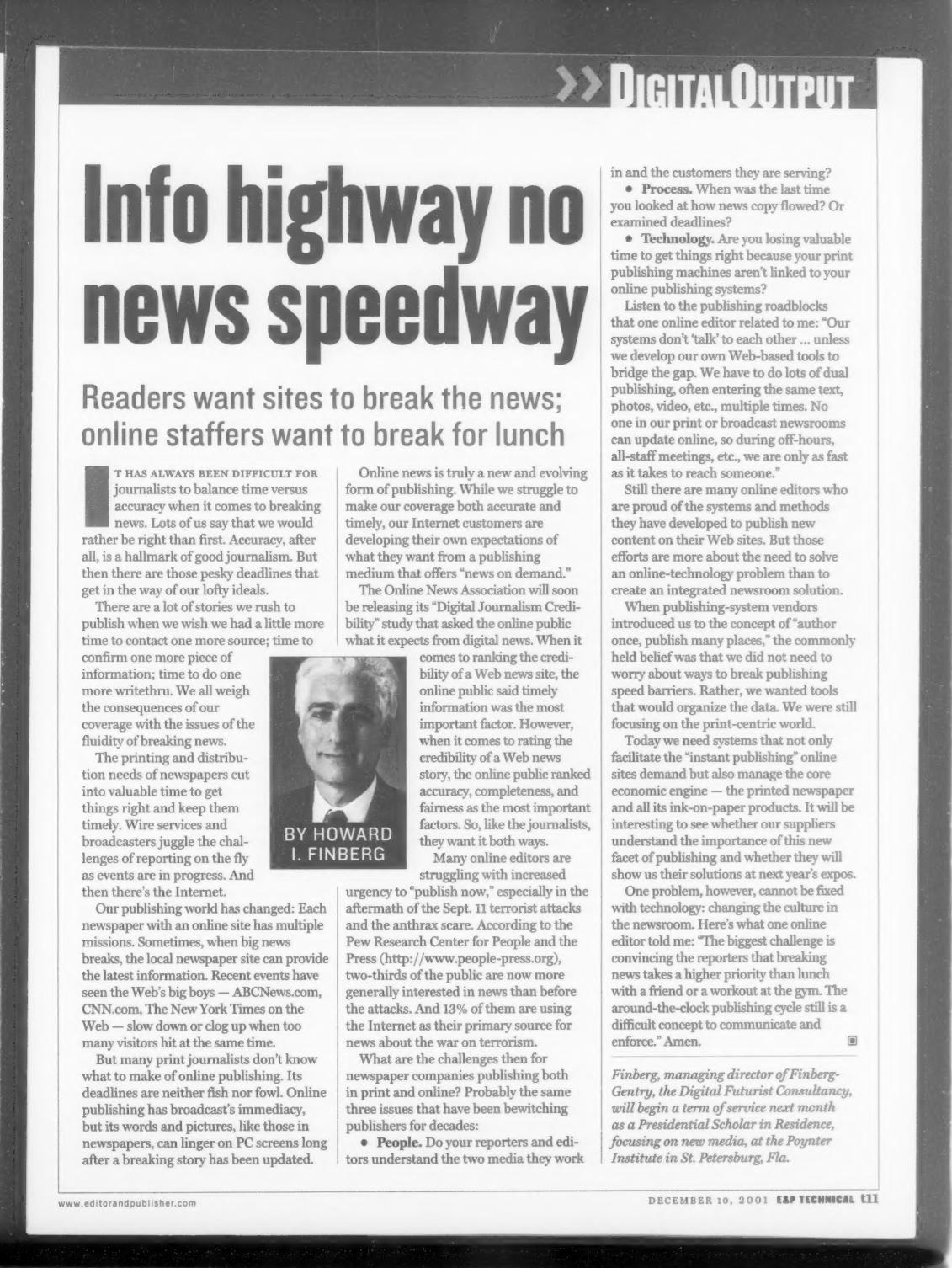
Editor & Publisher column headlined "Info highway no news speedway" from December 10, 2001

Info Highway: No News Speedway

A column I wrote for Editor & Publisher, published December 10, 2001, under the headline “Info highway no news speedway” and the subhead: “Readers want sites to break the news; online staffers want to break for lunch.”

The piece takes up the old tension between speed and accuracy and argues that online publishing has made it harder to resolve, because its deadlines are “neither fish nor fowl” — broadcast immediacy combined with words and pictures that linger on screen the way print does.

It cites the Online News Association‘s forthcoming “Digital Journalism Credibility” study, which found that the online public ranked timely information as the most important factor in judging the credibility of a Web news site, but ranked accuracy, completeness, and fairness first when judging an individual news story:

So, like the journalists, they want it both ways.

The column also notes Pew Research Center for People and the Press findings that two-thirds of the public were more generally interested in news than before the Sept. 11 attacks, and that 13% were using the Internet as their primary source for news about the war on terrorism.

The challenges for companies publishing in both print and online, I wrote, came down to the same three issues that had been “bewitching publishers for decades”: people, process, and technology. One online editor described the roadblocks this way:

Our systems don’t ‘talk’ to each other … unless we develop our own Web-based tools to bridge the gap. We have to do lots of dual publishing, often entering the same text, photos, video, etc., multiple times. No one in our print or broadcast newsrooms can update online, so during off-hours, all-staff meetings, etc., we are only as fast as it takes to reach someone.

The column closes on the one problem technology can’t solve — newsroom culture — quoting another online editor:

The biggest challenge is convincing the reporters that breaking news takes a higher priority than lunch with a friend or a workout at the gym. The around-the-clock publishing cycle still is a difficult concept to communicate and enforce.

The tagline at the end notes that I was then managing director of Finberg-Gentry, the Digital Futurist Consultancy, and would begin a term the following month as a Presidential Scholar in Residence, focusing on new media, at the Poynter Institute in St. Petersburg, Fla.