Report on potential audiences for PNI online services [not launched yet] and inventory of PNI content. Part of the AzCentral startup work.
Report on potential audiences for PNI online services [not launched yet] and inventory of PNI content. Part of the AzCentral startup work.
In the summer of 1995, a group of editors and other staff members of The Arizona Republic and Phoenix Gazette worked on a ‘semi-secret’ project — created Phoenix Newspaper’s first online products. The group started with creating a sub-site on American Online. Later, we created an Internet [Web] About AZ Central.
We used our imaginations and research into other online pioneers to figure out what the home screen, the secondary screens and menus. It was an interesting and challenging project.
AZ Central officially launched in November 1995
You need to have a memo about the plan, even though there are lots of conversations along the way. Here’s the memo I wrote John Oppedahl (my boss), editor of The Arizona Republic. It outlined our strategy to launch on both AOL and on the Web. And we also had a bulletin board service for home sales.
June 2, 1995
TO: John Oppedahl
FROM: Howard I. Finberg
SUBJECT: Executive Summary/Online Plan
This is an executive summary of Phoenix Newspapers’ Online Plan:
As outlined in the “Online Opportunities” report, PNI will take a multi-platform (or multi-newsstand approach). This will allow PNI to control where content is placed and will provide opportunities to reach readers through different services (America Online, the Internet/World Wide Web server and PNI’s existing bulletin board service). PNI will not sign an “exclusive agreement” with any online service, and hence will be free to take advantage of upcoming opportunities in 1996 and 1997 (e.g. Microsoft Network and New Century Network).
The full memo has more details about staffing and revenue expectations. The revenue was optimistic, but realistic given the AOL bounties.
This is a report I put together in August 1996 for managers at Phoenix Newspapers who didn’t quite understand what “going online” meant — or where it was headed. Rather than argue in the hallway, I built a briefing book: talking points, traffic charts, a project list, revenue and expense projections, and a stack of clippings from the trade and business press so no one had to take my word for the direction of the market.
The first section is organized around questions from Chip Weil, then President and CEO of Central Newspapers, with my answers filled in:
I’ve taken some of Chip Weil’s questions [the italics] and added some general answers and/or talking points that could be discussed at the meeting. Marilyn Tanious was helpful regarding some key points that should be discussed.
Most of the questions were about classified advertising — real estate and employment — which was where the money was and where the threat was. The report notes on-going discussions with the area’s multiple listing service [ARMLS] for complete property-for-sale data, work on getting employment display advertising online, more “Virtual Job Fairs” starting in September, an outside company [Moore Data] on a rentals database, and an automotive push with the AIG group and with Bill Luke, which wanted to put its used-car inventory online.
Asked about strategy over the next 24 months, I listed four areas: consumer acceptance, broadband delivery, directory publishing and transactions. Longer term, commerce systems and agency relationships — shared “ad space” with content partners. PAFET, the newspaper technology consortium, gets credit for access to experiences that would have been hard to duplicate, along with the strategic alliances with InfoSeek and Pointcast. On the money: about $2.3 million being spent CNI-wide, with a projected 10% expense increase for 1997 and capital spending estimated at $150,000.
The overview section reprints a piece I’d written for the first edition of an in-house newsletter, the Cyber Chronicles, aimed at a general newsroom audience:
While using a 17th Century technology — ink on paper — to communicate what’s happening with PNI’s online efforts may seem strange, it helps make the point that the newspaper isn’t going away. Frankly, there are just some things you can do better on newsprint.
Arizona Central ran two editions — one on the Web, one on America Online — and a good part of the internal confusion was about why we bothered with both. The answer in the report is blunt:
We are often asked, “Why have any content on AOL?” The reason is simple: It reaches a different audience than the Internet.
AOL was then the world’s largest commercial online service with six million customers, sharing market revenue with PNI and paying bounties for each customer we signed up with a special Arizona Central disk. The distinction I drew was between “the technically advanced” — comfortable with IP addresses and hunting on the Web — and “the technically evolving,” who preferred the safer environment of a commercial service.
The traffic charts are a reminder of how crude measurement was. Web numbers were “hits,” with a note that our pages used only three or four image files while boston.com used 19 on its home page — so our hit counts looked small by comparison. The big spike came from putting employment liners online in late June; the flattening was blamed on the Olympic games, a drop seen across AOL as well. AOL, at least, could count actual paid entries into Arizona Central. Median age was 43.7 on AOL and 43.5 on the Web, and the daypart charts show AOL peaking at 8 p.m. while Web use tracked working hours — traffic from major Valley employers and corporate sites around the country.
The project list is the part I still enjoy: movie times, Living Here, Meet Your Match, calendars formatted for database searching, Prep Stats, Holiday Lights with the Downtown Association, and a SAVE system to search and purchase past stories. And the honest bottom line, stated up front:
While it is unlikely that online will be profitable this or next year, revenue is running ahead of projections.
Thirty years on, what strikes me is how much of the argument was about audience rather than technology — where readers actually were, and the willingness to publish in two places at once to reach them. That part of the job hasn’t changed at all.
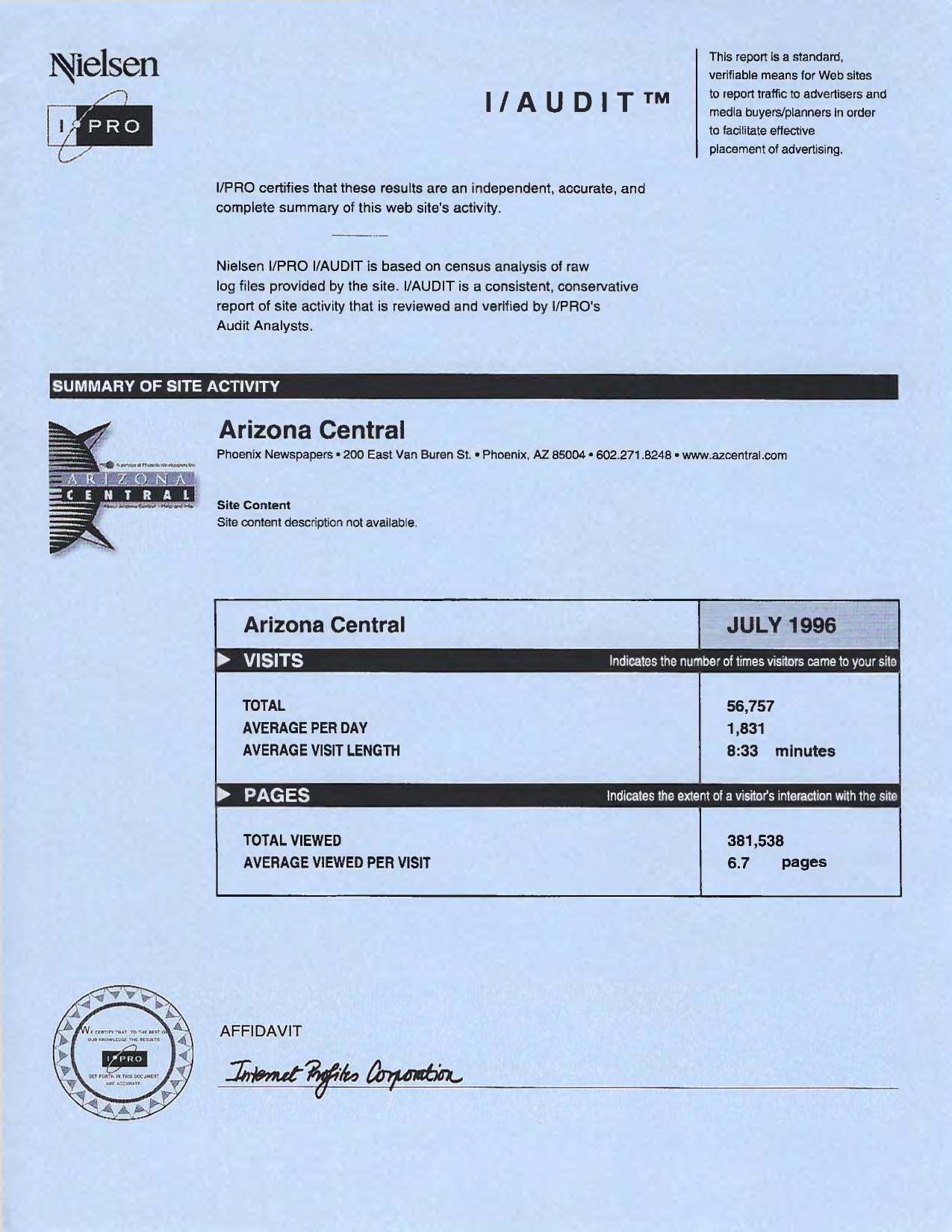
This is the Nielsen I/PRO I/AUDIT report for Arizona Central for the month of July 1996. I was managing Arizona Central at the time, and this was one of the first attempts by anyone to put an independent, third-party number on what a newspaper web site was actually doing.
The point of the exercise was advertising. If we were going to sell space on the site, someone other than us had to vouch for the traffic:
This report is a standard, verifiable means for Web sites to report traffic to advertisers and media buyers/planners in order to facilitate effective placement of advertising.
I/PRO built the audit from a census analysis of our raw log files, reviewed by their audit analysts, and certified the results as “an independent, accurate, and complete summary of this web site’s activity.” The affidavit language matters more than it might seem now — media buyers had no reason to trust self-reported server numbers.
The month’s totals:
VISITS … TOTAL 56,757 / AVERAGE PER DAY 1,831 / AVERAGE VISIT LENGTH 8:33 minutes
And on the content side, 381,538 pages viewed, an average of 6.7 pages per visit. The top 50 pages accounted for 299,906 pages, or 78.6 percent of everything viewed.
What those top pages were is the interesting part. Job Search, under the classifieds directory, drew 13,584 page views — a reminder of how early classifieds moved online. Alongside the standard departments (FLASH, FEATURES, FUN, comics, Dining, Destinations, the Arizona Golf Guide, the interactive TV listings, Home Buying Choices), the news pages that show up are exactly the stories of that summer in Arizona: “Phoenix bombing plot,” “Symington indicted,” and “Arizona’s Olympians.” There’s also a page titled “Tell us what you think!” — 617 views for the survey.
The visitor-by-organization table is its own time capsule. America Online alone delivered 14,143 visits, more than seven times the next name on the list, Primenet, at 1,824. Arizona State University, GoodNet, CompuServe, Netzone, Microsoft Network, Internet Direct — the local ISPs and the national online services were the on-ramps. The top 50 organizations were 60.7 percent of all site visits. Geographically, 91.0 percent of activity came from the United States, with Canada at 1.8 percent and a scattering from Australia, the Netherlands, Japan, the U.K., and Germany.
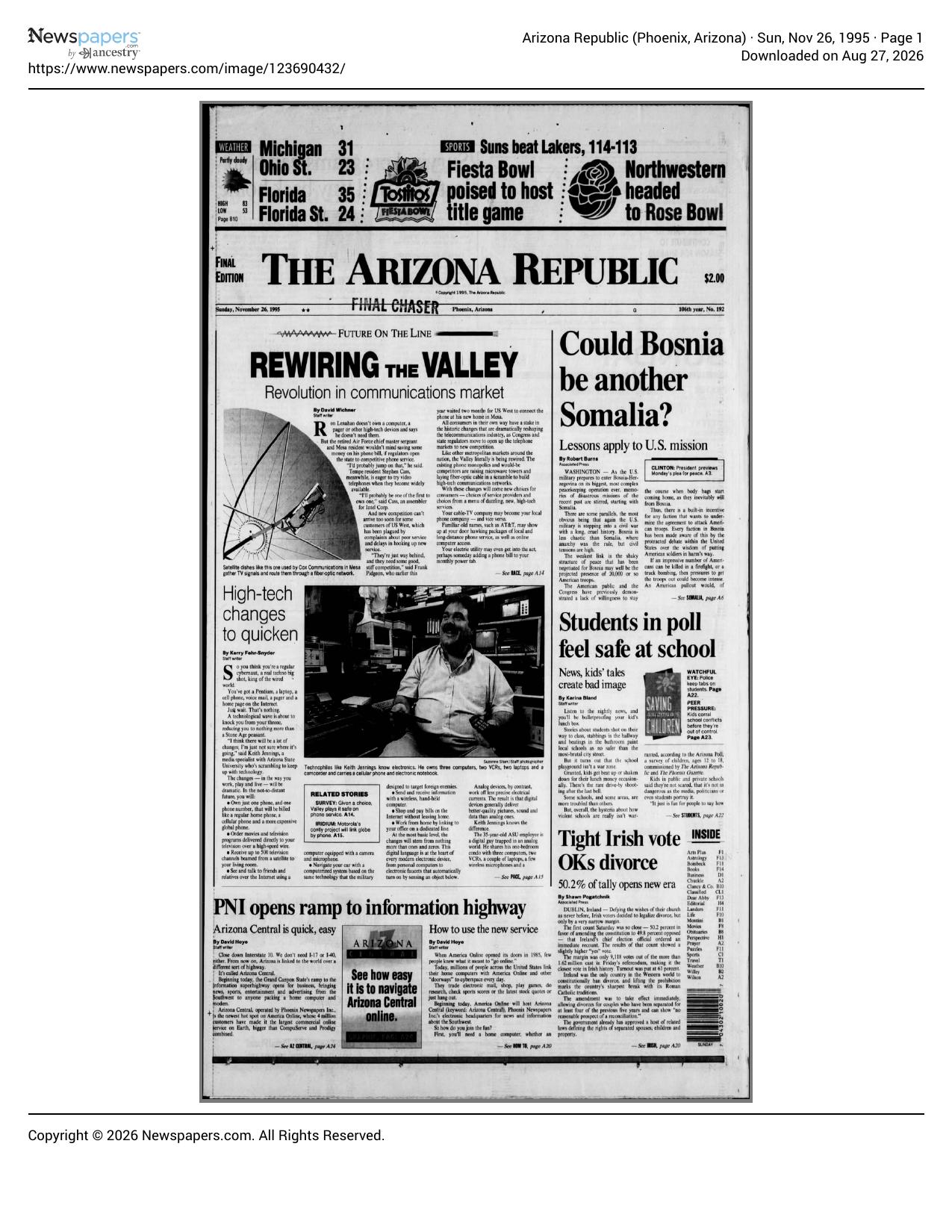
On Sunday, November 26, 1995, The Arizona Republic told its readers that Phoenix Newspapers Inc. had gone online. The story, by staff writer David Hoye, ran on page one under the headline “PNI opens ramp to information highway,” with a full page inside devoted to explaining what Arizona Central was and how to get to it.
There were two front doors. One was on America Online — at the time, by the paper’s own description, the largest commercial online service on Earth, with 4 million customers, “bigger than CompuServe and Prodigy combined.” The other was on the World Wide Web.
On America Online, type keyword: arizona central
On the Web, http://www.azcentral
The AOL service opened with a set of buttons that would look familiar to anyone who has built a home page since: News/Money, Sports, Destinations, Your Life, At Ease, Sound Off, ALT. and What’s Hot. Sound Off held the columnists, editorials, letters and Steve Benson‘s editorial cartoons. ALT. was aimed at young adults and carried stories written by local students. Elsewhere there were Penelope Corcoran’s restaurant reviews under Taste the Town, interactive TV grids customized to your cable company, a searchable golf-course database, the Pick the Pros contest, a GiftLine for holiday shopping, and a survey button asking readers what they wanted from an online service.
The ambition was larger than shoveling the newspapers onto a screen. As the story put it, Phoenix Newspapers planned “to create nothing less than an online community, where users can learn, communicate, buy and sell and have fun.” The Oasis, Arizona Central’s chat room, was already doing that work — Charles Barkley had spent more than an hour there the week before, taking questions about the 1995-96 Suns season.
John Oppedahl, executive editor of the newspapers, framed it this way:
“Our new effort online is a significant move forward for Phoenix Newspapers Inc.,” said John Oppedahl, executive editor of the newspapers. “I look at this as the beginning of a new era.”
I was quoted as well, in my role at the time:
“It’s instant journalism,” said Howard Finberg, Phoenix Newspapers’ senior editor of information technology. “It’s pretty exciting.”
Worth noting where the launch story sat on that Sunday front page. It shared A1 with a package called “FUTURE ON THE LINE: REWIRING THE VALLEY” — about Congress and state regulators opening the telephone market to competition, cable companies becoming phone companies, and the promise of 500 television channels and video calls over the Internet. The newspaper was covering the coming of the network and joining it on the same day.
The story also made the case to advertisers, with a comparison that has aged into a period piece: online was “the most important new communications medium since Johann Gutenberg‘s experiments with movable type more than 500 years ago.”