Newsroom Stress, 1995

Stress in the Newsroom: A Snapshot from 1995

In July 1995, the Associated Press Managing Editors (APME) conducted a survey to assess the levels of stress experienced by editors in American newsrooms. This was a follow-up to their 1983 study.  The 1995 APME Stress Survey offered a look at the emotional, physical, and professional tolls borne by editors at a pivotal time in media history. The report was chaired by Peter Bhatia, who was then at The Oregonian. [The following is a summary generated by AI.]

The world of journalism in 1995 was beginning to feel the tremors of the digital era. Pagination software was being introduced, newsroom resources were shrinking, and economic pressures were growing. But even amid these shifts, the most powerful insights from the survey remain deeply human: the pressures of responsibility, the desire for excellence, and the personal sacrifices made in pursuit of the truth.

Here are a few key findings that stood out:

A Job That Challenges—And Overwhelms

  • 90% of editors were highly committed to their work, and 62% felt highly challenged.
  • Yet only half reported having a sense of control over their responsibilities.
  • Editors were spending an average of 52 hours per week at the office, with an additional 5 hours at home.

What Fueled the Stress?

  • The top stressors: workload, understaffing, deadline pressure, and lack of resources.
  • Editors reported being “locked in” and feared being unable to change their lifestyle.
  • New pagination technology, while promising efficiency, increased stress for 67% of those who implemented it.

Mental and Physical Health Impacts

  • 41% of respondents had experienced a health issue due to job-related stress.
  • Hypertension (17%) and ulcers (9%) were among the most reported conditions.
  • Nearly half of editors said their job was “highly stressful,” with three-quarters experiencing high stress multiple times per week.

Stress at Home

  • 76% said their family was exposed to public scrutiny because of their editorial role.
  • Editors found it difficult to balance their jobs with family commitments, especially in dual-career households.
  • Marital conflicts, sleep disruption, and emotional burnout were common themes.

Coping Mechanisms

  • Editors turned to reading, music, exercise, humor, and spending time alone to decompress.
  • Alcohol and tobacco use were notably on the decline
  • Few turned to professional therapy—less than 10% reported seeing a counselor or therapist.

A Snapshot of a Changing Era

This survey, compiled and analyzed by Bardsley & Neidhart Inc., is more than just a stress audit—it is a time capsule of journalism at the edge of digital transformation. Editors were not only managing newspapers; they were managing expectations, shrinking budgets, changing technologies, and the growing emotional weight of their public roles.

As we look back from 2025, it is striking how many of the issues from 1995 remain relevant. Today’s media leaders still wrestle with technological change, financial pressures, and the challenge of maintaining editorial standards.

? Read the full 1995 APME Stress Survey here
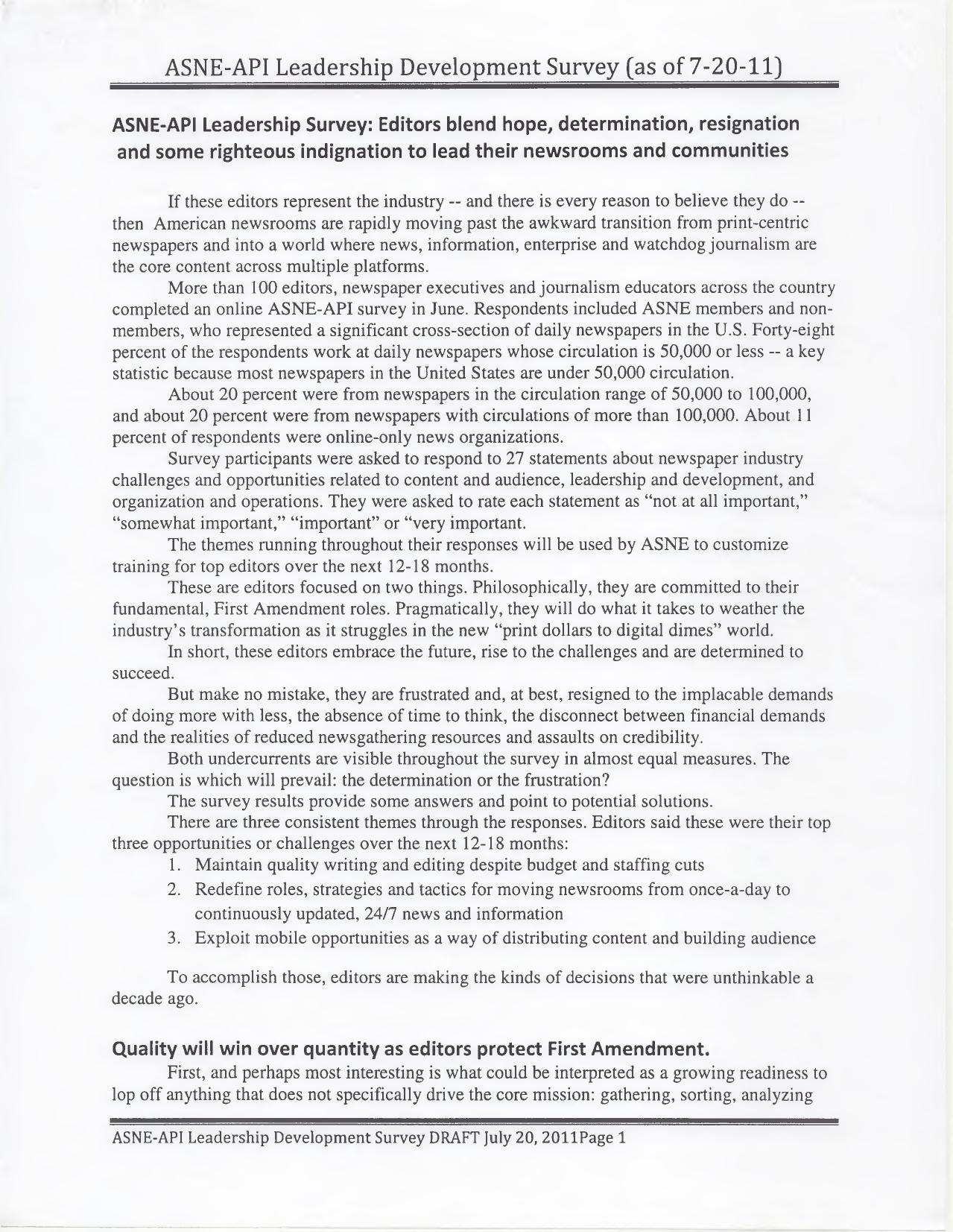
Draft report pages from the July 2011 ASNE and American Press Institute survey of newspaper editors

ASNE-API Leadership Survey, July 2011

This is the draft report of a joint survey by the American Society of News Editors and the American Press Institute, dated July 20, 2011. Invitations went to 1,830 editors at about 1,400 daily newspapers, 50 online-only news sites and the deans of 100 accredited journalism schools. One hundred five people responded — nearly half of them from papers with circulations of 50,000 or less, which is where most American dailies live. Respondents rated 27 statements about content and audience, leadership and development, and organization and operations. ASNE planned to use the findings to shape training for top editors over the following 12 to 18 months, beginning with a regional workshop in Lexington, Ky., in October.

The framing of the report is a tension the authors return to again and again — editors who are determined and editors who are worn down:

These are editors focused on two things. Philosophically, they are committed to their fundamental, First Amendment roles. Pragmatically, they will do what it takes to weather the industry’s transformation as it struggles in the new “print dollars to digital dimes” world.

The three top-ranked opportunities or challenges: maintain quality writing and editing despite budget and staffing cuts (83.8 percent called it “very important”); redefine roles, strategies and tactics for moving newsrooms from once-a-day publishing to continuously updated, 24/7 news; and exploit mobile opportunities to distribute content and build audience.

What gives the document its bite are the unattributed editor comments:

“It’s time,” wrote one editor, “for newsrooms to focus on finding ways to do fewer things well, instead of doing everything poorly.”

“Too many interruptions, distractions,” wrote one editor. “Not able to put together a stretch of time that’s long enough to focus and complete anything that can’t be accomplished in five minutes. … I can get a lot of things started, but it’s becoming harder and harder to see them through to successful completion.”

“We are all in this same leaky boat together and it’s time to let go of our old ideas about labor and management. We all need to start building a new ship — and fast.”

The draft press release attached to the report quotes Linda Grist Cunningham, vice chair of ASNE’s Leadership Committee; Carol Ann Riordan, interim executive director of the American Press Institute; and Mizell Stewart III, editor of the Evansville (Ind.) Courier & Press and chair of the Leadership Committee.

“The affirmation that editors can stay focused on good journalism as they wrestle with spreadsheets and new technology isn’t unexpected,” said Linda Grist Cunningham … “But it certainly is reassuring.”

The report ends with the question it can’t answer:

The question remains: Which will prevail? The determination to succeed, to beat back the naysayers? Or the resignation that comes with fear, inertia and a mourning of the loss of the past?

Reading this in 2026 — fifteen years later — the survey is a useful marker of where newsroom leadership thinking stood at the start of the mobile era. The priorities the editors named are no longer strategic questions; they were settled by events. What remains strikingly current is the complaint that there is no time to think, and the one editor who predicted the tablet future and wrote, “This is the generation of transition.”

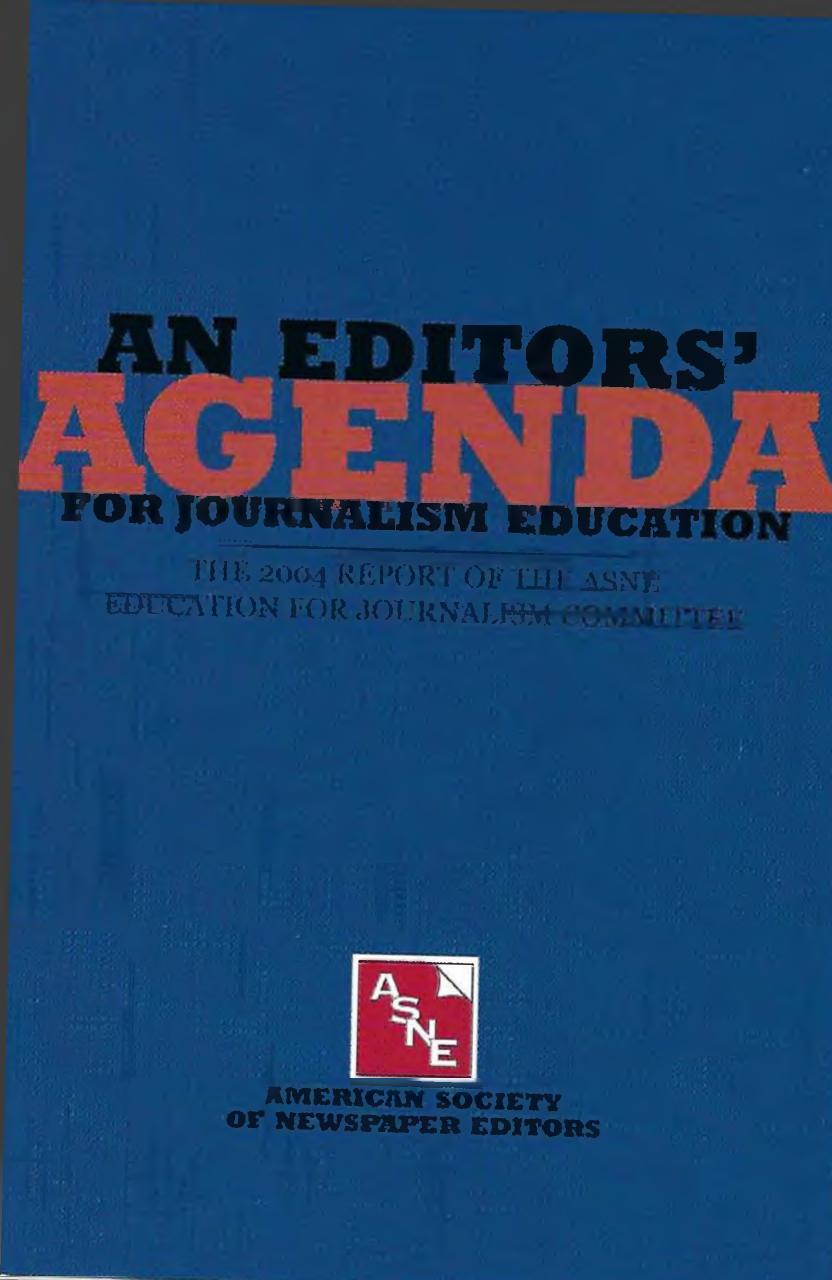
Cover page of the 2004 American Society of Newspaper Editors report Journalism Education: An Editors' Agenda

Journalism Education: An Editors’ Agenda, 2004

This is the American Society of Newspaper Editors report Journalism Education: An Editors’ Agenda, published in 2004 by the ASNE Education for Journalism Committee. Jerry Ceppos of Knight Ridder chaired the committee and wrote the report; I served on the committee representing The Poynter Institute, along with Jennie Buckner, Judy Pace Christie, Richard S. Holden, Saundra E. Keyes, Maryanne B. McNellis, Annette Jo Procter, Susanne Shaw, George Thottam and Kenneth M. Winter.

The report summarizes a February 2004 survey of ASNE members, conducted mostly by e-mail, with a 33 percent response rate — about 180 members, though the number varied by question. The survey was inspired by a suggestion from Susanne Shaw of the University of Kansas and by earlier research from Lee Stinnett, the former ASNE executive director.

The finding, as Ceppos put it, was not subtle:

Journalism schools can’t provide too much practical, skills-based learning, according to ASNE members.

Editors were tough graders. Two-thirds mostly disagreed that today’s graduates had a better grasp of the English language than graduates five years earlier. Less than two percent strongly agreed that graduates had a broad-enough range of knowledge across subjects. Only one percent strongly agreed that graduates think more analytically. The bright spots: more than eight in 10 agreed graduates better understood the importance of diversity, and six in 10 agreed they better understood journalism ethics.

The open-ended answers carried the report. A sampling:

“MAKE EVERYONE WRITE MORE!! I think a journalism major should have to write in every class, every week! I am disheartened when I see how little some journalism students actually write. I would not like to be operated on by a surgeon who’d had as little practice in cutting as some journalism graduates have had in writing.” — Bob Haiman, The Freedom Forum

“More required hands-on production of news: publishing articles, photos, page layout, headlines, writing editorials and producing news Web pages.” — Gilbert Bailon, Dallas Morning News

Educators pushed back, or at least complicated the picture. Tom Kunkel, then dean at the University of Maryland, described the squeeze:

“But keeping that focus is more challenging by the year, as we’re expected to stay current with the industry’s technological advances and offer more courses on, say, ethics, and yet still not exceed the number of credit hours students can take in the major. Too often and at too many places, I fear, it’s the core skills that get shorted.”

Ceppos closed by naming the contradiction in his own data — editors said schools were best at teaching the basics, and also that the basics weren’t good enough:

My interpretation of the apparent conflict: Editors want more teaching of the basics and believe that it’s what journalism schools do best–but they still expect students to do even better.

A personal note on why this document matters to me. I was sitting on this committee at exactly the moment Poynter was building News University, the online training effort I would go on to lead. The editors answering this survey were, in effect, describing the demand: more writing, more reporting, more hands-on practice, more of it available to people already in newsrooms and to students who weren’t getting enough of it in class. NewsU was one answer to that demand — self-paced, low-cost, scalable in a way a week-long seminar in St. Petersburg could never be.

Reading it now, in 2026, the complaint is remarkably durable. Every generation of editors has told every generation of educators to teach more writing and more reporting, and that argument outlived most of the newsrooms that were hiring in 2004. What has changed is the technology gap: in this survey, “producing news Web pages” was the forward-looking ask. Today the same conversation is about generative AI in the classroom and in the newsroom. But the underlying question the committee was chasing — what should a journalism graduate actually be able to do on day one — hasn’t changed at all.

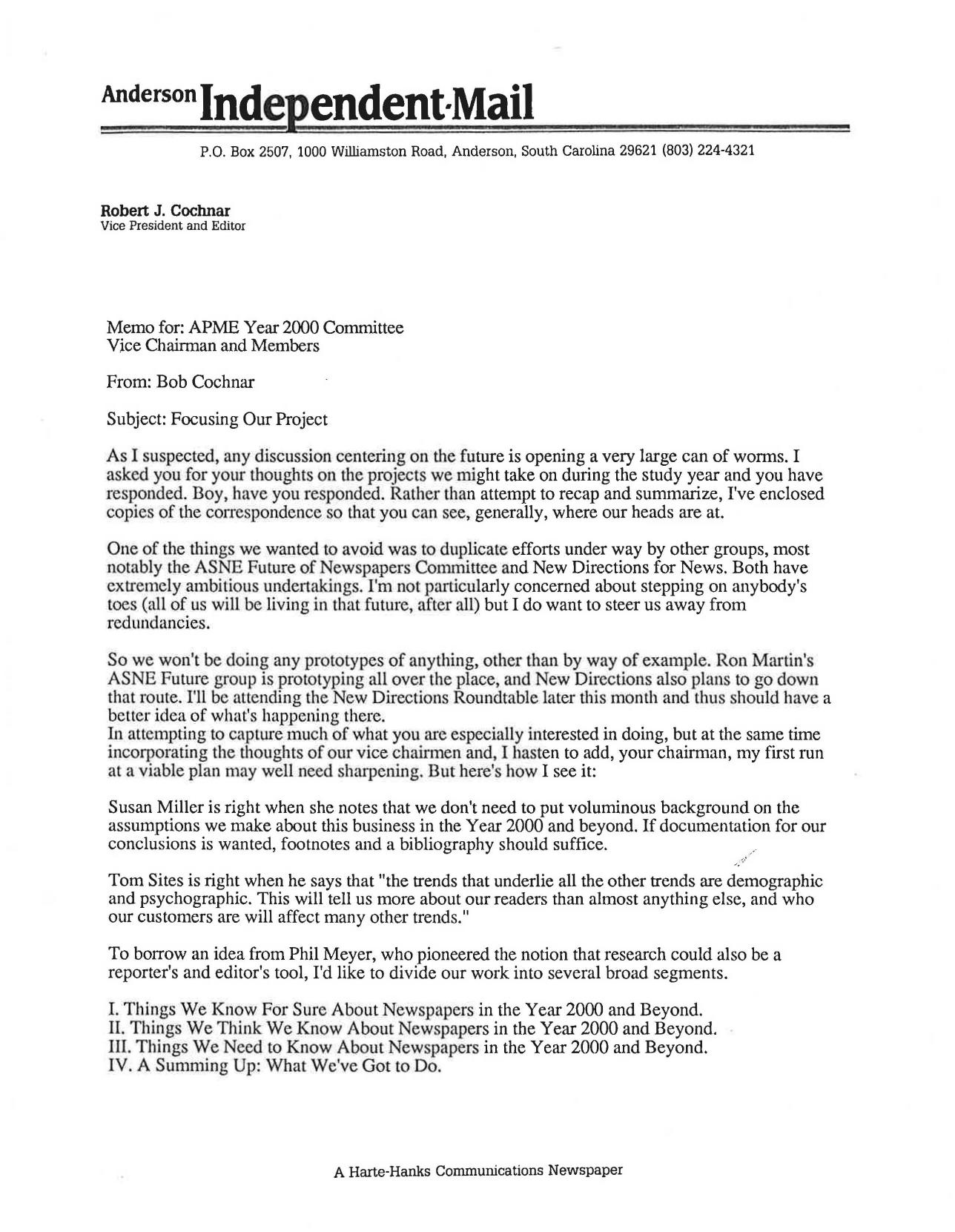
Typewritten memo from editor Robert J. Cochnar to the APME Year 2000 Committee outlining a study plan for newspapers

Focusing a Committee on the Year 2000

This is a memo from Robert J. Cochnar, vice president and editor of the Anderson Independent-Mail in South Carolina, to the members of the Associated Press Managing Editors Year 2000 Committee. He had asked the committee what it should study during its year of work, and the replies — enclosed with the memo, from papers all over the country — make up the bulk of the packet.

As I suspected, any discussion centering on the future is opening a very large can of worms. I asked you for your thoughts on the projects we might take on during the study year and you have responded. Boy, have you responded.

I’m in this document twice: once as a new addition to the committee, and once in the membership list, at 120 E. Van Buren St. in Phoenix.

Incidentally, I’ve expanded our committee a bit with some distinguished folks who have expressed their willingness to add their expertise to the hopper. They are Bob Haiman, who runs the Poynter Institute, and Howard Finberg, assistant managing editor for graphics at the Arizona Republic.

Cochnar’s first concern was not duplicating the work of the ASNE Future of Newspapers Committee, chaired by Ron Martin, or New Directions for News. So no prototypes. Instead he proposed a structure that still strikes me as a smart way to organize thinking about the future:

I. Things We Know For Sure About Newspapers in the Year 2000 and Beyond.
II. Things We Think We Know About Newspapers in the Year 2000 and Beyond.
III. Things We Need to Know About Newspapers in the Year 2000 and Beyond.
IV. A Summing Up: What We’ve Got to Do.

Not essays. An introduction, a conclusion, and in between, well-organized snippets from the literature and from smart people inside and outside the business — contradictions allowed, sources required. Cochnar described the goal as “a sort of extended data bank, or almanac, of facts, ideas and notions” that an editor could cherry-pick from a table of contents. He also liked a committee member’s suggestion that it all be treated as an interim report, with annual updates from future committees on the future, which he thought should adopt Satchel Paige’s line:

“Don’t look back; something may be gaining on us.”

The work was split into two groups: George Blake of the Cincinnati Enquirer on content and production, Susan Miller of Scripps Howard on everything else — circulation, advertising, competition, legal trends. Doug Ramsey at the Foundation for American Communications had proposed a co-sponsored committee meeting; Cochnar was thinking June, in Atlanta.

The enclosed correspondence is the real reward here. Tom Stites of the Chicago Tribune argued for starting with the underlying trends, a point Cochnar quoted back to the committee:

“the trends that underlie all the other trends are demographic and psychographic. This will tell us more about our readers than almost anything else, and who our customers are will affect many other trends.”

Stites also noted that Alvin Toffler wrote “Future Shock” on a personal computer but never mentioned personal computers in the book — a warning I’ve repeated in one form or another for most of my career. Others wrote about pagination and electronic photo handling reshaping newsroom structure, about classified advertising eventually moving to interactive electronic media, about retailing shifting away from the big department stores, about recruiting and keeping women and minorities, and about owners with no history in journalism buying profitable newspapers.

Reading it now, what stands out isn’t what the committee got wrong. It’s how much of it the industry saw coming and how little of it changed anyone’s behavior in time. And a small note of personal history: Bob Haiman joined this committee running Poynter, an institution where I’d spend a good chunk of my later career.

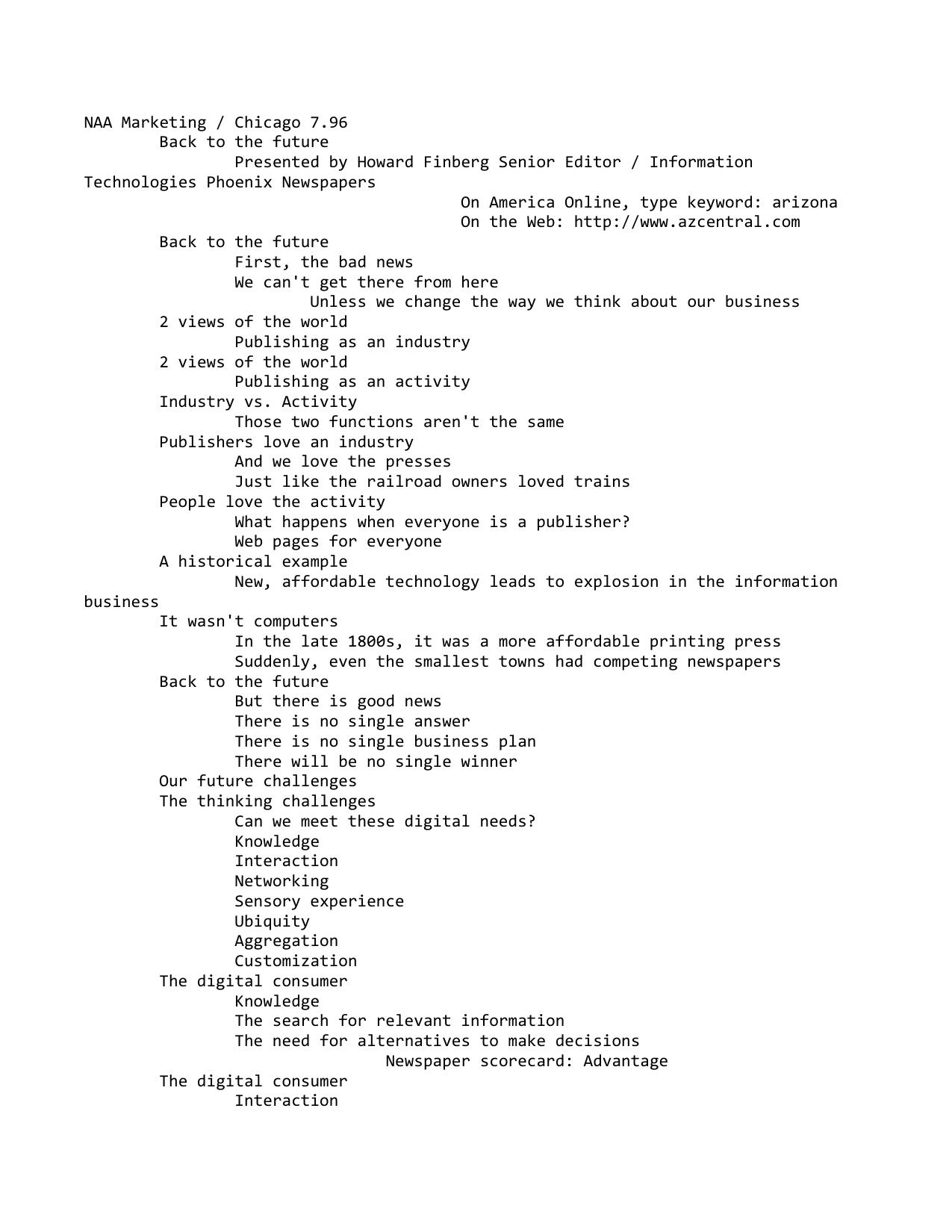
Title slide reading "Back to the future" from a July 1996 NAA marketing and technology meeting presentation in Chicago

Back to the Future: A 1996 Presentation to NAA Marketing

In July 1996 I presented “Back to the future” at an NAA marketing and technology business meeting in Chicago. At the time I was Senior Editor / Information Technologies at Phoenix Newspapers

The argument started with the bad news:

We can’t get there from here
Unless we change the way we think about our business

That change meant seeing the difference between publishing as an industry and publishing as an activity. Publishers love the industry — and the presses — “Just like the railroad owners loved trains.” But people love the activity. My historical example wasn’t computers at all: in the late 1800s a more affordable printing press gave even the smallest towns competing newspapers.

The heart of the talk was a scorecard, rating newspapers against seven digital consumer needs — knowledge, interaction, networking, sensory experience, ubiquity, aggregation and customization. The tally: two advantages, three neutrals, two disadvantages.

I also warned against the era’s favorite word:

Don’t “repurpose” content
Repurpose our role

And about the delivery debate: “It isn’t about dead trees OR live wires.” Forget online, forget the Web, forget about the wires — focus on information value.

Two outside voices made the point better than I could. Mark Hauptschein, director of strategy and business development at Ameritech:

“The old way of throwing advertising – spraying and praying – will weaken over time. Marketing will become a form of content.”

And Eric Berg, Price Waterhouse director of technology:

“In the late 1990s, getting access to information will no longer be an issue. The real issue will be avoiding information. We’re going to need new technology which will enable us to filter, sort and extract the information which is relevant to us.”

The process section covered the questions we were all avoiding — what is news, what are the jobs, what kind of organization — plus the return of the 24-hour newsroom and a caveat I still like: going from hot type to cold type is evolutionary; going digital is revolutionary. Make sure the paradigm really shifts.

There was good news, too. No new technology has yet replaced an older one, and information providers have always found a way, from newsbooks to newsletters to newspapers. I closed with Darwin — survival belongs to the most adaptable — and with people:

Give them information
Give them tools
Give them training
Give them room

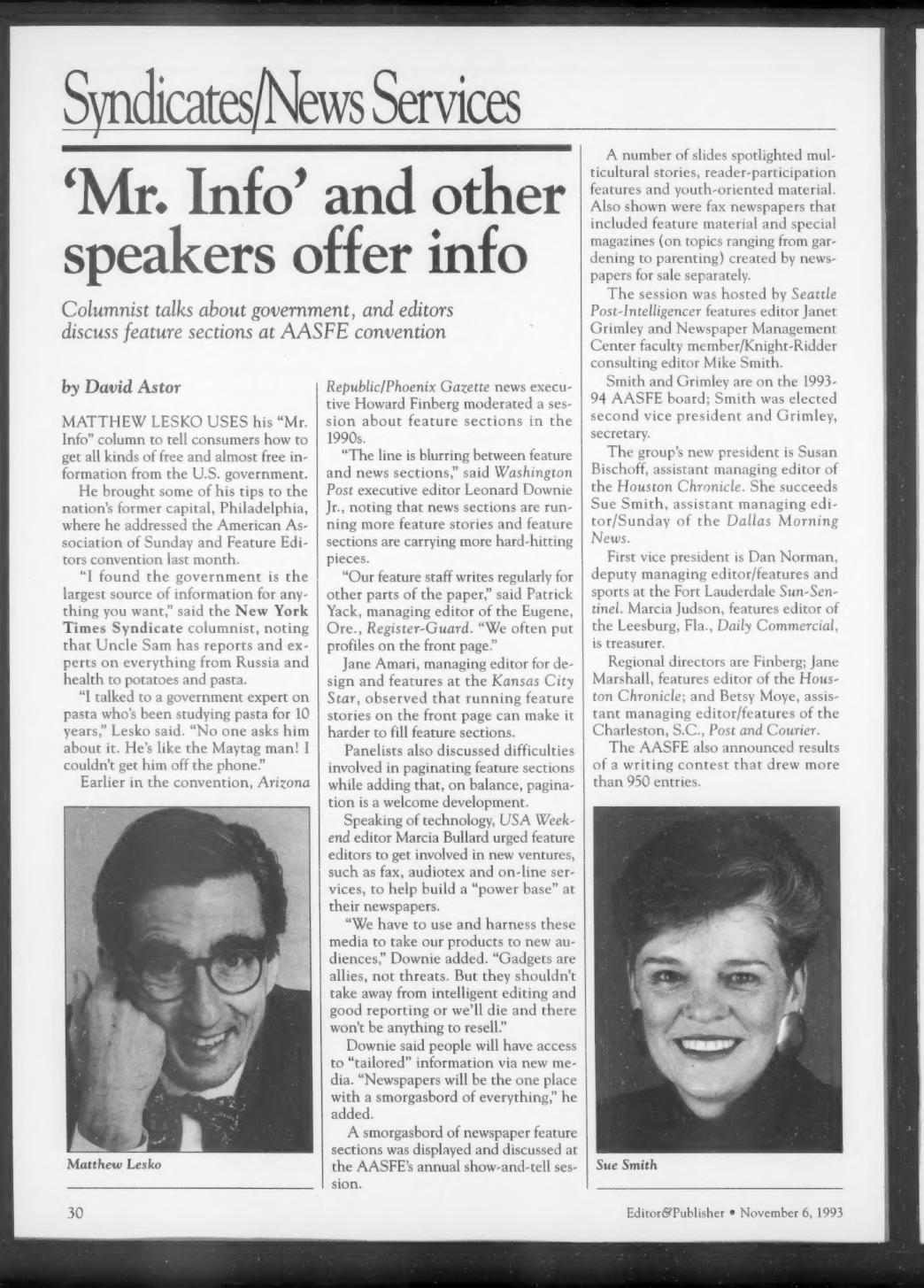
1993 Editor & Publisher article by David Astor on the Philadelphia convention of Sunday and feature editors

Gadgets Are Allies, Not Threats: Feature Editors Meet in Philadelphia

This is a report from Editor & Publisher of Nov. 6, 1993, written by David Astor, covering the American Association of Sunday and Feature Editors convention held the previous month in Philadelphia. The headliner was Matthew Lesko, the New York Times Syndicate columnist behind “Mr. Info,” whose specialty was telling readers how to pry free information out of the federal government. Lesko’s best line was about a federal pasta expert:

I talked to a government expert on pasta who’s been studying pasta for 10 years. No one asks him about it. He’s like the Maytag man! I couldn’t get him off the phone.

Earlier in the convention I moderated a session about feature sections in the 1990s. Astor identified me as an Arizona Republic/Phoenix Gazette news executive — my title at the time. The panel included Leonard Downie Jr., executive editor of the Washington Post; Patrick Yack, managing editor of the Eugene, Ore., Register-Guard; and Jane Amari, managing editor for design and features at the Kansas City Star.

The discussion centered on how the walls between sections were coming down.

The line is blurring between feature and news sections.

Downie noted that news sections were running more feature stories and feature sections were carrying more hard-hitting pieces. Yack said his feature staff wrote regularly for other parts of the paper and often put profiles on the front page. Amari pointed out the flip side: moving feature stories to Page One makes it harder to fill the feature sections. The panel also talked about the difficulties of paginating feature sections, while agreeing that, on balance, pagination was a welcome development.

Technology was the other thread. USA Weekend editor Marcia Bullard urged feature editors to get involved in fax, audiotex and on-line services as a way to build a “power base” at their papers. Downie’s response is the line I’ve remembered:

We have to use and harness these media to take our products to new audiences. Gadgets are allies, not threats. But they shouldn’t take away from intelligent editing and good reporting or we’ll die and there won’t be anything to resell.

He added that readers would soon have access to “tailored” information through new media, but that Newspapers will be the one place with a smorgasbord of everything.

The story closes with AASFE board business. Susan Bischoff of the Houston Chronicle became president, succeeding Sue Smith of the Dallas Morning News. I was listed as one of the regional directors, along with Jane Marshall of the Houston Chronicle and Betsy Moye of the Charleston, S.C., Post and Courier.

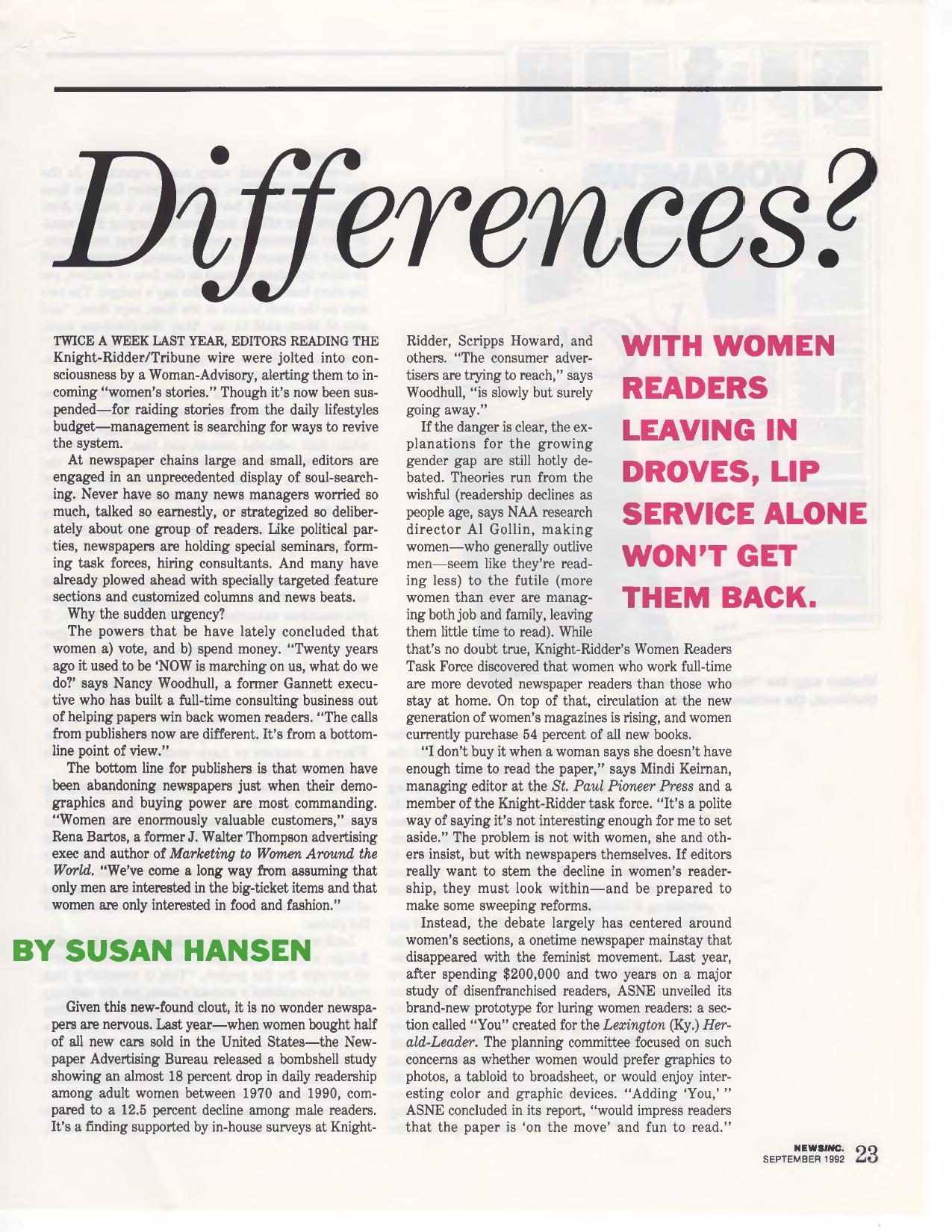
NewsInc. September 1992 article spread headlined "Differences?" examining why women were leaving newspapers

Looking at the Newspaper Gender Gap,1992

An article by Susan Hansen in the September 1992 issue of NewsInc., examining why women were leaving newspapers and what editors were — and weren’t — doing about it. The piece opens with the Knight-Ridder/Tribune wire’s short-lived “Woman-Advisory” alerts and moves through the task forces, consultants, seminars and targeted sections that chains large and small had launched, driven less by principle than by economics.

The powers that be have lately concluded that women a) vote, and b) spend money.

The numbers cited: a Newspaper Advertising Bureau study showing an almost 18 percent drop in daily readership among adult women between 1970 and 1990, compared with a 12.5 percent decline among male readers; women holding only 10 percent of editor and executive editor slots at papers with circulations of more than 250,000, per the National Federation of Press Women; and a Women, Men, and Media Project survey of 20 front pages in February 1992 that found women claimed just 34 percent of bylines and only 13 percent of those referenced or quoted.

Quoted throughout are consultant and former Gannett executive Nancy Woodhull, St. Paul Pioneer Press managing editor Mindi Keirnan, Los Angeles Times associate editor Narda Zacchino, Washington Post columnist Judy Mann, Knight-Ridder vice president for news Jennie Buckner, and Georgetown linguist Deborah Tannen. Keirnan on the “no time to read” explanation:

“I don’t buy it when a woman says she doesn’t have enough time to read the paper… It’s a polite way of saying it’s not interesting enough for me to set aside.”

Much of the industry’s response, the article reports, centered on reviving women’s sections — ASNE‘s $200,000 “You” prototype for the Lexington (Ky.) Herald-Leader, and the Chicago Tribune‘s “Womanews,” which about 60 newspapers signed on to syndicate in its first year. Critics warned of ghettoizing serious coverage. Zacchino:

“I find women saying we need to do more in the rest of the paper. We should start on the front page—make women feel this entire newspaper has something of interest to them.”

A companion feature, “Advice and Dissent,” gave 10 newswomen free rein to critique the front pages of The New York Times and the Los Angeles Times. The panel: Deborah Howell of Newhouse News Service; Jacqui Banaszynski of the St. Paul Pioneer Press; Amy Kisman of USA Weekend; Nina Bernstein of New York Newsday; Emilia Askari of the Detroit Free Press; Renée Loth of the Boston Globe; columnists Judy Mann, Robin Abcarian of the L.A. Times and Betty Bayé of the Louisville Courier-Journal; and graphics director Laura Varon Brown of the Detroit Free Press. Their consensus was to focus on real people, replace foreign roundups with enterprise, and give women a presence.

“The truth about why women are leaving newspapers is self-evident,” says Washington Post columnist Judy Mann. “I don’t exist on these front pages.”

The article closes with examples of papers changing beats rather than adding sections — a full-time day care reporter and family page at the Charlotte Observer, expanded women’s sports and personal finance coverage at the Rocky Mountain News, and at the St. Paul Pioneer Press, reduced local political coverage, doubled education staffing, a new women’s health care reporter, and new consumer and local transportation beats. Keirnan on what convinced her staff, after she made line editors and reporters interview women readers and nonreaders directly:

“When people say to you ‘I read the paper while I blow dry my hair,’ you get religion.”

Typewritten 1974 Chicago Tribune staff report titled Proposals for Improving the Chicago Tribune and Attracting Younger Readers

Attracting Younger Readers: 1974 Tribune Report

This is a staff report from my early days at the Chicago Tribune, titled “Proposals for Improving the Chicago Tribune and Attracting Younger Readers.” It carries the names of nine staffers: Ovie Carter, Gary Deeb, Howard Finberg, Clarence Page, Don Pierson, Bill Plunkett, Schickedanz, Rick Soll and Linda Winer. We were tasked to help the Tribune reach younger readers.  We were the younger staff members; I had been at the Trib for just about 2 years.

The introduction doesn’t ease into the problem. It opens with a description of how the paper was being seen from the outside:

Big, bulky. Impersonal. Stodgy. More concerned with things than people. As much fun as drinking cod liver oil (good for you but not so easy to swallow). Nearly devoid of any flair, flamboyance, or personality.

The committee’s argument was that this was a problem of perception and image more than content, and that the attitudes outside the building were mirrored by the attitudes inside it.

Simply stated, the Chicago Tribune takes itself too seriously. This is not to diminish its role as one of the nation’s best newspapers. Rather, it is a suggestion that the time has come for the Chicago Tribune to slaughter, once and for all, many of its sacred cows.

From there the report goes section by section — main news, editorial page, Perspective, Tempo, sports, business, the picture page, comics, Metro, the Sunday paper, copy editing, promotion. The recommendations are specific and, in places, blunt. A page one index every day. Long stories jumped to a designated jump page. A news-feature editor responsible for Column 1 and other offbeat material. Tempo remade from an old-fashioned women’s section into a daily “magazine-of-life,” preferably as an easy-to-handle tabloid pullout for the bus or train commuter. Entertainment and the arts displayed prominently rather than buried. A pop-culture column three times a week. Business pulled out as its own section. Sports writing tightened, with irreverence and humor encouraged.

The masthead got its own recommendation:

Removal of the flag would not necessarily attract new readership by itself. However, the slogan “World’s Greatest Newspaper” should be dumped. Its hyperbolic nature is unsuitable for the Tribune’s newly acclaimed progressive attitude of fairness and credibility.

The editorial page came in for the harshest treatment — described as the single most offensive part of the paper to young readers, with editorials characterized as “prairie populism” and “jumping jingoism.” The committee acknowledged that asking the paper to moderate its editorial stance might be impractical, then added a line I still like:

Editorial writers are advised that it is not always necessary to stand athwart progress hollering “Halt!”

What holds up best, reading it now, are the sections on people rather than packaging. The report faulted the paper for poor use of staff — writers forced to write formula stories, individual voices absorbed into what the report called “the Grey Blob,” and very little discussion between writers and editors about the quality of work. It also pressed on coverage of women and on Black and Latin communities, noting that most coverage of those communities “still consists of crime news, special series, and Operation PUSH,” and calling for the paper’s shortcomings there to be thoroughly investigated.

The closing borrowed the paper’s own advertising line:

To paraphrase the Trib’s current ad-promo line, “We need a friend in the Tribune.”

Fifty-plus years later, the questions in this report — how does a newspaper reach readers who don’t already have the habit, and how does it let its own staff sound like human beings — have never really gone away. Only the platforms changed.