Attracting Younger Readers: 1974 Tribune Report
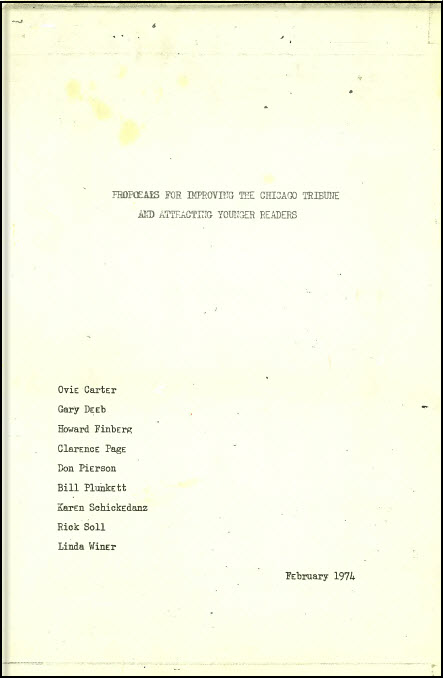
This is a staff report from my early days at the Chicago Tribune, titled “Proposals for Improving the Chicago Tribune and Attracting Younger Readers.” It carries the names of nine staffers: Ovie Carter, Gary Deeb, Howard Finberg, Clarence Page, Don Pierson, Bill Plunkett, Schickedanz, Rick Soll and Linda Winer. We were tasked to help the Tribune reach younger readers. We were the younger staff members; I had been at the Trib for just about 2 years.
The introduction doesn’t ease into the problem. It opens with a description of how the paper was being seen from the outside:
Big, bulky. Impersonal. Stodgy. More concerned with things than people. As much fun as drinking cod liver oil (good for you but not so easy to swallow). Nearly devoid of any flair, flamboyance, or personality.
The committee’s argument was that this was a problem of perception and image more than content, and that the attitudes outside the building were mirrored by the attitudes inside it.
Simply stated, the Chicago Tribune takes itself too seriously. This is not to diminish its role as one of the nation’s best newspapers. Rather, it is a suggestion that the time has come for the Chicago Tribune to slaughter, once and for all, many of its sacred cows.
From there the report goes section by section — main news, editorial page, Perspective, Tempo, sports, business, the picture page, comics, Metro, the Sunday paper, copy editing, promotion. The recommendations are specific and, in places, blunt. A page one index every day. Long stories jumped to a designated jump page. A news-feature editor responsible for Column 1 and other offbeat material. Tempo remade from an old-fashioned women’s section into a daily “magazine-of-life,” preferably as an easy-to-handle tabloid pullout for the bus or train commuter. Entertainment and the arts displayed prominently rather than buried. A pop-culture column three times a week. Business pulled out as its own section. Sports writing tightened, with irreverence and humor encouraged.
The masthead got its own recommendation:
Removal of the flag would not necessarily attract new readership by itself. However, the slogan “World’s Greatest Newspaper” should be dumped. Its hyperbolic nature is unsuitable for the Tribune’s newly acclaimed progressive attitude of fairness and credibility.
The editorial page came in for the harshest treatment — described as the single most offensive part of the paper to young readers, with editorials characterized as “prairie populism” and “jumping jingoism.” The committee acknowledged that asking the paper to moderate its editorial stance might be impractical, then added a line I still like:
Editorial writers are advised that it is not always necessary to stand athwart progress hollering “Halt!”
What holds up best, reading it now, are the sections on people rather than packaging. The report faulted the paper for poor use of staff — writers forced to write formula stories, individual voices absorbed into what the report called “the Grey Blob,” and very little discussion between writers and editors about the quality of work. It also pressed on coverage of women and on Black and Latin communities, noting that most coverage of those communities “still consists of crime news, special series, and Operation PUSH,” and calling for the paper’s shortcomings there to be thoroughly investigated.
The closing borrowed the paper’s own advertising line:
To paraphrase the Trib’s current ad-promo line, “We need a friend in the Tribune.”
Fifty-plus years later, the questions in this report — how does a newspaper reach readers who don’t already have the habit, and how does it let its own staff sound like human beings — have never really gone away. Only the platforms changed.