After attending the DRUPA conference in Hamburg in 2000, I wrote a memo to key executives at Central Newspapers, Inc. In that memo, I outlined three major developments with strategic implications for newspapers: growing interest in print personalization, hybrid press models blending offset and digital technologies, and increasing automation in production workflows. I noted the relevance of digital asset management and variable data printing, advising that newspapers explore how these innovations could improve cost control and product flexibility. The memo frames DRUPA 2000 as a critical checkpoint for understanding how commercial print technology could influence the future of newspaper publishing.
“Archival Documents” Items
Year 2000 – Are You Ready? 1998 Talk
Here is a summary of the presentation titled “The Year 2000 – Are You Ready?” delivered by Howard Finberg at the Great Lakes Press Association Conference in February 1998:
This presentation addressed the potential business and operational impacts of the Year 2000 (Y2K) computer bug on newspaper organizations. Finberg outlined risks posed by date-sensitive systems across editorial, advertising, and production departments. The talk encouraged newspaper executives to take the issue seriously, highlighting both technical and managerial vulnerabilities. He emphasized contingency planning, IT audits, vendor verification, and executive accountability. The presentation concluded by calling for industry-wide preparation and cooperation to ensure publishing continuity and public trust in the event of system failures or disruptions caused by Y2K-related errors.
NewsU Milestones & Projections, 2003
This internal planning document from 2003 outlines key development milestones and projected benchmarks for Poynter’s News University (NewsU) e-learning initiative. It includes a proposed timeline for prototype development, course offerings, marketing strategies, and technology deployment. The plan targets phased rollouts, with specific goals for course completions, registered users, and institutional partnerships. The document anticipates growing user engagement and national visibility by the end of year one. It also highlights core deliverables including a course management system, self-directed learning design, and alignment with journalism education goals established in early grant proposals.
Understanding PAFET, 1995
Summary of a February 7, 1995 presentation about PAFET, generated by AI
An Interview with PAFET – 1995 Slide Deck Summary
Overview:
PAFET (Partners Affiliated for Exploring Technology) was a research consortium formed by six leading U.S. media companies in the early 1990s: A.H. Belo, Central Newspapers, Cowles Media, Freedom Communications, McClatchy Newspapers, and Pulitzer Publishing. Collectively, these companies represented the second-largest daily newspaper circulation in the U.S.
Mission:
PAFET’s purpose was to support its member companies in exploring and understanding emerging technologies related to media content and marketing. It was not a development or operational body, but a strategic initiative focused on information-sharing and innovation.
“PAFET is not a development or operating entity… It provides information, experience, and analytical support.”
Key Objectives (1995):
-
Track technological and market threats to traditional newspapers
-
Identify opportunities for digital expansion
-
Support internal R&D efforts
-
Assist members in repurposing content across new platforms
-
Launch industry-focused consumer studies on online behavior
-
Monitor legislative and regulatory changes affecting digital media
Structure:
-
Management Committee: Company executives (e.g., Michael Pulitzer)
-
Operating Committee: Media strategists and technologists (e.g., Howard Finberg, Martha Duckert, David Lipman, Gary Pruitt)
-
Operated under the National Cooperative Research and Production Act (NCRPA)
1995 Priorities:
-
Launch a multi-market consumer study on online news habits
-
Create CD-ROM and digital publishing tools
-
Conduct innovation workshops for employment and real estate
-
Collaborate with vendors to improve repurposing workflows
-
Study the evolution of content markets and user behavior
American Press Institute Schedule: 1988
This 1988 flyer from the American Press Institute outlines its seminar offerings for newspaper professionals. API, based in Reston, VA, offered immersive, topic-specific programs ranging from editorial leadership and design to marketing, technology, and HR. The flyer highlights seminar structure, costs, admission criteria, and a robust schedule for continuing education in journalism and media management.
PAFET Meeting Schedule: 1997
Here’s an internal memo from the executive director regarding the Partners Affiliated for Exploring Technology [PAFET] discussing the 1997 meeting schedule
TO: Howard Finberg
FROM: Marla McDonald
SUBJECT: 1997 PAFET Meeting Schedule
*****
I have attached a revised schedule based on our discussion this morning. I switched the Jan OpCom and Nov MngCom meetings since Freedom is behind in hosting MngCom meetings, and then tried to select locations based on weather and Member Company balance. I also changed the date of the May MngCom meeting due to McClatchy scheduling conflicts (Gary Pruitt is the only MngCom member to notify me of date preferences).
Susan just reminded me that we have tentatively scheduled the next Internet Workshop in Dallas on January 16-17th – should we try to coordinate the OpCom meeting with this workshop? Is this workshop still on?
Changing Needs of Newspaper Readers, 1978
PAFET Operating Committee Meeting, October 1997
This PAFET operating committee was held in Boston, MA, October 20-21, 1997. The document includes agenda items and a discussion about 1998.
PAFET Committee Meetings, May 1997
The PAFET management committee met May 29, 1997 in Minneapolis, MN. The day before, May 28, the operating committee held its meeting.
PAFET Operating Committee Meeting, August 1995
PAFET Operating Committee Agenda and notes for Minneapolis, MN, meeting on August 22-23, 1995. It includes discussions about online activities and information about New Century Network.
PAFET Operating Committee Meeting, July 1995
PAFET Operating Committee Agenda and meeting notes, held in Seattle, WA on July 18-19, 1995. This document also includes the organization’s mission statement: The mission of PAFET shall be to assist individual member companies in the development of mechanisms for presentation and marketing of information using new technolgies, in order to help the member companies make better individual decisions concerning the future of their businesses.
PAFET Operating Committee, April 1996
PAFET Operating Committee meeting and agenda. Held in Phoenix, AZ. Includes documents about “Elect to Connect,” a project involving Newspapers in Education.
The NIE Project was initially established as an experiment in conducting joint development within PAFET. This area was selected in part based on the existing relationships (and history of collaboration) among PAFET NIE representatives. After several discussions, the group decided to focus the project on jointly developing curriculum to support the 1996 Elections. The curriculum would contain both a print and “new media” component (e.g. online/Internet, diskette, and/or CD-ROM).
PAFET Operating Meeting, March 1996
Agenda and information about the PAFET Operating Committee Meeting held in Raleigh, NC
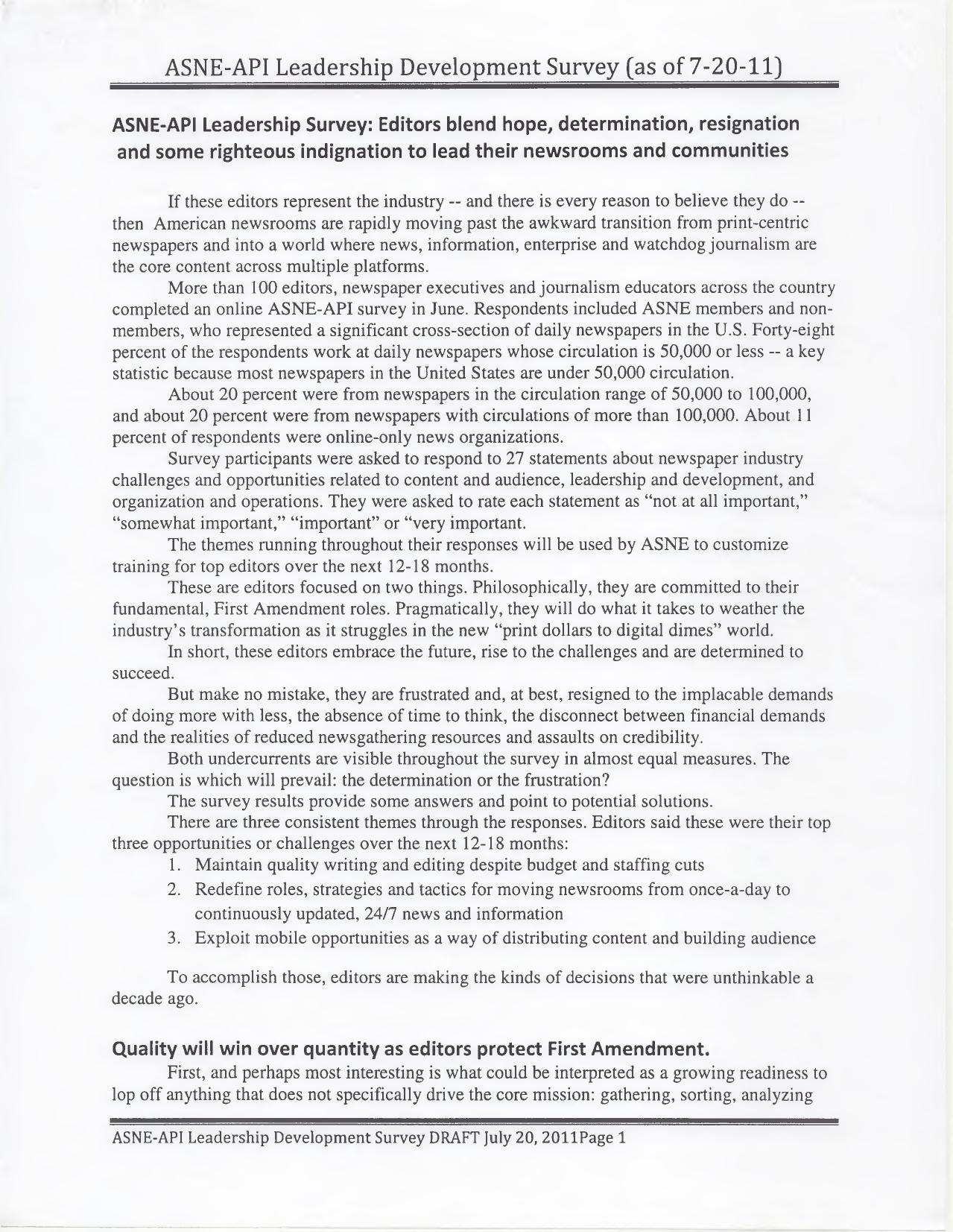
ASNE-API Leadership Survey, July 2011
This is the draft report of a joint survey by the American Society of News Editors and the American Press Institute, dated July 20, 2011. Invitations went to 1,830 editors at about 1,400 daily newspapers, 50 online-only news sites and the deans of 100 accredited journalism schools. One hundred five people responded — nearly half of them from papers with circulations of 50,000 or less, which is where most American dailies live. Respondents rated 27 statements about content and audience, leadership and development, and organization and operations. ASNE planned to use the findings to shape training for top editors over the following 12 to 18 months, beginning with a regional workshop in Lexington, Ky., in October.
The framing of the report is a tension the authors return to again and again — editors who are determined and editors who are worn down:
These are editors focused on two things. Philosophically, they are committed to their fundamental, First Amendment roles. Pragmatically, they will do what it takes to weather the industry’s transformation as it struggles in the new “print dollars to digital dimes” world.
The three top-ranked opportunities or challenges: maintain quality writing and editing despite budget and staffing cuts (83.8 percent called it “very important”); redefine roles, strategies and tactics for moving newsrooms from once-a-day publishing to continuously updated, 24/7 news; and exploit mobile opportunities to distribute content and build audience.
What gives the document its bite are the unattributed editor comments:
“It’s time,” wrote one editor, “for newsrooms to focus on finding ways to do fewer things well, instead of doing everything poorly.”
“Too many interruptions, distractions,” wrote one editor. “Not able to put together a stretch of time that’s long enough to focus and complete anything that can’t be accomplished in five minutes. … I can get a lot of things started, but it’s becoming harder and harder to see them through to successful completion.”
“We are all in this same leaky boat together and it’s time to let go of our old ideas about labor and management. We all need to start building a new ship — and fast.”
The draft press release attached to the report quotes Linda Grist Cunningham, vice chair of ASNE’s Leadership Committee; Carol Ann Riordan, interim executive director of the American Press Institute; and Mizell Stewart III, editor of the Evansville (Ind.) Courier & Press and chair of the Leadership Committee.
“The affirmation that editors can stay focused on good journalism as they wrestle with spreadsheets and new technology isn’t unexpected,” said Linda Grist Cunningham … “But it certainly is reassuring.”
The report ends with the question it can’t answer:
The question remains: Which will prevail? The determination to succeed, to beat back the naysayers? Or the resignation that comes with fear, inertia and a mourning of the loss of the past?
Reading this in 2026 — fifteen years later — the survey is a useful marker of where newsroom leadership thinking stood at the start of the mobile era. The priorities the editors named are no longer strategic questions; they were settled by events. What remains strikingly current is the complaint that there is no time to think, and the one editor who predicted the tablet future and wrote, “This is the generation of transition.”
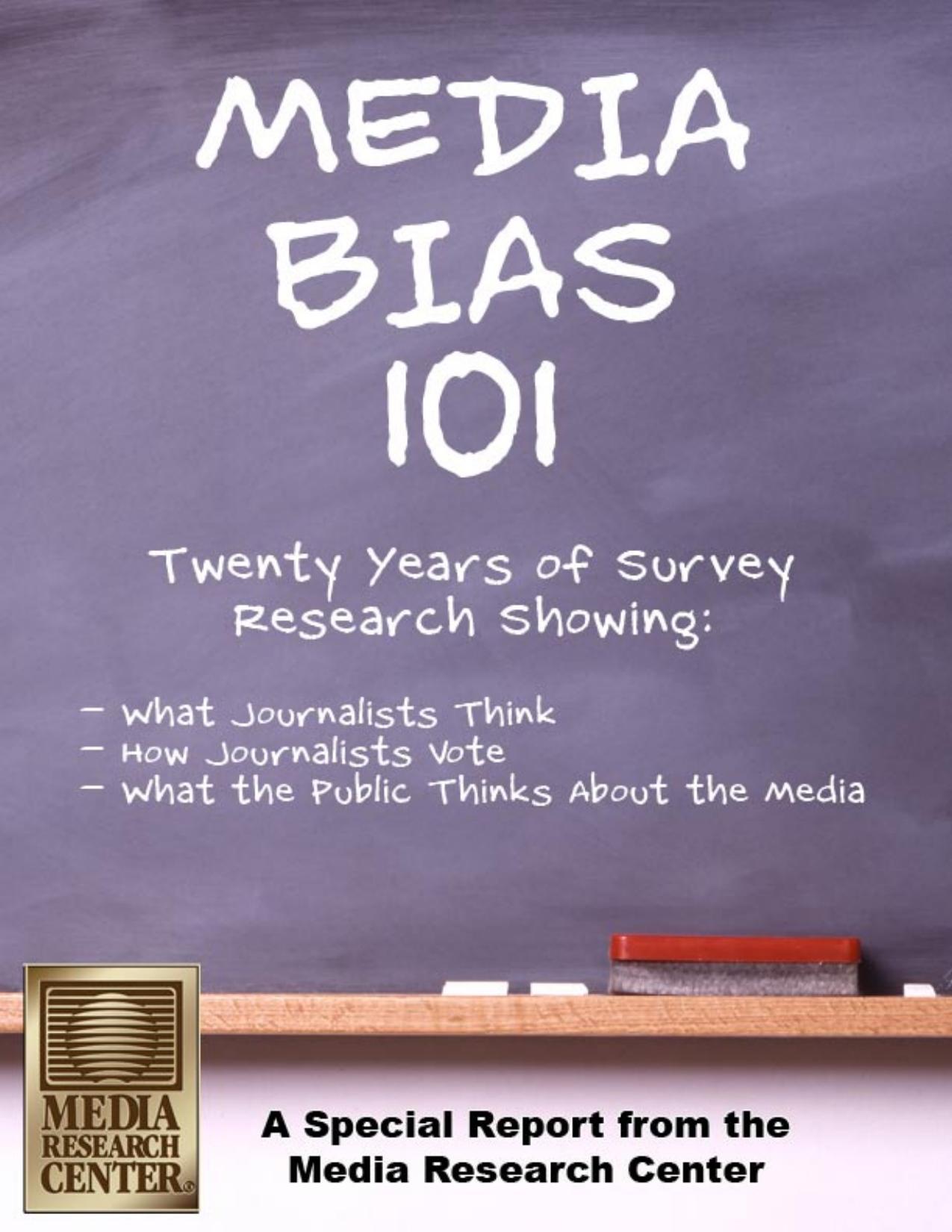
Media Bias 101: Twenty Years of Research
A special report from the Media Research Center, marked “Last Updated: October 2009,” collecting two decades of polling into a single argument. The booklet is organized in three chapters: what journalists think and how journalists vote; what the public thinks about the media; and what journalists themselves say about media bias — divided into those denying it and those admitting it.
Chapter one runs 16 exhibits, from the 1981 Lichter-Rothman study The Media Elite through the Weaver and Wilhoit surveys at Indiana University, the 1985 Los Angeles Times poll of 2,700 journalists at 621 newspapers, ASNE’s 1996 The Newspaper Journalists of the ’90s, Pew’s 2004 survey of 547 journalists and media executives, and Slate’s pre-election staff polls in 2000, 2004 and 2008. The MRC’s framing is explicit about the provenance of the data:
These surveys of journalists were conducted by professional pollsters, academics or news organizations, not by conservatives trying to score a political point against the press.
Chapter two turns the lens around, with 19 exhibits of public opinion research — Pew, Gallup, ASNE’s 1998 Journalism Credibility Project, Rasmussen, Harvard’s National Leadership Index, the Sacred Heart University Polling Institute, the Missouri School of Journalism. The chapter’s thesis:
These polls document a crisis for the news media. Years of skewed reporting has squandered the public’s trust.
The third chapter is a clip file of quotations, arranged as “Journalists Denying Liberal Bias” and “Journalists Admitting Liberal Bias,” running back to 1989. Among the admissions, New York Times Public Editor Daniel Okrent’s July 25, 2004 column asking “Is The New York Times a Liberal Newspaper?”:
Of course it is…. These are the social issues: gay rights, gun control, abortion and environmental regulation, among others. And if you think The Times plays it down the middle on any of them, you’ve been reading the paper with your eyes closed.
And, from the same chapter, Seattle Times Executive Editor David Boardman in an August 15, 2007 e-mail to his staff:
If we wore our politics on our sleeves in here, I have no doubt that in this and in most other mainstream newsrooms in America, the majority of those sleeves would be of the same color: blue.
The closing page describes the organization: founded in 1987, based in Alexandria, Virginia, with divisions including the Business & Media Institute, the Culture & Media Institute, TimesWatch.org, NewsBusters.org and CNSNews.com.
Reading this in 2026, the numbers are a period piece but the argument is not. Every trust-in-news survey since has kept measuring the same gap the MRC was documenting here, and the partisan split in who believes which outlet — which this report flagged in 2009 — has only widened. Worth having in the archive as a primary document: this is how the case was assembled, exhibit by exhibit, at the end of the first decade of the century.