21st Century Journalist, a 1994 Blueprint

In 1994, the Associated Press Managing Editors (APME) and The Freedom Forum released a wide-ranging, thoughtful report titled “The 21st Century Journalist.” This was not a position paper or a brief memo—it was a substantial, internally distributed document designed to challenge assumptions, spark discussion, and encourage newsroom leaders to rethink what it would mean to be a journalist in the decades ahead.

Though written well before the digital revolution took full hold, the report foreshadowed much of what would come—and in doing so, offered one of the most complete early frameworks for how newsrooms could evolve.

The report is organized around key themes that redefine the identity and work of journalists—not by platform or format, but by values, skills, and institutional alignment.

? Continuous Learning as Core Identity

“The 21st century journalist must be a learner—for life.”

The document highlights that a journalism degree is merely a starting point. True professionals must embrace ongoing training and adaptability—not just to technology, but to changing audiences and responsibilities.

? From Individualism to Teamwork

“The future newsroom will reward those who share, not hoard, information.”

Rather than lionize the lone-wolf reporter model, the report champions collaboration across roles and departments. Future newsrooms are portrayed as interdisciplinary teams that must operate with trust and shared goals.

? Strategic Understanding of the Newsroom Mission

“Journalists must understand the why behind their work—not just the how.”

The 21st-century journalist is described as someone who connects their work to the overall strategy and purpose of the organization. Curiosity is not enough—journalists must be mission-driven.

? Comfort with Uncertainty and Change

“They must work without a map.”

One of the report’s most lasting ideas is that future journalists will operate amid constant change—technologically, economically, and culturally. The best professionals will be those who can experiment, adjust, and remain effective even in ambiguity.

? A Deeper Commitment to the Audience

“The journalist must care about the reader, and the reader must know it.”

The document anticipates the rise of audience-first strategies, long before the formal creation of roles like engagement editors or audience producers. It promotes humility, listening, and service as journalistic traits.

Contributors and Leadership

The 21st Century Journalist report was developed under the leadership of two APME committees—Journalism Education and Newsroom Management—and supported by The Freedom Forum. Among the key contributors were:

  • Pam Fine, Managing Editor, The Indianapolis Star, who chaired the Journalism Education Committee.

  • Tom Kunkel, then with The Freedom Forum and a respected journalism educator and author, who helped frame the initiative and facilitate dialogue.

  • Kathy Best, Assistant Managing Editor, The Seattle Times, who helped guide the Newsroom Management Committee’s contributions.

  • Debra Hale, Editor, The Herald-Times (Bloomington, IN), and a key voice in translating management perspectives into newsroom action.

  • Doug Fisher, then with The News & Observer, who contributed to the emphasis on training, flexibility, and institutional learning.

These individuals—along with others across participating newsrooms—played a vital role in developing a report that was not only aspirational but rooted in real newsroom concerns. Their collective insights shaped a practical, values-based framework for rethinking journalism in the digital age.


2025 Retrospective

Three decades after its publication, The 21st Century Journalist stands out as a foundational document in journalism’s digital transition. Long before newsrooms adopted CMS platforms, hosted webinars, launched newsletters, or experimented with social media, this report correctly identified the professional transformation that would be required.

Today’s most successful journalists and media organizations reflect the report’s values: they are team-based, adaptable, deeply audience-aware, and committed to lifelong learning. Moreover, the report’s tone—serious, pragmatic, and forward-thinking—contrasts with the panic that often marked later reactions to disruption.

This report wasn’t just ahead of its time; it was deeply humane. It reminded newsroom leaders that technology would not be the solution or the problem—people would be. And how those people learned, collaborated, and cared would determine the industry’s future.
Techno-Evangelism in the Newsroom Revisited, 2025

[This post was written with the help of AI (ChatGPT) under the direction of Howard Finberg, using original materials from the 1993 SND workshop.]

In October 1993, Howard Finberg, then a senior executive at Phoenix Newspapers, presented a bold and forward-thinking call to action at the Society for News Design (SND) workshop in Dallas. His message? Technology alone doesn’t transform journalism—leadership does.

In a trio of materials—his presentation slides, a one-page manifesto, and an adapted quiz on “techno-types”—Finberg introduced the concept of techno-evangelism. This philosophy positioned newsroom managers not just as adopters of tools, but as cultural guides capable of leading staff through the disruptions of digital transformation.

“Technology is not hardware or even software,” Finberg emphasized. “It’s about workflow—how people work, how information moves, and how decisions are made.”

A Culture Shift, Not Just a Technical One

Finberg’s insights in these documents reflect a growing realization in the early 1990s that digital change was not just about adding computers—it required restructuring editorial thinking and habits. Drawing a distinction between evolutionary changes like hot type to cold type and revolutionary changes like digital publishing, Finberg argued that this moment required newsroom leaders to step into the unknown.

“Techno-evangelism means finding a leader who will take risks, become a teacher, shoulder responsibilities, and be willing to go wandering in the ‘desert.’”

That metaphor—a lonely figure advocating change in a skeptical environment—was not accidental. Many newsroom leaders at the time were still uneasy with even basic digital tools. To address this, Finberg included a humorous quiz that helped participants identify if they were Techno-Phobes, Techno-Boomers, or Techno-Wizards. His approach was thoughtful but practical, focused not on hype, but on education and empathy.

Connections to Other Work

This presentation links conceptually with Finberg’s earlier and later work:

Across these efforts, a consistent message emerges: people, not platforms, determine whether technology succeeds or fails in journalism.

AI Conclusion 2025
As we revisit this pivotal moment through the lens of the Digital Futurist archive, it’s clear that Finberg’s guidance still resonates in today’s AI-infused media world. The same challenges he identified—skepticism, organizational inertia, and the need for cultural leadership—are present again as AI tools enter the newsroom. Institutions like The Associated Press have emphasized editorial oversight and human accountability when deploying AI, echoing Finberg’s focus on workflow and responsibility. The New York Times and other major media organizations have released AI principles that stress the central role of editorial judgment. Meanwhile, journalism philanthropy groups such as the Craig Newmark Foundation have emphasized training, transparency, and newsroom culture as essential to successfully integrating new technologies. Finberg’s vision—of leaders willing to explore, teach, and humanize technological change—continues to offer a roadmap that is as relevant today as it was in 1993.

Impact of Technology on Newsrooms, 1993

In a forward-looking presentation at the Seybold Conference in San Francisco in 1993, I explore the transformational impact of digital technology on the newsroom. Speaking in 1993, at the dawn of the digital revolution, I emphasize that technological change isn’t just about adopting new tools—it’s about fundamentally rethinking how journalism is practiced, how newsrooms are structured, and how people work together. The shift to digital, I argue, is not just evolutionary but revolutionary.

Key Points

  • Circular Workflows: Traditional linear production is giving way to a more collaborative, integrated process where editing, design, and content development happen in tandem.

  • Hybrid Roles – The “One Journalist”: Roles are blending. Journalists increasingly need to be multi-skilled—handling editing, layout, design, and even multimedia (audio, video, fax).

  • Organizational Shifts: Old org charts no longer reflect reality. The focus is moving toward fluid, cross-functional teams rather than rigid editorial silos.

  • Technology = Fewer Machines, Bigger Changes: While digital tools reduce hardware needs and cut costs, they also force reevaluation of workflows and staffing.

  • Tech is About People: Choosing the right tools starts with understanding how people work and how tasks flow. The goal is to enable, not restrict.

  • Leadership Through Learning: Managers must lead by example—learning new tools themselves, supporting their teams, and helping leadership embrace change.

  • Evolution vs. Revolution: Recognizing the difference is key. Shifts like hot type to cold type are evolutionary. The move to digital production is revolutionary—and demands a new mindset.

The file is a PDF of the presentation slides.


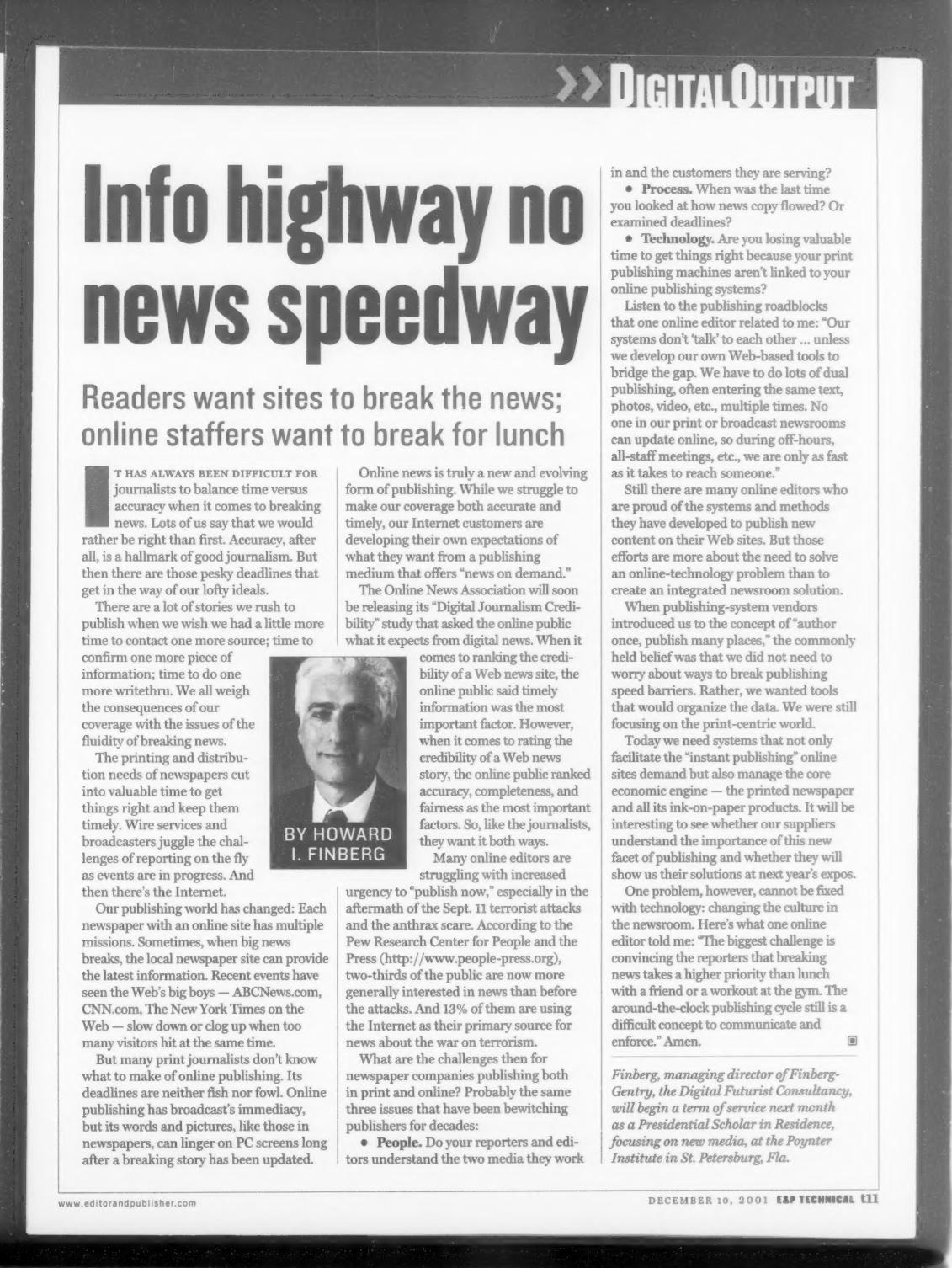
Editor & Publisher column headlined "Info highway no news speedway" from December 10, 2001

Info Highway: No News Speedway

A column I wrote for Editor & Publisher, published December 10, 2001, under the headline “Info highway no news speedway” and the subhead: “Readers want sites to break the news; online staffers want to break for lunch.”

The piece takes up the old tension between speed and accuracy and argues that online publishing has made it harder to resolve, because its deadlines are “neither fish nor fowl” — broadcast immediacy combined with words and pictures that linger on screen the way print does.

It cites the Online News Association‘s forthcoming “Digital Journalism Credibility” study, which found that the online public ranked timely information as the most important factor in judging the credibility of a Web news site, but ranked accuracy, completeness, and fairness first when judging an individual news story:

So, like the journalists, they want it both ways.

The column also notes Pew Research Center for People and the Press findings that two-thirds of the public were more generally interested in news than before the Sept. 11 attacks, and that 13% were using the Internet as their primary source for news about the war on terrorism.

The challenges for companies publishing in both print and online, I wrote, came down to the same three issues that had been “bewitching publishers for decades”: people, process, and technology. One online editor described the roadblocks this way:

Our systems don’t ‘talk’ to each other … unless we develop our own Web-based tools to bridge the gap. We have to do lots of dual publishing, often entering the same text, photos, video, etc., multiple times. No one in our print or broadcast newsrooms can update online, so during off-hours, all-staff meetings, etc., we are only as fast as it takes to reach someone.

The column closes on the one problem technology can’t solve — newsroom culture — quoting another online editor:

The biggest challenge is convincing the reporters that breaking news takes a higher priority than lunch with a friend or a workout at the gym. The around-the-clock publishing cycle still is a difficult concept to communicate and enforce.

The tagline at the end notes that I was then managing director of Finberg-Gentry, the Digital Futurist Consultancy, and would begin a term the following month as a Presidential Scholar in Residence, focusing on new media, at the Poynter Institute in St. Petersburg, Fla.

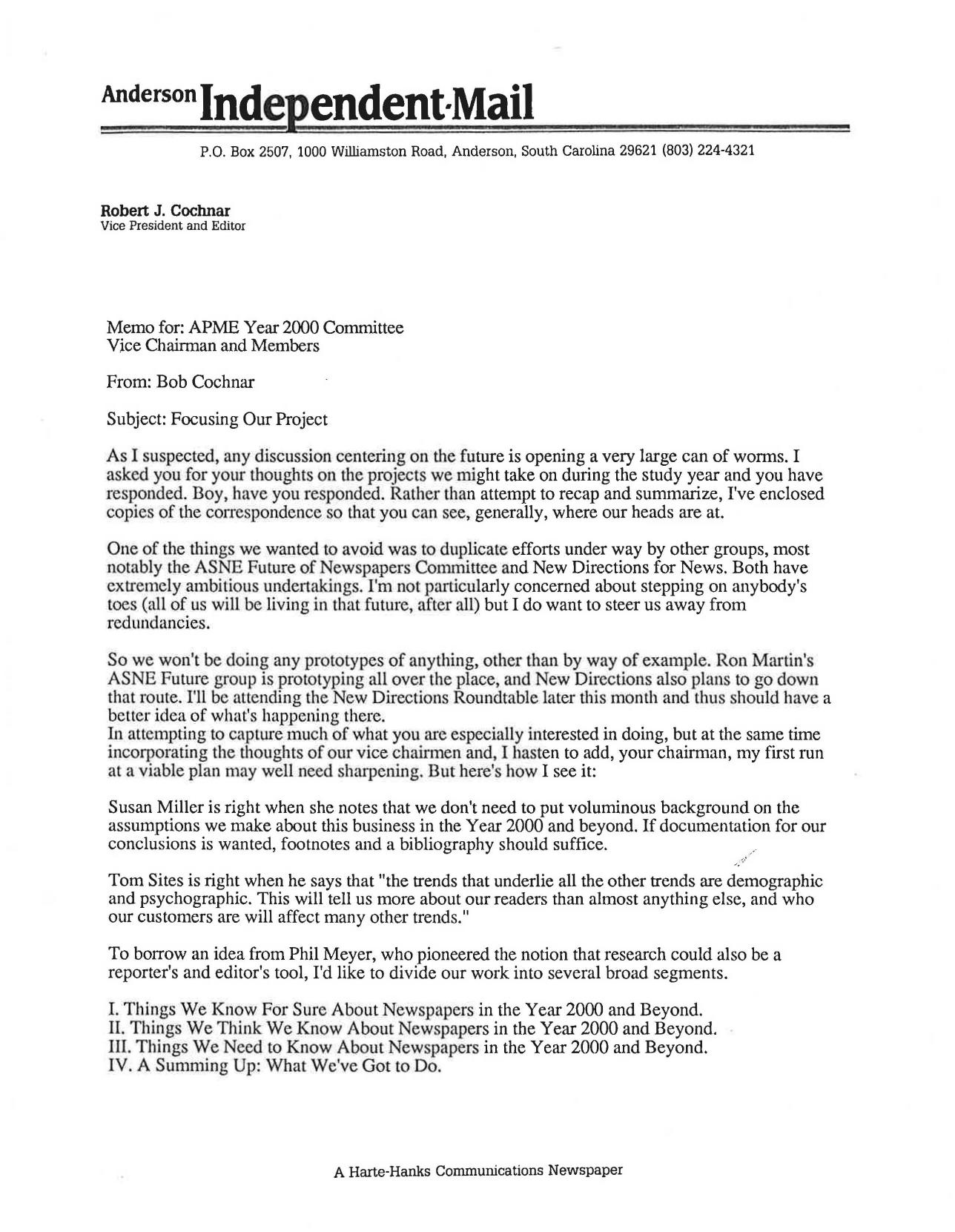
Typewritten memo from editor Robert J. Cochnar to the APME Year 2000 Committee outlining a study plan for newspapers

Focusing a Committee on the Year 2000

This is a memo from Robert J. Cochnar, vice president and editor of the Anderson Independent-Mail in South Carolina, to the members of the Associated Press Managing Editors Year 2000 Committee. He had asked the committee what it should study during its year of work, and the replies — enclosed with the memo, from papers all over the country — make up the bulk of the packet.

As I suspected, any discussion centering on the future is opening a very large can of worms. I asked you for your thoughts on the projects we might take on during the study year and you have responded. Boy, have you responded.

I’m in this document twice: once as a new addition to the committee, and once in the membership list, at 120 E. Van Buren St. in Phoenix.

Incidentally, I’ve expanded our committee a bit with some distinguished folks who have expressed their willingness to add their expertise to the hopper. They are Bob Haiman, who runs the Poynter Institute, and Howard Finberg, assistant managing editor for graphics at the Arizona Republic.

Cochnar’s first concern was not duplicating the work of the ASNE Future of Newspapers Committee, chaired by Ron Martin, or New Directions for News. So no prototypes. Instead he proposed a structure that still strikes me as a smart way to organize thinking about the future:

I. Things We Know For Sure About Newspapers in the Year 2000 and Beyond.
II. Things We Think We Know About Newspapers in the Year 2000 and Beyond.
III. Things We Need to Know About Newspapers in the Year 2000 and Beyond.
IV. A Summing Up: What We’ve Got to Do.

Not essays. An introduction, a conclusion, and in between, well-organized snippets from the literature and from smart people inside and outside the business — contradictions allowed, sources required. Cochnar described the goal as “a sort of extended data bank, or almanac, of facts, ideas and notions” that an editor could cherry-pick from a table of contents. He also liked a committee member’s suggestion that it all be treated as an interim report, with annual updates from future committees on the future, which he thought should adopt Satchel Paige’s line:

“Don’t look back; something may be gaining on us.”

The work was split into two groups: George Blake of the Cincinnati Enquirer on content and production, Susan Miller of Scripps Howard on everything else — circulation, advertising, competition, legal trends. Doug Ramsey at the Foundation for American Communications had proposed a co-sponsored committee meeting; Cochnar was thinking June, in Atlanta.

The enclosed correspondence is the real reward here. Tom Stites of the Chicago Tribune argued for starting with the underlying trends, a point Cochnar quoted back to the committee:

“the trends that underlie all the other trends are demographic and psychographic. This will tell us more about our readers than almost anything else, and who our customers are will affect many other trends.”

Stites also noted that Alvin Toffler wrote “Future Shock” on a personal computer but never mentioned personal computers in the book — a warning I’ve repeated in one form or another for most of my career. Others wrote about pagination and electronic photo handling reshaping newsroom structure, about classified advertising eventually moving to interactive electronic media, about retailing shifting away from the big department stores, about recruiting and keeping women and minorities, and about owners with no history in journalism buying profitable newspapers.

Reading it now, what stands out isn’t what the committee got wrong. It’s how much of it the industry saw coming and how little of it changed anyone’s behavior in time. And a small note of personal history: Bob Haiman joined this committee running Poynter, an institution where I’d spend a good chunk of my later career.

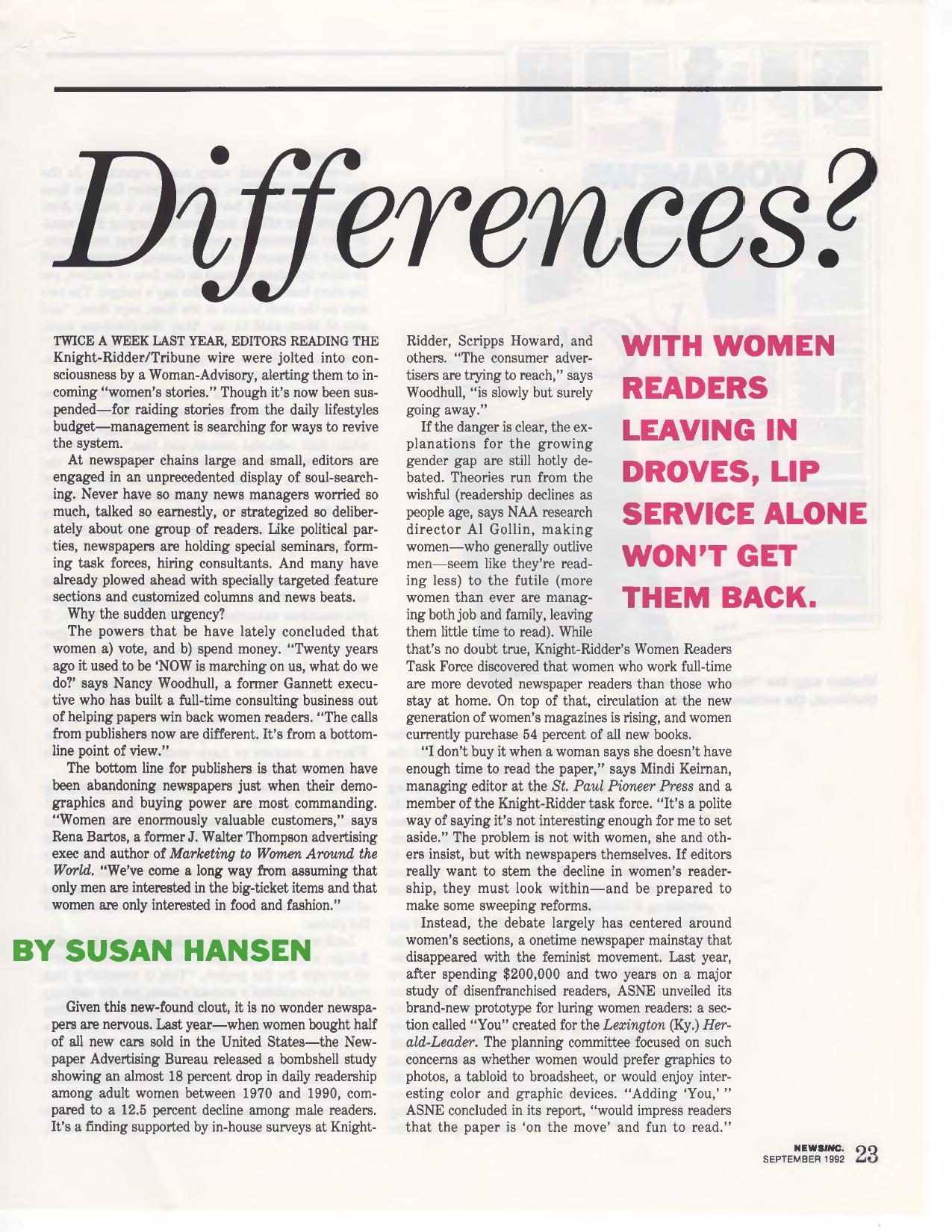
NewsInc. September 1992 article spread headlined "Differences?" examining why women were leaving newspapers

Looking at the Newspaper Gender Gap,1992

An article by Susan Hansen in the September 1992 issue of NewsInc., examining why women were leaving newspapers and what editors were — and weren’t — doing about it. The piece opens with the Knight-Ridder/Tribune wire’s short-lived “Woman-Advisory” alerts and moves through the task forces, consultants, seminars and targeted sections that chains large and small had launched, driven less by principle than by economics.

The powers that be have lately concluded that women a) vote, and b) spend money.

The numbers cited: a Newspaper Advertising Bureau study showing an almost 18 percent drop in daily readership among adult women between 1970 and 1990, compared with a 12.5 percent decline among male readers; women holding only 10 percent of editor and executive editor slots at papers with circulations of more than 250,000, per the National Federation of Press Women; and a Women, Men, and Media Project survey of 20 front pages in February 1992 that found women claimed just 34 percent of bylines and only 13 percent of those referenced or quoted.

Quoted throughout are consultant and former Gannett executive Nancy Woodhull, St. Paul Pioneer Press managing editor Mindi Keirnan, Los Angeles Times associate editor Narda Zacchino, Washington Post columnist Judy Mann, Knight-Ridder vice president for news Jennie Buckner, and Georgetown linguist Deborah Tannen. Keirnan on the “no time to read” explanation:

“I don’t buy it when a woman says she doesn’t have enough time to read the paper… It’s a polite way of saying it’s not interesting enough for me to set aside.”

Much of the industry’s response, the article reports, centered on reviving women’s sections — ASNE‘s $200,000 “You” prototype for the Lexington (Ky.) Herald-Leader, and the Chicago Tribune‘s “Womanews,” which about 60 newspapers signed on to syndicate in its first year. Critics warned of ghettoizing serious coverage. Zacchino:

“I find women saying we need to do more in the rest of the paper. We should start on the front page—make women feel this entire newspaper has something of interest to them.”

A companion feature, “Advice and Dissent,” gave 10 newswomen free rein to critique the front pages of The New York Times and the Los Angeles Times. The panel: Deborah Howell of Newhouse News Service; Jacqui Banaszynski of the St. Paul Pioneer Press; Amy Kisman of USA Weekend; Nina Bernstein of New York Newsday; Emilia Askari of the Detroit Free Press; Renée Loth of the Boston Globe; columnists Judy Mann, Robin Abcarian of the L.A. Times and Betty Bayé of the Louisville Courier-Journal; and graphics director Laura Varon Brown of the Detroit Free Press. Their consensus was to focus on real people, replace foreign roundups with enterprise, and give women a presence.

“The truth about why women are leaving newspapers is self-evident,” says Washington Post columnist Judy Mann. “I don’t exist on these front pages.”

The article closes with examples of papers changing beats rather than adding sections — a full-time day care reporter and family page at the Charlotte Observer, expanded women’s sports and personal finance coverage at the Rocky Mountain News, and at the St. Paul Pioneer Press, reduced local political coverage, doubled education staffing, a new women’s health care reporter, and new consumer and local transportation beats. Keirnan on what convinced her staff, after she made line editors and reporters interview women readers and nonreaders directly:

“When people say to you ‘I read the paper while I blow dry my hair,’ you get religion.”

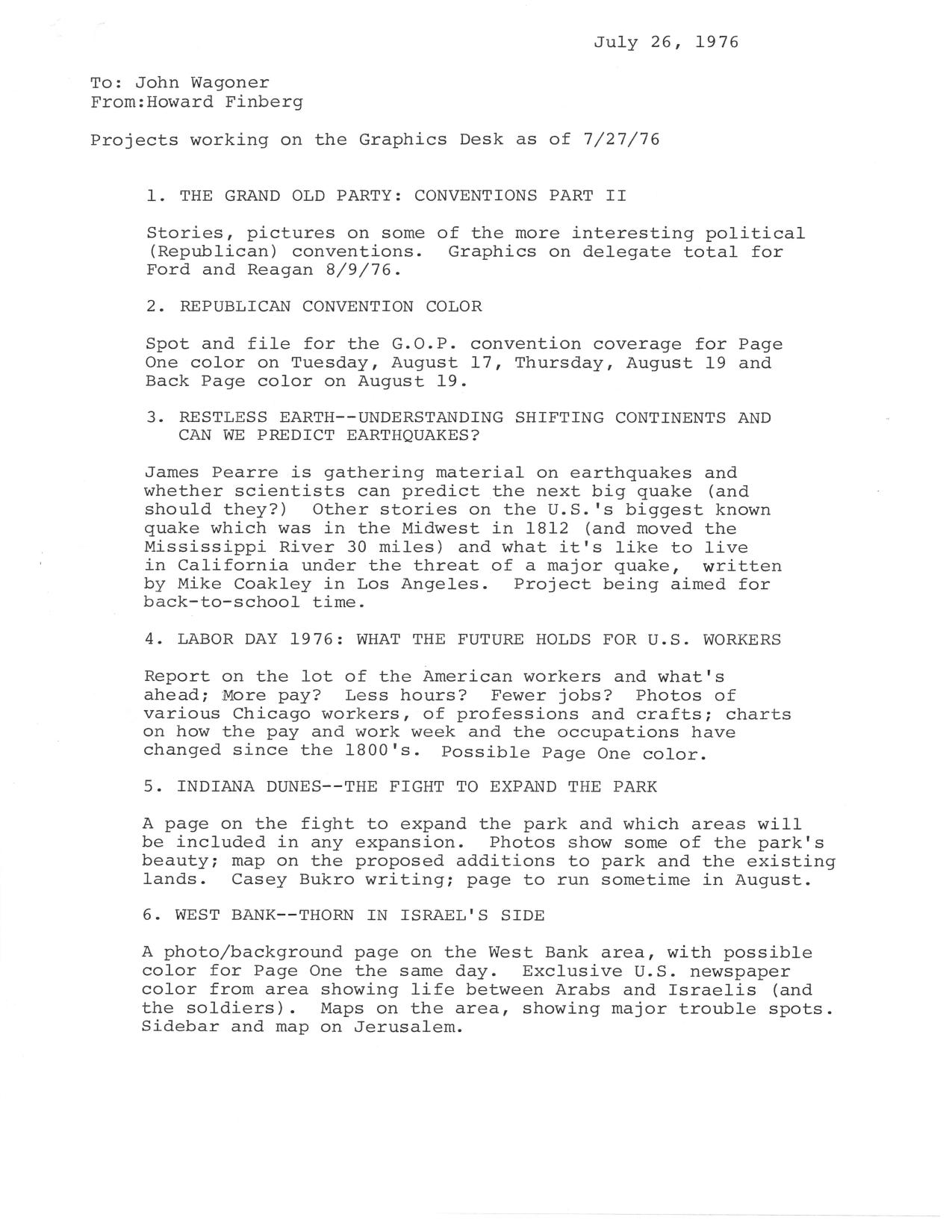
Typed July 1976 memo to Chicago Tribune news editor John Waggoner listing Graphics Desk projects in the works

Projects Working on the Graphics Desk, July 1976

A status memo I sent to John Waggoner, the Chicago Tribune‘s news editor, on July 26, 1976, listing what the Graphics Desk had in the works. It’s a snapshot of how an information graphics operation planned its projects — a mix of hard-news color coverage, explanatory packages, and long-lead background reports.

The list runs from the Republican convention (delegate totals for Ford and Reagan, Page One color on August 17 and 19) to a package on earthquakes aimed at back-to-school time:

Other stories on the U.S.’s biggest known quake which was in the Midwest in 1812 (and moved the Mississippi River 30 miles) and what it’s like to live in California under the threat of a major quake, written by Mike Coakley in Los Angeles.

Also on the schedule: a Labor Day report on American workers, with charts on how pay, the work week and occupations had changed since the 1800s; a page on the fight to expand the Indiana Dunes park, written by Casey Bukro; and a photo/background page on the West Bank, with maps of major trouble spots and a sidebar on Jerusalem.

The “other projects working” section is a reminder of what the mid-1970s looked like from a newsroom. The metric system:

Charts, tables, photos to make it easier on the reader who can’t tell a meter from a liter.

Plus solar energy (Bukro writing), “Weapons of the future” on Black Box technology (Jim Coates in Washington), and space after Viking, with the community turning its sights to the shuttle (Jim Pearre researching).

Copies went to Max McCrohon, Bill Jones, Joe Leonard, Denis Gosselin and Dick Leslie.

Typewritten 1974 Chicago Tribune staff report titled Proposals for Improving the Chicago Tribune and Attracting Younger Readers

Attracting Younger Readers: 1974 Tribune Report

This is a staff report from my early days at the Chicago Tribune, titled “Proposals for Improving the Chicago Tribune and Attracting Younger Readers.” It carries the names of nine staffers: Ovie Carter, Gary Deeb, Howard Finberg, Clarence Page, Don Pierson, Bill Plunkett, Schickedanz, Rick Soll and Linda Winer. We were tasked to help the Tribune reach younger readers.  We were the younger staff members; I had been at the Trib for just about 2 years.

The introduction doesn’t ease into the problem. It opens with a description of how the paper was being seen from the outside:

Big, bulky. Impersonal. Stodgy. More concerned with things than people. As much fun as drinking cod liver oil (good for you but not so easy to swallow). Nearly devoid of any flair, flamboyance, or personality.

The committee’s argument was that this was a problem of perception and image more than content, and that the attitudes outside the building were mirrored by the attitudes inside it.

Simply stated, the Chicago Tribune takes itself too seriously. This is not to diminish its role as one of the nation’s best newspapers. Rather, it is a suggestion that the time has come for the Chicago Tribune to slaughter, once and for all, many of its sacred cows.

From there the report goes section by section — main news, editorial page, Perspective, Tempo, sports, business, the picture page, comics, Metro, the Sunday paper, copy editing, promotion. The recommendations are specific and, in places, blunt. A page one index every day. Long stories jumped to a designated jump page. A news-feature editor responsible for Column 1 and other offbeat material. Tempo remade from an old-fashioned women’s section into a daily “magazine-of-life,” preferably as an easy-to-handle tabloid pullout for the bus or train commuter. Entertainment and the arts displayed prominently rather than buried. A pop-culture column three times a week. Business pulled out as its own section. Sports writing tightened, with irreverence and humor encouraged.

The masthead got its own recommendation:

Removal of the flag would not necessarily attract new readership by itself. However, the slogan “World’s Greatest Newspaper” should be dumped. Its hyperbolic nature is unsuitable for the Tribune’s newly acclaimed progressive attitude of fairness and credibility.

The editorial page came in for the harshest treatment — described as the single most offensive part of the paper to young readers, with editorials characterized as “prairie populism” and “jumping jingoism.” The committee acknowledged that asking the paper to moderate its editorial stance might be impractical, then added a line I still like:

Editorial writers are advised that it is not always necessary to stand athwart progress hollering “Halt!”

What holds up best, reading it now, are the sections on people rather than packaging. The report faulted the paper for poor use of staff — writers forced to write formula stories, individual voices absorbed into what the report called “the Grey Blob,” and very little discussion between writers and editors about the quality of work. It also pressed on coverage of women and on Black and Latin communities, noting that most coverage of those communities “still consists of crime news, special series, and Operation PUSH,” and calling for the paper’s shortcomings there to be thoroughly investigated.

The closing borrowed the paper’s own advertising line:

To paraphrase the Trib’s current ad-promo line, “We need a friend in the Tribune.”

Fifty-plus years later, the questions in this report — how does a newspaper reach readers who don’t already have the habit, and how does it let its own staff sound like human beings — have never really gone away. Only the platforms changed.