Looking at the Newspaper Gender Gap,1992
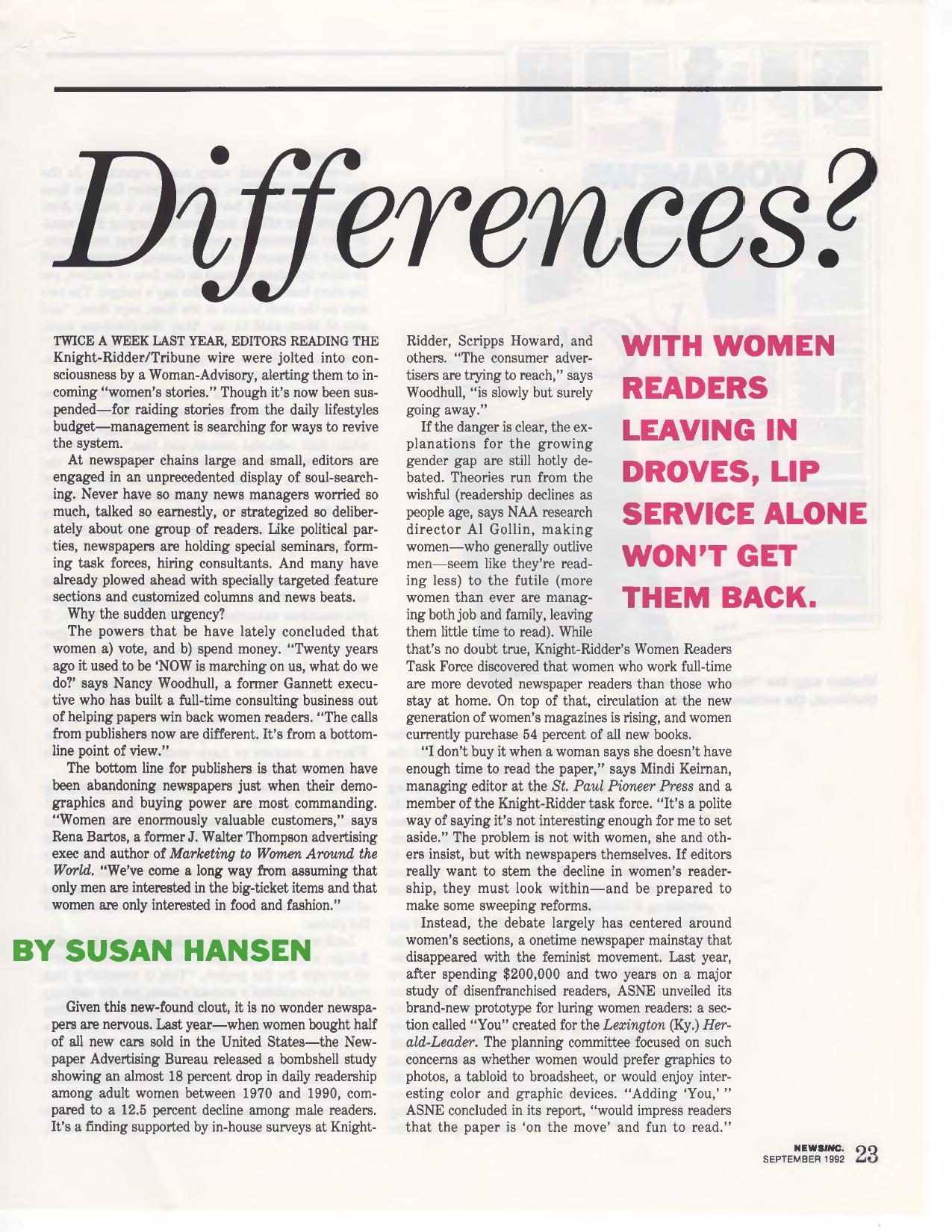
An article by Susan Hansen in the September 1992 issue of NewsInc., examining why women were leaving newspapers and what editors were — and weren’t — doing about it. The piece opens with the Knight-Ridder/Tribune wire’s short-lived “Woman-Advisory” alerts and moves through the task forces, consultants, seminars and targeted sections that chains large and small had launched, driven less by principle than by economics.
The powers that be have lately concluded that women a) vote, and b) spend money.
The numbers cited: a Newspaper Advertising Bureau study showing an almost 18 percent drop in daily readership among adult women between 1970 and 1990, compared with a 12.5 percent decline among male readers; women holding only 10 percent of editor and executive editor slots at papers with circulations of more than 250,000, per the National Federation of Press Women; and a Women, Men, and Media Project survey of 20 front pages in February 1992 that found women claimed just 34 percent of bylines and only 13 percent of those referenced or quoted.
Quoted throughout are consultant and former Gannett executive Nancy Woodhull, St. Paul Pioneer Press managing editor Mindi Keirnan, Los Angeles Times associate editor Narda Zacchino, Washington Post columnist Judy Mann, Knight-Ridder vice president for news Jennie Buckner, and Georgetown linguist Deborah Tannen. Keirnan on the “no time to read” explanation:
“I don’t buy it when a woman says she doesn’t have enough time to read the paper… It’s a polite way of saying it’s not interesting enough for me to set aside.”
Much of the industry’s response, the article reports, centered on reviving women’s sections — ASNE‘s $200,000 “You” prototype for the Lexington (Ky.) Herald-Leader, and the Chicago Tribune‘s “Womanews,” which about 60 newspapers signed on to syndicate in its first year. Critics warned of ghettoizing serious coverage. Zacchino:
“I find women saying we need to do more in the rest of the paper. We should start on the front page—make women feel this entire newspaper has something of interest to them.”
A companion feature, “Advice and Dissent,” gave 10 newswomen free rein to critique the front pages of The New York Times and the Los Angeles Times. The panel: Deborah Howell of Newhouse News Service; Jacqui Banaszynski of the St. Paul Pioneer Press; Amy Kisman of USA Weekend; Nina Bernstein of New York Newsday; Emilia Askari of the Detroit Free Press; Renée Loth of the Boston Globe; columnists Judy Mann, Robin Abcarian of the L.A. Times and Betty Bayé of the Louisville Courier-Journal; and graphics director Laura Varon Brown of the Detroit Free Press. Their consensus was to focus on real people, replace foreign roundups with enterprise, and give women a presence.
“The truth about why women are leaving newspapers is self-evident,” says Washington Post columnist Judy Mann. “I don’t exist on these front pages.”
The article closes with examples of papers changing beats rather than adding sections — a full-time day care reporter and family page at the Charlotte Observer, expanded women’s sports and personal finance coverage at the Rocky Mountain News, and at the St. Paul Pioneer Press, reduced local political coverage, doubled education staffing, a new women’s health care reporter, and new consumer and local transportation beats. Keirnan on what convinced her staff, after she made line editors and reporters interview women readers and nonreaders directly:
“When people say to you ‘I read the paper while I blow dry my hair,’ you get religion.”