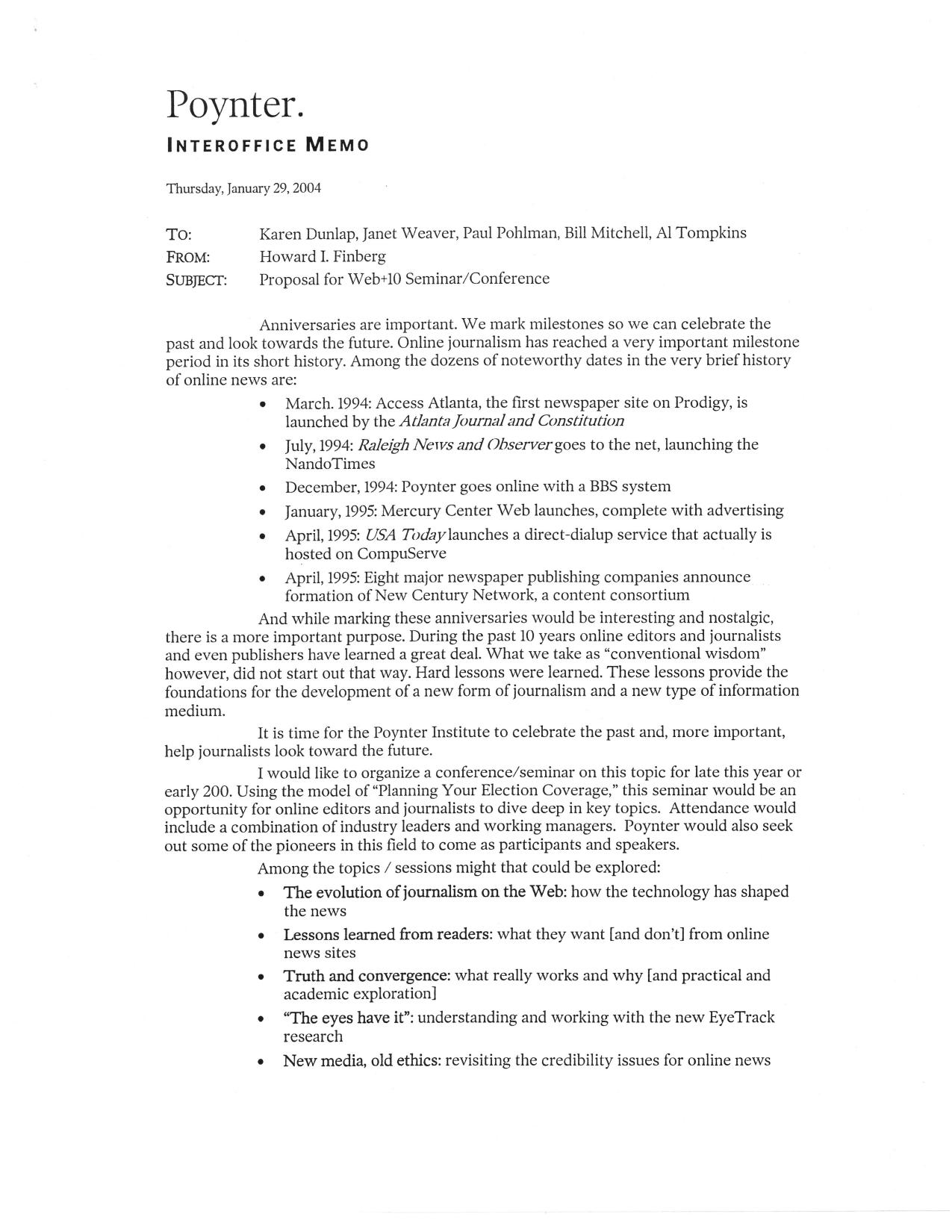
CNI’s Web Strategy Meeting, 1999

The March 15, 1999 memo titled “Web Strategy: Steering Committee Working Draft” was prepared for Central Newspapers, Inc. (CNI). It outlines a proposed strategic framework for how CNI should develop and manage its web presence across its various newspapers.

Key elements of the document include:

  • Need for Strategy and Coordination: Recognizing the fragmented and inconsistent web efforts across CNI properties, the memo proposes the creation of a Web Steering Committee to guide future development and unify strategy.

  • Editorial Control and Brand Integrity: Emphasis is placed on maintaining editorial standards and protecting the credibility of CNI’s newspaper brands online. The document highlights the importance of balancing innovation with journalistic values.

  • Business Goals: The memo acknowledges the growing commercial importance of the web and recommends that online efforts be aligned with broader business strategies, including advertising and revenue models.

  • Technology and Staffing: It notes the need for investment in technical infrastructure, training, and possibly new staff roles to support digital operations effectively.

  • Shared Resources and Collaboration: Proposes that CNI newspapers share best practices and technical solutions to avoid duplication of effort and benefit from economies of scale.

This draft represents an early, structured attempt by a traditional newspaper group to grapple with the implications of the digital transition, both operationally and editorially.


Retrospective (From 2025)

Looking back from 2025, this 1999 memo reads as a snapshot of a legacy media company at the edge of digital transformation. It captures the moment when the internet shifted from an experimental add-on to a core business and editorial concern.

While the memo does not predict the scale or speed of disruption that would follow—especially the impact of mobile, social media, and platform-driven distribution—it reveals a strong awareness that digital would require structural and cultural change. The idea of a centralized steering committee to shape digital policy foreshadows modern media governance models around digital ethics, product integration, and content monetization.

Ultimately, this document illustrates how media organizations like CNI were beginning to rethink their identity—not just as print publishers, but as multi-platform content providers. It’s a foundational artifact of journalism’s transition into the 21st century.
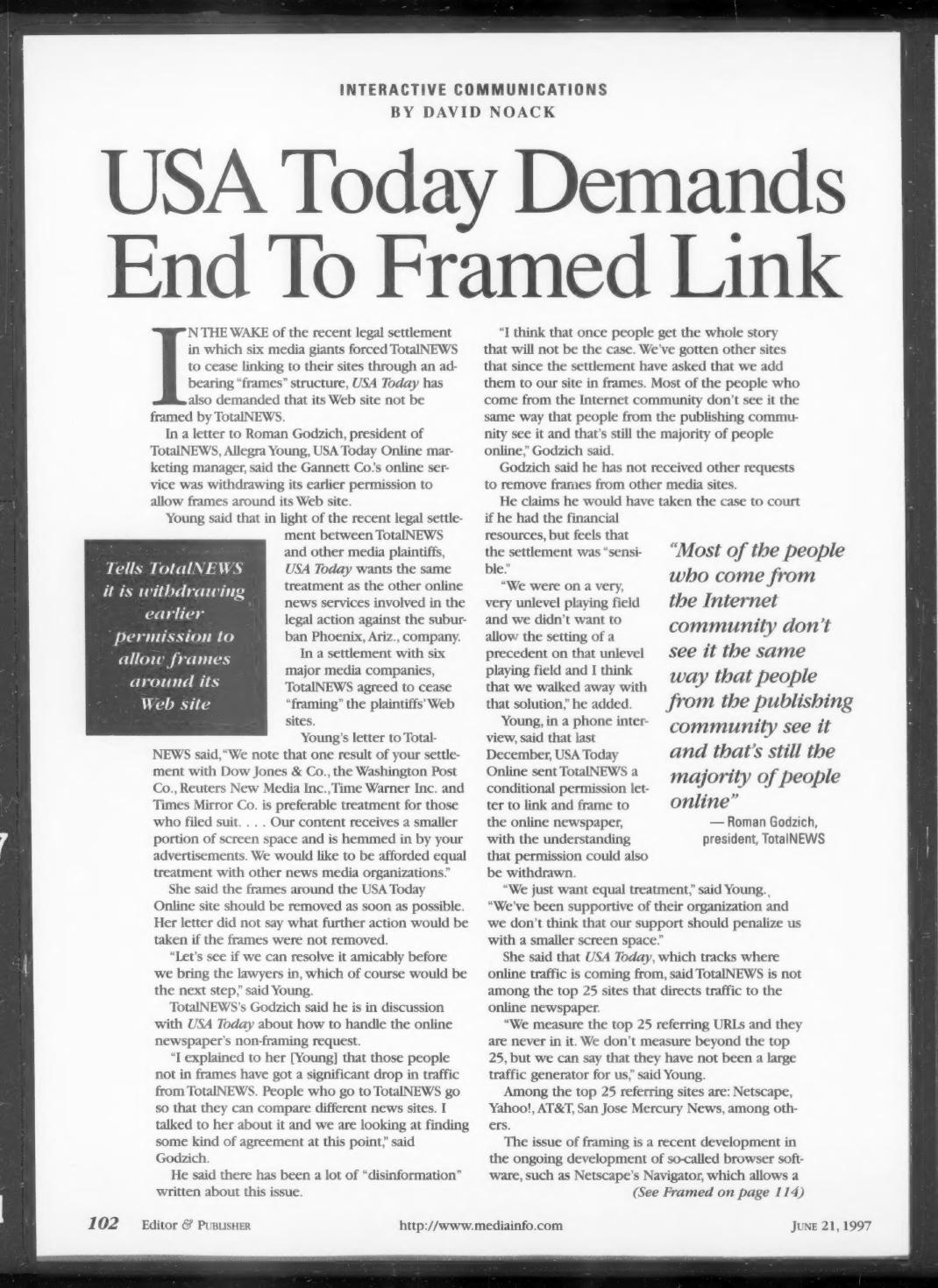
Driving Web to Print

At the 2002 IFRA Asia Conference in Bangkok (held March 20–22, 2002), I presented findings from a research project close to my heart—one that explored how newspapers could actually increase print subscriptions using their websites. Yes, increase. At the time, this idea ran counter to the conventional wisdom that digital only eroded print. [This is is a summary from my presentation slides.]

The project was a collaboration between my consultancy, Finberg-Gentry, and a number of forward-thinking circulation and online leaders across the industry. Our research included:

  • Over 100 site reviews
  • 290 responses from circulation managers
  • And dozens of in-depth interviews with media professionals

We asked a simple but often overlooked question: What if the web could help sell the newspaper?

What we found was encouraging—and revealing.

Some newspapers were already leveraging their digital platforms to drive subscriptions, but these successes had something in common: cooperation. When online and circulation teams worked together, when they shared goals and data, the results followed.

Unfortunately, that kind of collaboration was rare. Too often, subscription links were hidden “below the fold.” Technology systems didn’t talk to each other. Customer data wasn’t shared. And the user experience—especially for signing up or managing delivery—was clunky at best.

We identified several key challenges:

  • Most newspapers didn’t have an integrated system for online and print circulation.

  • Subscription buttons were buried or mislabeled—making it hard for users to take action.

  • Only 15% of papers offered web-exclusive pricing.

  • Many didn’t even allow basic customer service functions—like stopping or holding delivery—online.

But there were bright spots.

The Minneapolis Star Tribune used contests to generate over 6,000 subscription orders a year. The Poughkeepsie Journal tracked retention of web-generated subscriptions and found they performed just as well—if not better—than other channels. The Houston Chronicle developed a user-friendly online service center that set a new standard for self-service.

What all these examples showed was that technology and strategy must go hand-in-hand. We couldn’t just slap a “Subscribe” link on a site and hope it worked. We needed to design digital experiences that respected what users had come to expect—speed, convenience, clarity—and we needed to do it without forgetting the power and value of the printed product.

In the end, my presentation message was simple: web and print aren’t rivals—they’re partners. But partnership requires intent. It requires shared ownership. And, perhaps most importantly, it requires that we stop thinking in silos.

The opportunity for newspapers to increase their audiences across platforms is still very real. But it’s up to us to build the systems, culture, and customer experiences to make it happen. The full report is available on this site.

Poynter faculty and Indian journalists gathered for the traditional group photo at the Kochi workshop, Taj Gateway, March 2014

Points to Poynter: Report on Our India Workshop

In March 2014, Poynter took its teaching on the road to India — three three-day workshops, one each in Chennai, Kochi and Bengaluru, done in partnership with the U.S. Consulate. We covered more than 500 miles in the process. The Kochi workshop was organized with the Kerala Press Academy and ran March 23-25 at the Taj Gateway.

What makes this document historically interesting is that it isn’t ours. It’s a report by Ashok R. Chandran, an independent journalist and researcher in Palakkad, Kerala, who sat through all three days in Kochi and then wrote up the whole thing session by session — with a great deal more style and mischief than any of our own after-action summaries. He describes the workshop as something to zip through, seatbelts fastened, and the reader really does get carried along.

The report opens Day 1 with a detail that tells you exactly what era we were teaching in: a participant tweeting from the room while the inaugural speeches were still going, using a hashtag the faculty had created for the students.

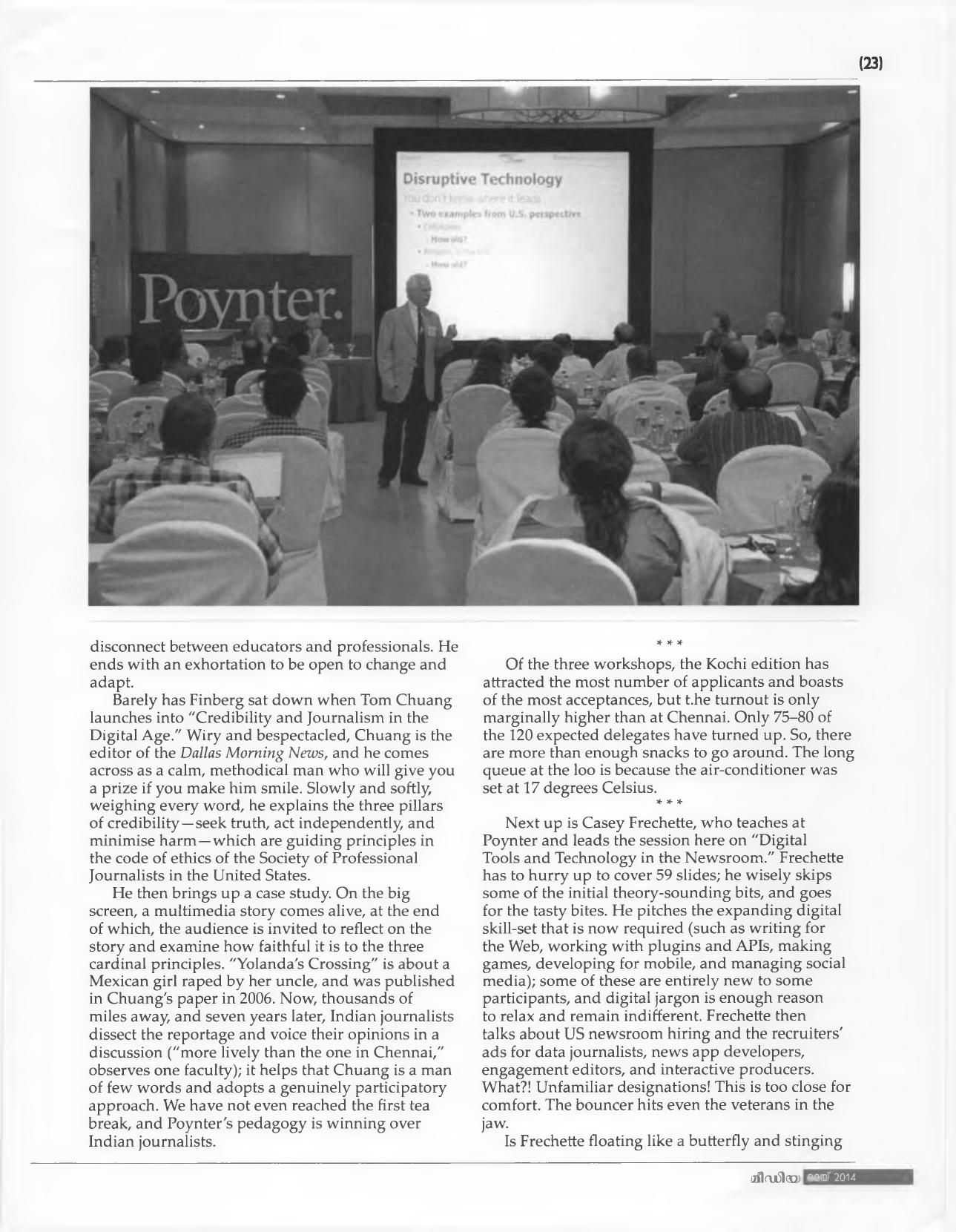
My own session kicked things off with disruption: Clayton Christensen, the collapse of U.S. newspaper advertising revenue, and then findings from The Future of Journalism Education 2013 report and a preview of Core Skills for the Future of Journalism, which was released the following month. The through-line was the gap between what professionals value and what journalism educators value, a gap that looked much the same in an Indian classroom as it did in an American one.

Chandran was kind about the session. Mostly.

It is not every day that one gets to see in this part of the world, an energetic 70+ educator enlightening the audience on “The Exciting, Changing Future of Journalism.”

I’ll happily take “energetic.” The rest of the faculty got sharper portraits: Tom Huang of The Dallas Morning News on credibility, story ideas and finding focus; Casey Frechette on digital tools and how to teach them; Zella Bracy of McClatchy on the business side; Jeffry Couch of the Belleville News-Democrat on transformational newsrooms and watchdog journalism; Sue Burzynski Bullard of the University of Nebraska on Twitter as a teaching tool and on digital ethics. And Vidisha Priyanka on multimedia, whose session Chandran renders as an action movie. I was tweeting from the room too:

@vidisha71 owns the room talking about multimedia at #PoynterIndia workshop. Lots of teaching.

The most valuable passage in the report, and the most uncomfortable, is the Day 2 session on editorial-business collaboration. Our faculty pushed for newsrooms to work across the old firewall; the Indian journalists in the room pushed back hard, describing the phenomenon of paid news and citing what the Times of India’s Vineet Jain had told the New Yorker: “We are not in the newspaper business, we are in the advertising business.” Chandran’s verdict on the exchange is blunt.

The faculty see a storm coming but apparently misread it as part of century-long rivalry between journalists and marketers in media houses.

He also notes that the session then turned genuinely two-directional, ending with what he calls a Gandhian compromise — collaboration for need, but not for greed. That’s the part I keep coming back to. We went to teach and got taught, which is the honest outcome of any cross-border training worth doing.

He closes with the group photo — “It is a Poynter tradition,” I told him — the certificates, and a feedback session that ran hot instead of polite, recorded by a room full of phone and iPad cameras. His last line is the headline of the piece:

The future is in digital, and the Malayali journalist is already there.