Driving Web to Print

At the 2002 IFRA Asia Conference in Bangkok (held March 20–22, 2002), I presented findings from a research project close to my heart—one that explored how newspapers could actually increase print subscriptions using their websites. Yes, increase. At the time, this idea ran counter to the conventional wisdom that digital only eroded print. [This is is a summary from my presentation slides.]

The project was a collaboration between my consultancy, Finberg-Gentry, and a number of forward-thinking circulation and online leaders across the industry. Our research included:

  • Over 100 site reviews
  • 290 responses from circulation managers
  • And dozens of in-depth interviews with media professionals

We asked a simple but often overlooked question: What if the web could help sell the newspaper?

What we found was encouraging—and revealing.

Some newspapers were already leveraging their digital platforms to drive subscriptions, but these successes had something in common: cooperation. When online and circulation teams worked together, when they shared goals and data, the results followed.

Unfortunately, that kind of collaboration was rare. Too often, subscription links were hidden “below the fold.” Technology systems didn’t talk to each other. Customer data wasn’t shared. And the user experience—especially for signing up or managing delivery—was clunky at best.

We identified several key challenges:

  • Most newspapers didn’t have an integrated system for online and print circulation.

  • Subscription buttons were buried or mislabeled—making it hard for users to take action.

  • Only 15% of papers offered web-exclusive pricing.

  • Many didn’t even allow basic customer service functions—like stopping or holding delivery—online.

But there were bright spots.

The Minneapolis Star Tribune used contests to generate over 6,000 subscription orders a year. The Poughkeepsie Journal tracked retention of web-generated subscriptions and found they performed just as well—if not better—than other channels. The Houston Chronicle developed a user-friendly online service center that set a new standard for self-service.

What all these examples showed was that technology and strategy must go hand-in-hand. We couldn’t just slap a “Subscribe” link on a site and hope it worked. We needed to design digital experiences that respected what users had come to expect—speed, convenience, clarity—and we needed to do it without forgetting the power and value of the printed product.

In the end, my presentation message was simple: web and print aren’t rivals—they’re partners. But partnership requires intent. It requires shared ownership. And, perhaps most importantly, it requires that we stop thinking in silos.

The opportunity for newspapers to increase their audiences across platforms is still very real. But it’s up to us to build the systems, culture, and customer experiences to make it happen. The full report is available on this site.
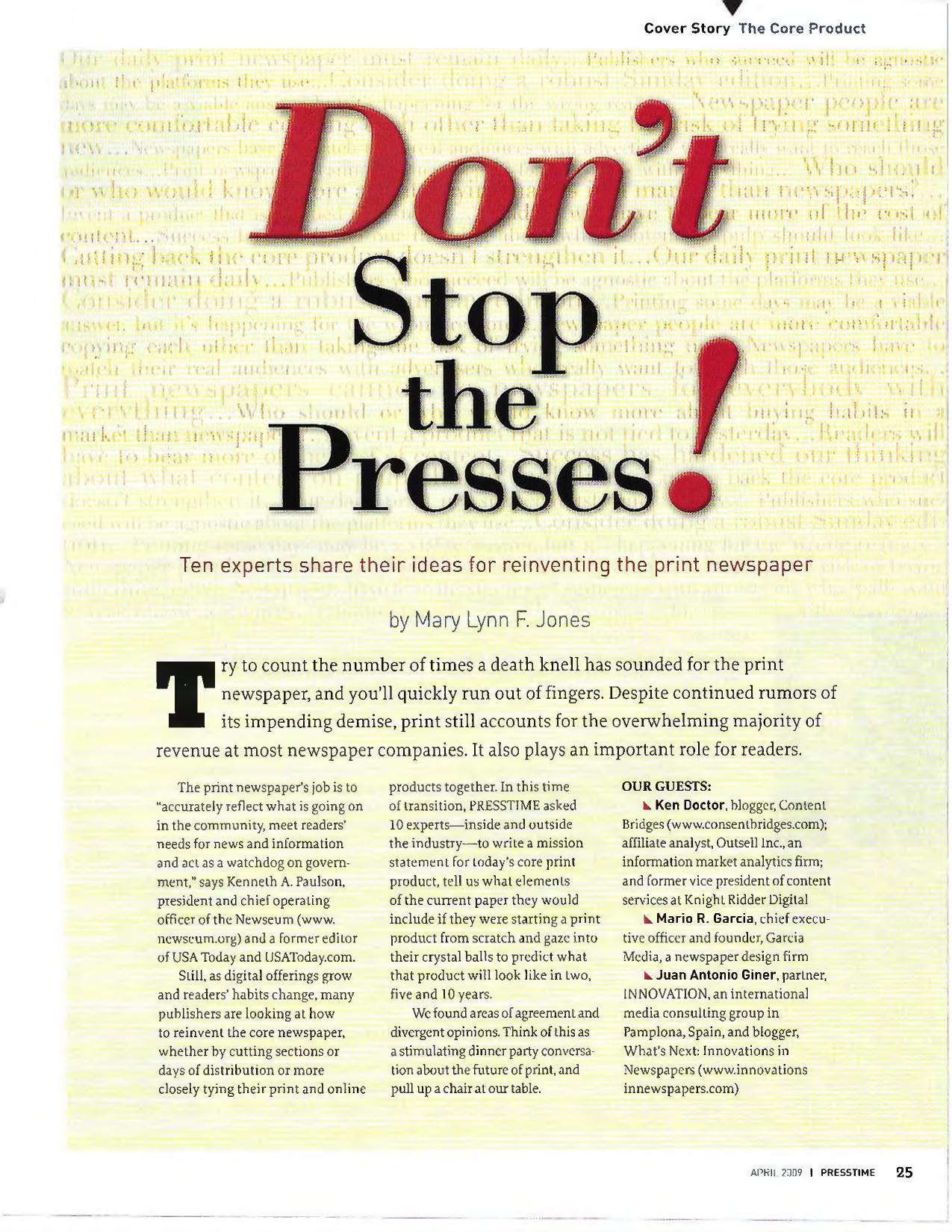
PRESSTIME magazine April 2009 cover story asking 10 experts to reinvent the core print product

Ten Experts Reinvent the Core Print Product, April 2009

The April 2009 cover story in PRESSTIME, the magazine of the Newspaper Association of America, asked 10 experts — inside and outside the industry — to write a mission statement for today’s core print product, say what they would keep if they were starting a print newspaper from scratch, and predict what that product would look like in two, five and 10 years. The piece was written by Mary Lynn F. Jones.

The guest list: Ken Doctor of Content Bridges and Outsell Inc.; Mario R. Garcia of Garcia Media; Juan Antonio Giner of INNOVATION in Pamplona, Spain; Charlotte H. Hall of the Orlando Sentinel and president of the American Society of Newspaper Editors; Alan Jacobson of Brass Tacks Design; Ted Leonsis of Lincoln Holdings LLC and vice chairman emeritus of AOL; Tim J. McGuire of the Walter Cronkite School of Journalism and Mass Communication at Arizona State University; Alan D. Mutter, the blogger behind Reflections of a Newsosaur; Kenneth A. Paulson of the Newseum; and Howard Weaver, formerly vice president of news for The McClatchy Co.

The story opens by noting that despite the repeated death knells, print still generated the overwhelming majority of newspaper company revenue. Paulson defined the print newspaper’s job as one that should

“accurately reflect what is going on in the community, meet readers’ needs for news and information and act as a watchdog on government”

Mutter argued that the framing itself was wrong:

Even though the newspaper generates 90 percent of a typical publisher’s sales, it is a mistake to think of it as the “core product.” The true core products of a newspaper company are its abilities to produce compelling content, build large audiences, sell advertising and make a profit.

On cutting sections and publication days, Doctor coined a term and a warning:

I call it “dayscrapping,” and it needs to be done judiciously. … Let’s not, above all, fool ourselves. Cutting back the core product doesn’t strengthen it. It may be a necessary evil, but pitching a less-is-more approach to readers won’t fool them.

Hall described the relationship between the two platforms in an image that stuck: print “stops the clock once a day,” and

One is the flowing river, changing constantly; the other is the rock on the shore, fixed and solid.

The predictions varied widely. Garcia expected compact and A4 formats inspired by magazines and books; Paulson expected smaller papers, higher single-copy prices and more reliance on circulation revenue; Hall declined to predict past two years. Jacobson was the most blunt:

In less than a year, there will be very few seven-day-a-week newspapers. In less than five years, newspapers will print for Sunday only. In less than 10 years, no newspapers will be printed.

The article notes that an expanded version of the report, including a podcast, was available at www.naa.org/presstime.