Demographic Wake-Up Call for Newspapers, 2003

In a 2003 commentary published in the Newspaper Association of Amereica‘s Presstime magazine, demographics expert Peter Francese offers a sobering but forward-thinking look at the structural challenges facing newspapers. Delivered at the NAA Future of Newspapers Conference, the piece outlines how changing lifestyles, shifting work patterns, and demographic transformations have deeply disrupted traditional readership models. [Summary created by AI]

Francese argues that the real threat to newspapers is not just the Internet—but the failure to adapt to evolving consumer behavior. Fewer Americans are buying newspapers, especially among those under 45. Even older readers—historically the industry’s loyal base—are spending less time at home, traveling more, and increasingly relying on digital alternatives.

Compounding the issue are demographic shifts: cities are getting younger and more diverse, while suburbs age and fragment. Women, especially, are more professionally engaged than ever, leaving less time for shopping and local community involvement—factors that impact advertisers and newspaper engagement alike.

Francese doesn’t just diagnose the problem—he issues a call to action. Newspapers must invest in understanding their readers, rethink delivery models, and modernize how they connect with new generations. He warns against clinging to outdated one-size-fits-all publishing strategies and urges publishers to embrace consumer data and feedback more aggressively.

He closes by championing Newspaper In Education (NIE) programs as essential for introducing young people to the value of a trusted news source. Without strategic outreach and content tailored to changing lifestyles, newspapers risk losing not just a generation—but their entire place in the cultural fabric.

“We have met the enemy, sir, and he is us,” Francese quotes. The future of newspapers, he insists, depends on recognizing—and acting on—this truth.

Source: Published in Presstime Magazine, May 2003
Driving Web to Print

At the 2002 IFRA Asia Conference in Bangkok (held March 20–22, 2002), I presented findings from a research project close to my heart—one that explored how newspapers could actually increase print subscriptions using their websites. Yes, increase. At the time, this idea ran counter to the conventional wisdom that digital only eroded print. [This is is a summary from my presentation slides.]

The project was a collaboration between my consultancy, Finberg-Gentry, and a number of forward-thinking circulation and online leaders across the industry. Our research included:

  • Over 100 site reviews
  • 290 responses from circulation managers
  • And dozens of in-depth interviews with media professionals

We asked a simple but often overlooked question: What if the web could help sell the newspaper?

What we found was encouraging—and revealing.

Some newspapers were already leveraging their digital platforms to drive subscriptions, but these successes had something in common: cooperation. When online and circulation teams worked together, when they shared goals and data, the results followed.

Unfortunately, that kind of collaboration was rare. Too often, subscription links were hidden “below the fold.” Technology systems didn’t talk to each other. Customer data wasn’t shared. And the user experience—especially for signing up or managing delivery—was clunky at best.

We identified several key challenges:

  • Most newspapers didn’t have an integrated system for online and print circulation.

  • Subscription buttons were buried or mislabeled—making it hard for users to take action.

  • Only 15% of papers offered web-exclusive pricing.

  • Many didn’t even allow basic customer service functions—like stopping or holding delivery—online.

But there were bright spots.

The Minneapolis Star Tribune used contests to generate over 6,000 subscription orders a year. The Poughkeepsie Journal tracked retention of web-generated subscriptions and found they performed just as well—if not better—than other channels. The Houston Chronicle developed a user-friendly online service center that set a new standard for self-service.

What all these examples showed was that technology and strategy must go hand-in-hand. We couldn’t just slap a “Subscribe” link on a site and hope it worked. We needed to design digital experiences that respected what users had come to expect—speed, convenience, clarity—and we needed to do it without forgetting the power and value of the printed product.

In the end, my presentation message was simple: web and print aren’t rivals—they’re partners. But partnership requires intent. It requires shared ownership. And, perhaps most importantly, it requires that we stop thinking in silos.

The opportunity for newspapers to increase their audiences across platforms is still very real. But it’s up to us to build the systems, culture, and customer experiences to make it happen. The full report is available on this site.

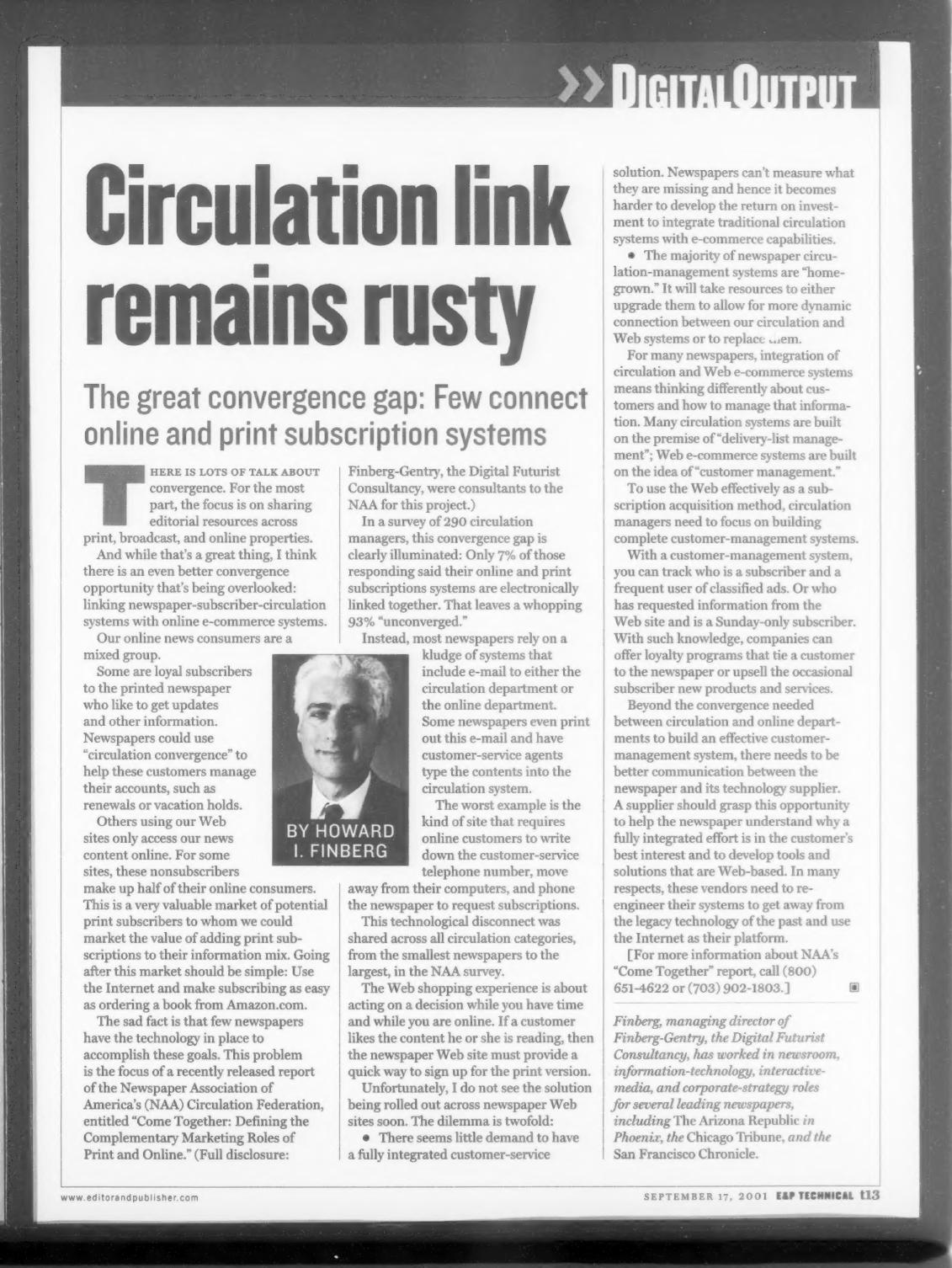
Tearsheet of the September 17, 2001 E&P Technical column headlined "Circulation link remains rusty" about the convergence gap between print and online subscription systems

Circulation-Web Link Remains Rusty, 2001

A column I wrote for E&P Technical, published September 17, 2001, under the headline “Circulation link remains rusty” and the deck “The great convergence gap: Few connect online and print subscription systems.” The argument: while the industry’s convergence conversation was focused on sharing editorial resources across print, broadcast, and online, a bigger opportunity was being ignored — connecting newspaper subscriber-circulation systems to online e-commerce systems.

And while that’s a great thing, I think there is an even better convergence opportunity that’s being overlooked: linking newspaper-subscriber-circulation systems with online e-commerce systems.

The column drew on a then-newly released report from the Newspaper Association of America‘s Circulation Federation, “Come Together: Defining the Complementary Marketing Roles of Print and Online.” As the column disclosed, Finberg-Gentry, the Digital Futurist Consultancy, were consultants to the NAA on the project. A survey of 290 circulation managers supplied the central number:

Only 7% of those responding said their online and print subscriptions systems are electronically linked together. That leaves a whopping 93% “unconverged.”

What newspapers used instead was described as “a kludge of systems” — e-mail to the circulation or online department, sometimes printed out and retyped into the circulation system by customer-service agents. The column singled out one practice as the worst case:

The worst example is the kind of site that requires online customers to write down the customer-service telephone number, move away from their computers, and phone the newspaper to request subscriptions

The disconnect held across all circulation size categories, from the smallest papers to the largest. The column identified a twofold dilemma: little internal demand for a fully integrated customer-service solution (papers “can’t measure what they are missing,” making ROI hard to build), and the fact that most circulation-management systems were “home-grown” and would take resources to upgrade or replace.

The underlying problem was framed as a difference in premise between the two kinds of systems:

Many circulation systems are built on the premise of “delivery-list management”; Web e-commerce systems are built on the idea of “customer management

The recommendation was for circulation managers to build complete customer-management systems — tracking, for example, who is a subscriber and a frequent user of classified ads, or who has requested information from the Web site and is a Sunday-only subscriber — to support loyalty programs and upselling. The column also called for better communication between newspapers and their technology suppliers, arguing vendors needed to re-engineer away from legacy technology and toward the Internet as their platform.