Demographic Wake-Up Call for Newspapers, 2003

In a 2003 commentary published in the Newspaper Association of Amereica‘s Presstime magazine, demographics expert Peter Francese offers a sobering but forward-thinking look at the structural challenges facing newspapers. Delivered at the NAA Future of Newspapers Conference, the piece outlines how changing lifestyles, shifting work patterns, and demographic transformations have deeply disrupted traditional readership models. [Summary created by AI]

Francese argues that the real threat to newspapers is not just the Internet—but the failure to adapt to evolving consumer behavior. Fewer Americans are buying newspapers, especially among those under 45. Even older readers—historically the industry’s loyal base—are spending less time at home, traveling more, and increasingly relying on digital alternatives.

Compounding the issue are demographic shifts: cities are getting younger and more diverse, while suburbs age and fragment. Women, especially, are more professionally engaged than ever, leaving less time for shopping and local community involvement—factors that impact advertisers and newspaper engagement alike.

Francese doesn’t just diagnose the problem—he issues a call to action. Newspapers must invest in understanding their readers, rethink delivery models, and modernize how they connect with new generations. He warns against clinging to outdated one-size-fits-all publishing strategies and urges publishers to embrace consumer data and feedback more aggressively.

He closes by championing Newspaper In Education (NIE) programs as essential for introducing young people to the value of a trusted news source. Without strategic outreach and content tailored to changing lifestyles, newspapers risk losing not just a generation—but their entire place in the cultural fabric.

“We have met the enemy, sir, and he is us,” Francese quotes. The future of newspapers, he insists, depends on recognizing—and acting on—this truth.

Source: Published in Presstime Magazine, May 2003
Cover of the Pew Internet & American Life Project report America's Online Pursuits, dated December 22, 2003

America’s Online Pursuits: Pew’s 2003 Snapshot

A December 22, 2003 report from the Pew Internet & American Life Project, pulling together more than three years of tracking survey data into one picture of who was online and what they were doing there. The numbers come from telephone interviews conducted by Princeton Survey Research Associates between March 2000 and December 2002, with additional data from an August 2003 survey.

The headline finding is a plateau. After the rush of the late 1990s, the online population had essentially stopped growing, even as the people already there kept finding more to do.

63% of Americans now go online — last measured in our August 2003 survey.

31% of Internet users who go online from home have broadband as of August 2003.

Email was still the center of gravity, and the report says so plainly. Among the 25 core activities tracked, online banking grew fastest — the kinds of transactions that required people to trust the medium.

Email continues to be the “killer app” of the Internet. More people use email than do any other activity online.

Online banking increased by 127% — more than any other activity about which we asked 2000 and 2002. In March 2000, just 15 million had tried some form of online banking, but by October 2002, 34 million had done so.

For those of us in the news business, the news line is the one worth marking: the online news audience grew 50% between March 2000 and December 2002, from 52 million to 78 million, and Pew credits big events — Campaign 2000, September 11, the run-up to the Iraq war — with each ratcheting the daily audience up a notch and leaving it there.

The conclusion reads as a prediction, and it holds up better than most:

All the trends set out here seem destined to continue, if not evolve, as the technology gets better, the applications become simpler, the appliances that use the Internet become omnipresent, and the technology fades into the background of people’s lives — as powerful, ubiquitous, commonplace, and “invisible” as electricity.

Some 2026 context for the numbers above, which is what makes this document interesting to me: the 63% of American adults online in August 2003 is now in the mid-90s — Pew’s recent tracking puts adult internet use at roughly 95%, which is about as close to universal as survey research gets. 

Home broadband, at 31% of home users in 2003, is now the norm rather than the advantage, and the “dial-up user” category that Pew compares against on nearly every page of this report has effectively vanished. Smartphone ownership, which does not appear in this report at all, now runs around 90% of adults, and a meaningful share of Americans go online only through a phone.

That last point is the real gap between 2003 and now. Pew’s 2003 framework assumed a computer, a connection, and a user who sat down to do a discrete thing — check a score, book a flight, read the news. The report’s own prediction about the technology fading into the background came true, and in doing so it dissolved the categories Pew was counting.

Mary Madden is the principal author; Lee Rainie, the project’s director, is listed as editor.

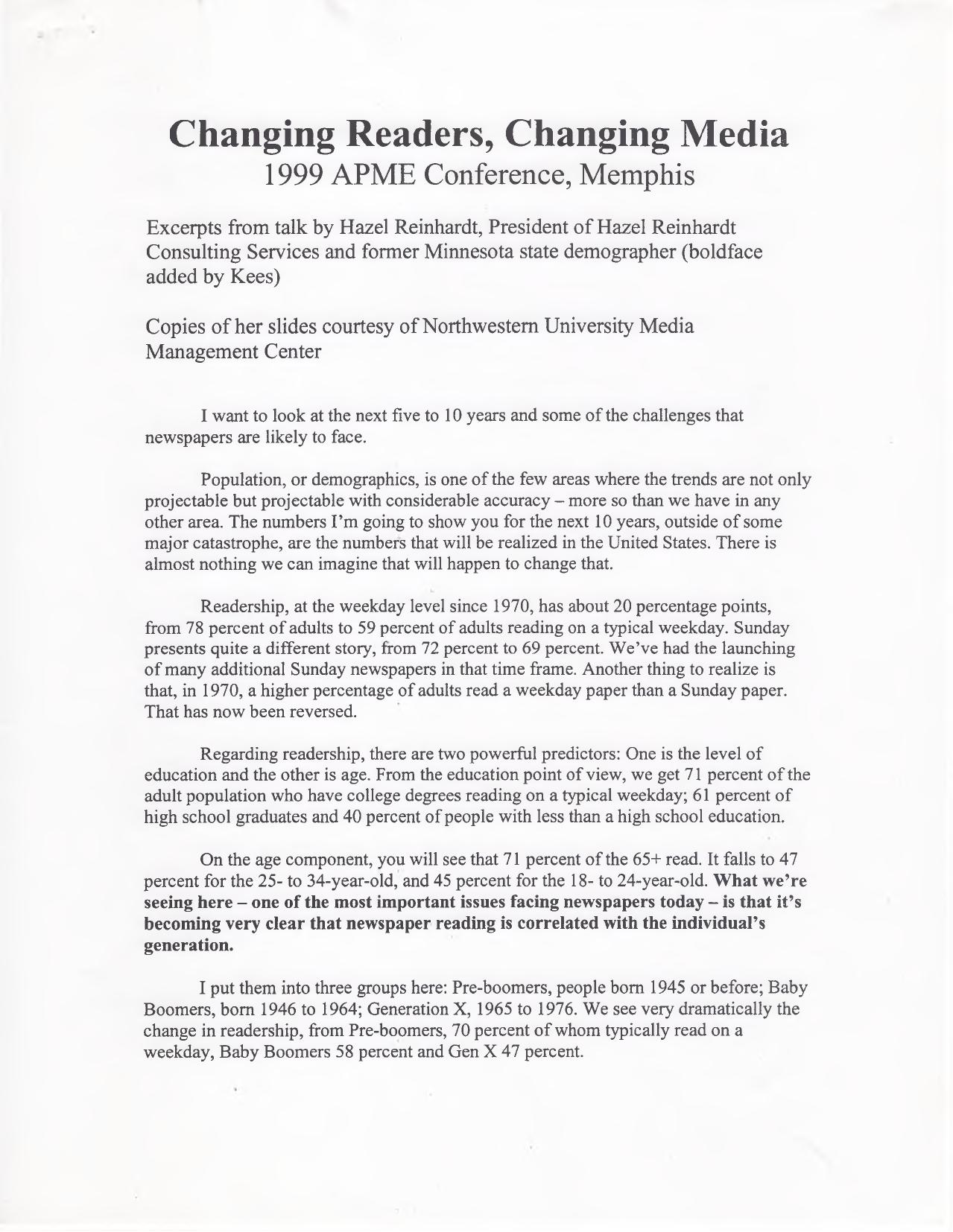
Archival transcript of Hazel Reinhardt's newspaper readership demographics talk at the 1999 APME Conference in Memphis

Changing Readers: A Demographic Warning to APME, 1999

This is a set of excerpts from a talk given by Hazel Reinhardt at the 1999 APME Conference in Memphis. Reinhardt was president of Hazel Reinhardt Consulting Services and the former Minnesota state demographer, and her subject was the one part of the newspaper business that could be forecast with confidence. The document notes that copies of her slides were provided courtesy of the Northwestern University Media Management Center, and that the boldface in the transcript was added by Kees.

Her opening argument was that demographics, unlike almost everything else the industry worried about, were not a matter of speculation.

The numbers I’m going to show you for the next 10 years, outside of some major catastrophe, are the numbers that will be realized in the United States. There is almost nothing we can imagine that will happen to change that.

The readership numbers were the sobering part. Weekday readership had fallen from 78 percent of adults in 1970 to 59 percent; Sunday had barely moved, from 72 percent to 69 percent. Education and age were the two powerful predictors — 71 percent of college graduates read on a typical weekday versus 40 percent of those with less than a high school education, and 71 percent of adults 65 and older versus 45 percent of 18- to 24-year-olds. Broken into generations, the pattern was unmistakable: Pre-boomers at 70 percent, Baby Boomers at 58 percent, Generation X at 47 percent.

It’s a mystery to me that we could have known about this for so long but seemed to not want to talk about it: Each generation of younger people is reading less or less frequently.

From there she walked the audience through four population changes — an aging population, growing racial and ethnic diversity, a widening gap between rich and poor, and the concentration of population in certain regions and metros. She spent the most time on aging: Boomers were then 42 and 43, not 50; fertility was low; the number of Americans over 100 was projected to grow from roughly 37,000 in 1990 to about 137,000 in 2010 and 850,000 by 2050. Households with children would not grow; empty nesters would. Editors who had built their sections around “what’s of interest to families” were going to need another hook.

The hinge of the whole talk was Generation Y, which contributed only 15 million adults in 1998 but would add 65 million by 2010 — 29 percent of all adults. Everything depended on how that generation behaved.

If Generation Y reads at the same level as Generation X, overall daily readership will be below 50 percent by 2010 — 45 percent by 2015. Following that train of logic, the last American reading a newspaper would be observed in 2078.

Reinhardt offered a reason for hope — surveys showed Generation Y as more optimistic, more community-minded, more involved than Generation X — and then framed the challenge as a question the room had a very short window to answer:

The challenge to newspapers is how and what do we need to do to make a larger proportion of them newspaper readers than Generation X?

She also dismissed the industry’s favorite consolation, that people pick up the habit as they age. Asked exactly that in the Q&A, she was blunt:

If you did not read a newspaper when you were 35 and you did not read one when you were 45, why would you suddenly take it up at 55 or 65? You have established patterns.

You have a few safe years. Do not be lulled. You have a few years when you have the Boomers and Pre-boomers who are big readers with you. The future is whether you can get Generation Y.

Reading this in 2026, the arithmetic has long since resolved itself, and not in the direction the hopeful reading allowed for. What stands out now is not the forecast but the framing: Reinhardt was telling a room full of editors that the crucial period was the next five to 10 years, and that working on it that day was “none too soon.” Those were the same years the industry spent arguing about what to put on its websites. The demographic clock she described was running the entire time.