The 2000 Outlook for Newspapers

As the new millennium approached, the Newspaper Association of America (NAA) published a broad industry forecast in Presstime magazine, capturing the hopes, hesitations, and strategic questions facing U.S. newspapers in the year 2000.

The article synthesizes insights from executives, editors, and advertising professionals, offering a layered view of a media industry at the threshold of digital disruption.

Digital: Emerging but Undefined

While online platforms were gaining traction, the newspaper industry was still uncertain about how to convert digital traffic into sustainable revenue. Optimism was tempered by hesitation, as leaders experimented with web publishing but lacked a unified digital strategy.

“We’re experimenting, learning, and listening. The answers are coming—but slowly.”

Ad Revenue Concerns

Executives voiced concerns about the future of classified and retail advertising, both of which were beginning to shift toward online platforms. Some predicted erosion; others were skeptical about the internet’s long-term viability as an ad medium.

Audience Attention Shifts

The report notes an increasing awareness that newspapers needed to better engage younger readers and tech-savvy consumers. Interactivity, personalization, and community engagement were emerging as key opportunities.

“The reader is in control now—and that’s not a bad thing.”

Internal Change Ahead

Leaders agreed that the industry’s evolution would demand cultural as well as technological adaptation. Success in the digital era would require new mindsets and leadership structures.

In retrospect, the Presstime 2000 Outlook reflects a moment of transition—when newspapers sensed the future approaching, but hadn’t yet grasped how rapidly or deeply it would reshape the entire media landscape.
Demographic Wake-Up Call for Newspapers, 2003

In a 2003 commentary published in the Newspaper Association of Amereica‘s Presstime magazine, demographics expert Peter Francese offers a sobering but forward-thinking look at the structural challenges facing newspapers. Delivered at the NAA Future of Newspapers Conference, the piece outlines how changing lifestyles, shifting work patterns, and demographic transformations have deeply disrupted traditional readership models. [Summary created by AI]

Francese argues that the real threat to newspapers is not just the Internet—but the failure to adapt to evolving consumer behavior. Fewer Americans are buying newspapers, especially among those under 45. Even older readers—historically the industry’s loyal base—are spending less time at home, traveling more, and increasingly relying on digital alternatives.

Compounding the issue are demographic shifts: cities are getting younger and more diverse, while suburbs age and fragment. Women, especially, are more professionally engaged than ever, leaving less time for shopping and local community involvement—factors that impact advertisers and newspaper engagement alike.

Francese doesn’t just diagnose the problem—he issues a call to action. Newspapers must invest in understanding their readers, rethink delivery models, and modernize how they connect with new generations. He warns against clinging to outdated one-size-fits-all publishing strategies and urges publishers to embrace consumer data and feedback more aggressively.

He closes by championing Newspaper In Education (NIE) programs as essential for introducing young people to the value of a trusted news source. Without strategic outreach and content tailored to changing lifestyles, newspapers risk losing not just a generation—but their entire place in the cultural fabric.

“We have met the enemy, sir, and he is us,” Francese quotes. The future of newspapers, he insists, depends on recognizing—and acting on—this truth.

Source: Published in Presstime Magazine, May 2003

Pagination: Implementation & Human Factors

One of my roles as Assistant Managing Editor of The Arizona Republic involved steering Phoenix Newspapers [PNI] into its next generation of pagination, the electronic design and production of newspaper pages.  In early March, 1993, the Newspaper Association of America held a Prespress Technology Symposium in Phoenix, AZ. I gave two speeches at that conference, one on how The Republic implemented its system.

If you were to create an adage about the installation of a pagination system it might go something like this:

Installing a pagination system is much like building a ship while already at sea – it is possible, but be prepared to get wet.

The second speech involved the human factors in pagination:

A design department using pagination can be one of two things:

  •  A creative department using a specialized electronic tool
  • A service or production department using new tools but following the direction of the paper’s editors

A design department using pagination can’t be both.

This is the fundamental linchpin of any discussion about the human factors of pagination. How to manage the people doing the work.


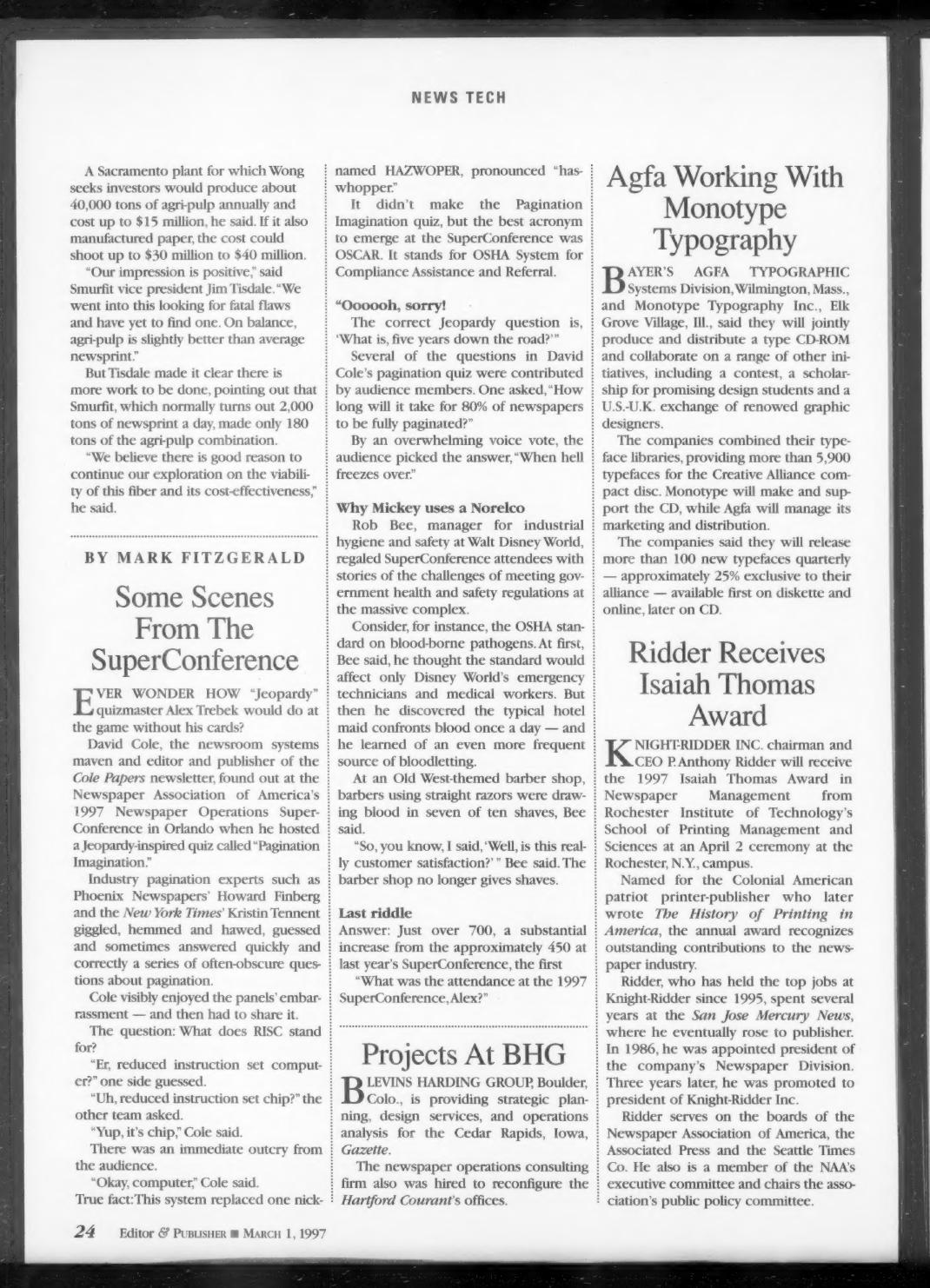
Editor & Publisher News Tech column page from March 1, 1997, reporting on the pagination quiz at the 1997 SuperConference in Orlando

“Pagination Imagination” at the 1997 SuperConference

A News Tech column by Mark Fitzgerald in the March 1, 1997, issue of Editor & Publisher, reporting scenes from the Newspaper Association of America‘s 1997 Newspaper Operations SuperConference in Orlando. The centerpiece: a Jeopardy-inspired quiz hosted by David Cole, described in the column as “the newsroom systems maven and editor and publisher of the Cole Papers newsletter.”

The panel of contestants included me, then at Phoenix Newspapers, and Kristin Tennent of the New York Times.

Industry pagination experts such as Phoenix Newspapers’ Howard Finberg and the New York Times‘ Kristin Tennent giggled, hemmed and hawed, guessed and sometimes answered quickly and correctly a series of often-obscure questions about pagination.

Cole’s answer key did not always survive audience review u2014 asked what RISC stands for, he ruled for “chip” over “computer” until the room objected, at which point: “Okay, computer,” Cole said.

One audience-contributed question asked how long it would take for 80% of newspapers to be fully paginated.

By an overwhelming voice vote, the audience picked the answer, “When hell freezes over.”

The column also noted attendance at the 1997 SuperConference was “just over 700, a substantial increase from the approximately 450 at last year’s SuperConference, the first.” Other items in the same News Tech package covered agri-pulp newsprint testing at Smurfit, Blevins Harding Group projects, an AgfaMonotype typeface alliance, and the 1997 Isaiah Thomas Award to Knight-Ridder‘s P. Anthony Ridder.

Cover of the Newspaper Advertising Bureau's October 1987 report summarizing the 1987 Newspaper Inventory Survey of U.S. daily newspapers

Daily Newspapers ’87: Taking Stock

An October 1987 report from the Newspaper Advertising Bureau summarizes the findings of NAB’s 1987 Newspaper Inventory Survey — a mail survey of every daily and Sunday/weekend newspaper in the United States and Canada, and the fifth in a series that began in 1967 and continued in 1974, 1979 and 1983. This volume covers local, English-language weekday editions in the U.S. only; a companion volume handled Sunday and weekend editions.

The survey’s original purpose was commercial: give advertisers and agencies a way to find newspapers carrying particular standing features, so an ad could be positioned next to the right kind of content. Later editions added questions about content, graphics and layout, positioning practices, ROP color, zoning, split runs and home delivery. The 1987 weekday inventory counted twelve kinds of sections and fifty-eight kinds of features or columns. (Pretty quaint given how ads are placed today.)

The base for the tables:

The summary tables shown are based on completed questionnaires from 987 daily newspapers representing 59% of all United States dailies and 79% of total circulation.

On content, the report found the churn of the early 1980s hadn’t slowed:

Findings from the 1987 Newspaper Inventory show that the period of rapid change in content, previously noted in the 1979 and 1983 inventories, continues unabated. Since 1983, nearly seven out of ten newspapers (69%) report substantial changes in content.

The most frequently reported changes were increased business coverage (53% of newspapers), increased sports coverage (45%), and a shift in the ratio of state and local to national and international coverage (35%).

The design numbers are the ones I keep coming back to. Eighty-two percent of newspapers — 91% of circulation — reported substantial changes in graphics or layout since 1983. More use of ROP color (61%) and conversion to Standard Advertising Units (SAU) page and column specs (60%) led the list, followed by changed mastheads, changed typefaces, more photographs, and modular front pages. And then this:

There has also been a substantial increase in use of computer graphics. In the 1987 study, 28% of responding dailies (52% of circulation) reported more use of graphics compared to 2% in 1983 (3% of circulation).

The feature tables are a time capsule. Crossword puzzles appeared in 98% of weekday circulation, spectator sports 94%, astrology 92%, TV log 92%, business and finance 89%, weather map 89%. Ninety-five percent of responding papers carried comic strips, and the typical weekday edition had three physically separate sections. Zoning was reported by 30% of dailies but 59% of circulation. The median share of weekday circulation that was home delivered: 85%.

The study was directed by Charles Lehman of NAB’s Research Department, and the report was updated by Dorothy Shea. A computerized list of editions carrying any particular section or feature was available on request — by telephone.

Reading this in 2026, what stands out isn’t just how many of these features have vanished from print (the TV log, the movie timetable, the radio log, the stock tables) but that the inventory itself was a product for advertisers — a printed, mailed, hand-tabulated database of what newspapers contained. That function moved online long ago, along with the advertising it was built to serve. The Newspaper Advertising Bureau no longer exists as a separate organization; its work eventually merged into the industry association that became the Newspaper Association of America.