CNI’s Web Strategy Meeting, 1999

The March 15, 1999 memo titled “Web Strategy: Steering Committee Working Draft” was prepared for Central Newspapers, Inc. (CNI). It outlines a proposed strategic framework for how CNI should develop and manage its web presence across its various newspapers.

Key elements of the document include:

  • Need for Strategy and Coordination: Recognizing the fragmented and inconsistent web efforts across CNI properties, the memo proposes the creation of a Web Steering Committee to guide future development and unify strategy.

  • Editorial Control and Brand Integrity: Emphasis is placed on maintaining editorial standards and protecting the credibility of CNI’s newspaper brands online. The document highlights the importance of balancing innovation with journalistic values.

  • Business Goals: The memo acknowledges the growing commercial importance of the web and recommends that online efforts be aligned with broader business strategies, including advertising and revenue models.

  • Technology and Staffing: It notes the need for investment in technical infrastructure, training, and possibly new staff roles to support digital operations effectively.

  • Shared Resources and Collaboration: Proposes that CNI newspapers share best practices and technical solutions to avoid duplication of effort and benefit from economies of scale.

This draft represents an early, structured attempt by a traditional newspaper group to grapple with the implications of the digital transition, both operationally and editorially.


Retrospective (From 2025)

Looking back from 2025, this 1999 memo reads as a snapshot of a legacy media company at the edge of digital transformation. It captures the moment when the internet shifted from an experimental add-on to a core business and editorial concern.

While the memo does not predict the scale or speed of disruption that would follow—especially the impact of mobile, social media, and platform-driven distribution—it reveals a strong awareness that digital would require structural and cultural change. The idea of a centralized steering committee to shape digital policy foreshadows modern media governance models around digital ethics, product integration, and content monetization.

Ultimately, this document illustrates how media organizations like CNI were beginning to rethink their identity—not just as print publishers, but as multi-platform content providers. It’s a foundational artifact of journalism’s transition into the 21st century.
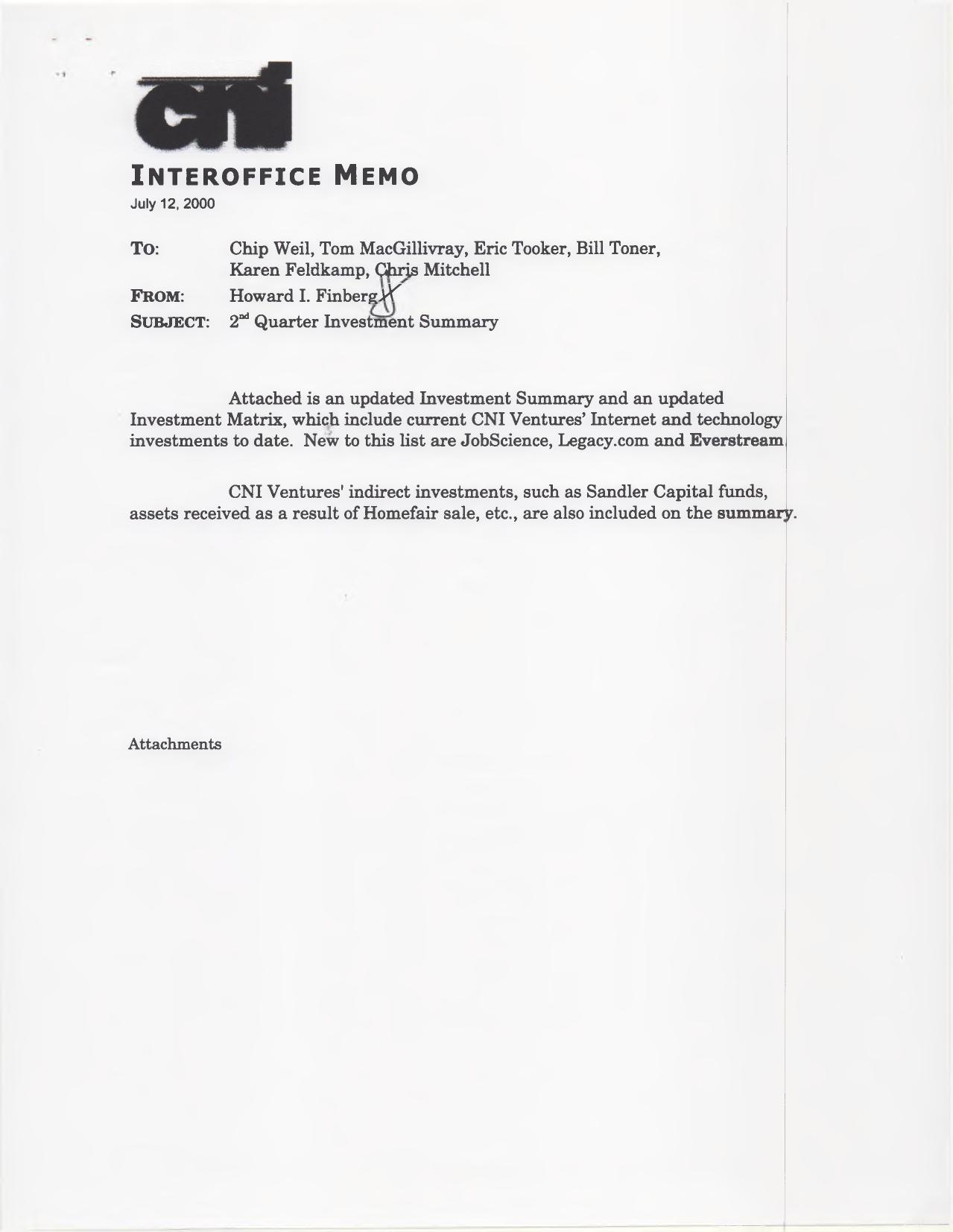
July 2000 CNI Ventures quarterly memo to Central Newspapers executives with attached investment summary and matrix

CNI Ventures: Investment Summary, 2000

As head of Central Newspapers‘ venture capital investments, I sent quarterly reports to the CEO and other senior executives. This one — dated July 12, 2000 — went to Chip Weil, Tom MacGillivray, Eric Tooker, Bill Toner, Karen Feldkamp and Chris Mitchell.

Attached is an updated Investment Summary and an updated Investment Matrix, which include current CNI Ventures’ Internet and technology investments to date. New to this list are JobScience, Legacy.com and Everstream

The memo also notes that indirect investments — the Sandler Capital funds, assets received as a result of the Homefair sale — are included in the summary.

The attachments are the interesting part. The Investment Update Summary lists the portfolio company by company: EntryPoint, WaveShift, Event 411, E-ink, BrightStreet, StreamSearch, GAMUT [SmartTV], JobScience, Everstream and Legacy.com, with $8,882,998 in invested capital against a current valuation of $9,119,411. Add the realized, partially realized and publicly traded holdings — Microsoft, Homestore and the Sandler funds — and total investments come to $25,613,452.

The Investment Matrix, which I created, is the most interesting document because it asked more than “what is it worth?” Each company was tracked against its target market, its relationship to CNI’s businesses, our working relations with the company, and which other media companies were in the deal — Knight Ridder, McClatchy, Tribune Ventures, Cox, Hearst, Gannett, the Washington Post. On E-Ink:

Development of an electronic newspaper and the business models to support product[s]

And the entry for EntryPoint, our oldest holding, is a reminder that not everything worked:

Dormant. PointCast technology; assets were purchased by an IdeaLab company

A $200,000 investment carried at $13,571.

January 2000 Editor & Publisher clipping announcing that Central Newspapers created CNI Ventures for internet and technology investments

Central Newspapers Creates CNI Ventures

In January 2000, Editor & Publisher ran a short item announcing that Central Newspapers Inc. had created a new business unit to handle its investments in internet and technology companies. The story was only a few paragraphs, but it marked a real shift in how the company — publisher of The Arizona Republic and The Indianapolis Star — thought about where the future of news and information might be built.

Central Newspapers Inc. (CNI), publisher of The Arizona Republic and Indianapolis Star, has created a new business unit – CNI Ventures – to handle the company’s investments in the Internet and technology sectors. CNI Ventures will focus primarily on investments that develop delivery methods for news and information.

The distinction E&P drew was an important one inside the company. The existing newspaper websites were not going into the new unit; they stayed with the newspapers, where they belonged as part of the core business.

Central’s existing newspaper Web sites, such as Arizona Central and StarNews.com, will not become a part of the Ventures division, but remain a part of Central’s core business.

The investments that did move under the Ventures umbrella were a good snapshot of what looked promising at the turn of the century: BrightStreet, described as a provider of online promotions management solutions; E Ink, a developer of electronic display technology; Event411, a creator of online event-planning tools; and WaveShift, a creator of systems and software for new media. Incpad, the company’s high-tech job site — until recently called Westech Virtual Job Fair, as the item notes — stayed with the main internet activities alongside the newspaper sites.

E Ink is the one that still makes me smile. In 2000, electronic display technology was an article of faith, a bet on a future device that would carry news and information without paper. It took a while, but that one worked out.

And then the last paragraph, which is why this clipping is in my files:

Howard I. Finberg, director of technology and information strategies, has been given the added responsibility of vice president at CNI Ventures in order to coordinate the investment committee.

Coordinating the investment committee was a different kind of work than anything I’d done in a newsroom. The timing, of course, is part of the story — January 2000 was very near the top of the market for this sort of enthusiasm. The idea behind the fund was sound: newspaper companies needed to understand and have a stake in the technologies that would deliver news next. The trick, then as now, was picking correctly.