Arizona Central’s Official Launch Announcements

Even though Arizona Central (AzCentral) was live on both AOL and the Web earlier, we needed to make an official and public announcement about both services.  The Phoenix Newspapers (PNI) marketing department created an excellent package of materials, including press releases (one for each service) and screenshots of the online services.  And, of course, a FAQ about going online.  It reads quaint today, but the basic “here’s how to get online” information was essential in 1995.  The other members of the launch team were Dave Gianelli, special projects manager, Dan Hontz, online project for AzCentral on the Web, and Jeff Unger, online producer for AzCentral on AOL.

Both press releases are here: pni_annouces azcentral_12_08_1995

The FAQ about Arizona Central on AOL and on the Web are here: azcentral faq sheets_12_08_1995

Editor & Publisher clipping by Jim Rosenberg reporting the closing of JForum, the Journalism Forum on CompuServe

JForum Ends: Where the Digital Pioneers Went to School

This is an Editor & Publisher story by Jim Rosenberg, published May 17, 2001, reporting the end of the Journalism Forum on CompuServe. JForum was merged with CompuServe‘s PR Forum into a new service called MediaPro, and the old forum stopped operating.

Rosenberg’s account is a short obituary for something that mattered a great deal to a small number of people. JForum began, as he wrote, on a Radio Shack laptop:

Launched on a Radio Shack laptop in 1985, the then-300-baud journalists’ computer bulletin board eventually served thousands of members worldwide, with job listings and messaging in four languages on a variety of topics.

It was also, the story notes, the first online home of the Society of News Design, the National Press Photographers Association, Investigative Reporters and Editors, and other organizations — and the subject of an early ’90s ruling in which a U.S. judge found CompuServe not responsible for messages it was unaware of that were posted in JForum.

Former NBC News manager Jim Cameron, who started the forum, said he

founded JForum … for the dwindling number of radio news people to share survival tips.

He credited the section leaders and assistants “who really ran JForum as editors.” I was one of them, and Rosenberg quoted me at some length about what made the place work — the effort required to participate at all, and what that effort produced:

You really had to commit to be a member of this community. At that point, you realized the possibility of community was not a geographical issue … It was about shared interest.

And on what its closing meant:

This is a passing of a forefather of a lot of what is going on right now. This was an educational experience for the digital pioneers. This is where we went to school. We learned from each other.

The story closes by noting that Cameron would stay on in an interim capacity, with MediaPro to be operated by PR Forum’s Mike Bayer. Rosenberg was then a senior editor covering newspaper technology for E&P.

Typed pages from a 1996 Arizona Central briefing report for Phoenix Newspapers managers, with talking points and traffic charts

Making the Case for Arizona Central, 1996

This is a report I put together in August 1996 for managers at Phoenix Newspapers who didn’t quite understand what “going online” meant — or where it was headed. Rather than argue in the hallway, I built a briefing book: talking points, traffic charts, a project list, revenue and expense projections, and a stack of clippings from the trade and business press so no one had to take my word for the direction of the market.

The first section is organized around questions from Chip Weil, then President and CEO of Central Newspapers, with my answers filled in:

I’ve taken some of Chip Weil’s questions [the italics] and added some general answers and/or talking points that could be discussed at the meeting. Marilyn Tanious was helpful regarding some key points that should be discussed.

Most of the questions were about classified advertising — real estate and employment — which was where the money was and where the threat was. The report notes on-going discussions with the area’s multiple listing service [ARMLS] for complete property-for-sale data, work on getting employment display advertising online, more “Virtual Job Fairs” starting in September, an outside company [Moore Data] on a rentals database, and an automotive push with the AIG group and with Bill Luke, which wanted to put its used-car inventory online.

Asked about strategy over the next 24 months, I listed four areas: consumer acceptance, broadband delivery, directory publishing and transactions. Longer term, commerce systems and agency relationships — shared “ad space” with content partners. PAFET, the newspaper technology consortium, gets credit for access to experiences that would have been hard to duplicate, along with the strategic alliances with InfoSeek and Pointcast. On the money: about $2.3 million being spent CNI-wide, with a projected 10% expense increase for 1997 and capital spending estimated at $150,000.

The overview section reprints a piece I’d written for the first edition of an in-house newsletter, the Cyber Chronicles, aimed at a general newsroom audience:

While using a 17th Century technology — ink on paper — to communicate what’s happening with PNI’s online efforts may seem strange, it helps make the point that the newspaper isn’t going away. Frankly, there are just some things you can do better on newsprint.

Arizona Central ran two editions — one on the Web, one on America Online — and a good part of the internal confusion was about why we bothered with both. The answer in the report is blunt:

We are often asked, “Why have any content on AOL?” The reason is simple: It reaches a different audience than the Internet.

AOL was then the world’s largest commercial online service with six million customers, sharing market revenue with PNI and paying bounties for each customer we signed up with a special Arizona Central disk. The distinction I drew was between “the technically advanced” — comfortable with IP addresses and hunting on the Web — and “the technically evolving,” who preferred the safer environment of a commercial service.

The traffic charts are a reminder of how crude measurement was. Web numbers were “hits,” with a note that our pages used only three or four image files while boston.com used 19 on its home page — so our hit counts looked small by comparison. The big spike came from putting employment liners online in late June; the flattening was blamed on the Olympic games, a drop seen across AOL as well. AOL, at least, could count actual paid entries into Arizona Central. Median age was 43.7 on AOL and 43.5 on the Web, and the daypart charts show AOL peaking at 8 p.m. while Web use tracked working hours — traffic from major Valley employers and corporate sites around the country.

The project list is the part I still enjoy: movie times, Living Here, Meet Your Match, calendars formatted for database searching, Prep Stats, Holiday Lights with the Downtown Association, and a SAVE system to search and purchase past stories. And the honest bottom line, stated up front:

While it is unlikely that online will be profitable this or next year, revenue is running ahead of projections.

Thirty years on, what strikes me is how much of the argument was about audience rather than technology — where readers actually were, and the willingness to publish in two places at once to reach them. That part of the job hasn’t changed at all.

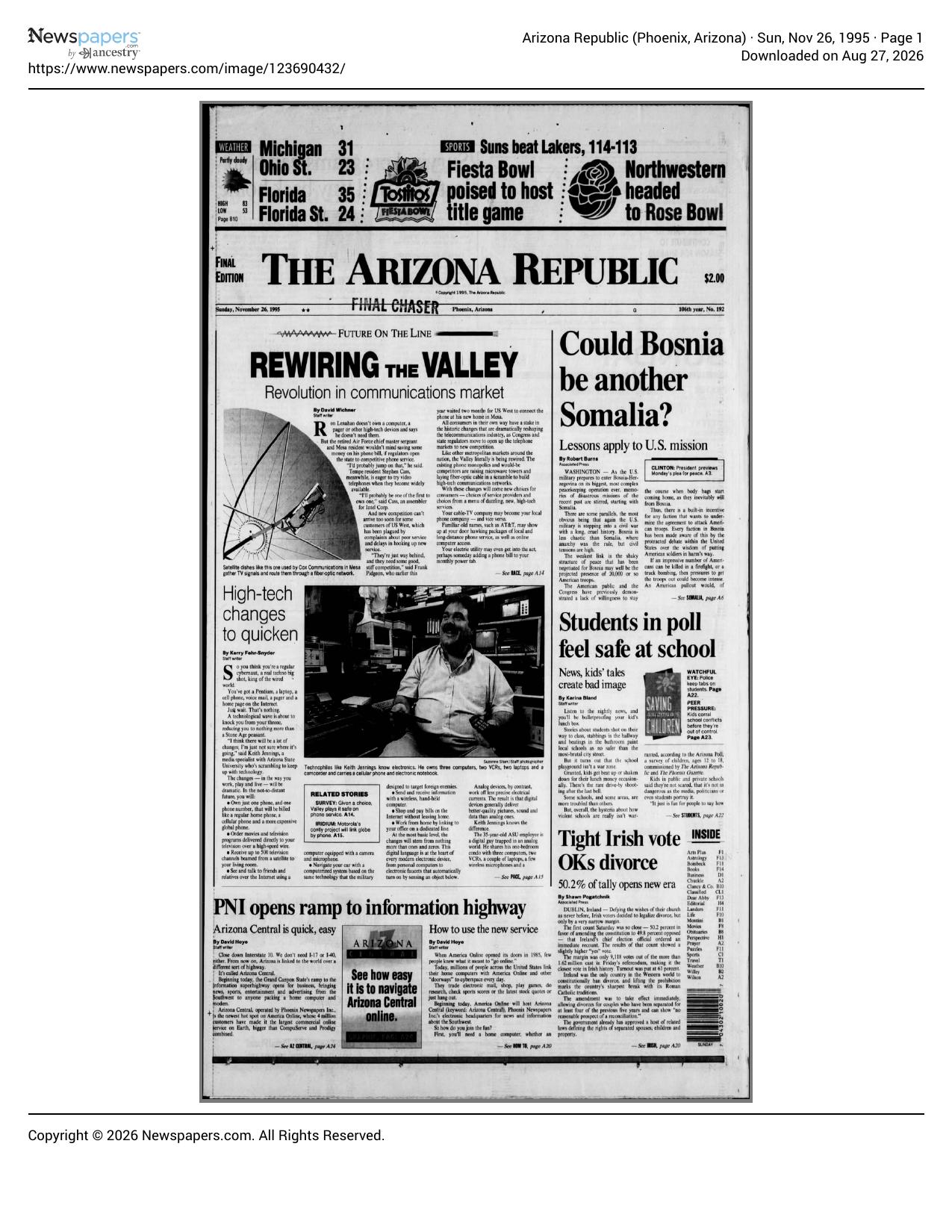
The Arizona Republic front page from November 26, 1995, announcing the Arizona Central online service on America Online and the Web

Arizona Central Opens for Online Business

On Sunday, November 26, 1995, The Arizona Republic told its readers that Phoenix Newspapers Inc. had gone online. The story, by staff writer David Hoye, ran on page one under the headline “PNI opens ramp to information highway,” with a full page inside devoted to explaining what Arizona Central was and how to get to it.

There were two front doors. One was on America Online — at the time, by the paper’s own description, the largest commercial online service on Earth, with 4 million customers, “bigger than CompuServe and Prodigy combined.” The other was on the World Wide Web.

On America Online, type keyword: arizona central

On the Web, http://www.azcentral

The AOL service opened with a set of buttons that would look familiar to anyone who has built a home page since: News/Money, Sports, Destinations, Your Life, At Ease, Sound Off, ALT. and What’s Hot. Sound Off held the columnists, editorials, letters and Steve Benson‘s editorial cartoons. ALT. was aimed at young adults and carried stories written by local students. Elsewhere there were Penelope Corcoran’s restaurant reviews under Taste the Town, interactive TV grids customized to your cable company, a searchable golf-course database, the Pick the Pros contest, a GiftLine for holiday shopping, and a survey button asking readers what they wanted from an online service.

The ambition was larger than shoveling the newspapers onto a screen. As the story put it, Phoenix Newspapers planned “to create nothing less than an online community, where users can learn, communicate, buy and sell and have fun.” The Oasis, Arizona Central’s chat room, was already doing that work — Charles Barkley had spent more than an hour there the week before, taking questions about the 1995-96 Suns season.

John Oppedahl, executive editor of the newspapers, framed it this way:

“Our new effort online is a significant move forward for Phoenix Newspapers Inc.,” said John Oppedahl, executive editor of the newspapers. “I look at this as the beginning of a new era.”

I was quoted as well, in my role at the time:

“It’s instant journalism,” said Howard Finberg, Phoenix Newspapers’ senior editor of information technology. “It’s pretty exciting.”

Worth noting where the launch story sat on that Sunday front page. It shared A1 with a package called “FUTURE ON THE LINE: REWIRING THE VALLEY” — about Congress and state regulators opening the telephone market to competition, cable companies becoming phone companies, and the promise of 500 television channels and video calls over the Internet. The newspaper was covering the coming of the network and joining it on the same day.

The story also made the case to advertisers, with a comparison that has aged into a period piece: online was “the most important new communications medium since Johann Gutenberg‘s experiments with movable type more than 500 years ago.”

Arizona Republic front page from November 26, 1995 announcing Arizona Central, Phoenix Newspapers' new online service on America Online and the Web

Arizona Central Opens for Online Business

On Sunday, November 26, 1995, The Arizona Republic told its readers that Phoenix Newspapers Inc. had gone online. The story, by staff writer David Hoye, ran on page one under the headline “PNI opens ramp to information highway,” with a full page inside devoted to explaining what Arizona Central was and how to get to it.

There were two front doors. One was on America Online — at the time, by the paper’s own description, the largest commercial online service on Earth, with 4 million customers, “bigger than CompuServe and Prodigy combined.” The other was on the World Wide Web.

On America Online, type keyword: arizona central

On the Web, http://www.azcentral.com/

The AOL service opened with a set of buttons that would look familiar to anyone who has built a home page since: News/Money, Sports, Destinations, Your Life, At Ease, Sound Off, ALT. and What’s Hot. Sound Off held the columnists, editorials, letters and Steve Benson‘s editorial cartoons. ALT. was aimed at young adults and carried stories written by local students. Elsewhere there were Penelope Corcoran’s restaurant reviews under Taste the Town, interactive TV grids customized to your cable company, a searchable golf-course database, the Pick the Pros contest, a GiftLine for holiday shopping, and a survey button asking readers what they wanted from an online service.

The ambition was larger than shoveling the newspapers onto a screen. As the story put it, Phoenix Newspapers planned “to create nothing less than an online community, where users can learn, communicate, buy and sell and have fun.” The Oasis, Arizona Central’s chat room, was already doing that work — Charles Barkley had spent more than an hour there the week before, taking questions about the 1995-96 Suns season.

John Oppedahl, executive editor of the newspapers, framed it this way:

“Our new effort online is a significant move forward for Phoenix Newspapers Inc.,” said John Oppedahl, executive editor of the newspapers. “I look at this as the beginning of a new era.”

I was quoted as well, in my role at the time:

“It’s instant journalism,” said Howard Finberg, Phoenix Newspapers’ senior editor of information technology. “It’s pretty exciting.”

Worth noting where the launch story sat on that Sunday front page. It shared A1 with a package called “FUTURE ON THE LINE: REWIRING THE VALLEY” — about Congress and state regulators opening the telephone market to competition, cable companies becoming phone companies, and the promise of 500 television channels and video calls over the Internet. The newspaper was covering the coming of the network and joining it on the same day.

The story also made the case to advertisers, with a comparison that has aged into a period piece: online was “the most important new communications medium since Johann Gutenberg‘s experiments with movable type more than 500 years ago.”

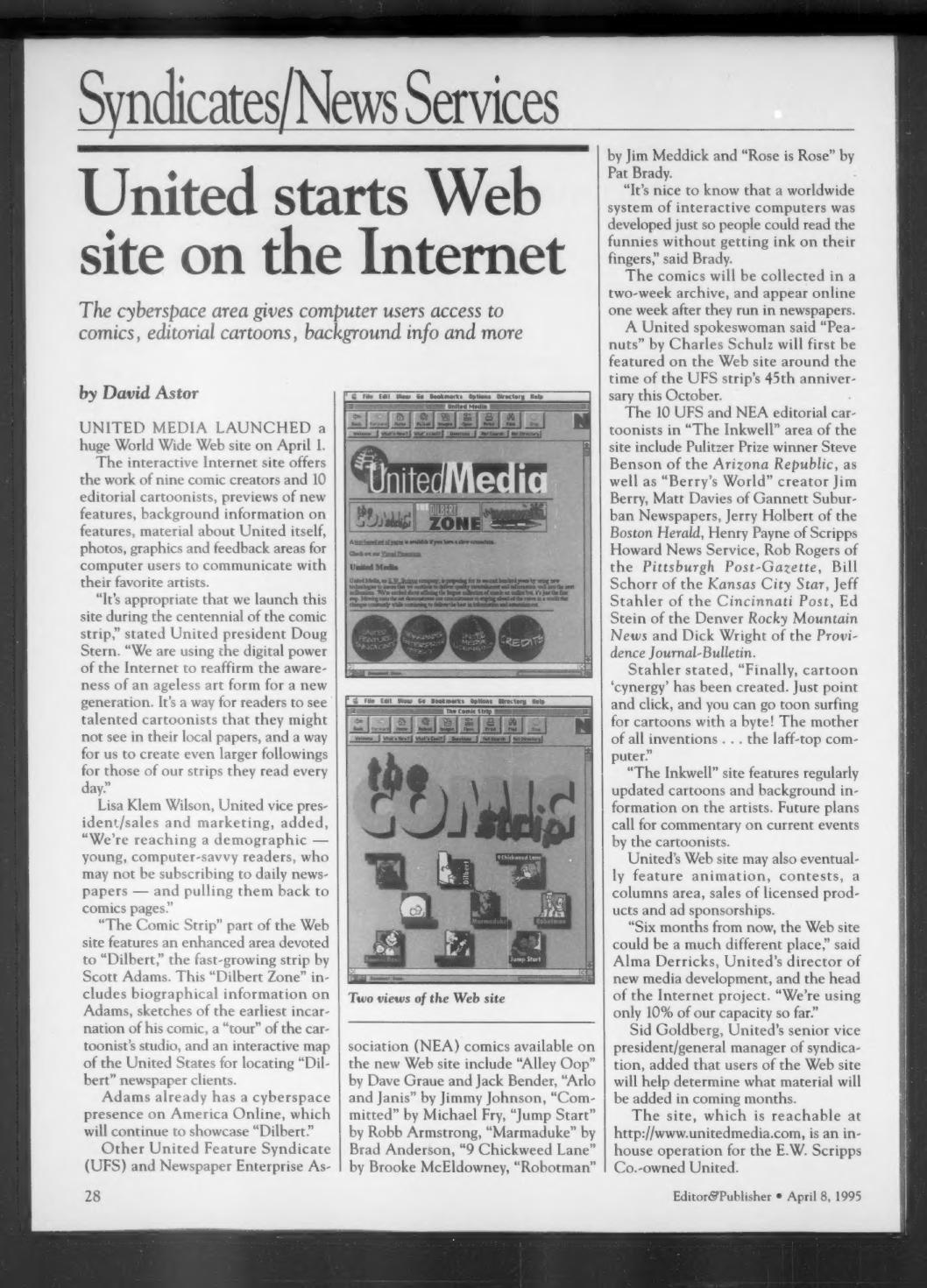
Editor & Publisher syndicates and news services page from April 8, 1995, reporting United Media's World Wide Web site launch

Early Syndicate Efforts on the Web, 1995

A syndicates and news services page from the April 8, 1995, issue of Editor & Publisher, reported by David Astor. The lead story covers United Media‘s April 1 launch of a World Wide Web site at http://www.unitedmedia.com — an in-house operation for the E.W. Scripps Co.-owned syndicate — carrying the work of nine comic creators and 10 editorial cartoonists, along with feature previews, background information, photos, graphics and feedback areas. 

Comics from United Feature Syndicate and Newspaper Enterprise Association were to be collected in a two-week archive and posted online one week after newspaper publication. “The Comic Strip” section included an enhanced “Dilbert Zone” devoted to Scott Adams‘ strip, with biographical material, early sketches, a “tour” of the studio and an interactive map for locating “Dilbert” client newspapers; Adams also maintained a presence on America Online. “The Inkwell” area featured the editorial cartoonists, among them Pulitzer Prize winner Steve Benson of the Arizona Republic.

From United president Doug Stern:

“We are using the digital power of the Internet to reaffirm the awareness of an ageless art form for a new generation. It’s a way for readers to see talented cartoonists that they might not see in their local papers, and a way for us to create even larger followings for those of our strips they read every day.”

Lisa Klem Wilson, United vice president/sales and marketing, framed the audience question:

“We’re reaching a demographic — young, computer-savvy readers, who may not be subscribing to daily newspapers — and pulling them back to comics pages.”

Alma Derricks, United’s director of new media development and head of the Internet project, said the site could eventually add animation, contests, a columns area, licensed product sales and ad sponsorships:

“Six months from now, the Web site could be a much different place. We’re using only 10% of our capacity so far.”

The rest of the page carries shorter items: centennial-of-comics events announced by the Newspaper Features Council, including Sunday night live chat sessions with cartoonists on America Online beginning May 7 with Mort Walker, an AOL centennial area starting May 5, a Library of Congress comics exhibit, U.S. Postal Service cartoon stamps, and an October comic fair in Bryant Park; Universal Press Syndicate‘s new statistics column “Unconventional Wisdom” by Washington Post polling director Richard Morin; Tribune Media Services‘ new panel “True!” by Daryl Cagle; the debut of Tool User Comics, an “online comic book publisher” on the Web; Ray Walker’s promotion to news editor of Knight-Ridder/Tribune News Service; and “Jill Jackson’s Hollywood” from the King Features Weekly Service.

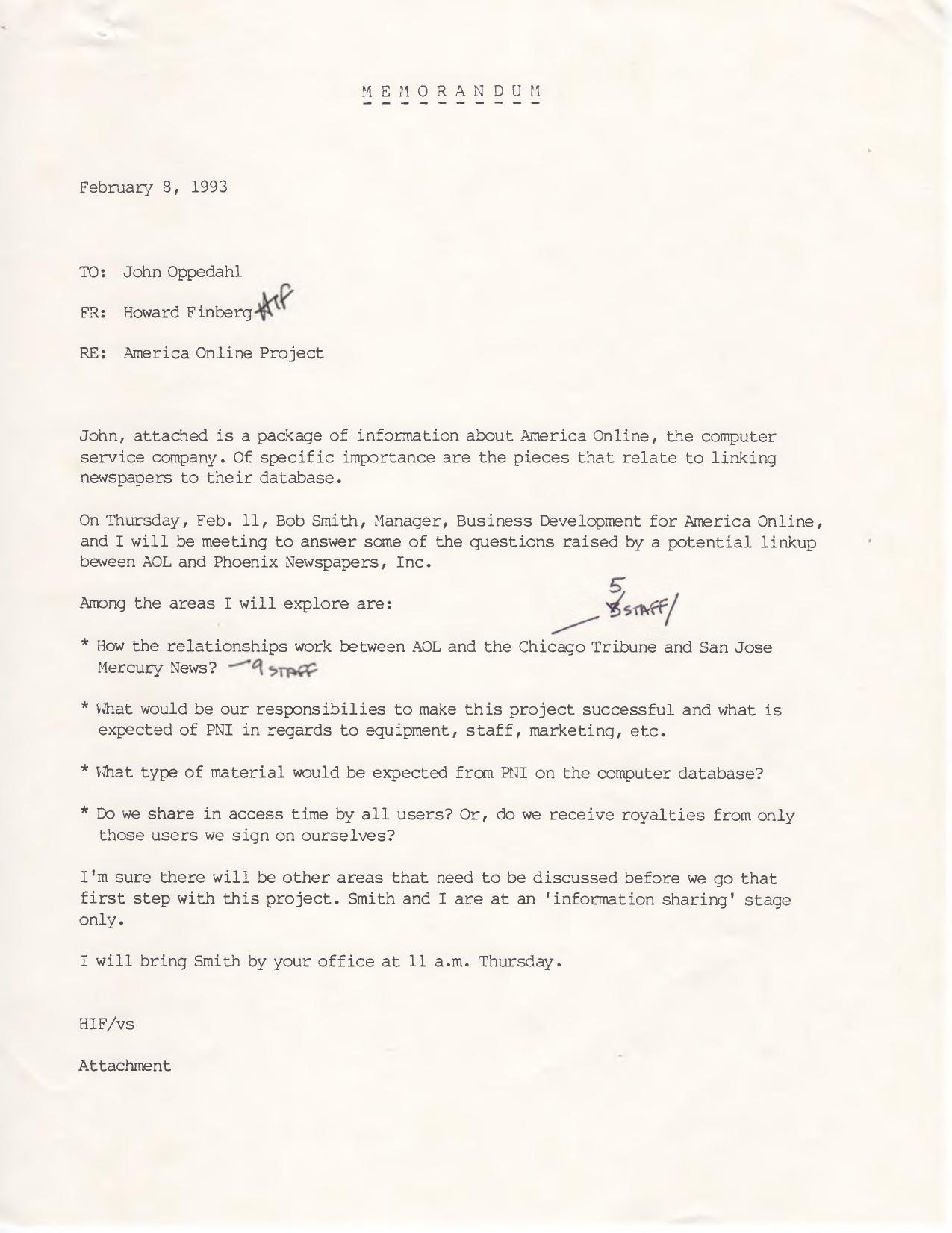
Typed 1993 internal memo to Phoenix Newspapers executive John Oppedahl outlining questions for a meeting with America Online

An Early Look at America Online

This is a short memo I wrote in February 1993 to John Oppedahl, then an executive at Phoenix Newspapers, Inc., about a meeting I had scheduled with America Online. At the time, AOL was signing up newspapers to put content into its database, and I wanted to understand what such a partnership would mean for PNI before anyone committed to anything.

John, attached is a package of information about America Online, the computer service company. Of specific importance are the pieces that relate to linking newspapers to their database.

The meeting was set for Thursday, Feb. 11, with Bob Smith, Manager, Business Development for America Online. The questions I planned to ask were the basic ones any newspaper should have been asking in 1993 — and, honestly, the ones many didn’t ask carefully enough:

* How the relationships work between AOL and the Chicago Tribune and San Jose Mercury News?

* What would be our responsibilities to make this project successful and what is expected of PNI in regards to equipment, staff, marketing, etc.

* What type of material would be expected from PNI on the computer database?

* Do we share in access time by all users? Or, do we receive royalties from only those users we sign on ourselves?

That last question — who gets paid, and for whose audience — turned out to be the one the industry spent the next decade arguing about.

I was careful to keep expectations modest:

I’m sure there will be other areas that need to be discussed before we go that first step with this project. Smith and I are at an ‘information sharing’ stage only.

The memo closes with the smallest of logistical notes: I would bring Smith by Oppedahl’s office at 11 a.m. Thursday.

Postscript: Phoenix Newspapers did sign an agreement with America Online.