ASNE-API Leadership Survey, July 2011
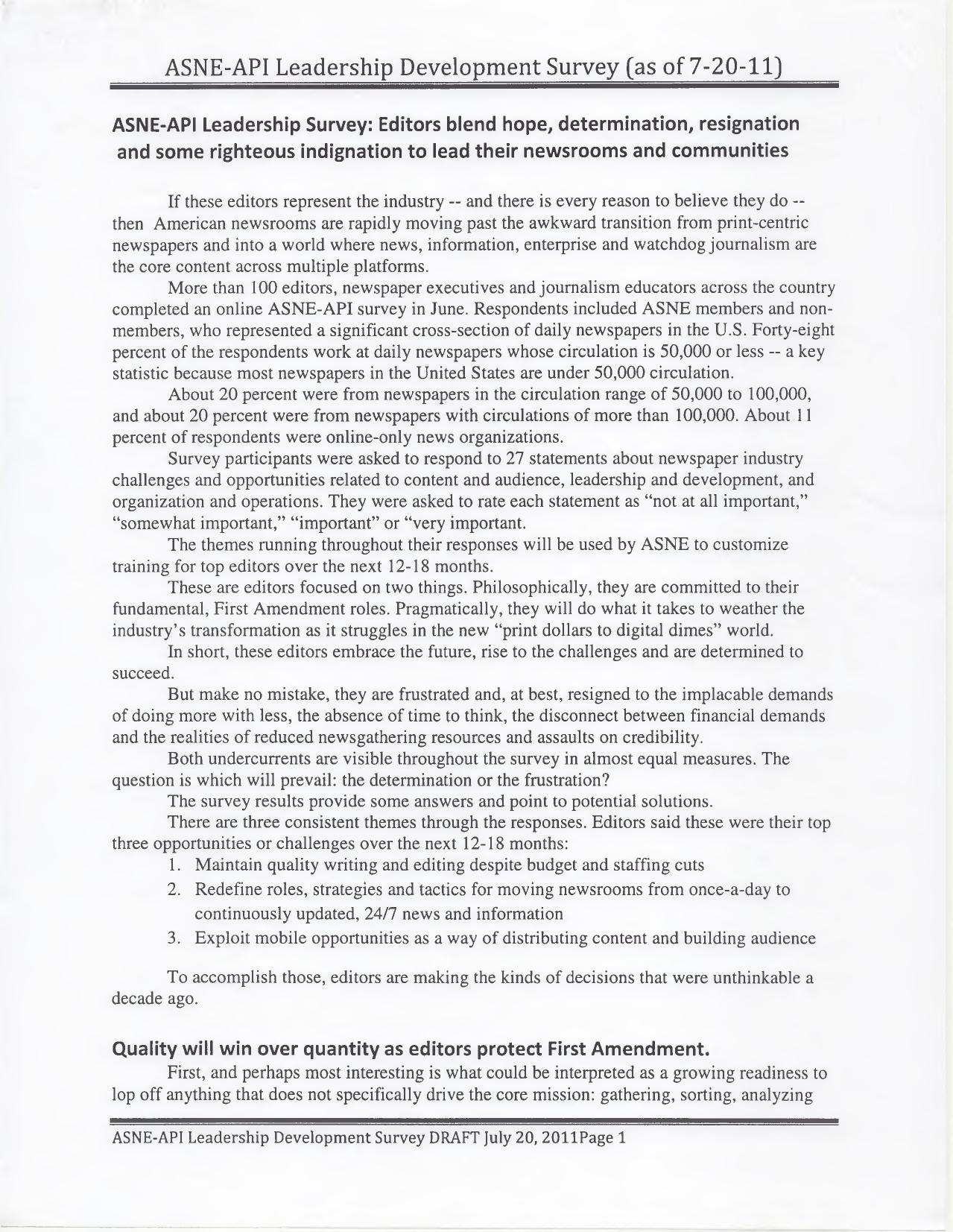
This is the draft report of a joint survey by the American Society of News Editors and the American Press Institute, dated July 20, 2011. Invitations went to 1,830 editors at about 1,400 daily newspapers, 50 online-only news sites and the deans of 100 accredited journalism schools. One hundred five people responded — nearly half of them from papers with circulations of 50,000 or less, which is where most American dailies live. Respondents rated 27 statements about content and audience, leadership and development, and organization and operations. ASNE planned to use the findings to shape training for top editors over the following 12 to 18 months, beginning with a regional workshop in Lexington, Ky., in October.
The framing of the report is a tension the authors return to again and again — editors who are determined and editors who are worn down:
These are editors focused on two things. Philosophically, they are committed to their fundamental, First Amendment roles. Pragmatically, they will do what it takes to weather the industry’s transformation as it struggles in the new “print dollars to digital dimes” world.
The three top-ranked opportunities or challenges: maintain quality writing and editing despite budget and staffing cuts (83.8 percent called it “very important”); redefine roles, strategies and tactics for moving newsrooms from once-a-day publishing to continuously updated, 24/7 news; and exploit mobile opportunities to distribute content and build audience.
What gives the document its bite are the unattributed editor comments:
“It’s time,” wrote one editor, “for newsrooms to focus on finding ways to do fewer things well, instead of doing everything poorly.”
“Too many interruptions, distractions,” wrote one editor. “Not able to put together a stretch of time that’s long enough to focus and complete anything that can’t be accomplished in five minutes. … I can get a lot of things started, but it’s becoming harder and harder to see them through to successful completion.”
“We are all in this same leaky boat together and it’s time to let go of our old ideas about labor and management. We all need to start building a new ship — and fast.”
The draft press release attached to the report quotes Linda Grist Cunningham, vice chair of ASNE’s Leadership Committee; Carol Ann Riordan, interim executive director of the American Press Institute; and Mizell Stewart III, editor of the Evansville (Ind.) Courier & Press and chair of the Leadership Committee.
“The affirmation that editors can stay focused on good journalism as they wrestle with spreadsheets and new technology isn’t unexpected,” said Linda Grist Cunningham … “But it certainly is reassuring.”
The report ends with the question it can’t answer:
The question remains: Which will prevail? The determination to succeed, to beat back the naysayers? Or the resignation that comes with fear, inertia and a mourning of the loss of the past?
Reading this in 2026 — fifteen years later — the survey is a useful marker of where newsroom leadership thinking stood at the start of the mobile era. The priorities the editors named are no longer strategic questions; they were settled by events. What remains strikingly current is the complaint that there is no time to think, and the one editor who predicted the tablet future and wrote, “This is the generation of transition.”