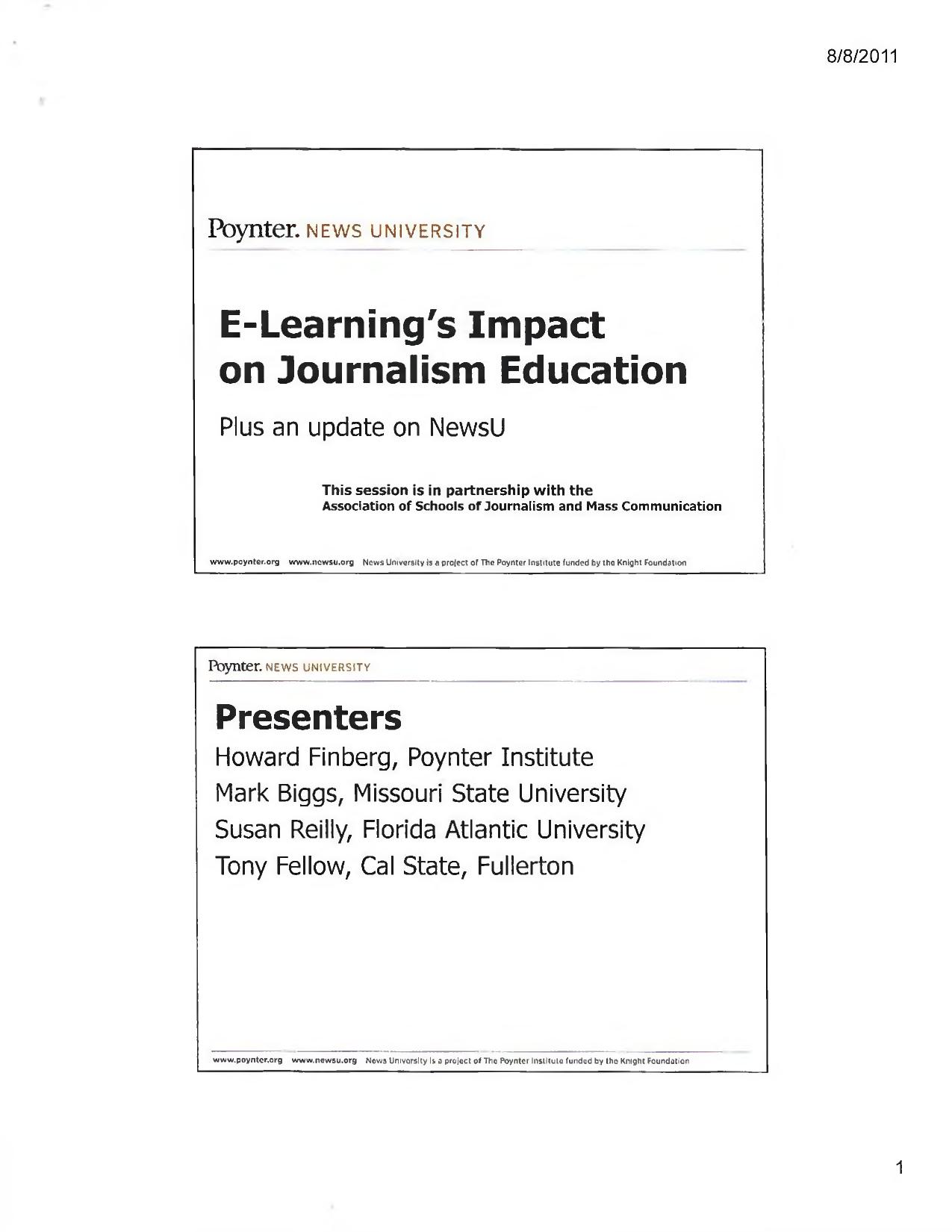
Title slide from a 2011 Poynter NewsU presentation on e-learning and journalism education, noting the partnership with the Association of Schools of Journalism and Mass Communication

E-Learning’s Impact on Journalism Education

These are the slides I used for a presentation about e-learning, given on August 8, 2011. The session was run under the NewsU banner and, as the title slide notes, was done in partnership with the journalism education association:

This session is in partnership with the Association of Schools of Journalism and Mass Communication

I wasn’t alone on the platform. The presenters slide lists:

Howard Finberg, Poynter Institute
Mark Biggs, Missouri State University
Susan Reilly, Florida Atlantic University
Tony Fellow, Cal State, Fullerton

The first half of the deck is about the J101 Project — an attempt to take NewsU‘s self-directed modules and online group seminars and build them into a semester-long introduction to journalism course taught in partnership with universities. The background slide describes the idea as leveraging self-directed modules plus online group seminars, working with schools on journalism education quality, intersecting with Carnegie Corporation interests, and running as a pilot program grant.

What made J101 different was the weekly rhythm. The “How it works” slide lays it out:

Read two essays • Self-directed course(s) and other Virtual Textbook materials • Tuesday Live Lecture or the replay • Study Group Work assignment • Study Group discussion • Thursday Live Chat • Weekly quiz

Several slides show the course itself — a 16-week virtual textbook running from “Who Is News?” and “Intro to Reporting” through interviewing, alternative story forms, dealing with diversity, style, rewriting, libel and privacy, news-gathering legality, and the business of journalism. There are pre- and post-assessments, weekly assessments drawn from a randomized pool of questions taken from the NewsU modules, the live lecture and the weekly readings, and a 50-question final exam scheduled for December.

The instructor dashboard got its own pair of slides, and for good reason. We were tracking logins and time spent in both the main course and each related self-directed module, weekly assessment scores, class participation and discussion posts, attendance at the weekly Live Lecture and Live Chat, and the final exam score. As the slide says plainly:

We are tracking lots of data

Our goals slide was less about the mechanics and more about the ambition — a unique educational experience leveraging the expertise of Poynter, closer relationships with universities, and a marriage of online group seminars, webinars and self-directed training. The second goals slide is the one I’d still stand behind:

Create lifelong learners • Increase the understanding of the role of journalism – No matter what students choose as their profession • Work more closely with universities

Partners for the pilot were Florida Atlantic University, Missouri State University and California State University, Fullerton, and we used the session to recruit partners for Spring and Fall 2012.

The second half of the deck is the NewsU stakeholders report. At our core was self-directed training, with more than 70 modules. New courses launched or launching that August included Sports Reporting: Beat Basics, Producing for TV & Web, Sourcing & Verification, Journalism Fundamentals, Introduction to Reporting and Covering Islam. We had just done our 100th webinar, ran a 10-session Writing Webinar Series in 2011, offered certificate programs in journalism basics, reporting and writing basics and multimedia basics, and were piloting a “Course Pack” with USF reporting classes — five modules with assessments worth 15% of a student’s grade. The Syllabus Exchange had drawn 200+ uploads and 900+ downloads.

And then the number, as of 6 a.m. the morning of the talk:

186,667 registered users

We were counting to 200,000, with a “Make Your Story Count” contest asking users to tell us how NewsU had helped them do better journalism. The deck closes with the next frontier: NewsU International, in partnership with ICFJ, launching in Persian and Russian, with 15% of NewsU users already outside North America.
Opening slide from the 2002 Journalism & Technology, Linked Forever presentation greeting a Danish audience with "God Eftermiddag"

Journalism & Technology, Linked Forever Presentation

This is a presentation I gave to the Centre for Journalism and Further Education on Sept. 23, 2002. The opening slide greets the audience with “God Eftermiddag,” so I was clearly speaking to a Danish room. At the time I was Managing Director of Finberg-Gentry, the Digital Futurist Consultancy, a Presidential Scholar at The Poynter Institute and a Senior Fellow at the American Press Institute’s Media Center.

The purpose, as I laid it out early on, was to help the audience think about the future: how journalism is shaped by technology, how consumers drive technology, and how journalists need to position themselves regarding technology. My argument was that journalists could no longer treat technology as somebody else’s department.

For decades, journalists had little reason to pay attention to technology… The pace of change was slow. 50 years between innovations. Hot type to cold type. Letterpress to offset. Today, the pace is much faster. 20 years or shorter…

I split the disruption into two buckets. Internal: how we do business. External: what is our business. And I was blunt that the external questions mattered more, because our industry was at what I called an “inflection point.” I leaned on the Marshall McLuhan line that has never stopped being useful:

“We see the world through a rear-view mirror. We march backwards into the future.”

Much of the middle of the talk was a tour of devices and delivery: broadband going mainstream in the U.S. and accelerating in Western Europe, information devices wired and wireless, the smart phone as “a telephone with an operating system,” the first generation of reading devices — Softbook, E-Reader, RocketBook — plus NewsStand and Zinio, the coming TabletPC from “those fun folks up in Redmond, Wash.,” home gateways, personal video recorders, IBM’s MetaPad, the OQO, E-Ink displays and IBM’s e-newspaper mockup. I also included my caveat that not all technological changes are valuable, and that convergence might be an example of value that isn’t clearly understood.

Woven through the slides were five questions for the audience, and the third one is the one I’d still ask today:

While the paper might not disappear from newspaper, what happens if those who read it on paper disappear?

The last third of the presentation was the part I cared most about: a method for deciding what to do. The Technology Prioritization Matrix, copyrighted by The Digital Futurist Consultancy, simplified the decision to two criteria — consumer value, and expense and effort — with a list of internal questions (productivity, training, skills alignment, probability of success) and external ones (revenue potential, market share, customer adoption). The point was that not every project with a “gee whiz” factor returns value to the consumer or the company, and that there would be no single leap to the new world. I closed with four technology rules, including one I’ve repeated many times since:

Experiments cost money; doing nothing costs even more

Reading this in 2026, the specific hardware is a museum tour — most of those reading devices are gone, and the ones that survived didn’t look much like the mockups. But the framing held up better than the gadgets: consumers drove the fundamental changes, adoption took longer than predicted, and the newsrooms that waited for certainty paid the higher price.

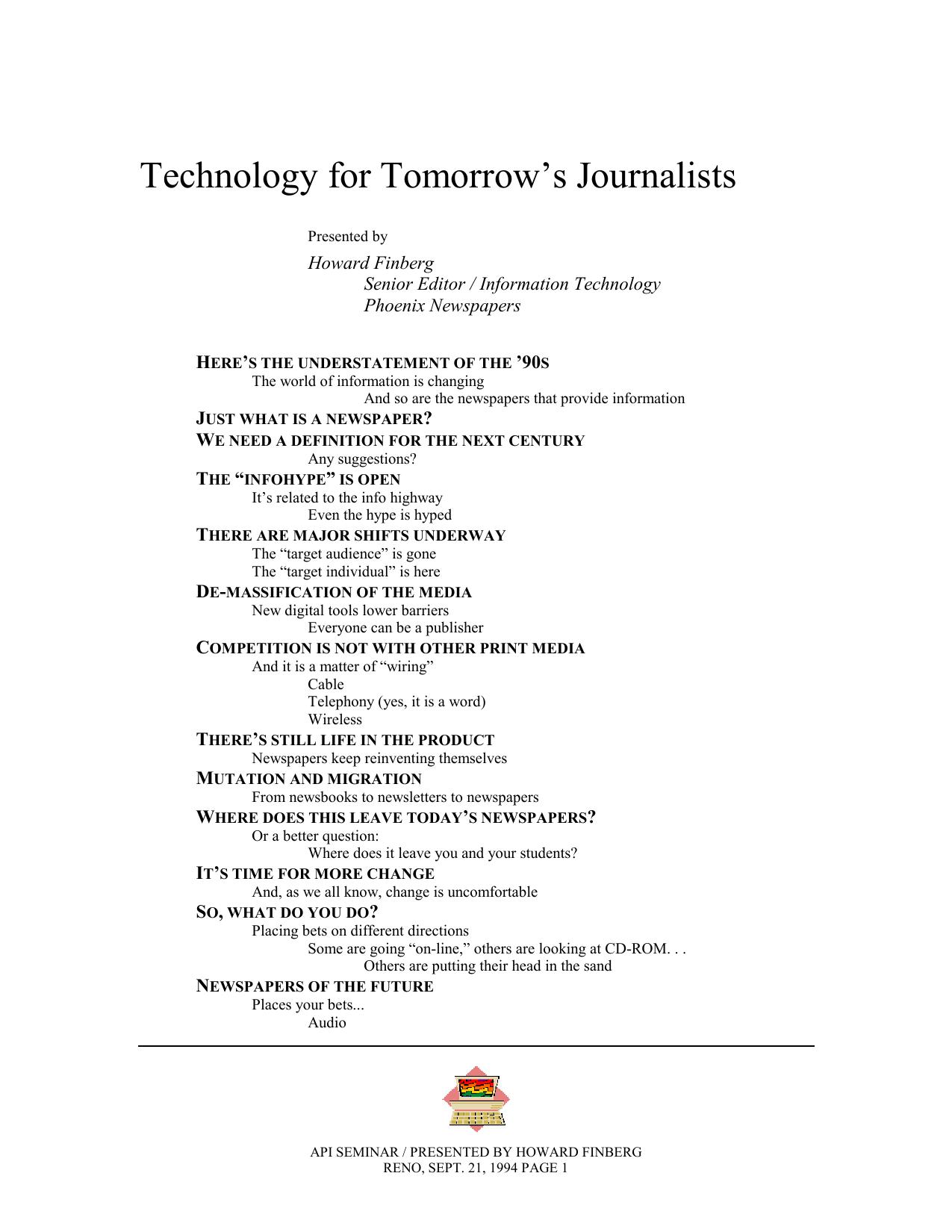
Opening slide from a 1994 American Press Institute seminar presentation for journalism educators in Reno

Technology For Tomorrow’s Journalists — an API Seminar, 1994

This is the slide outline from a presentation I gave at an American Press Institute seminar for journalism educators, in Reno, on September 21, 1994. At the time I was Senior Editor / Information Technology at Phoenix Newspapers, and the assignment was to talk to the people teaching the next generation of journalists about what was coming at them.

The opening slide set the tone with what I called the understatement of the decade:

The world of information is changing
And so are the newspapers that provide information

Then the harder question, which I put back to the room rather than answering it myself:

JUST WHAT IS A NEWSPAPER?
WE NEED A DEFINITION FOR THE NEXT CENTURY
Any suggestions?

Much of the middle of the presentation was a tour of the bets newspapers were placing in 1994 — audio services over the telephone, fax editions, CD-ROM, “electronic newspapers” delivered by e-mail to a portable computer, online services, and PDAs. I was blunt about the state of play: some publishers were going online, some were looking at CD-ROM, and “others are putting their head in the sand.” The framing throughout was gambling — place your bets, and then:

WILL ANY OF THESE BETS PAY OFF?
What happens if you lose?
What happens if you don’t play?

The numbers are a good reminder of how early this all was. My online services slide reported that 34% of homes had a personal computer and 13% had a modem, with a forecast that by 1997 the computer number would reach 40-50% but modems would only reach 20%. The named players were CompuServe, America Online, Prodigy and Delphi; the partnership examples were Mercury Center and Access Atlanta; the “future players” I listed were Microsoft, Ziff and Sony. And a slide on why modem penetration might not matter at all — because of “cable boxes that have a computer chips inside.”

Because the audience was educators, the second half turned to jobs and curriculum. I argued that reporters could no longer treat the process of getting the story onto the doorstep as somebody else’s problem, and that they would be gathering content for multiple products. Some of it was deliberately provocative:

Even “hot” jobs may disappear
Do we really need designers?

Coming from someone whose career had been built in newspaper design, that was meant to land. So was the slide on teaching:

HOW DO YOU TEACH THESE NEW SKILLS?
It won’t be from a textbook

My prescription was more connection — “Newsroom and classroom need to get closer / Classroom needs to get real.” Two decades later I was still working on exactly that problem, with News University at the Poynter Institute, trying to close the same gap with online training instead of slides.

The closing section was what I labeled my “vision thing”: that newspapers don’t just provide content, they provide context, and that dumping data isn’t journalism — “If you want data, try the phone book.” I also made the point that newspapers were already interactive:

Newspapers are already interactive
They push content
Readers push back

And the last two slides hold up best of all, in 1994 and in 2026:

Understand that “cutting edge” means “bleeding edge”
Look at workflow, not hardware

Followed by “TECHNO-EVANGELISM / Lead by example / Take an interest.” Substitute today’s technology of the moment for CD-ROM and PDAs and the advice doesn’t need much editing.