First U.S. Database Publishing System
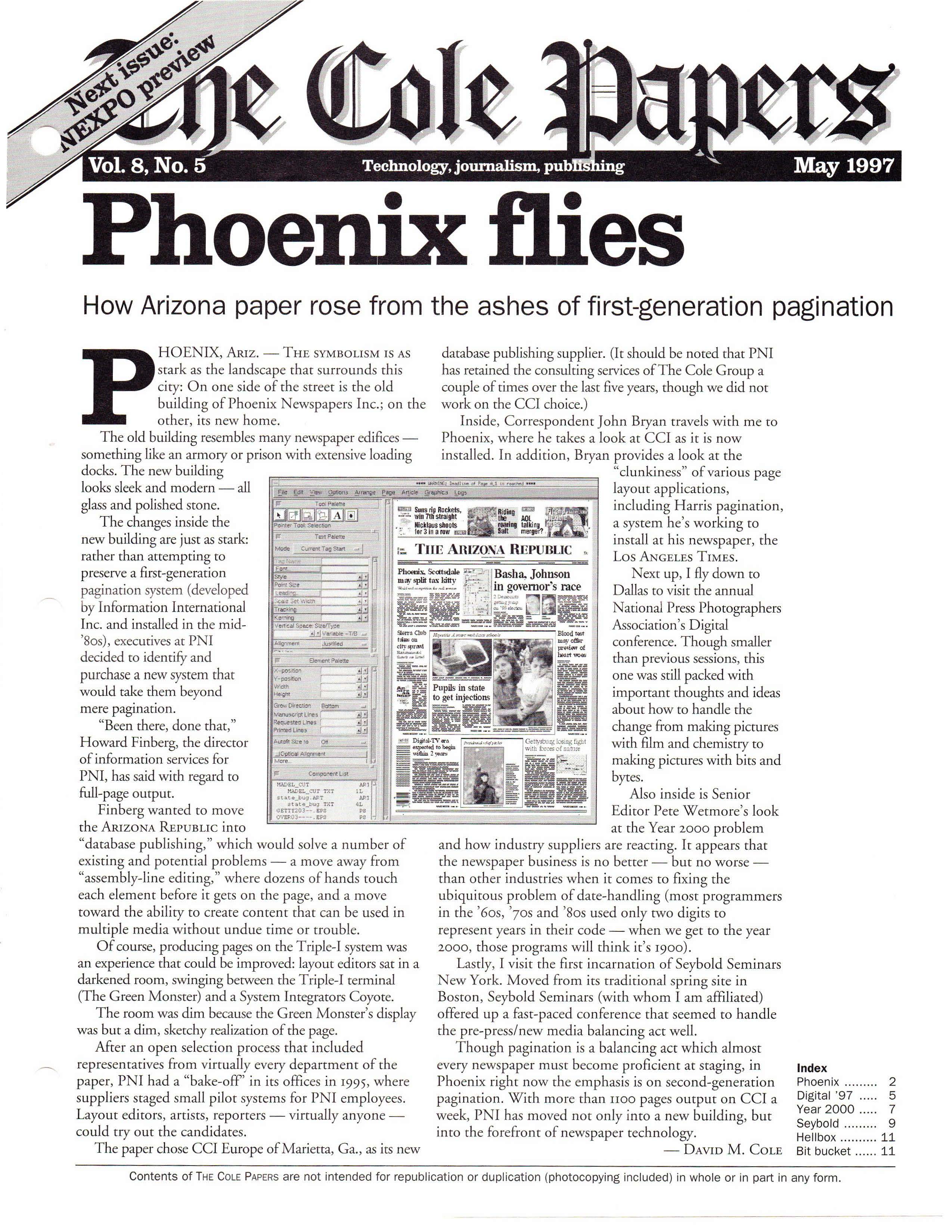
From the July/August 1997 issue of TechNews, the magazine of newspaper operations published by the Newspaper Association of America published a story about the conversion of The Arizona Republic to a CCI Europe database publishing system. This was work I led as the paper’s director of information technology. The new system replaced the Information International Inc. (Triple-I) pagination system that had made the Republic one of the first metro newspapers in the country to be completely paginated.
The Arizona Republic recently became the first newspaper in North America to be created entirely through “database-system publishing.” The Republic can now gather information once and distribute it in a variety of formats: from ink-on-paper to online, from fax to CD-ROM.
The first phase was completed June 2, 1997. The story notes that Phoenix Newspapers Inc. was doing this while also constructing a new 10-story building, launching Arizona Central, merging The Phoenix Gazette and Republic newsrooms and closing The Gazette, and moving more than 1,000 employees and their computers across the street.
Finberg described the timing of the switch to CCI’s database system as a lot like “changing the engine in an airplane at 35,000 feet. On paper it looks possible, but in your heart you know it will be pretty tricky. It is not something for the fainthearted.”
Dave Seibert, technology-development manager for news and information at PNI, is quoted on the hardest technical problem — getting CCI to talk to the existing SII text-editing system, which took about six months. David Neibergall, team leader for design, points to WYSIWYG editing, and to designers finally leaving the darkened room the staff called “The Cave,” a space required by the low-contrast green screens of the Triple-I system.
At the time of the article, the Republic was paginating more than 1,100 pages a week on CCI, with a common copy-editing and design database due that fall and reporters moving to Windows PCs in 1998. The piece closes on MediaServer and the ambition behind the whole project:
“With a database publishing system, we’ll have the tools to produce not only the newspaper, but also online editions, magazines, and more. The key is effective access to our content—text, photos, audio—regardless of the delivery method.”
Reading this in 2026, the vocabulary has changed but the argument has not. Create the content once, store it in a structured way, and deliver it wherever the audience happens to be. Every content management system and API-driven newsroom workflow in use today rests on that same idea — one we were arguing for, and building, a page at a time in Phoenix.