Learning to Walk: 2000 Look Back at Five Years Online
In December 2000, The Digital Edge, the online publication of the Newspaper Association of America‘s New Media Federation, marked the fifth anniversary of newspapers on the Web by asking seven veterans of the industry’s digital efforts to reflect on what they’d learned. The article, “Just Learning to Walk,” was written by Rob Runett, NAA Manager of Electronic Media Analysis. I was one of the seven, described in the piece as:
Howard I. Finberg, former vice president of Central Newspapers‘ CNI Ventures and CNI’s director of technology and information strategies. (He’s now sharing his wisdom as director of Tempe, Ariz.-based Digital Futurist Consultancy).
The others were Lisa DeSisto of boston.com, Todd Engdahl of DenverPost.com, John Granatino of Belo Interactive, Chris Jennewein of KnightRidder.com, Joe Michaud of MaineToday.com and Chris Morrill of the Hartford Courant’s ctnow.com.
Runett’s framing was that five years is nothing in the life of a medium, but felt like several lifetimes to the people who lived it. The questions ranged from proudest moment to biggest regret, and the answers were candid in a way industry panels rarely are.
My toughest hurdle was not technology. It was classified advertising:
The hardest challenge or hurdle we faced was getting the classified department to understand that that the company needed to move quickly or we’ll lose in the online marketplace. This was early in the development of the site [azcentral.com] and all we really knew was that our readers/customers wanted classifieds. And they wanted them for free, something that went to the opposite of the teachings at classified managers school. We didn’t have a business model, just a business “gut feeling” in 1996.
On business models, I argued that it was far too early to declare winners — and that interactive media was something genuinely new, not simply print extended:
Heck, we aren’t even walking yet and you want us to declare a college major?
Interactive, a.k.a. online, media truly is a new form of communication; it is less of an extension of our existing businesses or business models. Hey, that doesn’t mean we can’t learn from our forefathers. Interactive media should share the best traits of its “parents” and then move out of the house quickly.
Asked what I would undo, I picked the pace of the Web build-out at azcentral — and the pull of an easier revenue stream:
I resisted the temptation and probably should have moved quicker to have the team build out more Web features and spent fewer resources on AOL. But AOL was sending us money every month.
The “most important lesson in two lines or less” question produced the best writing in the piece. Morrill: “The user comes first. The user comes first. The user comes first.” Engdahl: “This isn’t a sprint, it’s a marathon.” Jennewein reminded everyone that traffic, advertising and low costs are Business 101, “but many of us lost sight of this during the dot-com boom.” I failed to follow the rules:
The basics, however, still matter: Quality. Accuracy. Fairness. Fun. Service. To do less is to fail the customer. I have also learned that I probably could never sum up in “two lines or less.”
The same December issue carried a column by New Media Federation President Gordon Borrell, vice president/new media at Landmark Communications, titled “Recommit or Pull the Plug.” Borrell noted that the Arizona Republic had cut 28 new-media positions in November and that Tribune Interactive had terminated 24 online positions in October — and listed me among those on the conference speaking circuit who had found themselves jobless since early summer. He quoted me on how I read the shakeout:
During the next year, the strong will get stronger; the weak will struggle. Those companies that recognize that the Internet is a new medium and not an extension of existing print models will do the best… What dot-com and traditional media businesses need to do is roll up their sleeves and get to work. No one said it would be easy — that’s why they call it work.
Borrell closed his column by agreeing: the 1990s were the years of experimentation and innovation, and what lay ahead was the real work.
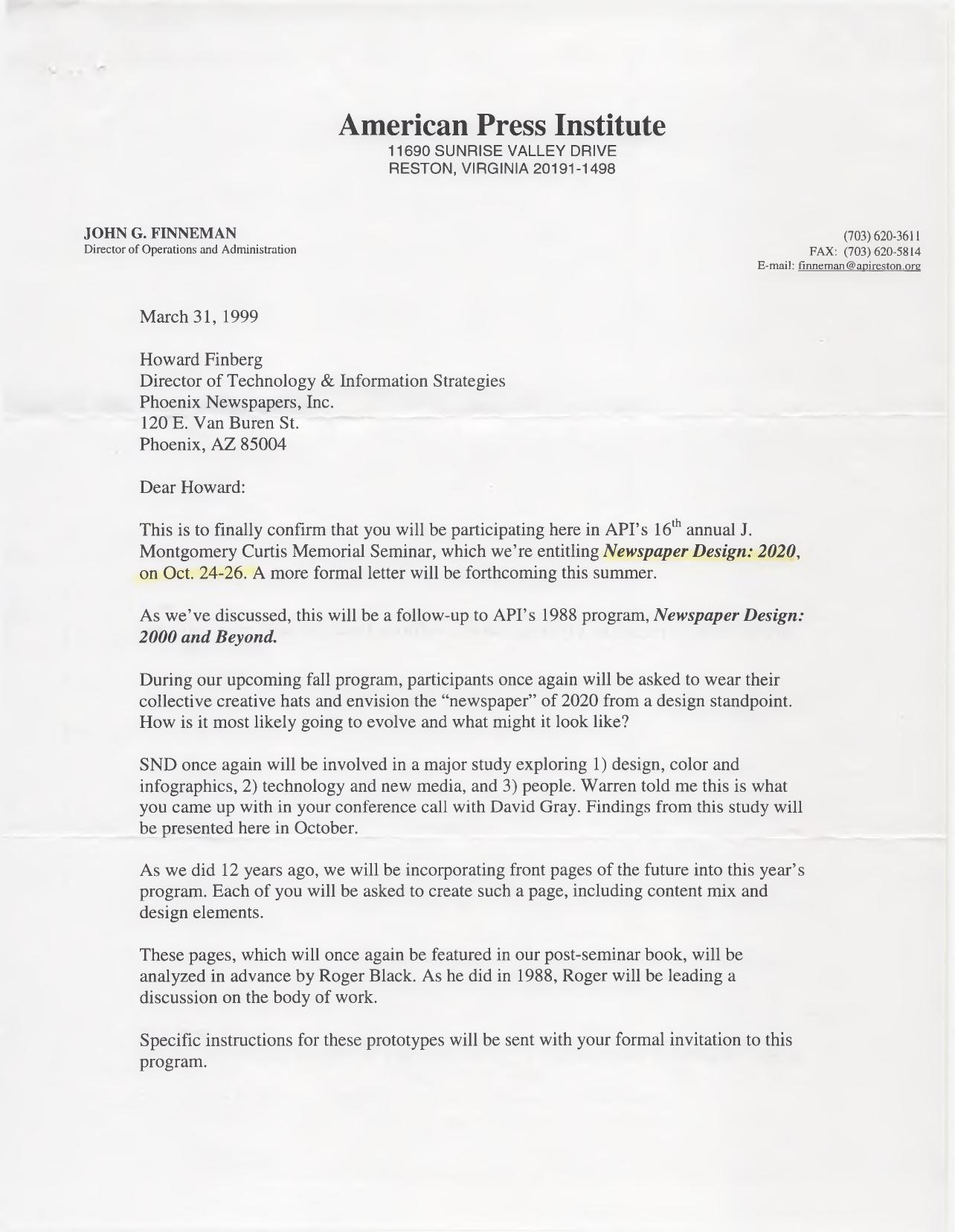
Scanned along with these pages is a snapshot of the Digital Futurist Consultancy site as it existed in December 2000 — the biography, the scouting reports from DRUPA and the Jupiter conference, the Arizona Republic “learning journey,” and the 2020 Southwest Republic prototype done for the American Press Institute. Also included is the NAA press release announcing that year’s Digital Edge Awards, which named me the New Media Federation’s New Media Pioneer for 2000.
Reading these predictions now is instructive. DeSisto’s five-year forecast for boston.com included being on Palms, on cell phones and streaming headlines to LCD screens on taxicab roofs — and, she added, the Red Sox winning the World Series. She was right about the Red Sox in 2004, and right about the phones, though not in the way anyone in 2000 expected. Jennewein predicted that newspapers would dominate the local Internet space “with the specter of competition from dot-com startups long dissipated.” That one didn’t age as well.
What holds up, I think, is the thing I kept insisting on: that this was a new medium, not an extension of print. Twenty-five years later, that argument is still being relitigated in newsrooms — and the industry is still, in some important ways, just learning to walk. For others, they have been stopped in their tracks.