First Personal Computer, Sort of…

My first computer was an Atari 800, with 8k of memory.  Yes, that’s 8 kilobytes of memory.  Not megabytes. It cost, after Illinois taxes, $1,149.  In 2013 dollars that would be $3,256.

It connected to a television set, as that was the monitor.  It used cartridges for some of the programs, including the Star Raiders game.  It also had a tape disk drive and some programming capability using the Basic language.

I tried to create a “Wine Cellar” database program.

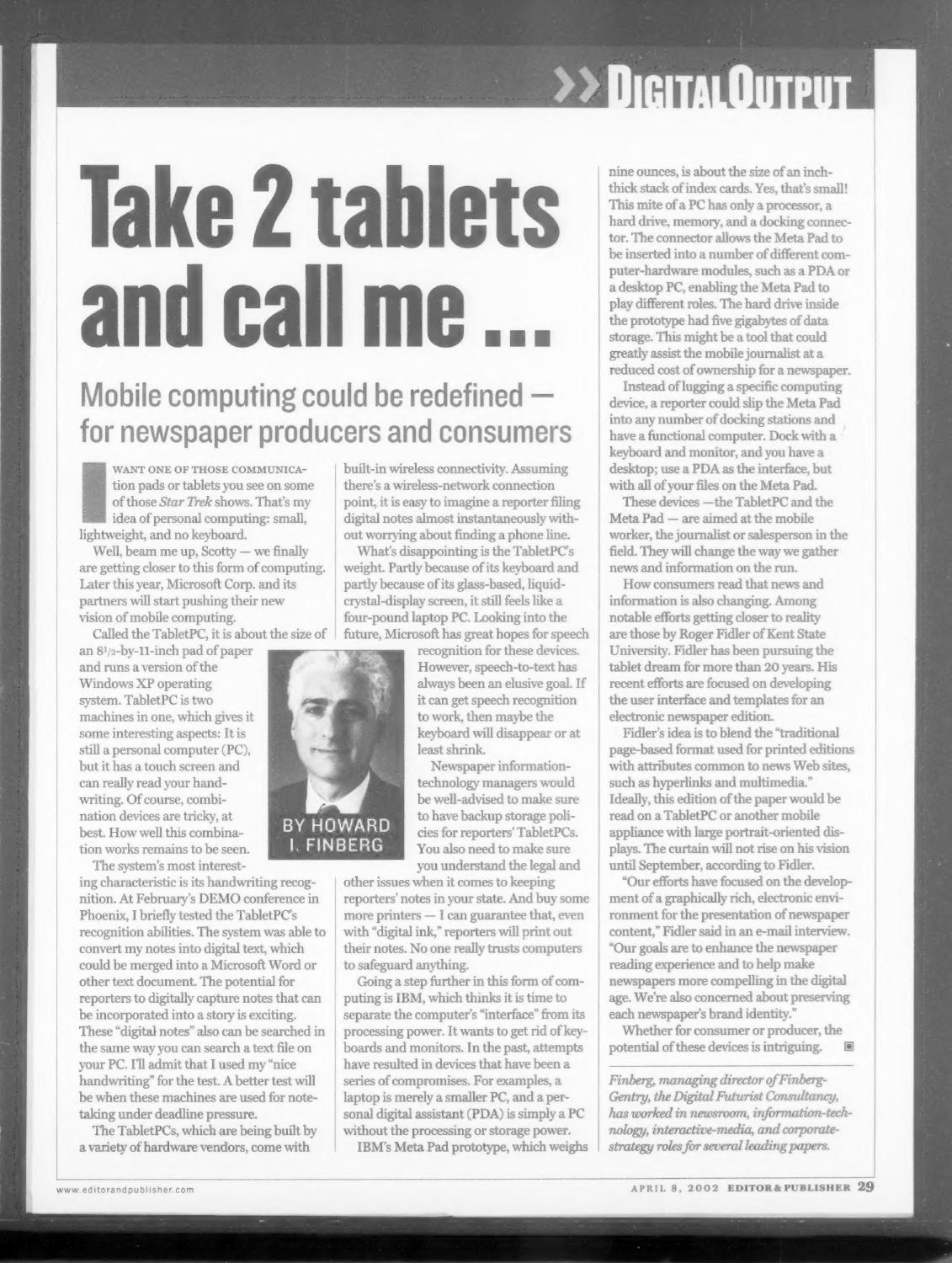
Tablet-style device representing the 2002 promise of mobile computing for newspapers, from an Editor & Publisher column

Take 2 Tablets and Call Me — Mobile Computing, 2002

My column in the April 8, 2002, issue of Editor & Publisher looked at two devices that promised to redefine mobile computing for both newspaper producers and consumers: Microsoft’s forthcoming TabletPC and IBM’s Meta Pad prototype.

The column opens with an admission about where the idea came from:

I want one of those communication pads or tablets you see on some of those Star Trek shows. That’s my idea of personal computing: small, lightweight, and no keyboard.

The TabletPC, about the size of an 8 1/2-by-11-inch pad of paper and running a version of Windows XP, was being built by a variety of hardware vendors with built-in wireless connectivity. I had briefly tested its handwriting recognition at February’s DEMO conference in Phoenix, where the system converted my notes into digital text that could be merged into a Word document. My caveat: I used my “nice handwriting,” and the real test would come with note-taking under deadline pressure. The disappointment was weight — it still felt like a four-pound laptop.

The column also offered practical advice for newspaper information-technology managers: back up reporters’ TabletPCs, understand the legal issues around keeping reporters’ notes in your state, and buy more printers.

No one really trusts computers to safeguard anything.

IBM’s Meta Pad prototype went a different direction — separating the interface from the processing power. At nine ounces and about the size of an inch-thick stack of index cards, it held only a processor, a hard drive, memory, and a docking connector, with five gigabytes of storage. Dock it with a keyboard and monitor and you have a desktop; dock it with a PDA and you have a handheld carrying all your files.

On the consumer side, the column reported on Roger Fidler of Kent State University, who had been pursuing the tablet dream for more than 20 years and was then working on the user interface and templates for an electronic newspaper edition — blending the page-based format of print with hyperlinks and multimedia. Fidler said his work would not be unveiled until September, and told me in an e-mail interview:

Our efforts have focused on the development of a graphically rich, electronic environment for the presentation of newspaper content. Our goals are to enhance the newspaper reading experience and to help make newspapers more compelling in the digital age. We’re also concerned about preserving each newspaper’s brand identity.

The column ran with the standard tagline identifying me as managing director of Finberg-Gentry, the Digital Futurist Consultancy.

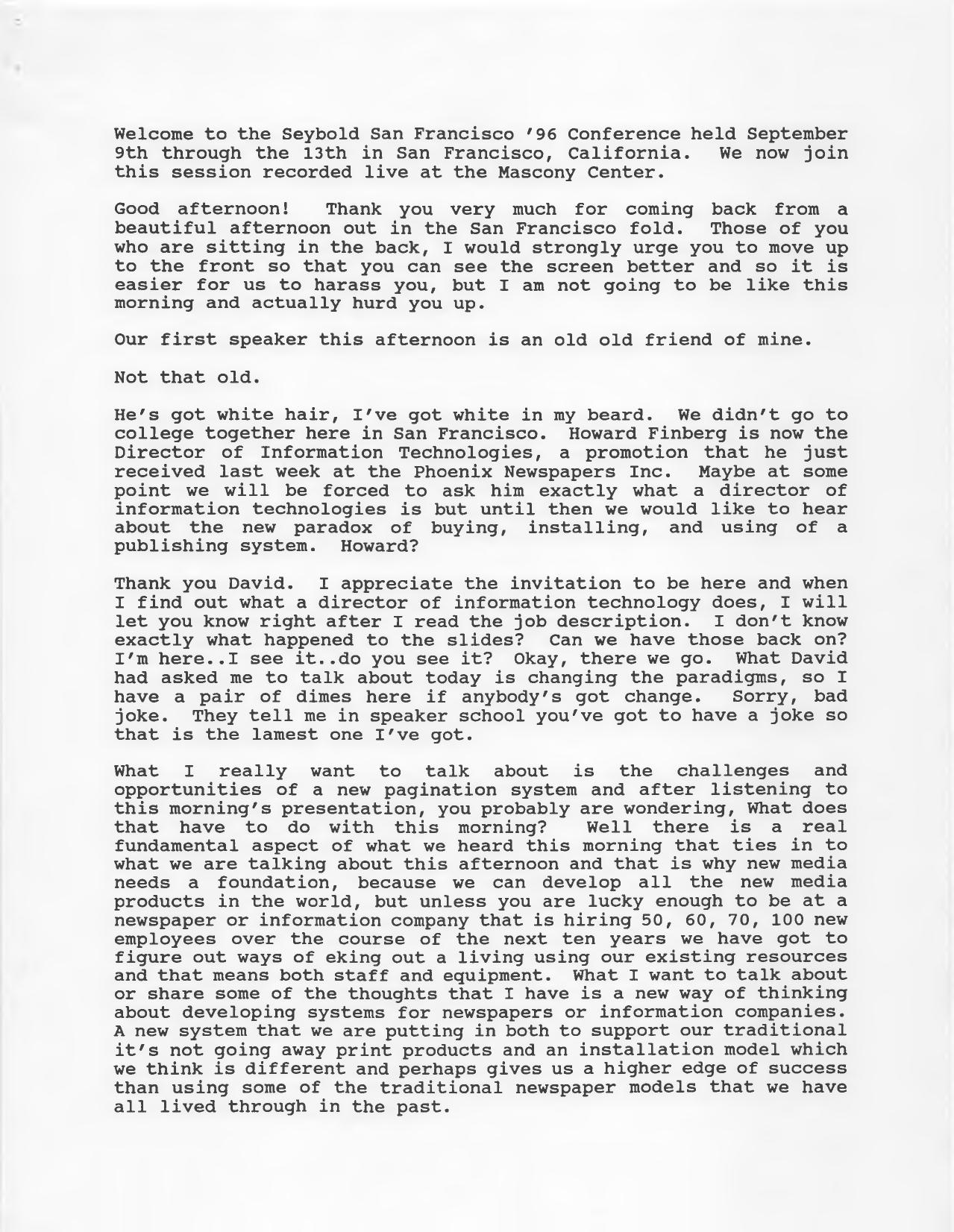
Seybold Seminars publishing conference session at Moscone Center in San Francisco, September 1996

Pagination and Paradigms at Seybold

In the 1990s, if you wanted to know where publishing technology was headed, you went to Seybold. The Seybold Seminars conferences were the industry’s gathering place for prepress, typesetting and publishing systems — the vendors, the consultants and the newspaper and magazine people who had to make it all work. This session was recorded live at Moscone Center during the San Francisco show, held Sept. 9-13, 1996.

I was introduced by David Cole, the technology consultant, who took some pleasure in my brand-new and rather vague job title.

Howard Finberg is now the Director of Information Technologies, a promotion that he just received last week at the Phoenix Newspapers Inc. Maybe at some point we will be forced to ask him exactly what a director of information technologies is but until then we would like to hear about the new paradox of buying, installing, and using of a publishing system.

My answer was that I’d let everyone know what the job was as soon as I’d read the description. The talk itself was about the pagination project at Phoenix Newspapers Inc. — replacing 15 aging Information International (Triple I) page makeup workstations, the big Raytheon-built terminals the staff called the “green-eyed monster,” and the design rooms kept dark enough for those screens that people called them “bat caves.” We selected CCI Europe, and by the end of August 1996 we were 82-85% complete on the rollout.

But the point I most wanted to make was that pagination was the wrong question.

We asked ourselves this fundamental question and if you have ever talked about this, if you are thinking about this, if this is a question for you…you really have to ask “do you want to paginate?” and I contend quite frankly, honestly, emphatically that the answer is no…not interested in pagination anymore.

What we actually wanted was a publication database — information in the middle, output neutral, feeding print and whatever came next. And that meant breaking the industry’s habit of treating the newsroom as the sole owner of anything valuable.

… we have a model in our industry that says information of value resides within the newsroom. I say let’s break that model, let’s break the paradigm, and say information belongs to whoever needs it and whoever can make use of it.

Much of the speech was about people, not machines: open committees that included the library and purchasing, cookies and free lunches to get staff to vendor demos, a full-time trainer, a Lotus Notes database of threaded project discussions going back to August 1995, and two “super users” from the design department who hated the title. One of them, Eddie Rossi, was quoted as saying the installation was going very well, “but not very elegantly.”

My favorite line in the whole transcript isn’t mine — it’s my boss’s, quoted secondhand: “if you want to know how to reorganize a newspaper, figure out who has control of the furniture, because that is what it is all about.” Nearly 30 years later, I’d still defend that as sound organizational theory.

A note on the transcript: it was typed from the audio recording, so a few things come out oddly. QuarkXPress becomes “cork express,” HTML becomes “HTMO,” and my confession about being a former Macintosh bigot gets rendered as “math bigot.” I’ve left them as they are.