Will Artists Become Computer Nerds? —E&P, 1988
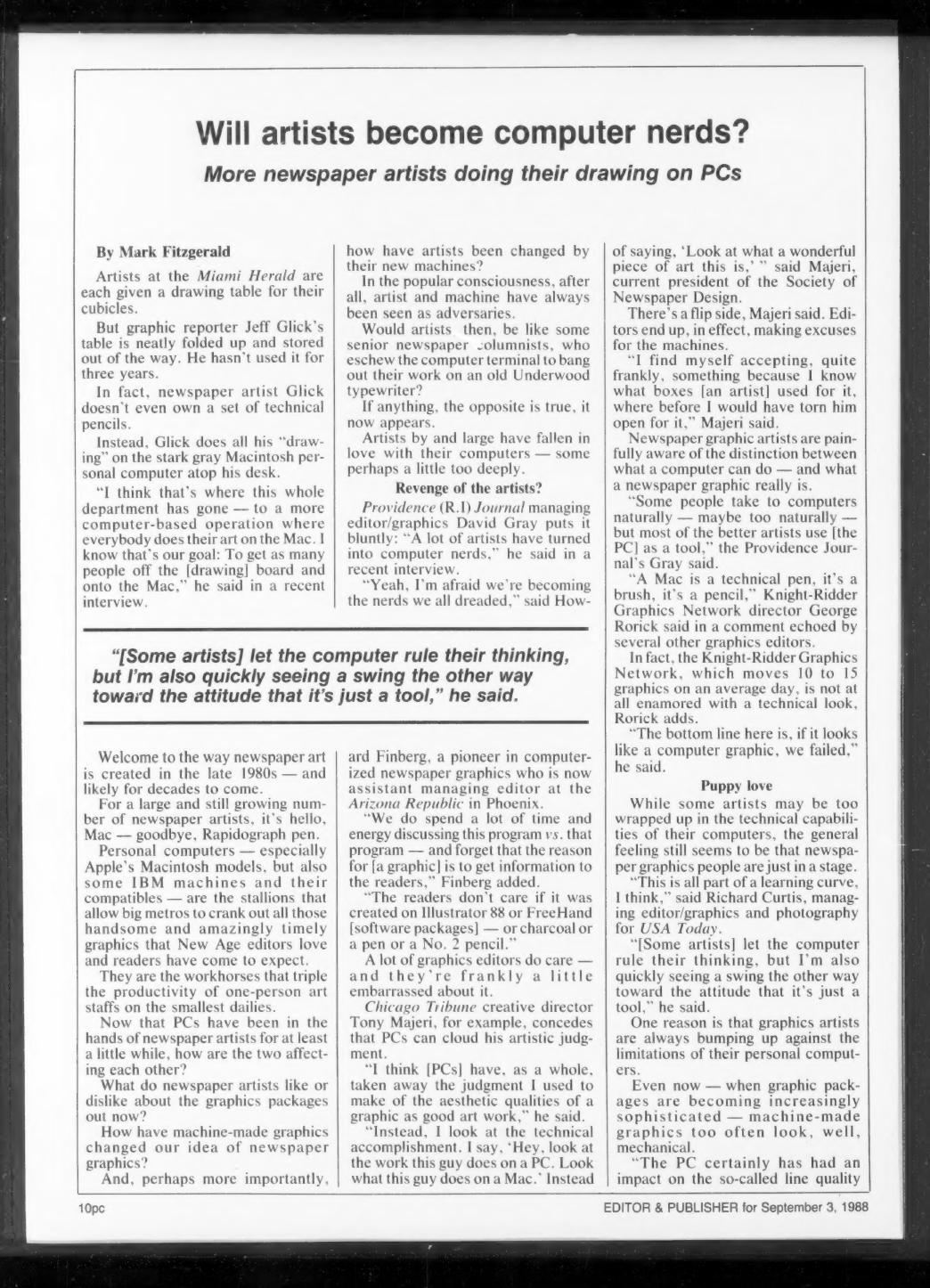
Two related stories by Mark Fitzgerald in the September 3, 1988, issue of Editor & Publisher survey what happened to newspaper art departments once the Macintosh arrived. The first piece, “Will artists become computer nerds?”, reports that artists had largely embraced the machines — Miami Herald graphic reporter Jeff Glick hadn’t used his drawing table in three years — and asks what the shift did to line quality, typography and editorial judgment. The second, “Graphics software,” catalogs the strengths and shortcomings of MacDraw, MacDraw II, Adobe Illustrator 88, Aldus FreeHand and Cricket Draw 1.1, and asks whether vendors were paying attention to the newspaper market at all.
I’m quoted throughout as assistant managing editor at the Arizona Republic in Phoenix, along with David Gray of the Providence Journal, Tony Majeri of the Chicago Tribune, George Rorick of the Knight-Ridder Graphics Network, Richard Curtis of USA Today, Marian Wachter of the Seattle Times and Ray Chattman of the Society of Newspaper Design.
“Yeah, I’m afraid we’re becoming the nerds we all dreaded,” said Howard Finberg, a pioneer in computerized newspaper graphics who is now assistant managing editor at the Arizona Republic in Phoenix.
“The readers don’t care if it was created on Illustrator 88 or FreeHand [software packages] — or charcoal or a pen or a No. 2 pencil.”
On the trade-offs of the technology:
“I think the Macintosh has been both a boon and a bane for information graphics,” said the Arizona Republic’s Finberg. … “The bane has been that the quality of typography and the quality of illustration has suffered.”
And on how the change arrived in newsrooms:
“This revolution in newsrooms in terms of using computer graphics is very interesting because it did not come from the bottom up — it came from the top down.”
The software story records a Society of Newspaper Design member survey taken at the previous fall’s convention: the Macintosh was used by 86.7% of respondents, IBM by 9.2%. It also quotes Rorick’s standard for the Knight-Ridder network — “The bottom line here is, if it looks like a computer graphic, we failed” — and my own less optimistic assessment of the tools then on the market.
“I’m not sure there is a perfect program out there. I don’t know if there ever will be a perfect graphics program,” said Howard Finberg, assistant managing editor at the Arizona Republic in Phoenix.