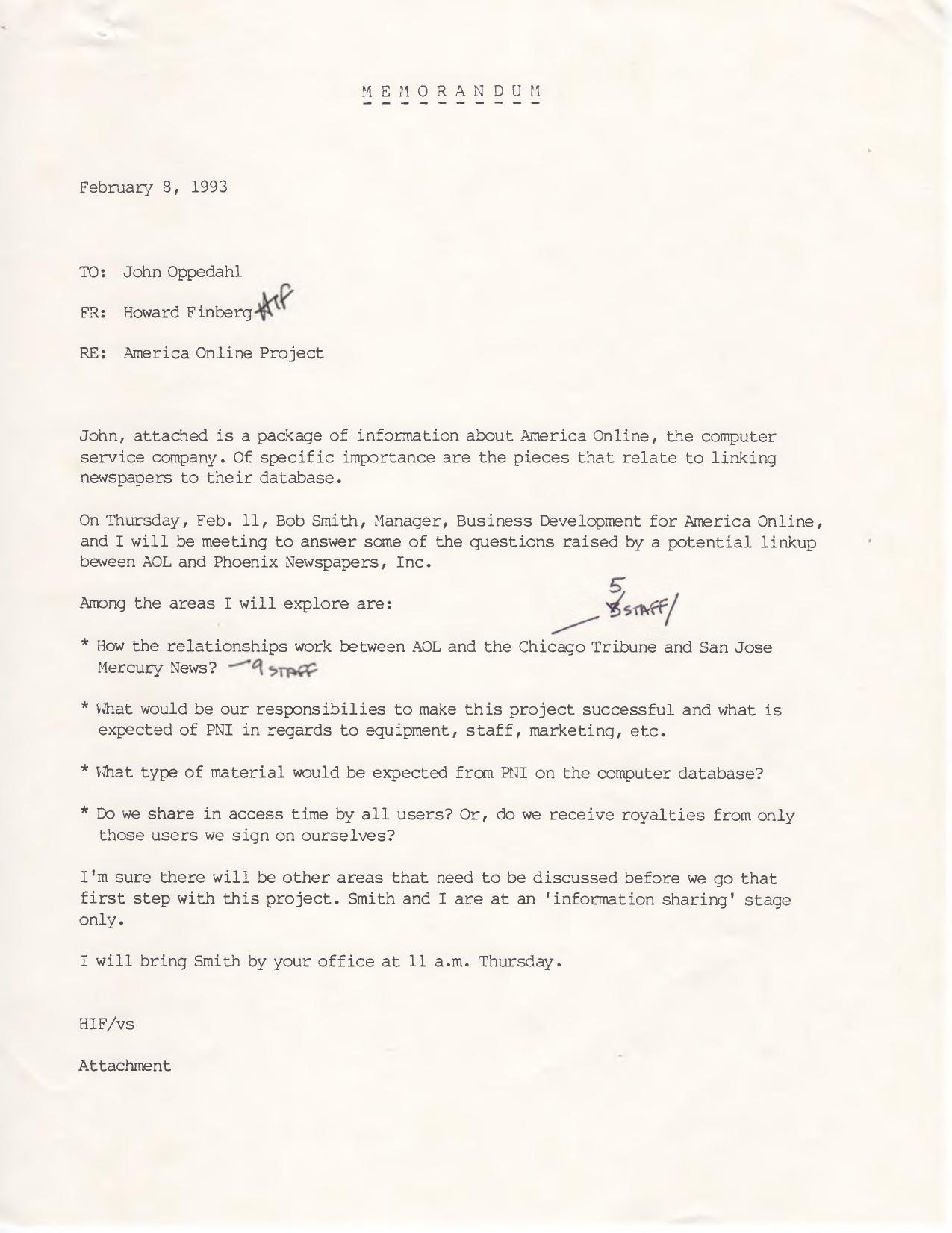
Typed 1993 internal memo to Phoenix Newspapers executive John Oppedahl outlining questions for a meeting with America Online

An Early Look at America Online

This is a short memo I wrote in February 1993 to John Oppedahl, then an executive at Phoenix Newspapers, Inc., about a meeting I had scheduled with America Online. At the time, AOL was signing up newspapers to put content into its database, and I wanted to understand what such a partnership would mean for PNI before anyone committed to anything.

John, attached is a package of information about America Online, the computer service company. Of specific importance are the pieces that relate to linking newspapers to their database.

The meeting was set for Thursday, Feb. 11, with Bob Smith, Manager, Business Development for America Online. The questions I planned to ask were the basic ones any newspaper should have been asking in 1993 — and, honestly, the ones many didn’t ask carefully enough:

* How the relationships work between AOL and the Chicago Tribune and San Jose Mercury News?

* What would be our responsibilities to make this project successful and what is expected of PNI in regards to equipment, staff, marketing, etc.

* What type of material would be expected from PNI on the computer database?

* Do we share in access time by all users? Or, do we receive royalties from only those users we sign on ourselves?

That last question — who gets paid, and for whose audience — turned out to be the one the industry spent the next decade arguing about.

I was careful to keep expectations modest:

I’m sure there will be other areas that need to be discussed before we go that first step with this project. Smith and I are at an ‘information sharing’ stage only.

The memo closes with the smallest of logistical notes: I would bring Smith by Oppedahl’s office at 11 a.m. Thursday.

Postscript: Phoenix Newspapers did sign an agreement with America Online.

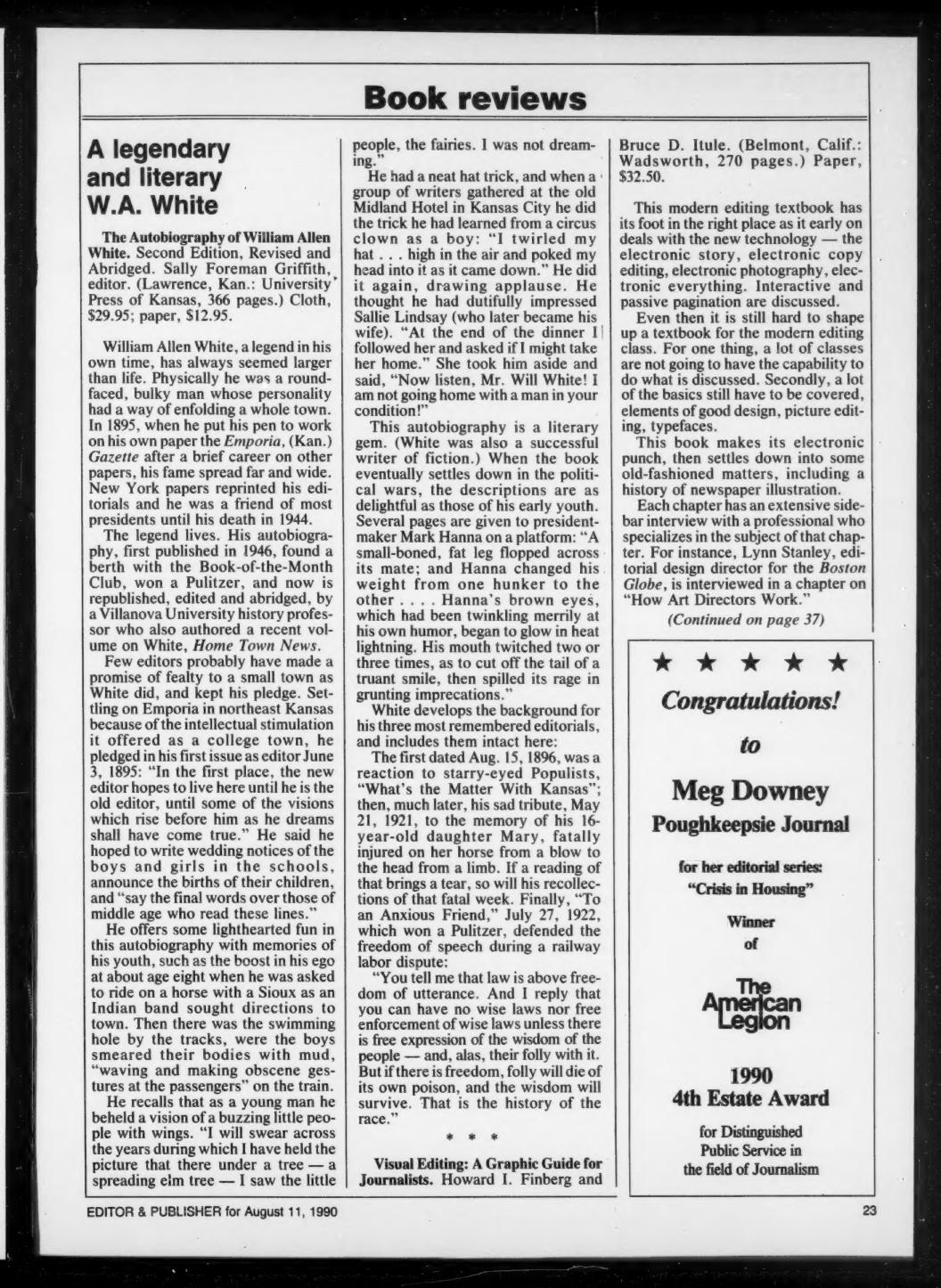
Editor & Publisher book review column from August 11, 1990 featuring a notice of Visual Editing: A Graphic Guide for Journalists

Editor & Publisher Reviews “Visual Editing”

A book review column from Editor & Publisher for August 11, 1990, written by Hiley Ward. The column paired a review of the revised and abridged Autobiography of William Allen White with a shorter notice of Visual Editing: A Graphic Guide for Journalists, by Howard I. Finberg and Bruce D. Itule (Belmont, Calif.: Wadsworth, 270 pages, paper, $32.50).

Ward’s review credited the book for leading with technology, then acknowledged the practical limits facing editing classes of the day.

This modern editing textbook has its foot in the right place as it early on deals with the new technology — the electronic story, electronic copy editing, electronic photography, electronic everything. Interactive and passive pagination are discussed.

Even then it is still hard to shape up a textbook for the modern editing class. For one thing, a lot of classes are not going to have the capability to do what is discussed. Secondly, a lot of the basics still have to be covered, elements of good design, picture editing, typefaces.

The review noted the chapter sidebar interviews with working professionals — citing Lynn Stanley, editorial design director for the Boston Globe, interviewed in the chapter on “How Art Directors Work” — along with the book’s history of newspaper illustration and its emphasis on information graphics and picture editing.

As it compares front pages, many in color, the book is as appealing for the practitioner as for the novice.

The review closed with the authors’ affiliations at the time:

Finberg is assistant managing editor at the Arizona Republic and Itule teaches at Arizona State University.

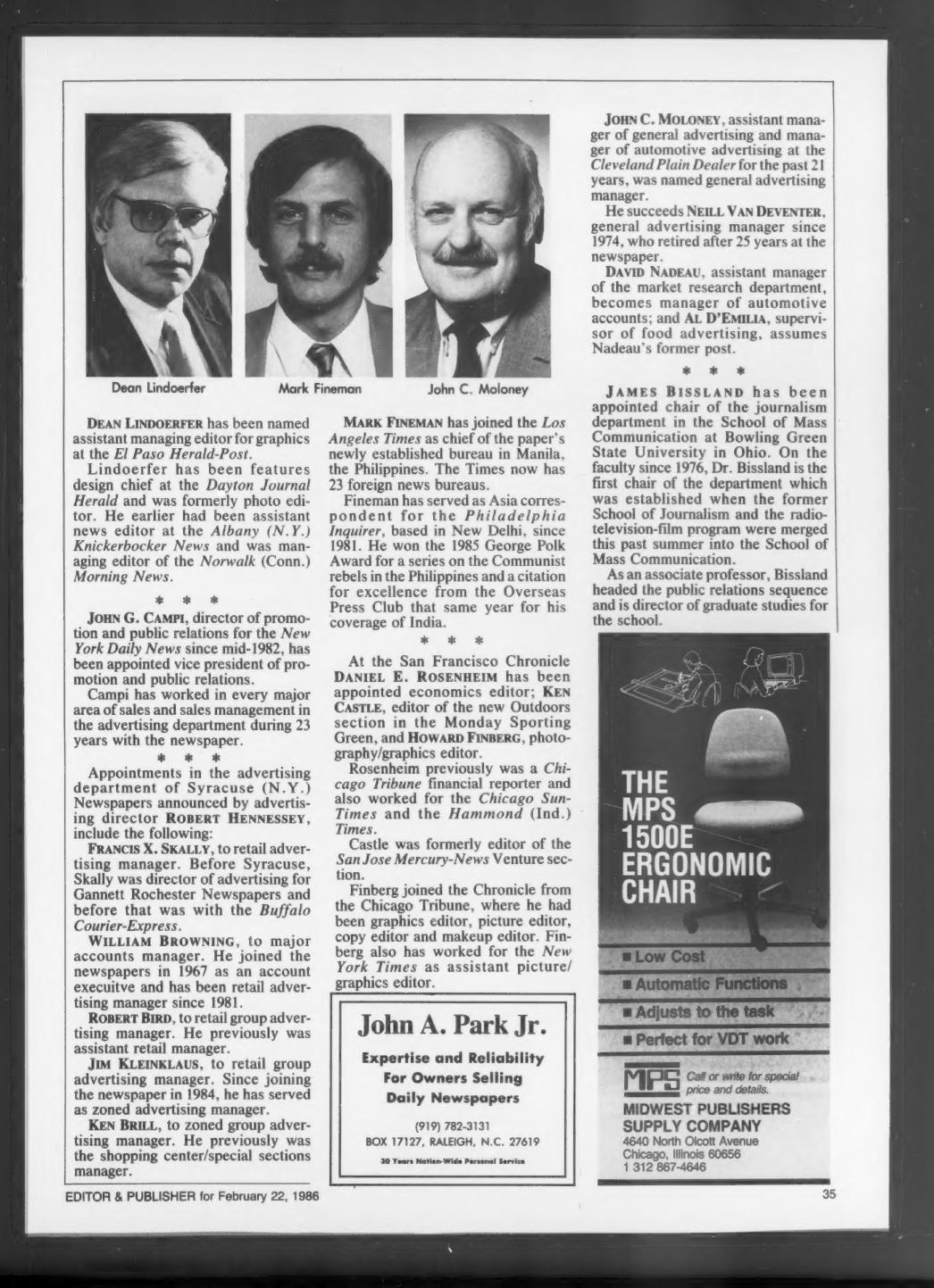
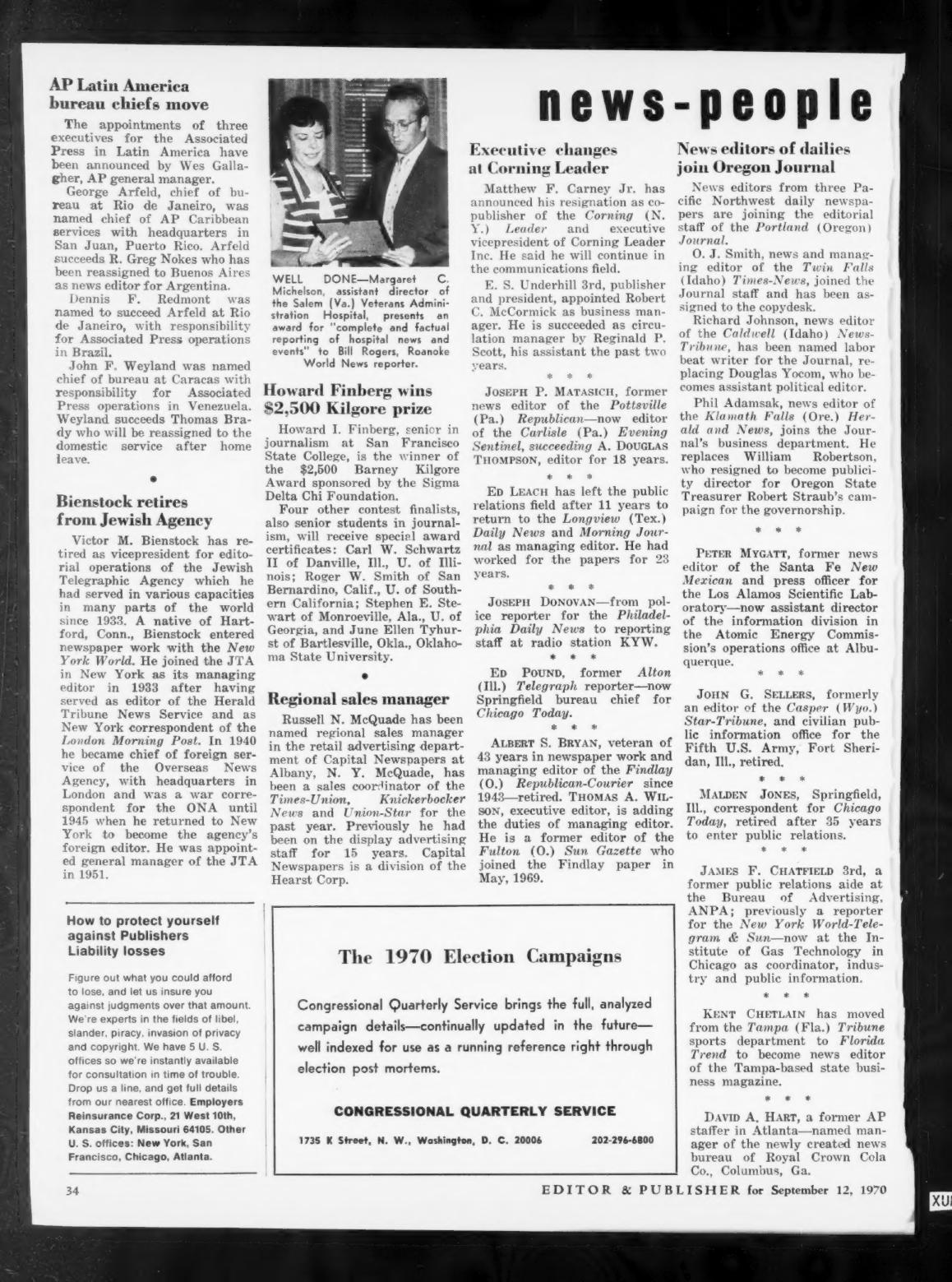
Editor & Publisher appointments column from Feb. 22, 1986, listing Howard Finberg as photography/graphics editor at the San Francisco Chronicle

E&P Notes My Move to San Francisco Chronicle

Before LinkedIn, before company press releases landed in your inbox, there was the back-of-the-book appointments column in Editor & Publisher. That’s where the industry found out who was moving where. This item, from the Feb. 22, 1986, issue, is where my arrival at the San Francisco Chronicle got recorded for the trade.

The Chronicle announced three appointments at once, and E&P ran them together in a single paragraph:

At the San Francisco Chronicle DANIEL E. ROSENHEIM has been appointed economics editor; KEN CASTLE, editor of the new Outdoors section in the Monday Sporting Green, and HOWARD FINBERG, photography/graphics editor.

Note the title: photography/graphics editor. The two responsibilities were bundled into one job, which tells you something about how newsrooms thought about visual journalism in the mid-1980s — pictures and graphics were still being sorted into the same drawer, even as informational graphics were becoming their own discipline. It also should be noted that I was the first person to hold this job at the paper.  Previously, the art and photo departments reported to other supervisors, such as the news editor.

The short biography that follows is a reasonable summary of the road that got me there:

Finberg joined the Chronicle from the Chicago Tribune, where he had been graphics editor, picture editor, copy editor and makeup editor. Finberg also has worked for the New York Times as assistant picture/graphics editor.

I’m also amused that Dan Rosenheim and I arrived at the Chronicle from the same place — he came from the Tribune’s financial staff. The Chicago-to-San Francisco pipeline was apparently running that year.

The rest of the page is a perfect artifact of the era: an assistant managing editor for graphics named at the El Paso Herald-Post, a promotion executive elevated at the New York Daily News, five advertising appointments at the Syracuse newspapers, the Los Angeles Times opening a Manila bureau (its 23rd foreign bureau), and a new journalism department chair at Bowling Green — all wrapped around display ads for a newspaper broker in Raleigh and a printing supply company in Chicago. That was the industry talking to itself, one column inch at a time.

My time at the Chronicle didn’t last long. The following year I left for Phoenix and The Arizona Republic, which announced my hiring as assistant managing editor for graphics in June 1987 — and identified me, naturally, as “Howard Finberg of the San Francisco Chronicle.”

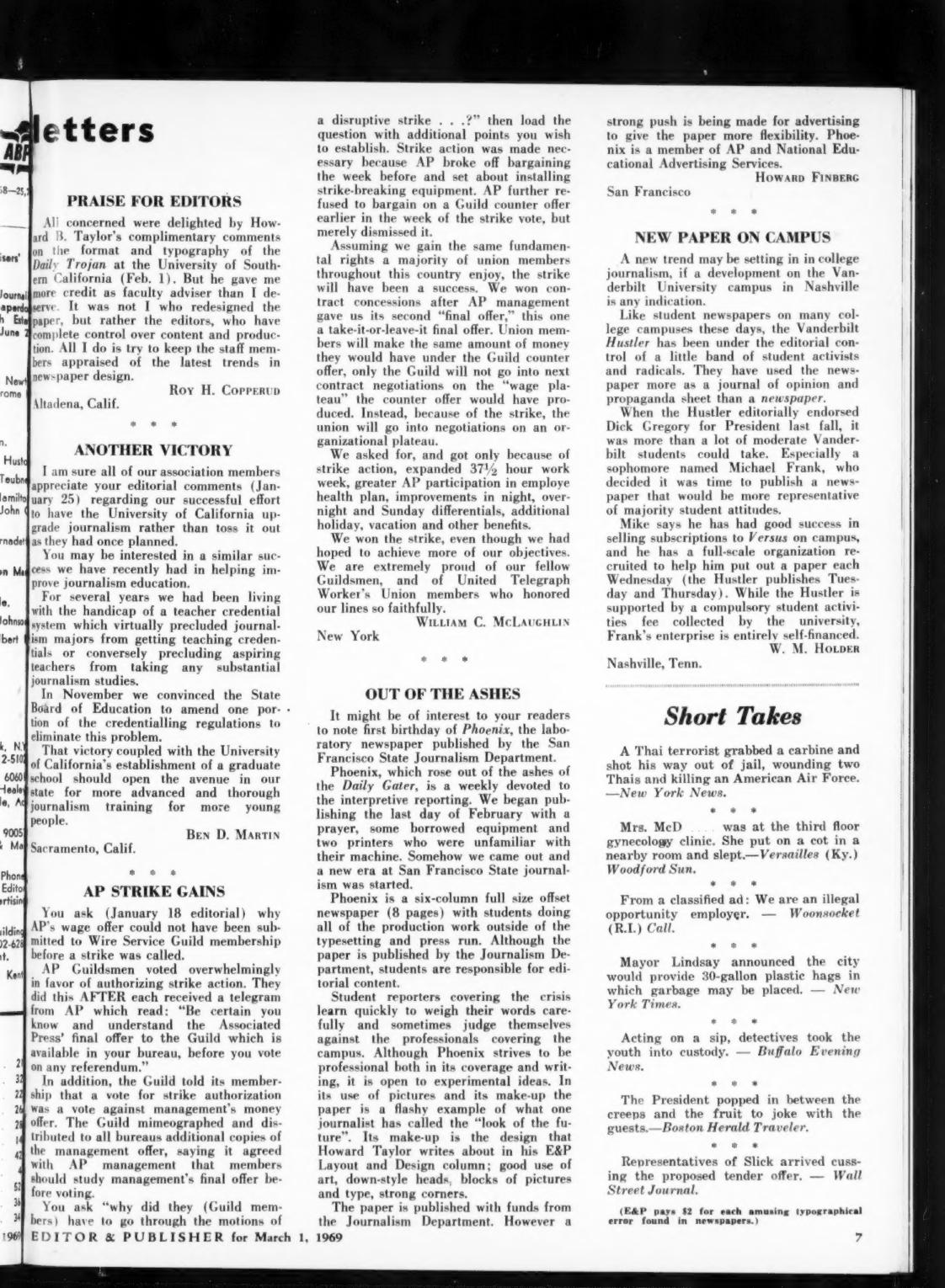
Editor & Publisher letters column from March 1, 1969, printing a letter about Phoenix, the San Francisco State laboratory newspaper

Out of the Ashes: A Letter to Editor & Publisher About the Phoenix

This is a letter of mine that ran in the letters column of Editor & Publisher for March 1, 1969. I was a journalism student at San Francisco State, and what I wanted the trade press to know was that our laboratory newspaper had made it through its first year.

It might be of interest to your readers to note the first birthday of Phoenix, the laboratory newspaper published by the San Francisco State Journalism Department.

The name was not subtle, and it wasn’t meant to be. The Phoenix came after the Daily Gater, and the letter says so plainly, along with a fairly honest account of how the first issue got out the door.

Phoenix, which rose out of the ashes of the Daily Gater, is a weekly devoted to interpretive reporting. We began publishing the last day of February with a prayer, some borrowed equipment and two printers (typesetters) who were unfamiliar with their machine. Somehow we came out and a new era in San Francisco State journalism was started.

What I described was a six-column, full-size offset paper, eight pages, with students doing all of the production work outside of the typesetting and the press run. The Journalism Department published it and paid for it, but, as I was careful to point out, students were responsible for the editorial content. We were pushing for advertising to give the paper more flexibility. The Phoenix was a member of AP and of National Educational Advertising Services.

The part of the letter I still think holds up is the paragraph about what it was like to be a student reporter on that campus, at that moment, with the professionals working the same story.

Student reporters covering the crisis learn quickly to weigh their words carefully and sometimes judge themselves against the professionals covering the campus.

And then, because even at that age I couldn’t resist talking about design, I spent a good chunk of a letter about a student newspaper describing its typography.

In its use of pictures and its make-up the paper is a flashy example of what one journalist has called the “look of the future.” Its make-up is the design that Howard Taylor writes about in his E&P Layout and Design column; good use of art, down-style heads, blocks of pictures and type, strong corners.

There’s a nice coincidence on the same page. The letter at the top of the column, from Roy H. Copperud of Altadena, Calif., is also responding to Howard Taylor’s design coverage — this time about the Daily Trojan at USC — and makes a point I would hear again and again in the years that followed about who actually does the work:

It was not I who redesigned the paper, but rather the editors, who have complete control over content and production.

A page of letters about student newspapers, journalism education in California, and the Wire Service Guild’s strike against the AP — and tucked in among them, a college student telling the industry’s trade magazine that the future would look a certain way on the page. The scan garbles my byline into “Howarp FInBerc,” which feels about right for a 1969 hot-type artifact making its way through a 21st-century scanner.