Covering the Big Story: Pope Visits Phoenix

On September 14, 1987, as a part of his whirlwind tour of the United States, Pope John Paul II visited Phoenix.  It was one of the biggest news events that The Arizona Republic and its sister newspaper, The Phoenix Gazette, would cover during my career at the newspaper.  In Tempe, he held Mass for 75,000 at Sun Devil Stadium.  As a way of celebrating successful coverage the papers jointly produced a special section about how they covered the event.  From the opening story:

The Pope is coming to Phoenix. Those six words, spoken more than a year ago, launched a herculean effort by the state’s two largest newspapers, The Arizona Republic and The Phoenix Gazette, to cover Pope John Paul II’s visit on Sept. 14, 1987. The goal was to capture the essence of the man and his effect on the city and those who saw him.

The task enveloped not only the Republic and Gazette newsrooms and such support services as the Library, Photo Lab and Promotion Department, but also Production, Circulation and Security.

What I like most about this special section was seeing all of the faces from the Republic newsroom and reading this list of managers at both newspapers.

Phoenix Newspapers Inc. publishes Arizona’s largest newspapers, The Arizona Republic and The Phoenix Gazette. Pat Murphy is publisher of both papers. The newsrooms are competitive. The Republic is a morning newspaper with a daily circulation of 343, 723 and a Sunday circulation of 539,323.

Alan Moyer is managing editor: Coordinating the papal coverage were Assistant Managing Editors Howard Armstrong, Howard I. Finberg and Robert Franken. Tom Bauer served as special sections editor. The Gazette, an afternoon newspaper, has a daily circulation of 111,253. Lynne Holt is managing editor. Coordinating papal coverage were Assistant Managing Editor / News Administration Mickey Hirten, City Editor Mike McGrevey and Photo Editor Mary Ann Nock. Nock also was special sections editor.
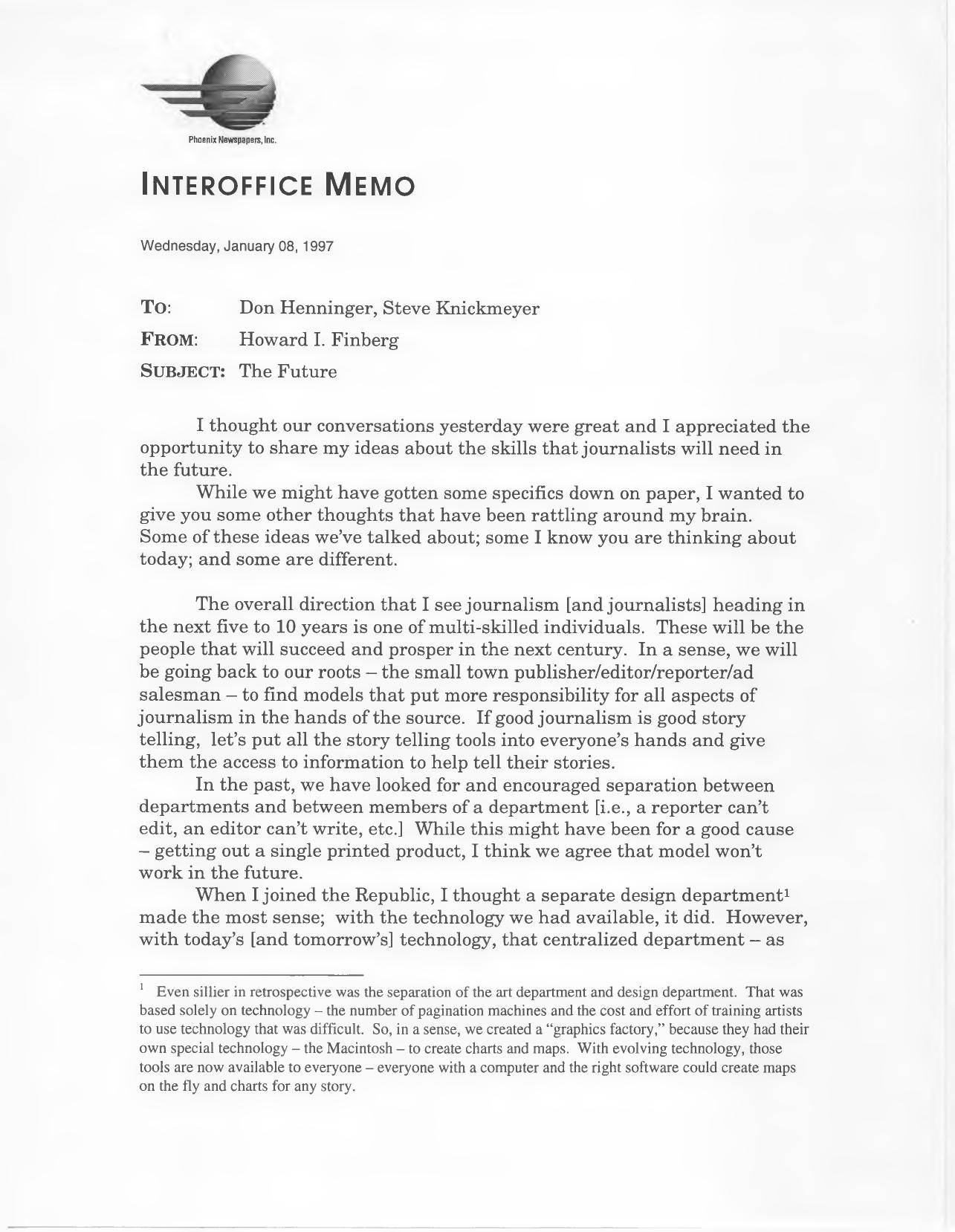
January 1997 memo to Arizona Republic editors on the multi-skilled journalist of the future

The Future: Journalist’s Skills

This is a January 1997 memo I wrote to Don Henninger and Steve Knickmeyer, two senior editors at The Arizona Republic and The Phoenix Gazette. It came out of a conversation we’d had the day before about the skills journalists were going to need, and it was very much part of my techno-evangelism at Phoenix Newspapers — trying to help editors prepare for changes coming to journalism and, potentially, to their newsrooms.

The core argument was that the future belonged to people who could do more than one thing:

The overall direction that I see journalism [and journalists] heading in the next five to 10 years is one of multi-skilled individuals. These will be the people that will succeed and prosper in the next century. In a sense, we will be going back to our roots — the small town publisher/editor/reporter/ad salesman — to find models that put more responsibility for all aspects of journalism in the hands of the source.

I used my own history at the newspaper as the example, which felt honest at the time and still does. Creating a separate design department had made sense when I arrived, given the technology we had. By 1997 it made a good deal less sense — and the split between the art department and the design department looked worse still.

So, in a sense, we created a “graphics factory,” because they had their own special technology — the Macintosh — to create charts and maps.

The point wasn’t that everyone should do everything. Specialized talent still mattered. What I expected to disappear were the divisions that existed only because of the equipment:

However, the artificial separation of skills based on technology will be eliminated [and much sooner than the five to 10-year time frame that I’m using].

From there the memo works through photography — why not put a digital camera in every reporter’s hands, since other delivery methods would consume far more visual material than the printed paper had room for — and then video and audio, and what editing skills would be needed to combine words, audio, stills and moving images.

The section I’m still fondest of is the one about the Web not being print and not being broadcast either.

On the Web, you tell stories in non-linear fashion. You need to tell those stories in such a way that the reader/consumer/user can understand the story regardless of where he entered the presentation. This is a different way of presenting news.

And the editing skill that follows from it, which I called “de-composing” linear stories into Web format.