Coming Media Industry Storm, 1999 Speech

In February 1999, I gave a speech at the 10th Annual Interactive Newspapers Conference in Atlanta. At that time, the newspaper industry was still clinging to its traditional revenue pillars—print circulation, display ads, and, most crucially, classifieds. However, to me, there was no doubt that those pillars were now built upon shifting sands.

I gave the speech in my role as Director of Technology and Information Strategies for Central Newspapers. I wanted to issue a warning that time was short to hope that changes were evolutionary not revolutionary. Looking back, I’m particularly proud that I said that the internet was a fundamentally a different medium, not an extension of an existing medium.

I asked Chat GPT to read the transcript of the speech and write a post. [The full transcript is available here.] This is what AI wrote:

Drawing from his experience launching online ventures like ArizonaCentral.com and HomeFair.com, Howard Finberg projected a not-so-distant future in which classifieds—the cash cow for local papers—would erode significantly. Industry research was already signaling a potential 7% loss in bottom-line revenue. “Look around the room,” Finberg said. “Seven percent of us won’t be here next year unless other things happen.”

What followed was a clear-eyed, sometimes humorous, always practical exploration of how newspapers needed to reinvent themselves—organizationally, culturally, and strategically—for the internet era.

A New Business, Not a New Department

Finberg’s core message was that digital wasn’t just an add-on. It was a fundamentally different medium with different economics, content, and user behavior. Drawing a comparison to how early television mimicked radio before finding its own identity, he urged media leaders to stop thinking of the web as an “extension of print.”

Instead, he proposed a hybrid model he called Integrated Independence. The idea was to combine centralized resources (like shared technology platforms and content services) with localized control. Local newsrooms would have the freedom to tailor digital strategies to their communities while benefiting from corporate-level efficiencies. “Nobody knows the local markets better than the local publishers,” Finberg reminded the audience.

Breaking the Assembly Line

Finberg also called for deep structural and cultural change within newsrooms. The traditional assembly-line workflow—where one department handed off content to another in rigid steps—wasn’t going to cut it. He advocated for flatter hierarchies, shared knowledge, and team-driven processes where journalists were empowered to collaborate, experiment, and respond to audience needs in real-time.

One visual metaphor stood out: the future journalist not as a solitary reporter with a notebook, but a nimble, multi-skilled “first-on-the-scene” storyteller—equipped with audio, video, and digital tools, capturing stories from the ground up.

Talent, Risk, and Retention

Finberg was equally blunt about the staffing crisis on the horizon. Starting salaries in journalism couldn’t compete with emerging web companies offering equity and entrepreneurial freedom. “We face a real brain drain,” he warned. His solution? Pay strategically for “Hot Jobs,” break HR molds when needed, and—most importantly—offer employees the chance to learn, move, and grow. “We (must) reward failure,” he said, “by not penalizing it—and by encouraging the next try.”

A Call to Look Beyond

Perhaps the most striking element of Finberg’s talk was his push for the industry to stop looking only inward. “We need to start attending conferences outside our field,” he said. “Broadcasting, cable, tech—we have to see what others are doing.” It was a call for curiosity, humility, and horizon scanning—a mindset that still resonates today.

More than two decades later, many of the ideas in this talk—content re-usability (“author once, publish many”), cross-platform journalism, digital-first thinking, and agile teams—have become core to modern media strategy. But in 1999, this was revolutionary thinking.

Finberg’s presentation wasn’t just a roadmap. It was a challenge. A reminder that digital disruption wasn’t just coming—it had already arrived.
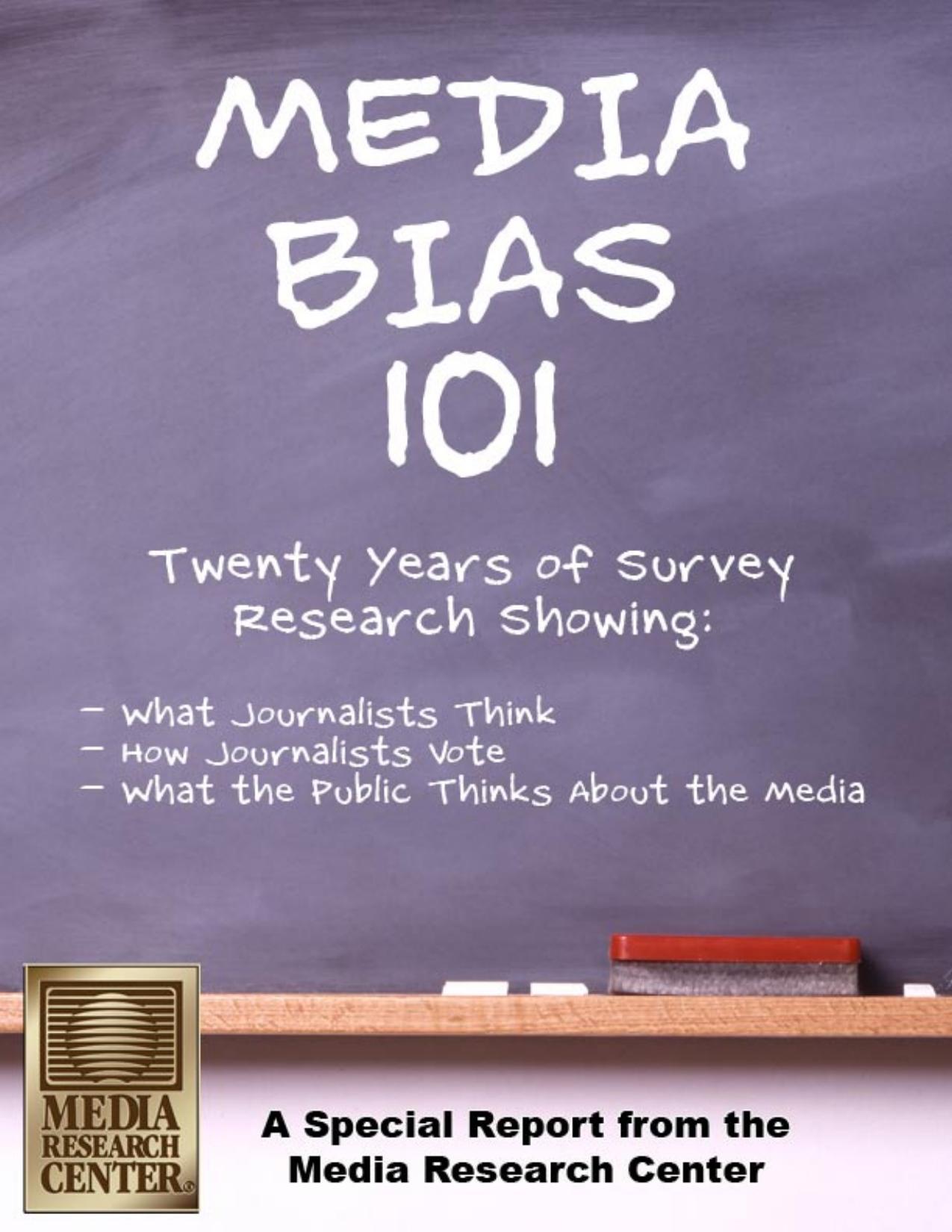
Cover of the Media Research Center special report Media Bias 101, last updated October 2009

Media Bias 101: Twenty Years of Research

A special report from the Media Research Center, marked “Last Updated: October 2009,” collecting two decades of polling into a single argument. The booklet is organized in three chapters: what journalists think and how journalists vote; what the public thinks about the media; and what journalists themselves say about media bias — divided into those denying it and those admitting it.

Chapter one runs 16 exhibits, from the 1981 Lichter-Rothman study The Media Elite through the Weaver and Wilhoit surveys at Indiana University, the 1985 Los Angeles Times poll of 2,700 journalists at 621 newspapers, ASNE’s 1996 The Newspaper Journalists of the ’90s, Pew’s 2004 survey of 547 journalists and media executives, and Slate’s pre-election staff polls in 2000, 2004 and 2008. The MRC’s framing is explicit about the provenance of the data:

These surveys of journalists were conducted by professional pollsters, academics or news organizations, not by conservatives trying to score a political point against the press.

Chapter two turns the lens around, with 19 exhibits of public opinion research — Pew, Gallup, ASNE’s 1998 Journalism Credibility Project, Rasmussen, Harvard’s National Leadership Index, the Sacred Heart University Polling Institute, the Missouri School of Journalism. The chapter’s thesis:

These polls document a crisis for the news media. Years of skewed reporting has squandered the public’s trust.

The third chapter is a clip file of quotations, arranged as “Journalists Denying Liberal Bias” and “Journalists Admitting Liberal Bias,” running back to 1989. Among the admissions, New York Times Public Editor Daniel Okrent’s July 25, 2004 column asking “Is The New York Times a Liberal Newspaper?”:

Of course it is…. These are the social issues: gay rights, gun control, abortion and environmental regulation, among others. And if you think The Times plays it down the middle on any of them, you’ve been reading the paper with your eyes closed.

And, from the same chapter, Seattle Times Executive Editor David Boardman in an August 15, 2007 e-mail to his staff:

If we wore our politics on our sleeves in here, I have no doubt that in this and in most other mainstream newsrooms in America, the majority of those sleeves would be of the same color: blue.

The closing page describes the organization: founded in 1987, based in Alexandria, Virginia, with divisions including the Business & Media Institute, the Culture & Media Institute, TimesWatch.org, NewsBusters.org and CNSNews.com.

Reading this in 2026, the numbers are a period piece but the argument is not. Every trust-in-news survey since has kept measuring the same gap the MRC was documenting here, and the partisan split in who believes which outlet — which this report flagged in 2009 — has only widened. Worth having in the archive as a primary document: this is how the case was assembled, exhibit by exhibit, at the end of the first decade of the century.

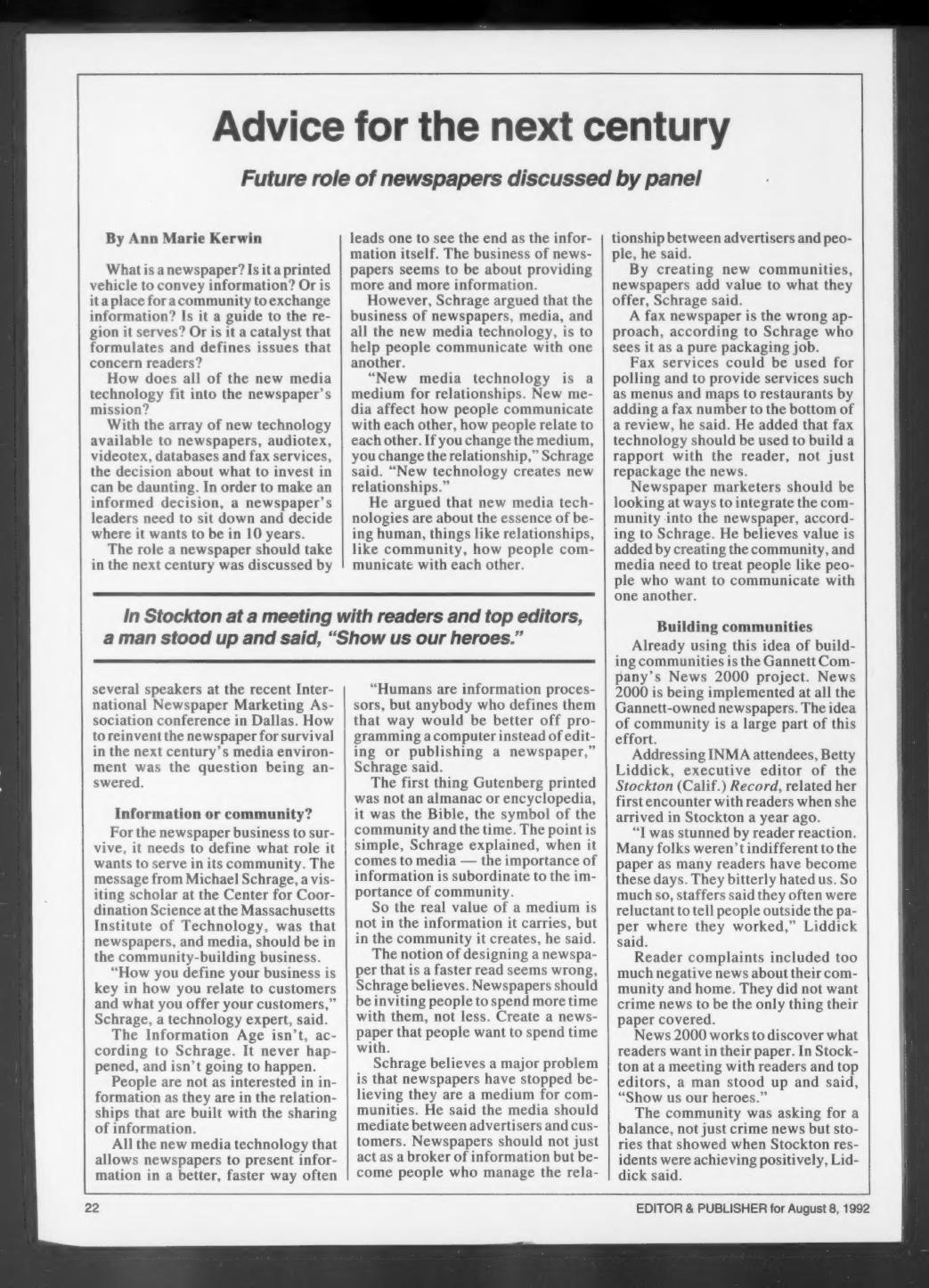
Editor & Publisher clipping from August 1992 covering an INMA conference panel on how to reinvent the newspaper for the next century

Advice for Next Century: An INMA Panel on the Future

An Editor & Publisher story by Ann Marie Kerwin, published August 8, 1992, reporting on a session at the International Newspaper Marketing Association conference in Dallas. The question on the table: how to reinvent the newspaper for survival in the next century’s media environment, at a moment when audiotex, videotex, databases and fax services were all competing for newspaper investment dollars.

The main speaker was Michael Schrage, a visiting scholar at the Center for Coordination Science at the Massachusetts Institute of Technology, who argued that newspapers and media should be in the community-building business rather than the information business.

“New media technology is a medium for relationships. New media affect how people communicate with each other, how people relate to each other. If you change the medium, you change the relationship. … New technology creates new relationships.”

Schrage said the Information Age never happened and isn’t going to happen, that the real value of a medium is not in the information it carries but in the community it creates, and that designing a newspaper for a faster read is the wrong goal — papers should invite readers to spend more time with them. He dismissed the fax newspaper as “a pure packaging job,” suggesting instead that fax be used for polling or for services like menus and maps tied to a restaurant review.

“Humans are information processors, but anybody who defines them that way would be better off programming a computer instead of editing or publishing a newspaper.”

The second half of the story covers the Gannett Company’s News 2000 project, then being implemented at all Gannett-owned papers, with community at the center of the effort. Betty Liddick, executive editor of the Stockton (Calif.) Record, described arriving in Stockton a year earlier:

“I was stunned by reader reaction. Many folks weren’t indifferent to the paper as many readers have become these days. They bitterly hated us. So much so, staffers said they often were reluctant to tell people outside the paper where they worked.”

Readers complained of too much negative news about their community and home, and didn’t want crime news to be the only thing the paper covered. At a meeting with readers and top editors, one man stood up and said, “Show us our heroes.”