Media Bias 101: Twenty Years of Research
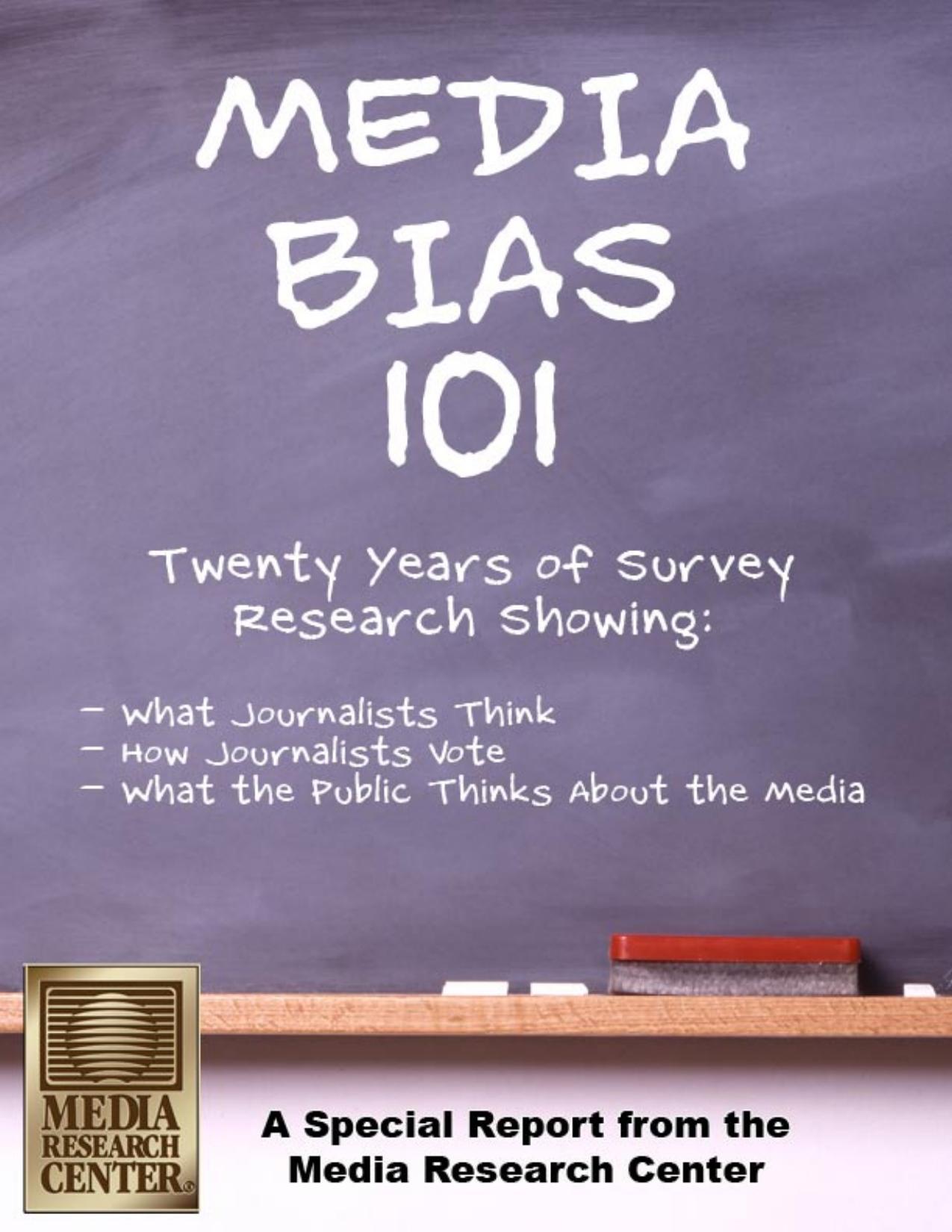
A special report from the Media Research Center, marked “Last Updated: October 2009,” collecting two decades of polling into a single argument. The booklet is organized in three chapters: what journalists think and how journalists vote; what the public thinks about the media; and what journalists themselves say about media bias — divided into those denying it and those admitting it.
Chapter one runs 16 exhibits, from the 1981 Lichter-Rothman study The Media Elite through the Weaver and Wilhoit surveys at Indiana University, the 1985 Los Angeles Times poll of 2,700 journalists at 621 newspapers, ASNE’s 1996 The Newspaper Journalists of the ’90s, Pew’s 2004 survey of 547 journalists and media executives, and Slate’s pre-election staff polls in 2000, 2004 and 2008. The MRC’s framing is explicit about the provenance of the data:
These surveys of journalists were conducted by professional pollsters, academics or news organizations, not by conservatives trying to score a political point against the press.
Chapter two turns the lens around, with 19 exhibits of public opinion research — Pew, Gallup, ASNE’s 1998 Journalism Credibility Project, Rasmussen, Harvard’s National Leadership Index, the Sacred Heart University Polling Institute, the Missouri School of Journalism. The chapter’s thesis:
These polls document a crisis for the news media. Years of skewed reporting has squandered the public’s trust.
The third chapter is a clip file of quotations, arranged as “Journalists Denying Liberal Bias” and “Journalists Admitting Liberal Bias,” running back to 1989. Among the admissions, New York Times Public Editor Daniel Okrent’s July 25, 2004 column asking “Is The New York Times a Liberal Newspaper?”:
Of course it is…. These are the social issues: gay rights, gun control, abortion and environmental regulation, among others. And if you think The Times plays it down the middle on any of them, you’ve been reading the paper with your eyes closed.
And, from the same chapter, Seattle Times Executive Editor David Boardman in an August 15, 2007 e-mail to his staff:
If we wore our politics on our sleeves in here, I have no doubt that in this and in most other mainstream newsrooms in America, the majority of those sleeves would be of the same color: blue.
The closing page describes the organization: founded in 1987, based in Alexandria, Virginia, with divisions including the Business & Media Institute, the Culture & Media Institute, TimesWatch.org, NewsBusters.org and CNSNews.com.
Reading this in 2026, the numbers are a period piece but the argument is not. Every trust-in-news survey since has kept measuring the same gap the MRC was documenting here, and the partisan split in who believes which outlet — which this report flagged in 2009 — has only widened. Worth having in the archive as a primary document: this is how the case was assembled, exhibit by exhibit, at the end of the first decade of the century.