Becoming a Better Online Editor, 2006

Presented at Journalism in a 24/7 World: Decision-making for the Online Editor
Knight New Media Center, October 2006

Generated by AI, Edited by Human

This presentation by Howard Finberg, then Director of Interactive Learning at The Poynter Institute, addressed the challenges of online journalism in a real-time environment. The focus was on ethical judgment, editorial roles, and the structural change necessary to support online decision-making.

The guiding idea: “Our real product is credibility.”

Slide-by-Slide Summary of Core Points
Journalism’s True Business
  • Begins with the question: “What business are we in?”
  • Answer: Not news, but credibility—the audience must trust the institution.
Public Expectations and Perceptions
  • Addresses the decline in public trust in journalism.
  • Readers expect speed and accuracy; failure in either undermines credibility.
Ethical Decision-Making in Real Time
  • Introduces the Online Credibility Gap.
  • Highlights the lack of established ethical norms in digital contexts.
  • Asks: “What are the rules online?”
Transparency and Corrections
  • Credibility requires visible corrections and transparent changes.
  • Encourages editors to avoid stealth editing or deletion without accountability.
Accountability and Structure
  • Notes that online editorial decisions are often made without authority or oversight.
  • Calls for clear delegation and training in ethical digital decision-making.
Organizational Alignment
  • Stresses that newsroom behavior online must align with institutional values.
  • Users judge the brand based on online actions, not just published mission statements.
Avoiding Legacy Thinking
  • Warns against asking old questions with new words.
  • Urges editors to develop entirely new frameworks for the digital environment.
Facilitating Ethical Culture
  • Editors should model ethical behavior, coach their teams, and create systemic support for digital ethics.
  • Online editing is not just technical—it is ethical leadership in real time.

The core message remains durable:

“Speed and reach do not eliminate responsibility—they amplify it.”


Related Posts

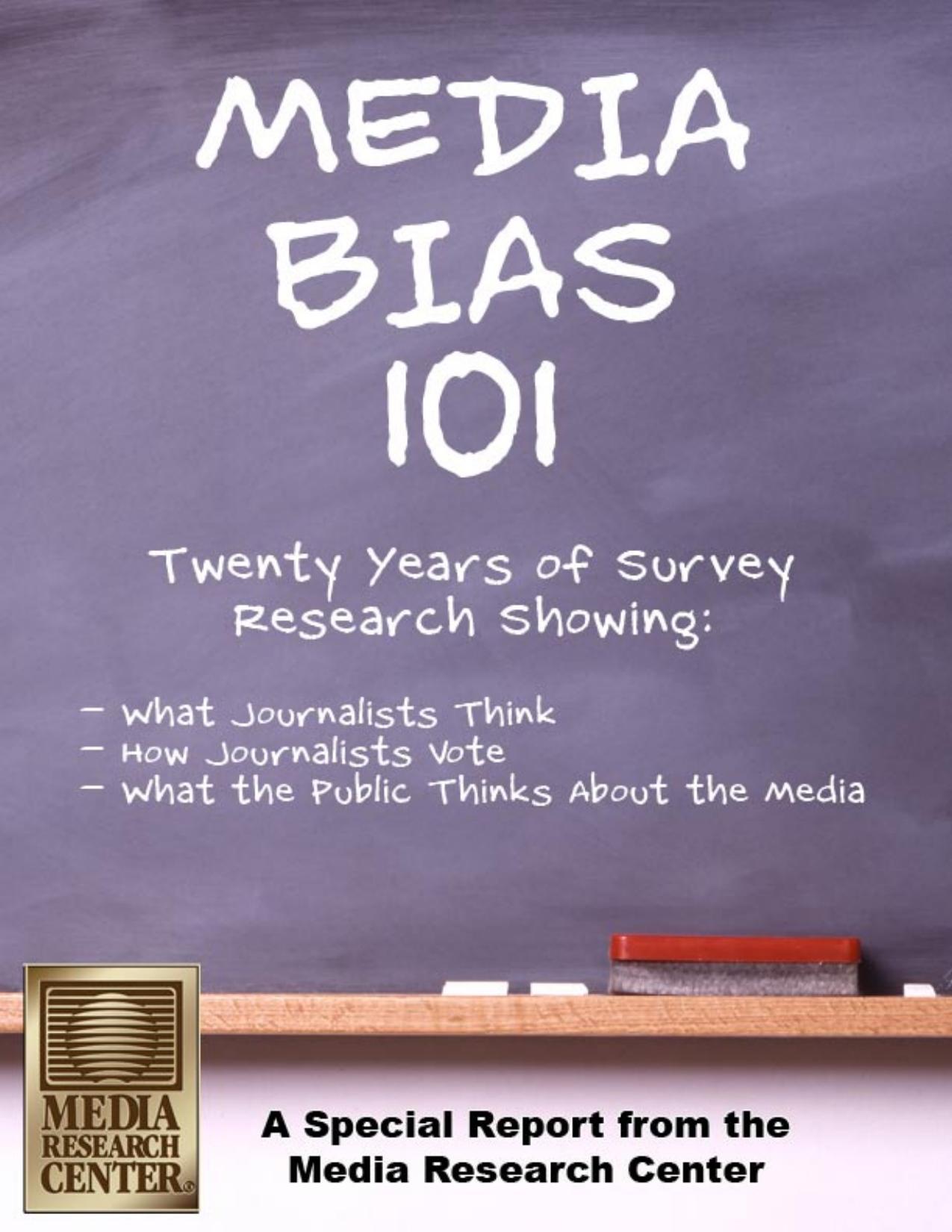
Cover of the Media Research Center special report Media Bias 101, last updated October 2009

Media Bias 101: Twenty Years of Research

A special report from the Media Research Center, marked “Last Updated: October 2009,” collecting two decades of polling into a single argument. The booklet is organized in three chapters: what journalists think and how journalists vote; what the public thinks about the media; and what journalists themselves say about media bias — divided into those denying it and those admitting it.

Chapter one runs 16 exhibits, from the 1981 Lichter-Rothman study The Media Elite through the Weaver and Wilhoit surveys at Indiana University, the 1985 Los Angeles Times poll of 2,700 journalists at 621 newspapers, ASNE’s 1996 The Newspaper Journalists of the ’90s, Pew’s 2004 survey of 547 journalists and media executives, and Slate’s pre-election staff polls in 2000, 2004 and 2008. The MRC’s framing is explicit about the provenance of the data:

These surveys of journalists were conducted by professional pollsters, academics or news organizations, not by conservatives trying to score a political point against the press.

Chapter two turns the lens around, with 19 exhibits of public opinion research — Pew, Gallup, ASNE’s 1998 Journalism Credibility Project, Rasmussen, Harvard’s National Leadership Index, the Sacred Heart University Polling Institute, the Missouri School of Journalism. The chapter’s thesis:

These polls document a crisis for the news media. Years of skewed reporting has squandered the public’s trust.

The third chapter is a clip file of quotations, arranged as “Journalists Denying Liberal Bias” and “Journalists Admitting Liberal Bias,” running back to 1989. Among the admissions, New York Times Public Editor Daniel Okrent’s July 25, 2004 column asking “Is The New York Times a Liberal Newspaper?”:

Of course it is…. These are the social issues: gay rights, gun control, abortion and environmental regulation, among others. And if you think The Times plays it down the middle on any of them, you’ve been reading the paper with your eyes closed.

And, from the same chapter, Seattle Times Executive Editor David Boardman in an August 15, 2007 e-mail to his staff:

If we wore our politics on our sleeves in here, I have no doubt that in this and in most other mainstream newsrooms in America, the majority of those sleeves would be of the same color: blue.

The closing page describes the organization: founded in 1987, based in Alexandria, Virginia, with divisions including the Business & Media Institute, the Culture & Media Institute, TimesWatch.org, NewsBusters.org and CNSNews.com.

Reading this in 2026, the numbers are a period piece but the argument is not. Every trust-in-news survey since has kept measuring the same gap the MRC was documenting here, and the partisan split in who believes which outlet — which this report flagged in 2009 — has only widened. Worth having in the archive as a primary document: this is how the case was assembled, exhibit by exhibit, at the end of the first decade of the century.

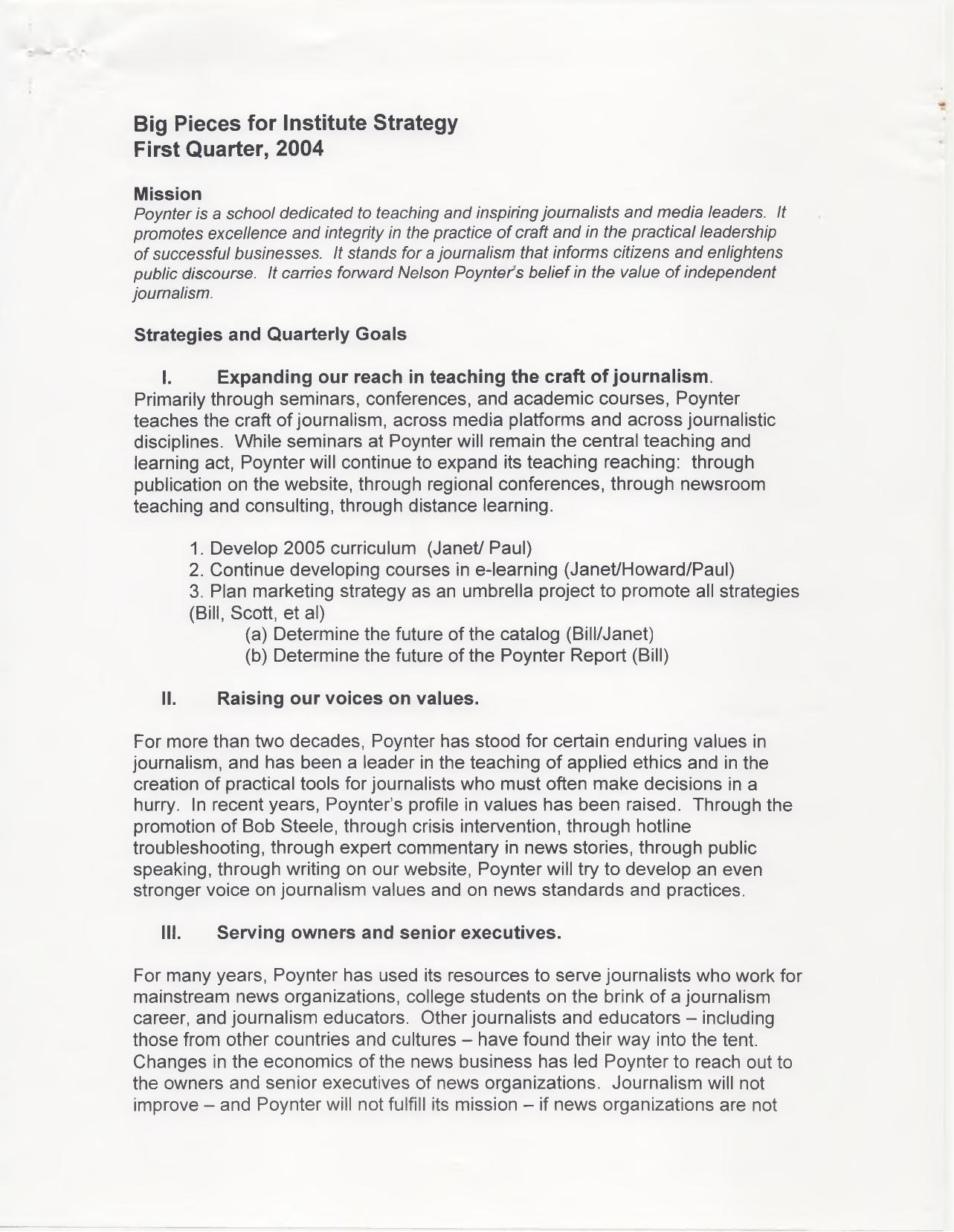
First page of the 2004 Poynter Institute strategy document listing the mission statement and four strategies

Big Pieces for Poynter Strategy, 2004

A two-page strategy document prepared for a Poynter Institute strategy session, dated January 15, 2004. It sets out the Institute’s mission and then four strategies, each with quarterly goals and named owners.

The mission statement opens the document:

Poynter is a school dedicated to teaching and inspiring journalists and media leaders. It promotes excellence and integrity in the practice of craft and in the practical leadership of successful businesses. It stands for a journalism that informs citizens and enlightens public discourse. It carries forward Nelson Poynter‘s belief in the value of independent journalism.

The four strategies: expanding the reach of teaching the craft of journalism; raising Poynter’s voice on values; serving owners and senior executives; and building the base at Poynter. Under the first, one of the numbered goals reads simply:

Continue developing courses in e-learning (Janet/Howard/Paul)

On the ethics side, the document describes Poynter’s long-standing role in the teaching of applied ethics and the creation of practical tools for journalists “who must often make decisions in a hurry,” and points to Bob Steele, crisis intervention, hotline troubleshooting, and expert commentary as the vehicles for a stronger voice on news standards and practices.

The third strategy marks the reach toward a new constituency:

Changes in the economics of the news business have led Poynter to reach out to the owners and senior executives of news organizations. Journalism will not improve and Poynter will not fulfill its mission if news organizations are not profitable and if journalists lack the resources they need to carry out their public service.

The final strategy is about the Institute itself: faculty and staff, campus, savings, and revenue, including hiring a development officer, partnerships, and re-evaluating tuition policies. It contains the line that best captures the place:

Poynter is a school that owns a newspaper, which keeps Poynter real, and brings to it resources in the form of stock dividends.

Sadly, things really didn’t work out for the newspaper or the Institute, which would go through a number of revenue models.