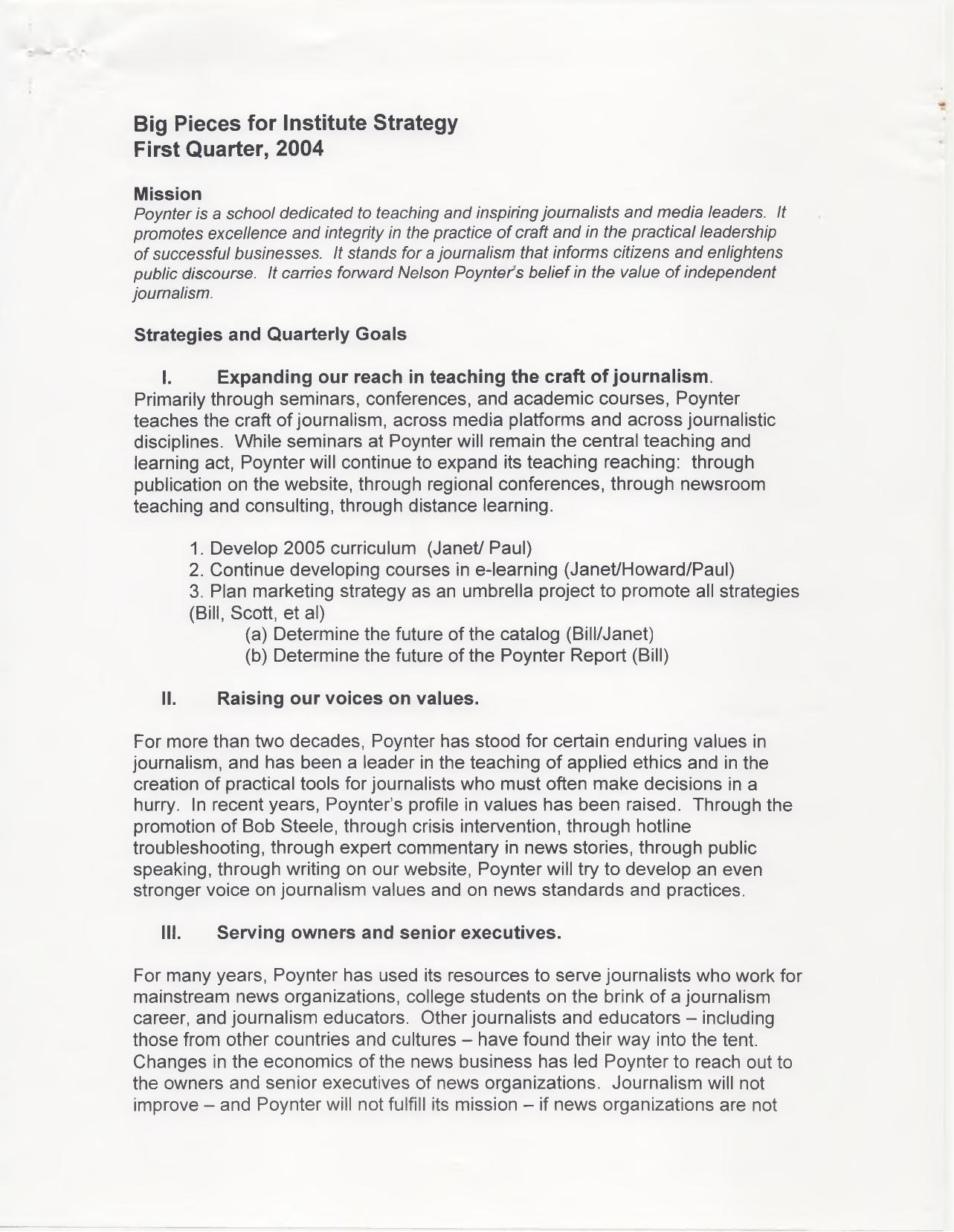
A two-page strategy document prepared for a Poynter Institute strategy session, dated January 15, 2004. It sets out the Institute’s mission and then four strategies, each with quarterly goals and named owners.
The mission statement opens the document:
Poynter is a school dedicated to teaching and inspiring journalists and media leaders. It promotes excellence and integrity in the practice of craft and in the practical leadership of successful businesses. It stands for a journalism that informs citizens and enlightens public discourse. It carries forward Nelson Poynter‘s belief in the value of independent journalism.
The four strategies: expanding the reach of teaching the craft of journalism; raising Poynter’s voice on values; serving owners and senior executives; and building the base at Poynter. Under the first, one of the numbered goals reads simply:
Continue developing courses in e-learning (Janet/Howard/Paul)
On the ethics side, the document describes Poynter’s long-standing role in the teaching of applied ethics and the creation of practical tools for journalists “who must often make decisions in a hurry,” and points to Bob Steele, crisis intervention, hotline troubleshooting, and expert commentary as the vehicles for a stronger voice on news standards and practices.
The third strategy marks the reach toward a new constituency:
Changes in the economics of the news business have led Poynter to reach out to the owners and senior executives of news organizations. Journalism will not improve and Poynter will not fulfill its mission if news organizations are not profitable and if journalists lack the resources they need to carry out their public service.
The final strategy is about the Institute itself: faculty and staff, campus, savings, and revenue, including hiring a development officer, partnerships, and re-evaluating tuition policies. It contains the line that best captures the place:
Poynter is a school that owns a newspaper, which keeps Poynter real, and brings to it resources in the form of stock dividends.
Sadly, things really didn’t work out for the newspaper or the Institute, which would go through a number of revenue models.