Shouting “Fire” in Cyberspace: Editor & Publisher, June 1995
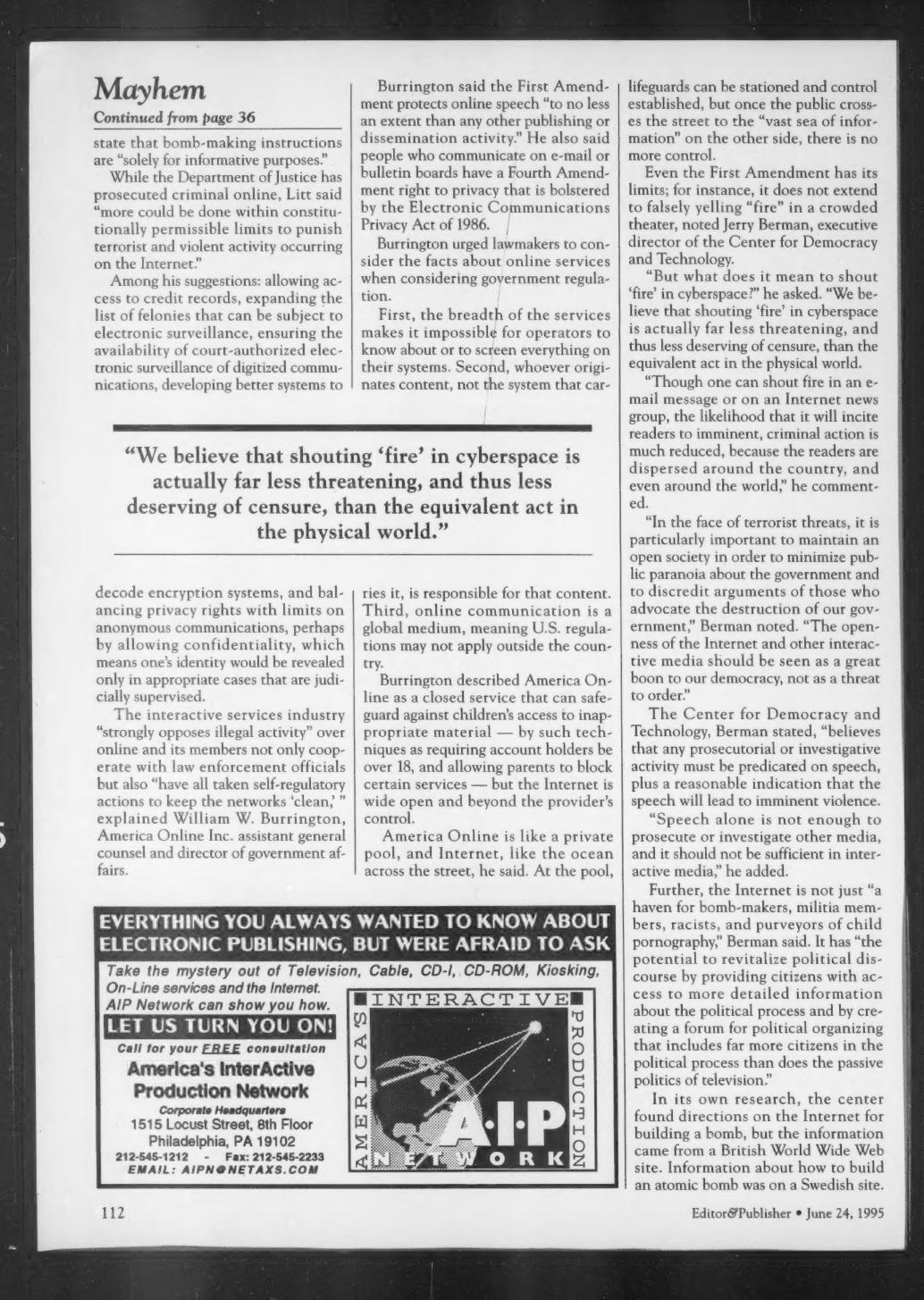
A jump page from Editor & Publisher, dated June 24, 1995, from an article headlined “Mayhem” (continued from page 36). The piece reports on testimony about online speech, bomb-making instructions circulating on the Internet, and how far the government should go in policing interactive media. Three voices carry the portion of the story preserved here: a Department of Justice official identified as Litt; William W. Burrington of America Online; and Jerry Berman of the Center for Democracy and Technology.
Litt argued that while the Justice Department had prosecuted criminals online, more was possible:
“more could be done within constitutionally permissible limits to punish terrorist and violent activity occurring on the Internet.”
His suggestions, as summarized in the article, included access to credit records, expanding the list of felonies subject to electronic surveillance, ensuring court-authorized surveillance of digitized communications, better systems to decode encryption, and limits on anonymous communication — with identity revealed only under judicial supervision.
Burrington, described as America Online Inc. assistant general counsel and director of government affairs, said the industry “strongly opposes illegal activity” online and that its members had “all taken self-regulatory actions to keep the networks ‘clean.'” He asked lawmakers to weigh three facts: the sheer breadth of the services makes screening everything impossible; responsibility for content rests with whoever originates it, not the system carrying it; and online communication is global, so U.S. rules may not reach beyond the border. He also argued that the First Amendment protects online speech “to no less an extent than any other publishing or dissemination activity,” with Fourth Amendment privacy protections reinforced by the Electronic Communications Privacy Act of 1986.
His analogy: America Online is a private pool where lifeguards can be stationed, and the Internet is the ocean across the street — the “vast sea of information” where no control is possible.
Berman, executive director of the Center for Democracy and Technology, took up the familiar limit on free speech — falsely yelling “fire” in a crowded theater — and asked what the equivalent would be online.
“We believe that shouting ‘fire’ in cyberspace is actually far less threatening, and thus less deserving of censure, than the equivalent act in the physical world.”
Because readers are “dispersed around the country, and even around the world,” he said, the likelihood of inciting imminent criminal action is much reduced. His organization’s position was that prosecution or investigation must be predicated on speech “plus a reasonable indication that the speech will lead to imminent violence.”
“In the face of terrorist threats, it is particularly important to maintain an open society in order to minimize public paranoia about the government and to discredit arguments of those who advocate the destruction of our government. The openness of the Internet and other interactive media should be seen as a great boon to our democracy, not as a threat to order.”
Berman also pushed back on the idea that the Internet was merely “a haven for bomb-makers, militia members, racists, and purveyors of child pornography,” citing its “potential to revitalize political discourse.” The center’s own research turned up bomb-building directions online — from a British World Wide Web site, with atomic bomb information on a Swedish site.
The page also carries a full advertisement for America’s InterActive Production Network of Philadelphia, headlined “EVERYTHING YOU ALWAYS WANTED TO KNOW ABOUT ELECTRONIC PUBLISHING, BUT WERE AFRAID TO ASK,” offering a free consultation on “Television, Cable, CD-I, CD-ROM, Kiosking, On-Line services and the Internet.”