Dual Online Strategy Memo

You need to have a memo about the plan, even though there are lots of conversations along the way.  Here’s the memo I wrote John Oppedahl (my boss), editor of The Arizona Republic.  It outlined our strategy to launch on both AOL and on the Web.  And we also had a bulletin board service for home sales.

June 2, 1995

TO:                     John Oppedahl

FROM:               Howard I. Finberg

SUBJECT:         Executive Summary/Online Plan

This is an executive summary of Phoenix Newspapers’ Online Plan:

As outlined in the “Online Opportunities” report, PNI will take a multi-platform (or multi-newsstand approach).  This will allow PNI to control where content is placed and will provide opportunities to reach readers through different services (America Online, the Internet/World Wide Web server and PNI’s existing bulletin board service). PNI will not sign an “exclusive agreement” with any online service, and hence will be free to take advantage of upcoming opportunities in 1996 and 1997 (e.g. Microsoft Network and New Century Network).

The full memo has more details about staffing and revenue expectations.  The revenue was optimistic, but realistic given the AOL bounties.

Arizona Central’s Official Launch Announcements

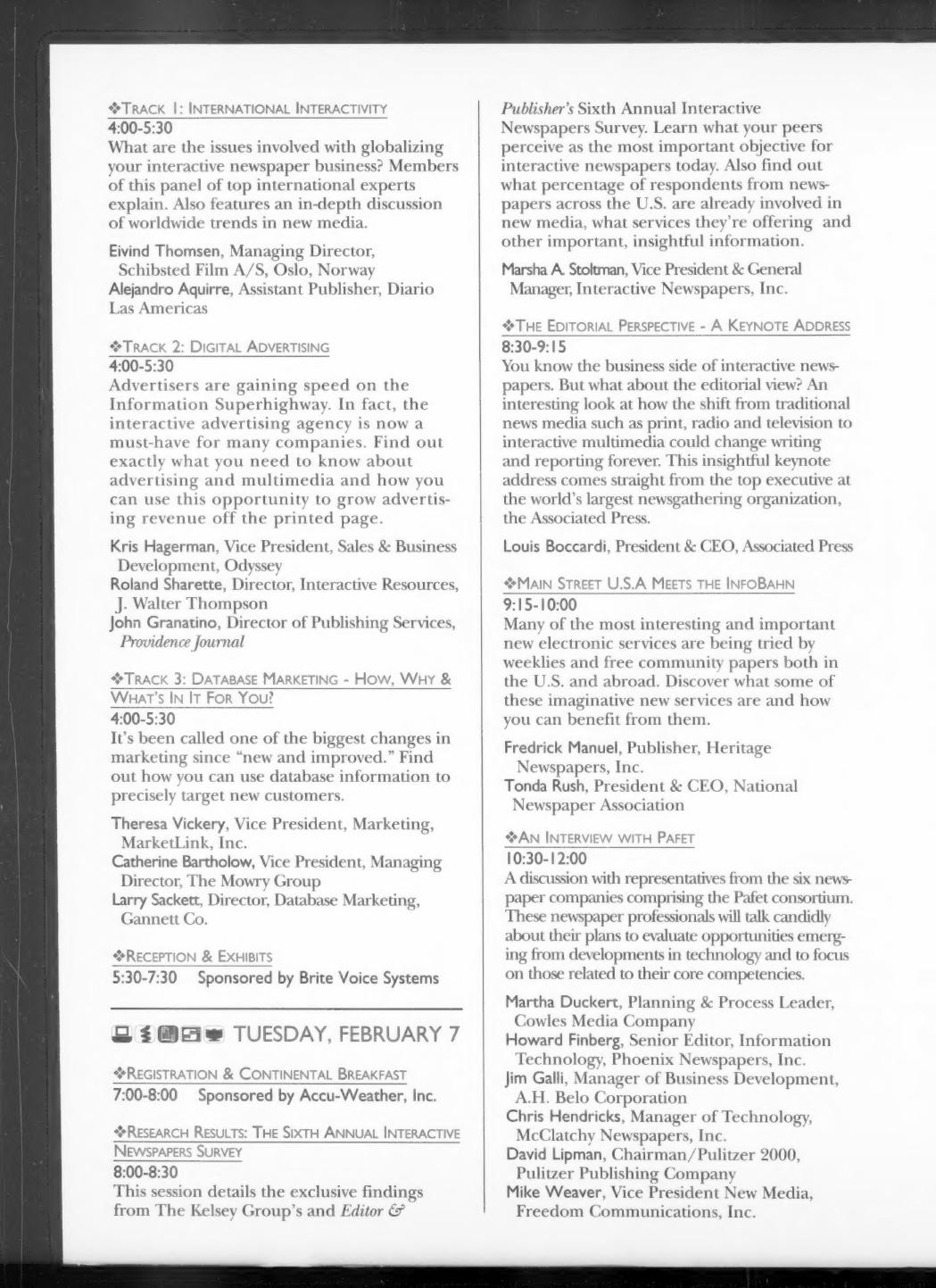
Even though Arizona Central (AzCentral) was live on both AOL and the Web earlier, we needed to make an official and public announcement about both services.  The Phoenix Newspapers (PNI) marketing department created an excellent package of materials, including press releases (one for each service) and screenshots of the online services.  And, of course, a FAQ about going online.  It reads quaint today, but the basic “here’s how to get online” information was essential in 1995.  The other members of the launch team were Dave Gianelli, special projects manager, Dan Hontz, online project for AzCentral on the Web, and Jeff Unger, online producer for AzCentral on AOL.

Both press releases are here: pni_annouces azcentral_12_08_1995

The FAQ about Arizona Central on AOL and on the Web are here: azcentral faq sheets_12_08_1995

How a Graphics Editor Works at the Chicago Tribune

The first edition of the journal of the Society of Newspaper Designers (SND) featured excerpts of a speech I gave the the organization’s first convention.  The gather was held in Tribune Tower, in a meeting room called Campbell Hall (if memory serves).  That meant we probably had no more than a couple of hundred folks in the room.  The editors of Design took a transcript of my speech and turned into an article.  However, I didn’t know any of this until publication.

Reading it over today still gives me lots to cringe about — I was a bit arrogant.  OK, I was a full of self-importance about this new role.  The Chicago Tribune was the leader in informational graphics.  And I was the Graphics Editor.  I wished I had remembered to talk about how this was a team activity, not a solo sport.

However, I still like my conclusion, that all of the work we do is about making it better for the audience:

You can have the prettiest looking graphics in the paper and it doesn’t mean anything  if  it doesn’t  communicate with readers. That’s the most important thing as far as the Tribune and the graphics editors go. If we’re not communicating  with  the reader, we’ve lost it all. It’s my job to go for it.

Not sure what I was going for, but I guess we did.

Here’s the article from Design

Young Readers and the Future of the Chicago Tribune

In late 1973 and early 1974 I was part of a committee at the Chicago Tribune.  The committee members were all under 30 and most of us recent hires by the newspaper.  Our task was to explore what the paper should do to attract more younger readers.  This task was less about getting young adults to read newspapers but to read the Tribune instead of the Chicago Sun-Times.  Members of the committee: Ovie Carter, Gary Deeb, Howard Finberg, Clarence Page, Don Pierson, Bill Plunkett, Karen Schickedanz, Rick Soll and Linda Winer.  Here’s what we wrote in our summary:

Simply stated, the Chicago Tribune takes itself too seriously. This is not to diminish its role as one of the nation’s best newspapers. Rather, it is a suggestion that the time has come for the Chicago Tribune to slaughter, once and for all, many of its sacred cows.

Further on, we concluded:

What we are recommending, in a general way, is a relaxation of the restraint that prohibits surprise and thought-provoking material from appearing in the Tribune.   It is not a recommendation to relax or reduce in any  way the standards of journalism: Strict reverence for the facts, a sense of fairness, and an attention to thoro reporting.

Please note the unique spelling of thorough, as the Tribune was still gripped by a style book that used simplified spelling, a cause of the previous owner/publisher:  Col. Robert McCormick.

The  is available as a PDF file: chi trib_young readers group_02_1974

Understanding the Online Future

In early 1994 I was given the task to figure out, with help of some great colleagues, the online future for Phoenix Newspapers [The Arizona Republic, the Phoenix Gazette and the Arizona Business Gazette]. Dave Gianelli and I spent a lot of time looking at different partnerships, such as America Online and Prodigy.  And we also looked at “going it alone” also known as the Web or Internet.  Remember, this was 1994.  The Web was something newer than the online services.  We created a report to help guide the company’s decision.  In the end, we urged a dual approach — partner with AOL [for the cash bounties] and go it alone, via the Web.  At the time, it was a bold and unusual strategy.

The first section is available as a PDF: PNI Online Opportunities Report 01_09_1994


Future of Journnalism Education Speech

I gave keynote speech at European Journalism Centre 20th Anniversary celebration in Maastricht, Netherlands, thanks to the director of the EJC’s director, Wilfried Rutten. The speech [PDF link] gave me an opportunity to build upon remarks I made the previous year at the “Picnic” conference.  I was part of a panel that addressed the future of journalism. I also wrote an article for Poynter Online about the topic.  I must admit that I love this line: “Journalism education can’t teach its way to the future.

Here’s the start of the Poynter Online article that captures the spirit of the speech:

As we think about the changes whipping through the media industry, there is a nearby storm about to strike journalism education.

The future of journalism education will be a very different and difficult future, a future that is full of innovation and creative disruption. And, I believe, we will see an evolution and uncoupling between the value of a journalism education and a journalism degree.

When we think about the future, there’s not a single future. The future for a 20-year-old is clearly very different than the future of a 60-year-old. Each will bring a very different perspective.

The future of journalism education is linked to the future of journalism itself. Each is caught within the other’s vortex, both spinning within today’s turmoil of change.

There is a video of the speech on YouTube.

The reaction to both the speech and the article were very good, although it was part of a swirl of postings and speeches about the topic.  With the encouragement of my colleague, Vicki Krueger, I decided that this topic needed continued study and that will lead to other reports and writing.

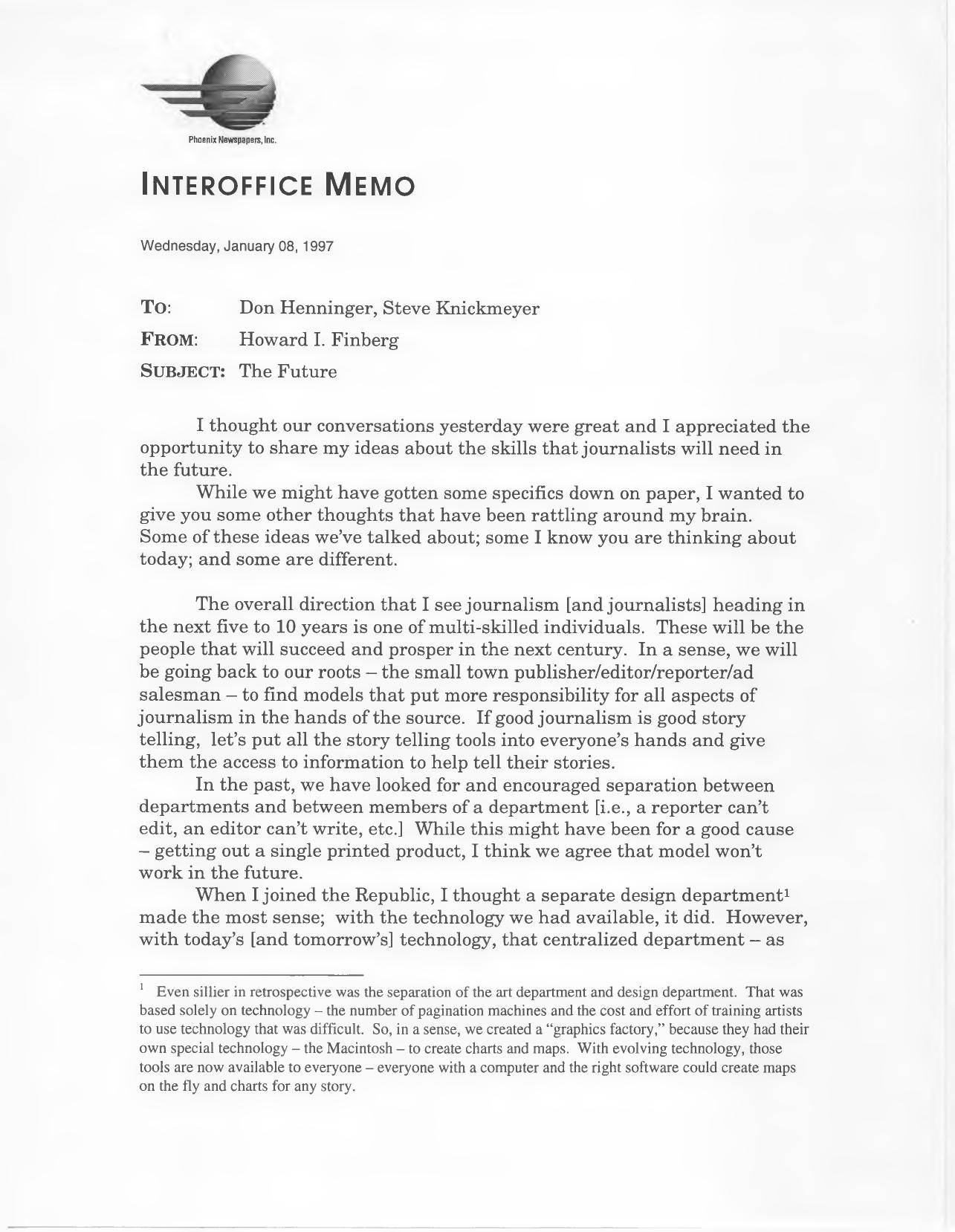
January 1997 memo to Arizona Republic editors on the multi-skilled journalist of the future

The Future: Journalist’s Skills

This is a January 1997 memo I wrote to Don Henninger and Steve Knickmeyer, two senior editors at The Arizona Republic and The Phoenix Gazette. It came out of a conversation we’d had the day before about the skills journalists were going to need, and it was very much part of my techno-evangelism at Phoenix Newspapers — trying to help editors prepare for changes coming to journalism and, potentially, to their newsrooms.

The core argument was that the future belonged to people who could do more than one thing:

The overall direction that I see journalism [and journalists] heading in the next five to 10 years is one of multi-skilled individuals. These will be the people that will succeed and prosper in the next century. In a sense, we will be going back to our roots — the small town publisher/editor/reporter/ad salesman — to find models that put more responsibility for all aspects of journalism in the hands of the source.

I used my own history at the newspaper as the example, which felt honest at the time and still does. Creating a separate design department had made sense when I arrived, given the technology we had. By 1997 it made a good deal less sense — and the split between the art department and the design department looked worse still.

So, in a sense, we created a “graphics factory,” because they had their own special technology — the Macintosh — to create charts and maps.

The point wasn’t that everyone should do everything. Specialized talent still mattered. What I expected to disappear were the divisions that existed only because of the equipment:

However, the artificial separation of skills based on technology will be eliminated [and much sooner than the five to 10-year time frame that I’m using].

From there the memo works through photography — why not put a digital camera in every reporter’s hands, since other delivery methods would consume far more visual material than the printed paper had room for — and then video and audio, and what editing skills would be needed to combine words, audio, stills and moving images.

The section I’m still fondest of is the one about the Web not being print and not being broadcast either.

On the Web, you tell stories in non-linear fashion. You need to tell those stories in such a way that the reader/consumer/user can understand the story regardless of where he entered the presentation. This is a different way of presenting news.

And the editing skill that follows from it, which I called “de-composing” linear stories into Web format.

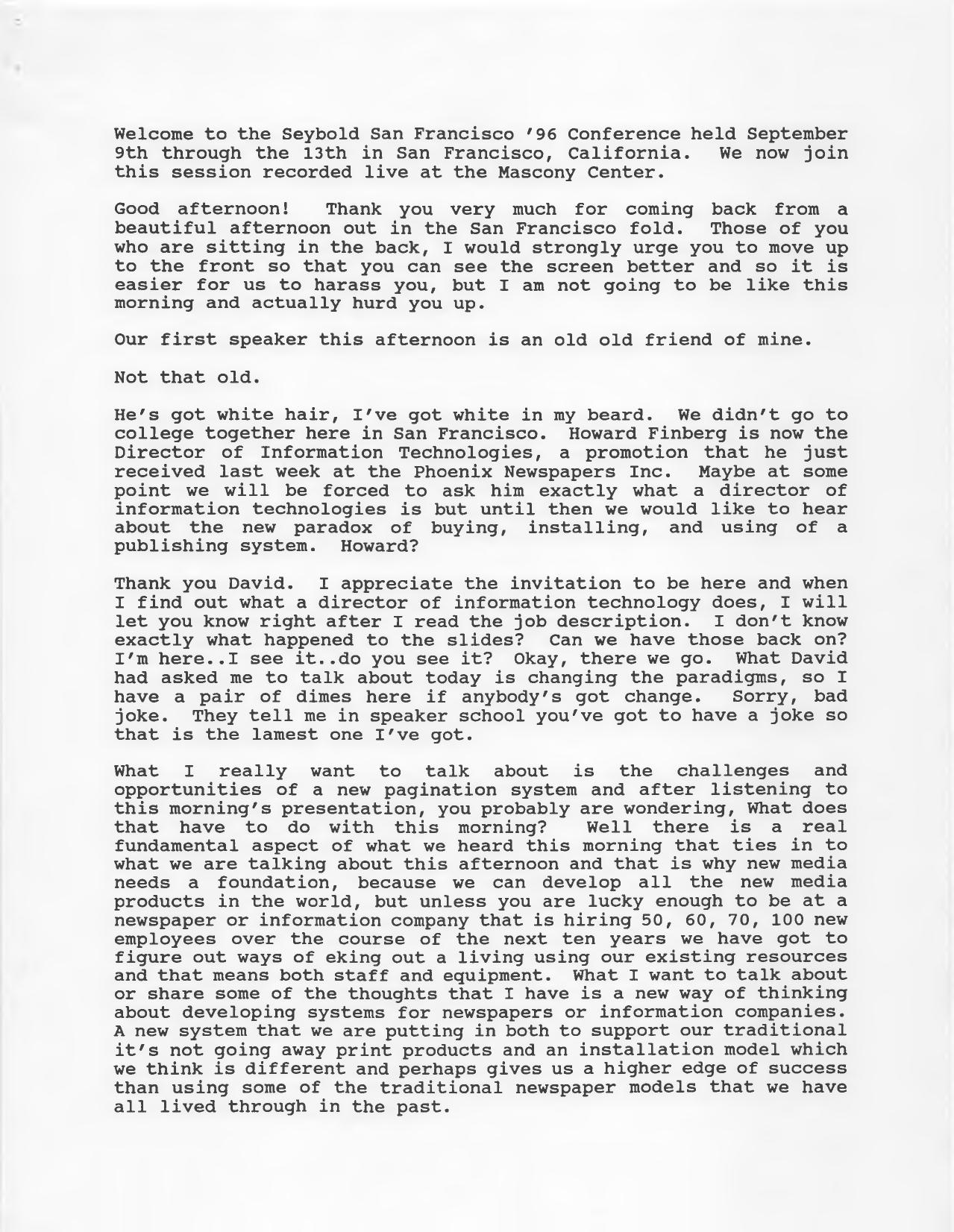
Seybold Seminars publishing conference session at Moscone Center in San Francisco, September 1996

Pagination and Paradigms at Seybold

In the 1990s, if you wanted to know where publishing technology was headed, you went to Seybold. The Seybold Seminars conferences were the industry’s gathering place for prepress, typesetting and publishing systems — the vendors, the consultants and the newspaper and magazine people who had to make it all work. This session was recorded live at Moscone Center during the San Francisco show, held Sept. 9-13, 1996.

I was introduced by David Cole, the technology consultant, who took some pleasure in my brand-new and rather vague job title.

Howard Finberg is now the Director of Information Technologies, a promotion that he just received last week at the Phoenix Newspapers Inc. Maybe at some point we will be forced to ask him exactly what a director of information technologies is but until then we would like to hear about the new paradox of buying, installing, and using of a publishing system.

My answer was that I’d let everyone know what the job was as soon as I’d read the description. The talk itself was about the pagination project at Phoenix Newspapers Inc. — replacing 15 aging Information International (Triple I) page makeup workstations, the big Raytheon-built terminals the staff called the “green-eyed monster,” and the design rooms kept dark enough for those screens that people called them “bat caves.” We selected CCI Europe, and by the end of August 1996 we were 82-85% complete on the rollout.

But the point I most wanted to make was that pagination was the wrong question.

We asked ourselves this fundamental question and if you have ever talked about this, if you are thinking about this, if this is a question for you…you really have to ask “do you want to paginate?” and I contend quite frankly, honestly, emphatically that the answer is no…not interested in pagination anymore.

What we actually wanted was a publication database — information in the middle, output neutral, feeding print and whatever came next. And that meant breaking the industry’s habit of treating the newsroom as the sole owner of anything valuable.

… we have a model in our industry that says information of value resides within the newsroom. I say let’s break that model, let’s break the paradigm, and say information belongs to whoever needs it and whoever can make use of it.

Much of the speech was about people, not machines: open committees that included the library and purchasing, cookies and free lunches to get staff to vendor demos, a full-time trainer, a Lotus Notes database of threaded project discussions going back to August 1995, and two “super users” from the design department who hated the title. One of them, Eddie Rossi, was quoted as saying the installation was going very well, “but not very elegantly.”

My favorite line in the whole transcript isn’t mine — it’s my boss’s, quoted secondhand: “if you want to know how to reorganize a newspaper, figure out who has control of the furniture, because that is what it is all about.” Nearly 30 years later, I’d still defend that as sound organizational theory.

A note on the transcript: it was typed from the audio recording, so a few things come out oddly. QuarkXPress becomes “cork express,” HTML becomes “HTMO,” and my confession about being a former Macintosh bigot gets rendered as “math bigot.” I’ve left them as they are.

Pages of an early-1990s seminar handout on the status of informational graphics in U.S. newspapers, drawn from the textbook Visual Editing

Status of Informational Graphics in the U.S.: A Swiss Seminar Handout

In the early 1990s I presented a seminar in Switzerland. Sadly, I don’t remember exactly when or where — which is why this file is going into the Archive section until more information turns up. The handout given to seminar participants also served as my speech. It draws on my then-newly published textbook, Visual Editing: A Graphic Guide for Journalists (1990). The document credits Thomas Hermann with the invitation.

The talk traces the evolution of informational graphics — diagrams, maps, charts and tabular lists — from a murder-scene diagram on Page One of The Times of London on April 7, 1806, through William Playfair’s 1786 The Commercial and Political Atlas, to war maps of World Wars I and II, the space program, and the arrival of USA Today on Sept. 15, 1982. Along the way it notes that the Chicago Tribune created a graphics editor position in 1974, one of the country’s first full-time visual journalists.

One of my favorite quotations, from the Austrian statistician Otto Neurath in 1925, appears early in the text:

“Words divide, pictures unite…to remember simplified pictures is better than to forget accurate figures.”

The handout also reports survey findings from more than 350 members of the American Society of Newspaper Editors, done in connection with the American Press Institute’s 1988 J. Montgomery Curtis seminar: 92 percent expected to use more informational graphics within five years, and 90 percent said graphics would play a greater role in their newspapers in the year 2000.

And a warning that still holds up:

When we run misleading graphics because of a lack of data points or “empty graphics” that are merely type-breakers, we communicate very little and take up precious news space.

The remainder of the handout is drawn from the textbook: chapters on how a graphics editor works — gathering and editing information, request forms, working with artists, fact checking — and a section on choosing the right device, with examples from The Arizona Republic illustrating tables and lists, line/fever charts, pie charts, pictograms, map graphics, and vertical and horizontal bar charts.