Editor & Publisher clipping from Aug. 8, 1992 naming Howard Finberg the first president of the new Society of Newspaper Design Foundation

My Selection as First President of the SND Foundation

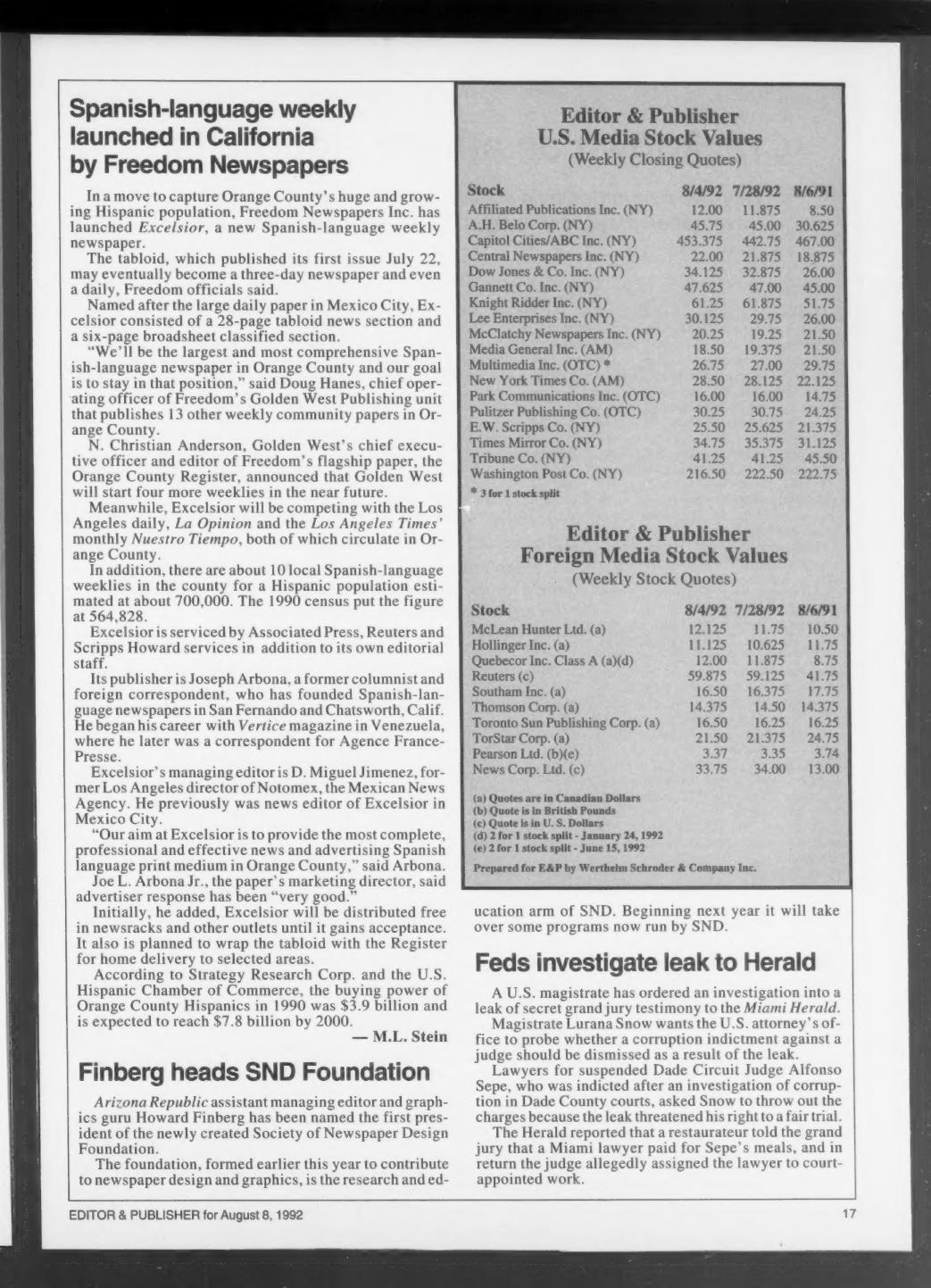
A short item in Editor & Publisher for Aug. 8, 1992, tucked between a story about a new Spanish-language weekly in Orange County and the week’s media stock tables:

Arizona Republic assistant managing editor and graphics guru Howard Finberg has been named the first president of the newly created Society of Newspaper Design Foundation.

The brief also explains what the new organization was set up to do:

The foundation, formed earlier this year to contribute to newspaper design and graphics, is the research and education arm of SND. Beginning next year it will take over some programs now run by SND.

Not a bad way to be introduced to the industry “graphics guru” is a title I never claimed for myself.

Pages of an early-1990s seminar handout on the status of informational graphics in U.S. newspapers, drawn from the textbook Visual Editing

Status of Informational Graphics in the U.S.: A Swiss Seminar Handout

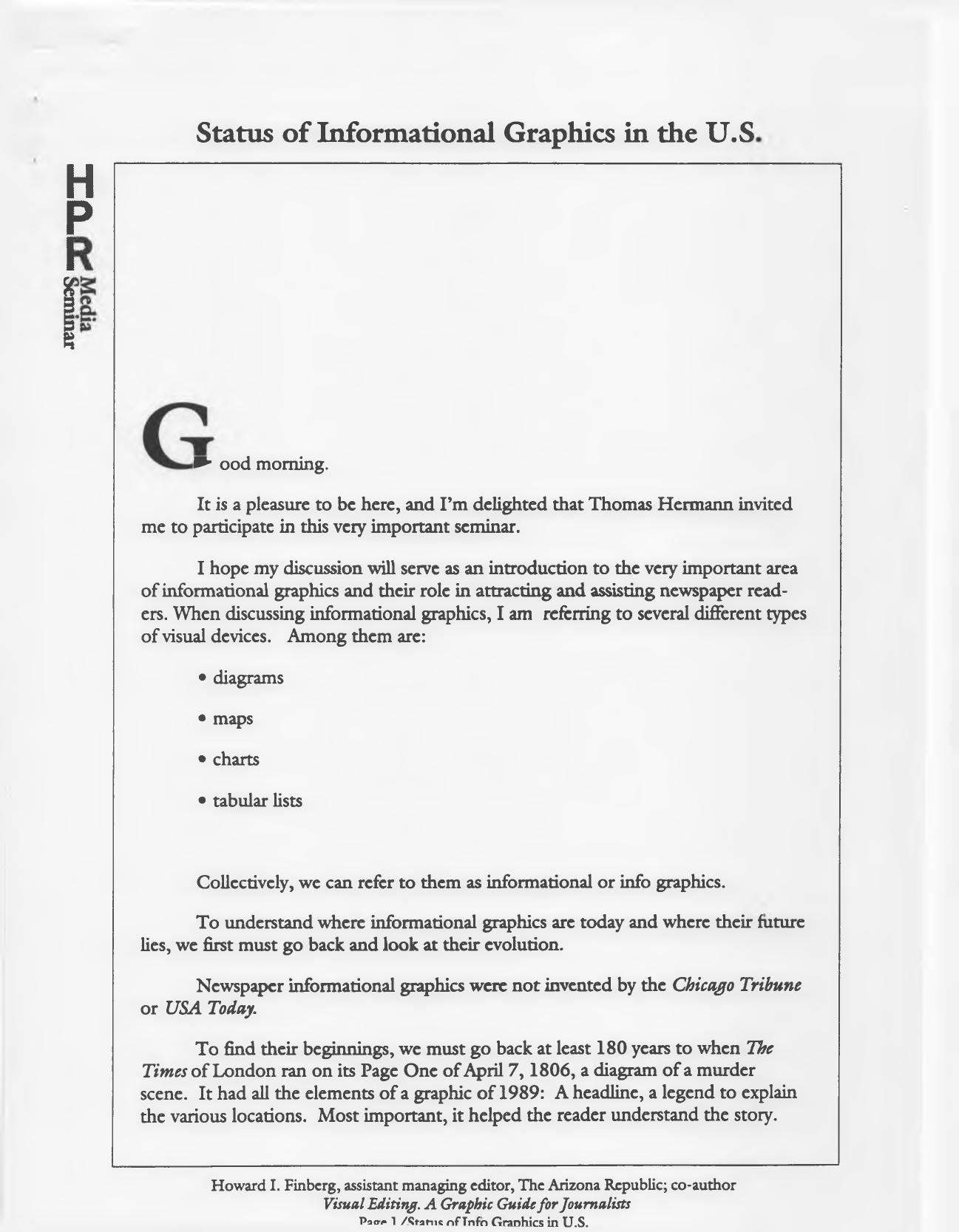
In the early 1990s I presented a seminar in Switzerland. Sadly, I don’t remember exactly when or where — which is why this file is going into the Archive section until more information turns up. The handout given to seminar participants also served as my speech. It draws on my then-newly published textbook, Visual Editing: A Graphic Guide for Journalists (1990). The document credits Thomas Hermann with the invitation.

The talk traces the evolution of informational graphics — diagrams, maps, charts and tabular lists — from a murder-scene diagram on Page One of The Times of London on April 7, 1806, through William Playfair’s 1786 The Commercial and Political Atlas, to war maps of World Wars I and II, the space program, and the arrival of USA Today on Sept. 15, 1982. Along the way it notes that the Chicago Tribune created a graphics editor position in 1974, one of the country’s first full-time visual journalists.

One of my favorite quotations, from the Austrian statistician Otto Neurath in 1925, appears early in the text:

“Words divide, pictures unite…to remember simplified pictures is better than to forget accurate figures.”

The handout also reports survey findings from more than 350 members of the American Society of Newspaper Editors, done in connection with the American Press Institute’s 1988 J. Montgomery Curtis seminar: 92 percent expected to use more informational graphics within five years, and 90 percent said graphics would play a greater role in their newspapers in the year 2000.

And a warning that still holds up:

When we run misleading graphics because of a lack of data points or “empty graphics” that are merely type-breakers, we communicate very little and take up precious news space.

The remainder of the handout is drawn from the textbook: chapters on how a graphics editor works — gathering and editing information, request forms, working with artists, fact checking — and a section on choosing the right device, with examples from The Arizona Republic illustrating tables and lists, line/fever charts, pie charts, pictograms, map graphics, and vertical and horizontal bar charts.

Editor & Publisher "Newspeople in the News" column from Sept. 12, 1987, with the item naming Howard I. Finberg assistant managing editor/graphics at the Arizona Republic

Editor & Publisher Notes My Move to the Arizona Republic

Trade-press personnel columns were the LinkedIn of their day. If you changed jobs in the newspaper business, you found out who else in the industry was paying attention by how many notes arrived after your name showed up in Editor & Publisher‘s “Newspeople in the News” roundup.

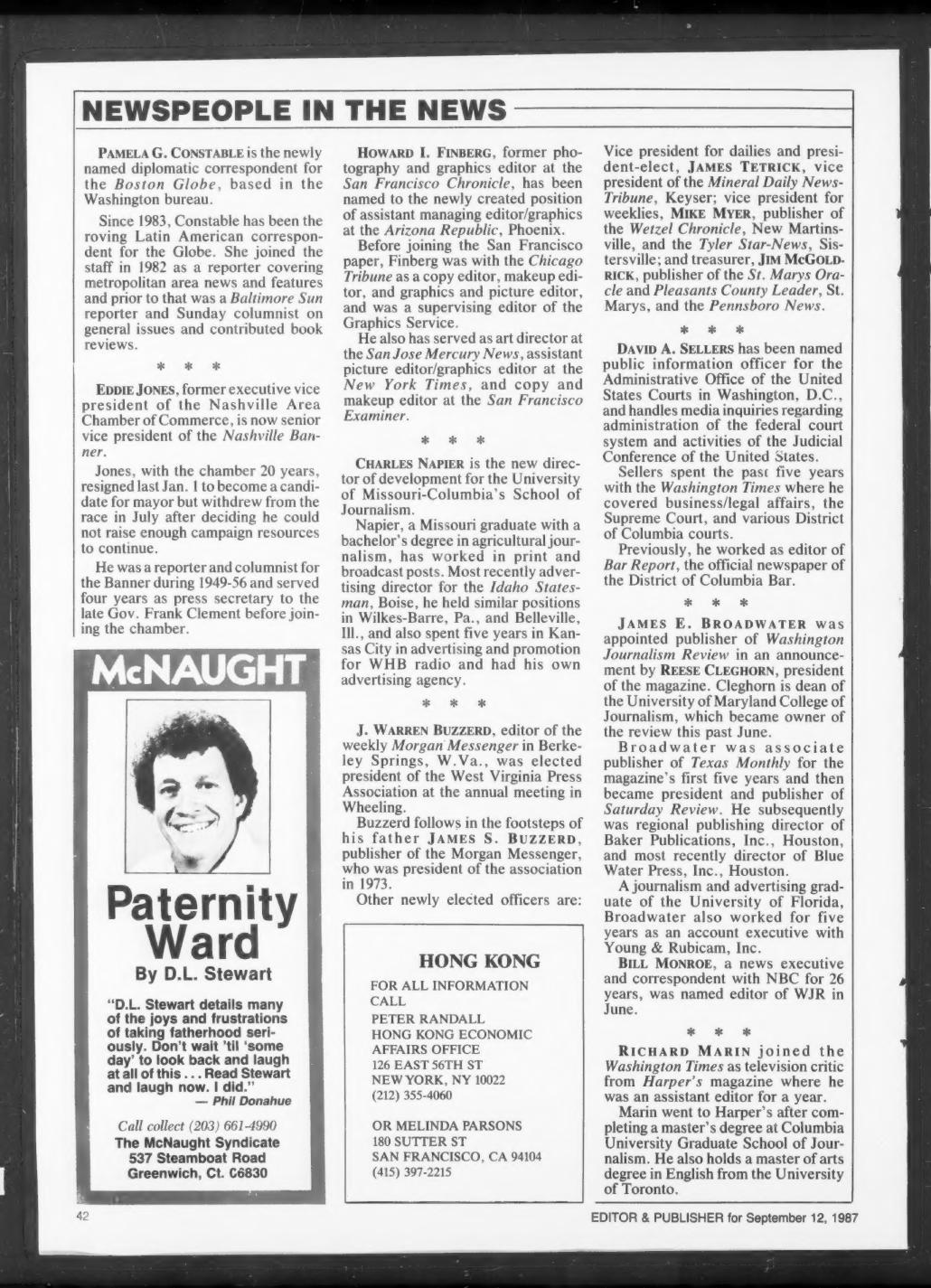
This one, from the Sept. 12, 1987, issue, put me in a column with a Boston Globe diplomatic correspondent, a new publisher for Washington Journalism Review, and the newly elected officers of the West Virginia Press Association. Here’s the item:

HOWARD I. FINBERG, former photography and graphics editor at the San Francisco Chronicle, has been named to the newly created position of assistant managing editor/graphics at the Arizona Republic, Phoenix.

The phrase that matters there is “newly created position.” In 1987, an AME for graphics was still a job a newspaper had to decide it wanted before it could fill it. The Republic had made that decision as part of a larger commitment to redesign — the paper’s internal newsletter had announced my hiring alongside the contract with Mario Garcia earlier that summer.

The rest of the item is a compressed version of the résumé that got me there — a reminder of how much of my early career was spent moving between the copy desk, the picture desk, and the art department, which was precisely the combination the graphics-editor job required:

Before joining the San Francisco paper, Finberg was with the Chicago Tribune as a copy editor, makeup editor, and graphics and picture editor, and was a supervising editor of the Graphics Service.

He also has served as art director at the San Jose Mercury News, assistant picture editor/graphics editor at the New York Times, and copy and makeup editor at the San Francisco Examiner.

I was an editor who worked with artists and photographers, not an artist myself — a distinction I’d been explaining since the Tribune days. By 1987, enough newspapers had come around to the idea that it no longer needed much explaining.

Editor & Publisher appointments column from Feb. 22, 1986, listing Howard Finberg as photography/graphics editor at the San Francisco Chronicle

E&P Notes My Move to San Francisco Chronicle

Before LinkedIn, before company press releases landed in your inbox, there was the back-of-the-book appointments column in Editor & Publisher. That’s where the industry found out who was moving where. This item, from the Feb. 22, 1986, issue, is where my arrival at the San Francisco Chronicle got recorded for the trade.

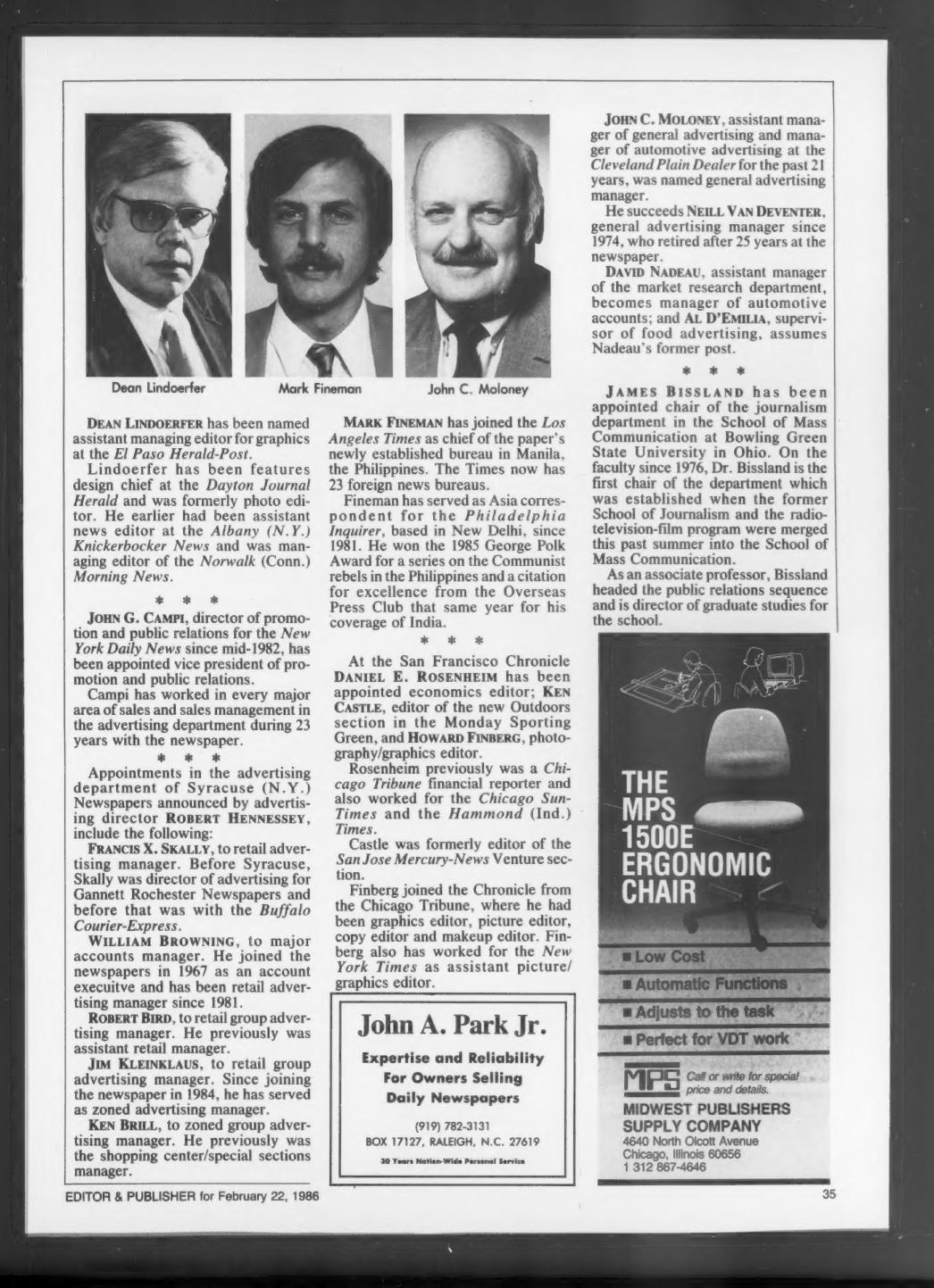
The Chronicle announced three appointments at once, and E&P ran them together in a single paragraph:

At the San Francisco Chronicle DANIEL E. ROSENHEIM has been appointed economics editor; KEN CASTLE, editor of the new Outdoors section in the Monday Sporting Green, and HOWARD FINBERG, photography/graphics editor.

Note the title: photography/graphics editor. The two responsibilities were bundled into one job, which tells you something about how newsrooms thought about visual journalism in the mid-1980s — pictures and graphics were still being sorted into the same drawer, even as informational graphics were becoming their own discipline. It also should be noted that I was the first person to hold this job at the paper.  Previously, the art and photo departments reported to other supervisors, such as the news editor.

The short biography that follows is a reasonable summary of the road that got me there:

Finberg joined the Chronicle from the Chicago Tribune, where he had been graphics editor, picture editor, copy editor and makeup editor. Finberg also has worked for the New York Times as assistant picture/graphics editor.

I’m also amused that Dan Rosenheim and I arrived at the Chronicle from the same place — he came from the Tribune’s financial staff. The Chicago-to-San Francisco pipeline was apparently running that year.

The rest of the page is a perfect artifact of the era: an assistant managing editor for graphics named at the El Paso Herald-Post, a promotion executive elevated at the New York Daily News, five advertising appointments at the Syracuse newspapers, the Los Angeles Times opening a Manila bureau (its 23rd foreign bureau), and a new journalism department chair at Bowling Green — all wrapped around display ads for a newspaper broker in Raleigh and a printing supply company in Chicago. That was the industry talking to itself, one column inch at a time.

My time at the Chronicle didn’t last long. The following year I left for Phoenix and The Arizona Republic, which announced my hiring as assistant managing editor for graphics in June 1987 — and identified me, naturally, as “Howard Finberg of the San Francisco Chronicle.”

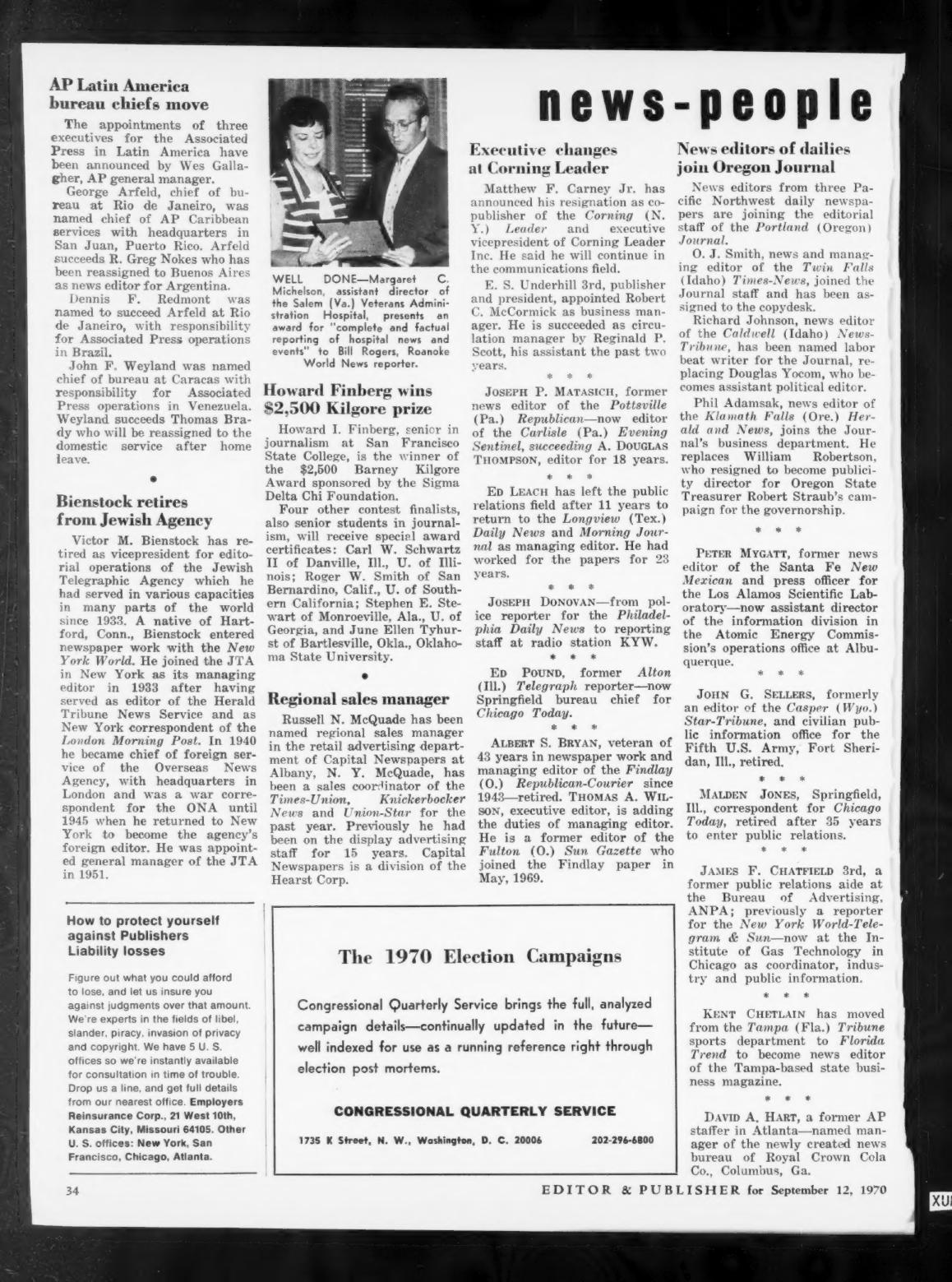
Editor & Publisher personnel page from September 12, 1970 announcing the $2,500 Barney Kilgore Award winner

Editor & Publisher, September 12, 1970: Winning the $2,500 Kilgore Prize

A short item in the personnel pages of Editor & Publisher for September 12, 1970, reporting the winner of the Barney Kilgore Award from the Sigma Delta Chi Foundation. The page around it is the usual mix of industry news: AP bureau chief moves in Latin America, a retirement at the Jewish Telegraphic Agency, editor changes at papers from Corning, N.Y., to Findlay, Ohio.

Howard I. Finberg, senior in journalism at San Francisco State College, is the winner of the $2,500 Barney Kilgore Award sponsored by the Sigma Delta Chi Foundation.

The item also names the four other finalists, all senior journalism students, who received special award certificates:

Carl W. Schwartz III of Danville, Ill., U. of Illinois; Roger W. Smith of San Bernardino, Calif., U. of Southern California; Stephen E. Stewart of Monroeville, Ala., U. of Georgia, and June Ellen Tyhurst of Bartlesville, Okla., Oklahoma State University.

A Telegram From Washington: Named a 1971 Sears Congressional Journalism Intern

In 1970, big news arrived on paper, delivered to your door. Not email, not a phone call, not a text message — a Western Union telegram, all capital letters, punctuation spelled out or dropped, and the sender paying by the word. This one came to my parents’ house on Ortega Street in San Francisco while I was a journalism student at San Francisco State.

THE AWARDS COMMITTEE HAS NAMED YOU A 1971 SEARS CONGRESSIONAL JOURNALISM INTERN AND IS ARRANGING FOR YOUR APPOINTMENT TO A CONGRESSIONAL OFFICE STAFF, FULL DETAILS WILL FOLLOW BY LETTER IN MID-JUNE, PLEASE SEND IMMEDIATELY YOUR SUMMER ADDRESS AND TELEPHONE NUMBER ROTH AT RESIDENCE AND PLACE OF EMPLOYMENT. CONGRATULATIONSS

The telegram is dated May 20, 1970, and it is signed by:

JOHN L WHEELER, VICE PRESIDENT, GOVERNMENTAL AFFAIRS, SEARS, ROEBUCK AND CO, 1211 CONNECTICUT AVENLE WASHINGTON, D.C. 20056

Note the address: the telegram was sent by a corporate executive in Washington, D.C. The awards committee named the interns; the details — where you would actually be working, and for whom — would follow by letter in mid-June. In other words, you were told you had won before anyone could tell you what you had won.

The image itself is a reminder of how these documents were made. The routing codes across the top, the operator’s marks, the transmission time stamps, the form number at the bottom — all of it printed around a message that a machine typed out at the receiving end. The optical character reader stumbles over parts of it, which is fair; so does the eye. “BOTH” became “ROTH.” “AVENUE” became “AVENLE.”

Looking at it now, more than fifty years on, what strikes me is that a piece of news that changed the direction of a young journalist’s year came as a fragile sheet of paper with a glued-on tape of type. Today the same message would be an email, or a notification on a phone, gone from view in a week and unfindable in a year. The telegram survived because it was an object, and because I thought it was worth keeping. That is a decent argument for archives, and part of why these documents are here.

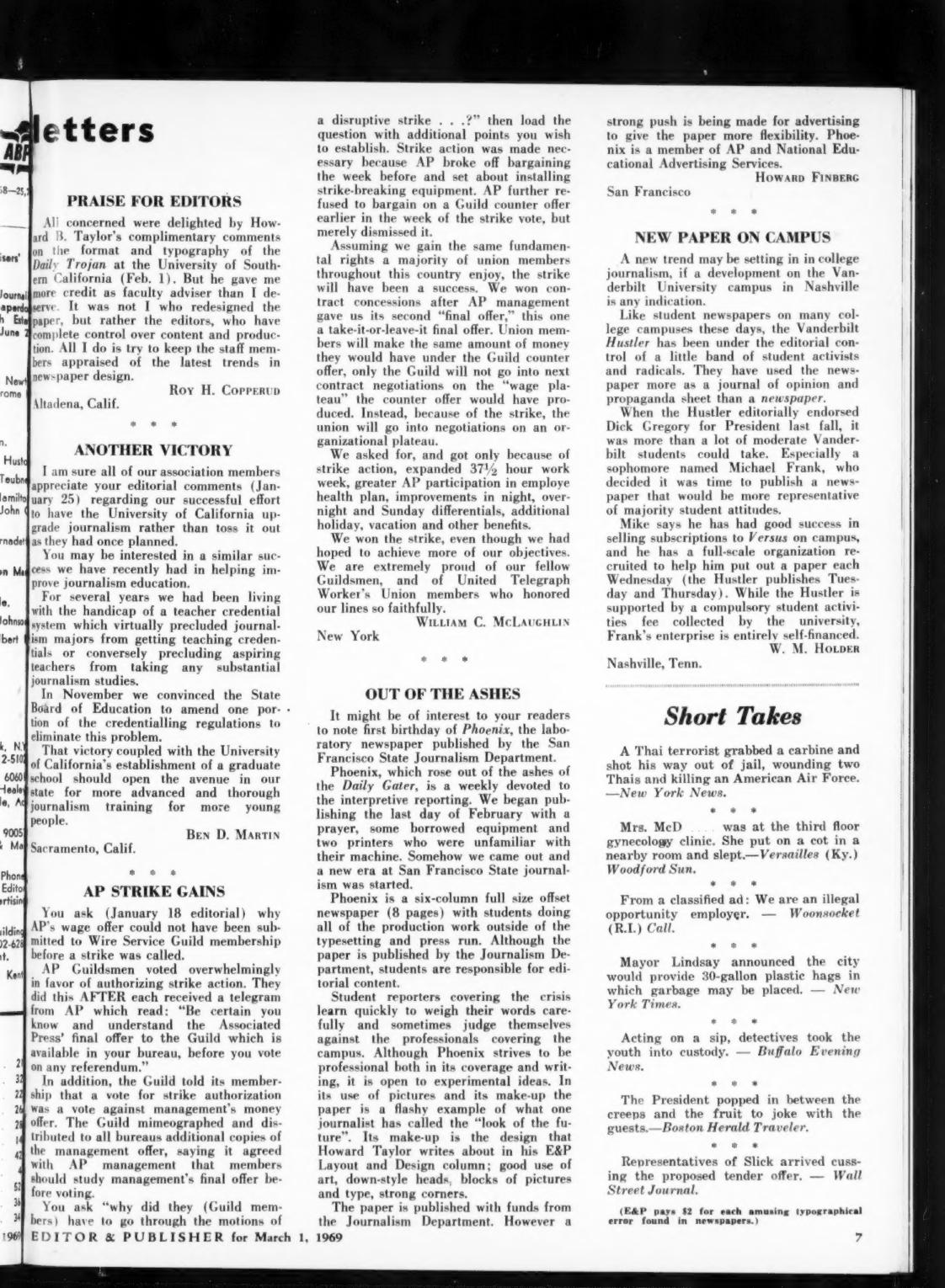
Editor & Publisher letters column from March 1, 1969, printing a letter about Phoenix, the San Francisco State laboratory newspaper

Out of the Ashes: A Letter to Editor & Publisher About the Phoenix

This is a letter of mine that ran in the letters column of Editor & Publisher for March 1, 1969. I was a journalism student at San Francisco State, and what I wanted the trade press to know was that our laboratory newspaper had made it through its first year.

It might be of interest to your readers to note the first birthday of Phoenix, the laboratory newspaper published by the San Francisco State Journalism Department.

The name was not subtle, and it wasn’t meant to be. The Phoenix came after the Daily Gater, and the letter says so plainly, along with a fairly honest account of how the first issue got out the door.

Phoenix, which rose out of the ashes of the Daily Gater, is a weekly devoted to interpretive reporting. We began publishing the last day of February with a prayer, some borrowed equipment and two printers (typesetters) who were unfamiliar with their machine. Somehow we came out and a new era in San Francisco State journalism was started.

What I described was a six-column, full-size offset paper, eight pages, with students doing all of the production work outside of the typesetting and the press run. The Journalism Department published it and paid for it, but, as I was careful to point out, students were responsible for the editorial content. We were pushing for advertising to give the paper more flexibility. The Phoenix was a member of AP and of National Educational Advertising Services.

The part of the letter I still think holds up is the paragraph about what it was like to be a student reporter on that campus, at that moment, with the professionals working the same story.

Student reporters covering the crisis learn quickly to weigh their words carefully and sometimes judge themselves against the professionals covering the campus.

And then, because even at that age I couldn’t resist talking about design, I spent a good chunk of a letter about a student newspaper describing its typography.

In its use of pictures and its make-up the paper is a flashy example of what one journalist has called the “look of the future.” Its make-up is the design that Howard Taylor writes about in his E&P Layout and Design column; good use of art, down-style heads, blocks of pictures and type, strong corners.

There’s a nice coincidence on the same page. The letter at the top of the column, from Roy H. Copperud of Altadena, Calif., is also responding to Howard Taylor’s design coverage — this time about the Daily Trojan at USC — and makes a point I would hear again and again in the years that followed about who actually does the work:

It was not I who redesigned the paper, but rather the editors, who have complete control over content and production.

A page of letters about student newspapers, journalism education in California, and the Wire Service Guild’s strike against the AP — and tucked in among them, a college student telling the industry’s trade magazine that the future would look a certain way on the page. The scan garbles my byline into “Howarp FInBerc,” which feels about right for a 1969 hot-type artifact making its way through a 21st-century scanner.