Opening slide from the 2002 Journalism & Technology, Linked Forever presentation greeting a Danish audience with "God Eftermiddag"

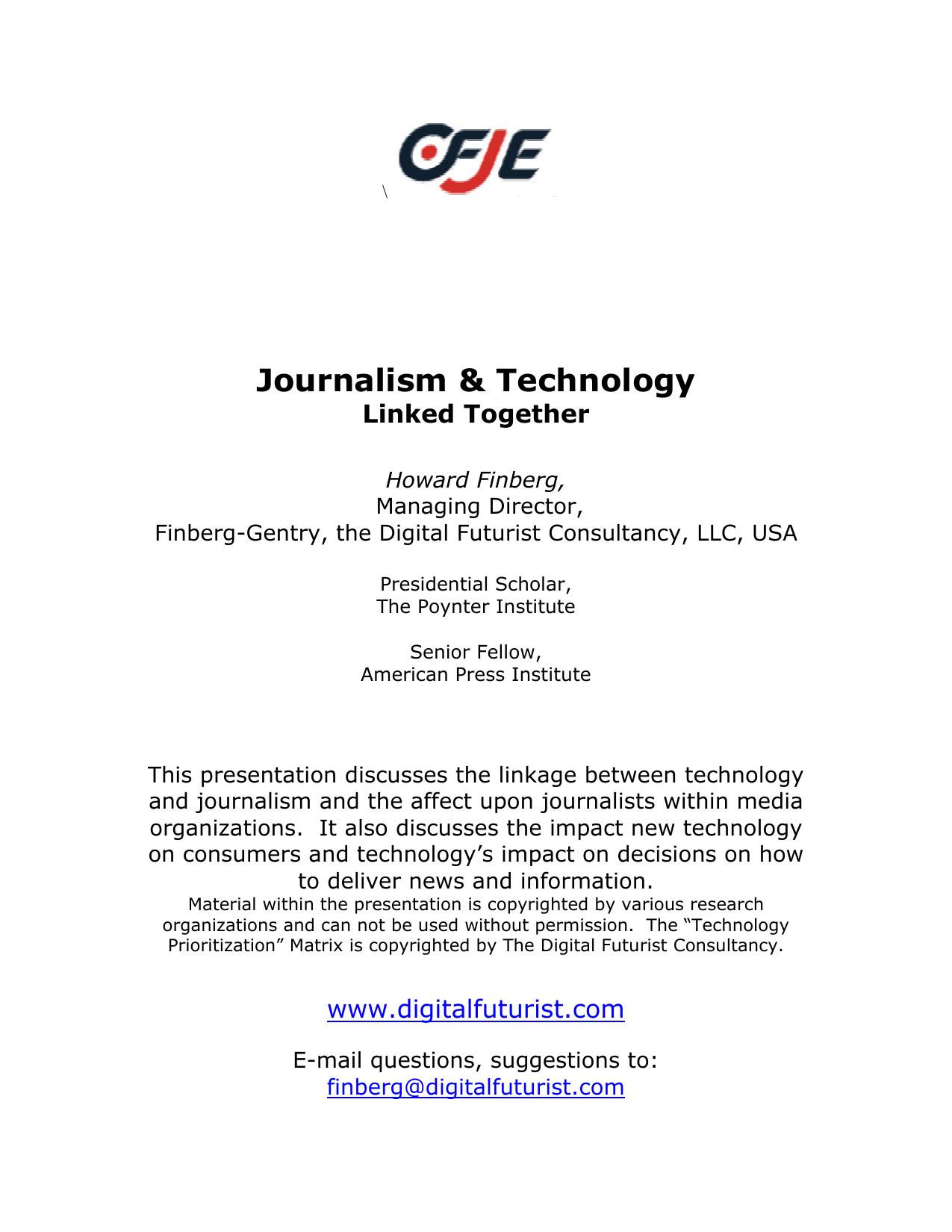
Journalism & Technology, Linked Forever Presentation

This is a presentation I gave to the Centre for Journalism and Further Education on Sept. 23, 2002. The opening slide greets the audience with “God Eftermiddag,” so I was clearly speaking to a Danish room. At the time I was Managing Director of Finberg-Gentry, the Digital Futurist Consultancy, a Presidential Scholar at The Poynter Institute and a Senior Fellow at the American Press Institute’s Media Center.

The purpose, as I laid it out early on, was to help the audience think about the future: how journalism is shaped by technology, how consumers drive technology, and how journalists need to position themselves regarding technology. My argument was that journalists could no longer treat technology as somebody else’s department.

For decades, journalists had little reason to pay attention to technology… The pace of change was slow. 50 years between innovations. Hot type to cold type. Letterpress to offset. Today, the pace is much faster. 20 years or shorter…

I split the disruption into two buckets. Internal: how we do business. External: what is our business. And I was blunt that the external questions mattered more, because our industry was at what I called an “inflection point.” I leaned on the Marshall McLuhan line that has never stopped being useful:

“We see the world through a rear-view mirror. We march backwards into the future.”

Much of the middle of the talk was a tour of devices and delivery: broadband going mainstream in the U.S. and accelerating in Western Europe, information devices wired and wireless, the smart phone as “a telephone with an operating system,” the first generation of reading devices — Softbook, E-Reader, RocketBook — plus NewsStand and Zinio, the coming TabletPC from “those fun folks up in Redmond, Wash.,” home gateways, personal video recorders, IBM’s MetaPad, the OQO, E-Ink displays and IBM’s e-newspaper mockup. I also included my caveat that not all technological changes are valuable, and that convergence might be an example of value that isn’t clearly understood.

Woven through the slides were five questions for the audience, and the third one is the one I’d still ask today:

While the paper might not disappear from newspaper, what happens if those who read it on paper disappear?

The last third of the presentation was the part I cared most about: a method for deciding what to do. The Technology Prioritization Matrix, copyrighted by The Digital Futurist Consultancy, simplified the decision to two criteria — consumer value, and expense and effort — with a list of internal questions (productivity, training, skills alignment, probability of success) and external ones (revenue potential, market share, customer adoption). The point was that not every project with a “gee whiz” factor returns value to the consumer or the company, and that there would be no single leap to the new world. I closed with four technology rules, including one I’ve repeated many times since:

Experiments cost money; doing nothing costs even more

Reading this in 2026, the specific hardware is a museum tour — most of those reading devices are gone, and the ones that survived didn’t look much like the mockups. But the framing held up better than the gadgets: consumers drove the fundamental changes, adoption took longer than predicted, and the newsrooms that waited for certainty paid the higher price.
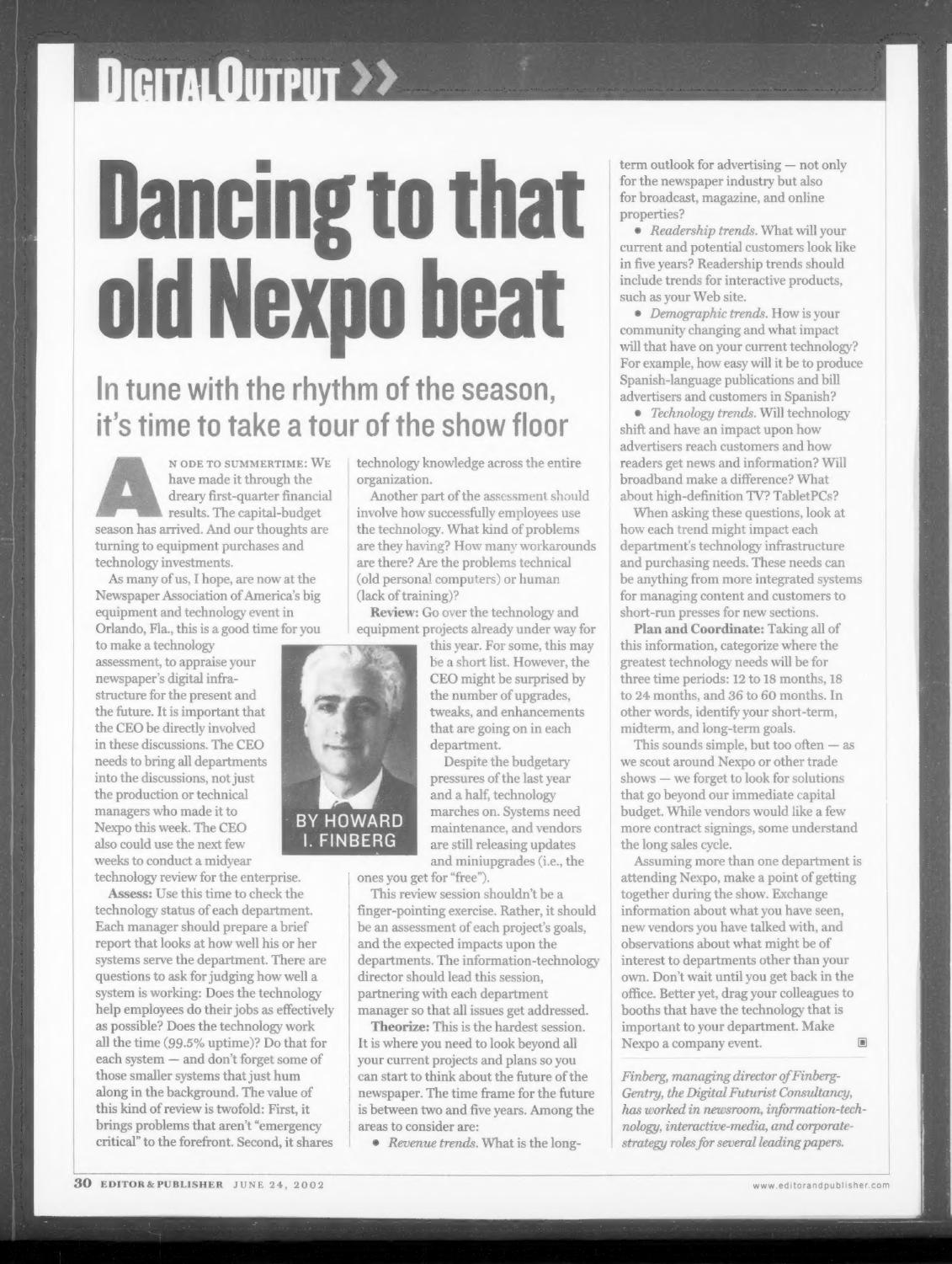
Editor & Publisher column from Nexpo 2002 advising newspaper CEOs to take stock of their digital infrastructure

Dancing To That Old Nexpo Beat

A column for Editor & Publisher, published June 24, 2002, timed to the Newspaper Association of America‘s big equipment and technology show, Nexpo, then under way in Orlando, Fla. The piece argues that the trade-show season is the right moment for a newspaper to take stock of its digital infrastructure — and that the review should not be left to the production and technical managers who happen to be walking the show floor.

It is important that the CEO be directly involved in these discussions. The CEO needs to bring all departments into the discussions, not just the production or technical managers who made it to Nexpo this week.

The column lays out a midyear technology review in four steps. Assess: each manager prepares a brief report on how well the department’s systems are working — including the smaller ones that “just hum along in the background” — and on how successfully employees actually use them, distinguishing technical problems from human ones such as lack of training.

Does the technology help employees do their jobs as effectively as possible? Does the technology work all the time (99.5% uptime)?

Review: go over projects already under way, led by the information-technology director in partnership with each department manager, and not as a finger-pointing exercise. Theorize: look two to five years out at revenue trends, readership trends (including interactive products such as the Web site), demographic trends — the column uses Spanish-language publishing and billing as an example — and technology trends, asking whether broadband, high-definition TV, or TabletPCs will change how advertisers reach customers and how readers get news. Plan and Coordinate: sort the resulting needs into short-term, midterm, and long-term buckets of 12 to 18 months, 18 to 24 months, and 36 to 60 months.

The closing advice is about the show itself: departments attending Nexpo should compare notes while they are still there.

Don’t wait until you get back in the office. Better yet, drag your colleagues to booths that have the technology that is important to your department. Make Nexpo a company event.

The column’s tagline reads: “Finberg, managing director of Finberg-Gentry, the Digital Futurist Consultancy, has worked in newsroom, information-technology, interactive-media, and corporate-strategy roles for several leading papers.”

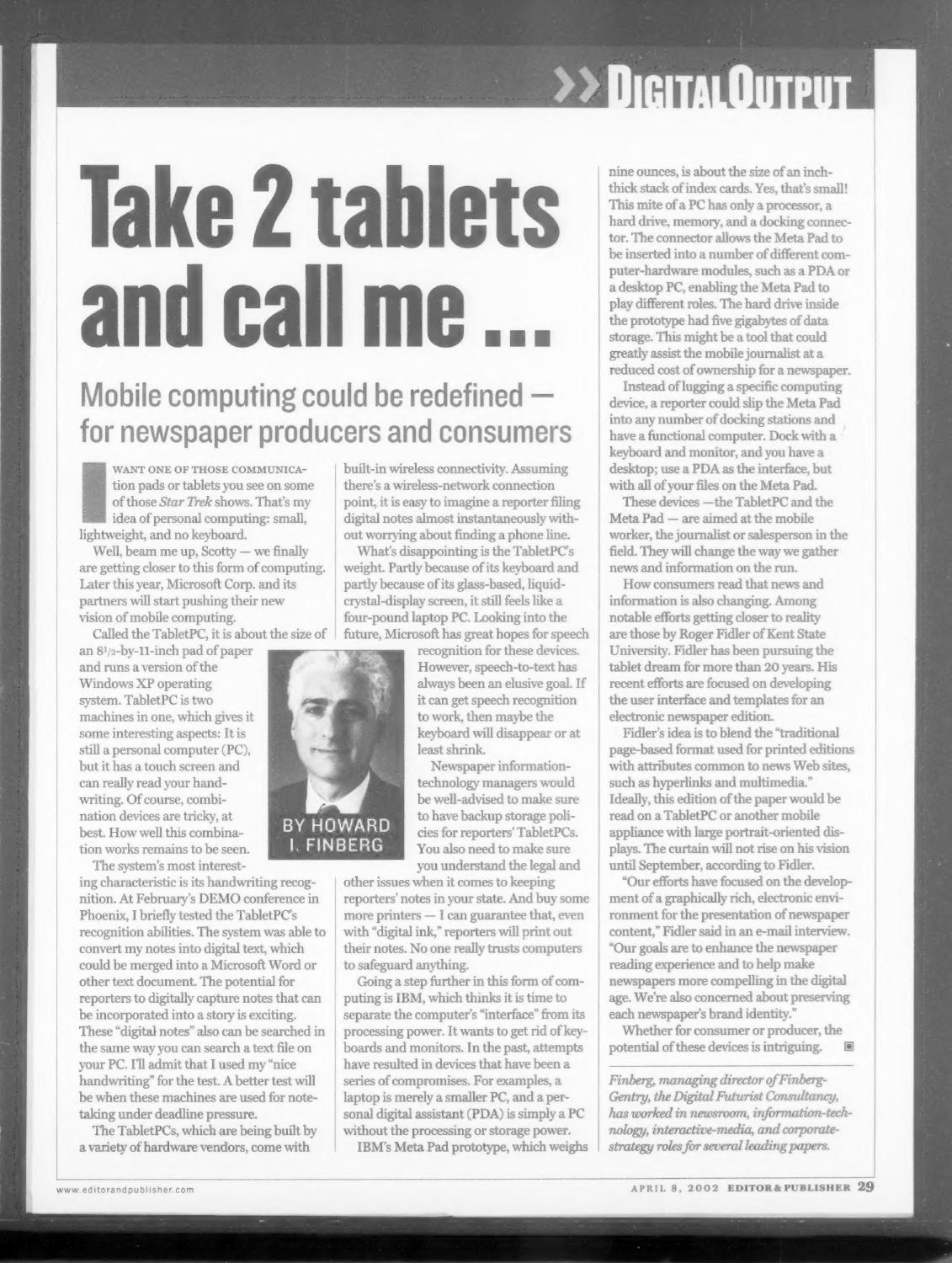
Tablet-style device representing the 2002 promise of mobile computing for newspapers, from an Editor & Publisher column

Take 2 Tablets and Call Me — Mobile Computing, 2002

My column in the April 8, 2002, issue of Editor & Publisher looked at two devices that promised to redefine mobile computing for both newspaper producers and consumers: Microsoft’s forthcoming TabletPC and IBM’s Meta Pad prototype.

The column opens with an admission about where the idea came from:

I want one of those communication pads or tablets you see on some of those Star Trek shows. That’s my idea of personal computing: small, lightweight, and no keyboard.

The TabletPC, about the size of an 8 1/2-by-11-inch pad of paper and running a version of Windows XP, was being built by a variety of hardware vendors with built-in wireless connectivity. I had briefly tested its handwriting recognition at February’s DEMO conference in Phoenix, where the system converted my notes into digital text that could be merged into a Word document. My caveat: I used my “nice handwriting,” and the real test would come with note-taking under deadline pressure. The disappointment was weight — it still felt like a four-pound laptop.

The column also offered practical advice for newspaper information-technology managers: back up reporters’ TabletPCs, understand the legal issues around keeping reporters’ notes in your state, and buy more printers.

No one really trusts computers to safeguard anything.

IBM’s Meta Pad prototype went a different direction — separating the interface from the processing power. At nine ounces and about the size of an inch-thick stack of index cards, it held only a processor, a hard drive, memory, and a docking connector, with five gigabytes of storage. Dock it with a keyboard and monitor and you have a desktop; dock it with a PDA and you have a handheld carrying all your files.

On the consumer side, the column reported on Roger Fidler of Kent State University, who had been pursuing the tablet dream for more than 20 years and was then working on the user interface and templates for an electronic newspaper edition — blending the page-based format of print with hyperlinks and multimedia. Fidler said his work would not be unveiled until September, and told me in an e-mail interview:

Our efforts have focused on the development of a graphically rich, electronic environment for the presentation of newspaper content. Our goals are to enhance the newspaper reading experience and to help make newspapers more compelling in the digital age. We’re also concerned about preserving each newspaper’s brand identity.

The column ran with the standard tagline identifying me as managing director of Finberg-Gentry, the Digital Futurist Consultancy.

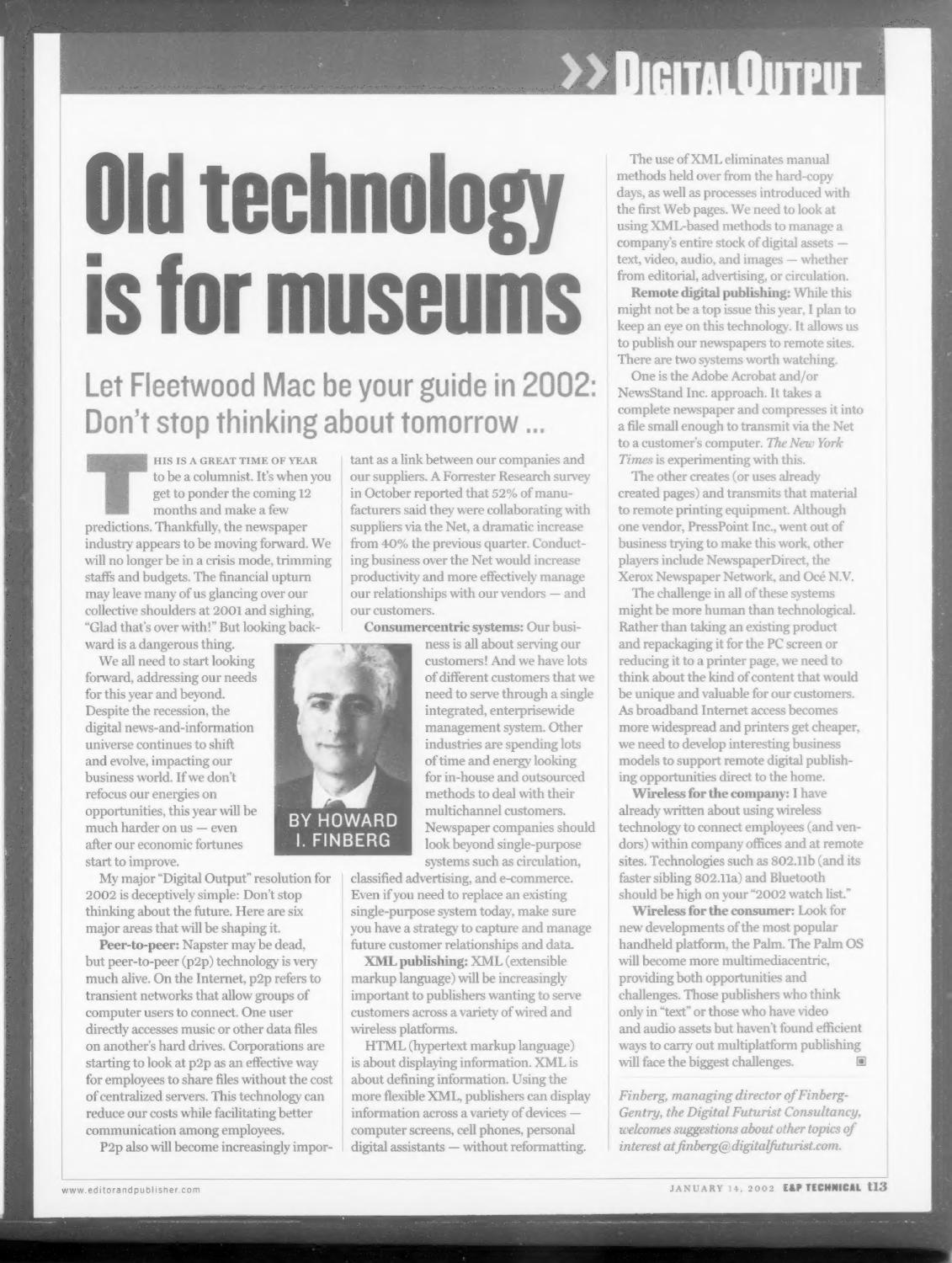
Digital Output column in the Editor & Publisher Technical section, January 14, 2002, on technologies to watch

Old Technology Is for Museums

My “Digital Output” column for Editor & Publisher, published January 14, 2002, in the E&P Technical section. It’s a start-of-the-year prediction column, written as the newspaper industry came out of the budget-and-staff cutting of 2001, and it lays out six technology areas worth watching.

The framing came from Fleetwood Mac — the subhead read “Let Fleetwood Mac be your guide in 2002: Don’t stop thinking about tomorrow …” — and the column’s central point was that the recession was no excuse to stop paying attention to what was coming next.

My major “Digital Output” resolution for 2002 is deceptively simple: Don’t stop thinking about the future.

The six areas: peer-to-peer technology, which I argued was alive well past Napster and would matter both inside companies and as a link to suppliers; consumer-centric systems, urging publishers to look beyond single-purpose circulation, classified, and e-commerce systems toward one integrated, enterprise-wide approach to customer data; XML publishing; remote digital publishing; wireless inside the company; and wireless for the consumer.

On XML, the column drew the distinction plainly:

HTML (hypertext markup language) is about displaying information. XML is about defining information.

The remote digital publishing section looked at two approaches — the Adobe Acrobat and/or NewsStand Inc. model of compressing a complete newspaper for transmission to a customer’s computer, which The New York Times was experimenting with, and transmitting pages to remote printing equipment. PressPoint Inc. had already gone out of business trying to make the second work; other players named were NewspaperDirect, the Xerox Newspaper Network, and Oc
u00e9 N.V. My conclusion about all of it:

The challenge in all of these systems might be more human than technological.

For wireless, 802.11b and 802.11a and Bluetooth were on the “2002 watch list,” and on the consumer side the column pointed to the Palm OS becoming “more multimedia-centric.” The column ran with the standard tagline identifying me as managing director of Finberg-Gentry, the Digital Futurist Consultancy.

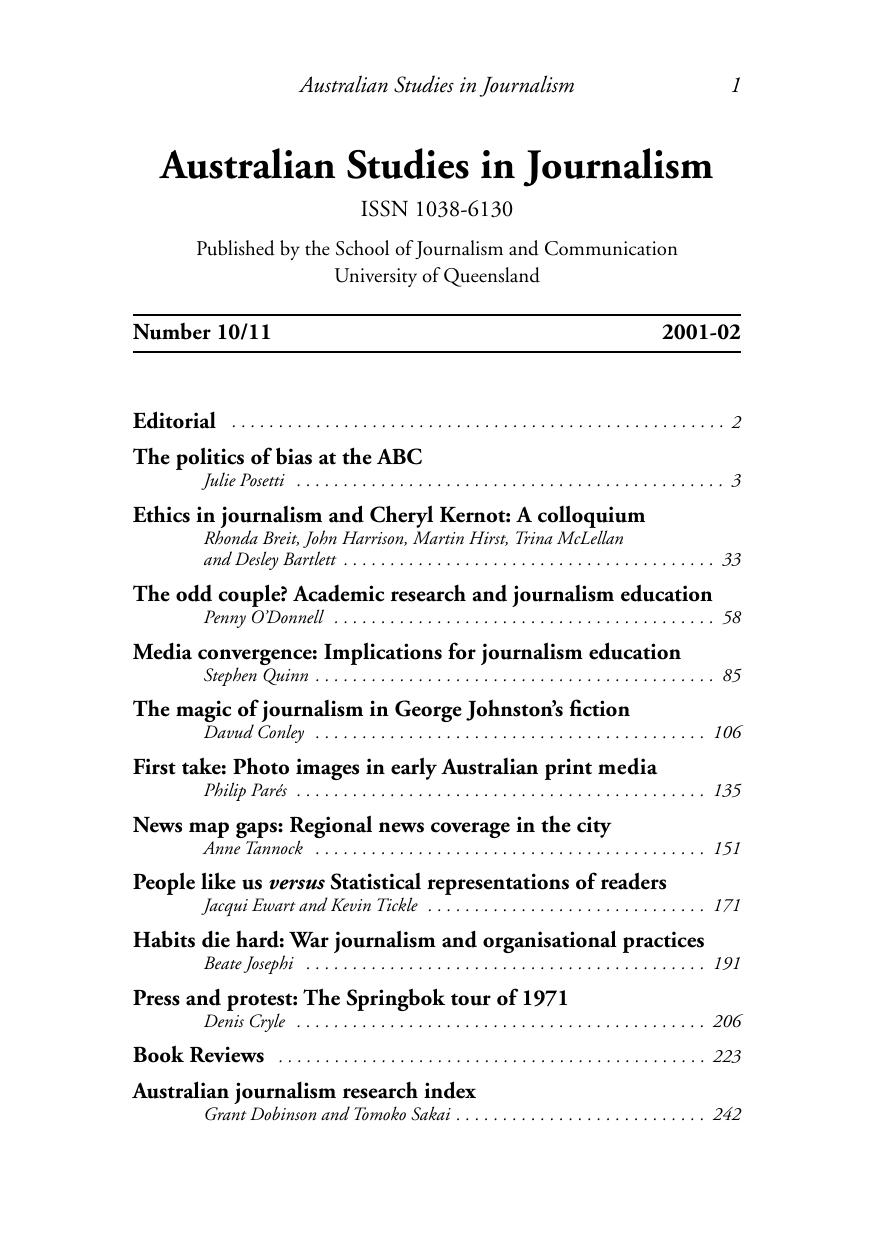
Scanned pages of Stephen Quinn's paper "Media convergence: Implications for journalism education" from Australian Studies in Journalism, 2001-02

Media Convergence and Journalism Education, 2002

This is Stephen Quinn’s paper “Media convergence: Implications for journalism education,” published in Australian Studies in Journalism, Number 10/11, 2001-02, from the School of Journalism and Communication at the University of Queensland. Quinn was then director of the Center for Media Training and Research at Zayed University in Dubai, and he surveys what was, at the time, the newest idea in the newspaper business: the notion that one reporter’s work should appear in print, on the Web, on radio and television, and eventually on a mobile phone.

The paper takes its starting point from the IFRA/WAN “Beyond the Printed Word” conference in Amsterdam in October 2000 — a gathering of nearly 500 senior newspaper managers from more than 40 countries. I was one of the two conference chairs, which is how I turn up in the text and in the references.

The other conference chairperson, Howard Finberg, pointed out the publishing industry’s strength was its staff, and these people would be “called on more and more in this multimedia, multi-task newsroom” (Finberg 2000).

The bibliography entry is a small pleasure to find in a scanned journal two decades later:

Finberg, Howard (2000), The Digital Futurist Consultancy <www.digitalfuturist.com>. [Finberg’s paper was “Classified: Cannibalism or growth impetus”.]

Much of the paper is case studies: the Tribune Company’s three models of “multiple-journalism” at the Chicago Tribune, the Orlando Sentinel and the Tampa Tribune, as described by IFRA’s Kerry Northrup; the Turun Sanomat operation in Finland; Ming Pao in Hong Kong; Singapore Press Holdings; and the Australian cross-media ownership debate. Quinn also gives space to the skeptics, including Walter Kiechel of the Harvard Business Review, who argued news was far more “medium-specific” than the convergence enthusiasts believed.

The section that has aged best is the one on education. Northrup frames the problem as a chicken-and-egg relationship between the schools and the industry:

“Do you train journalism students for the jobs that exist today so that when they graduate they can be employed? Or do you train people for the skills that they’re going to need in the news organisation tomorrow so that when the newspapers come along and say ‘we need a new generation of journalists’ they have people to pick from?”

And John Pavlik, then executive director of the Center for New Media at Columbia’s Graduate School of Journalism, argues that most American journalism programs were still organized along “early twentieth-century technological lines”:

“Rather than learning to be newspaper, magazine, television, radio or online reporters, they should simply be taught to be journalists working in a digital age” (Pavlik 1998).

Quinn’s conclusion is blunt — “Convergence is inevitable” — and his prescription is training, on the theory that news organizations would have to spend money teaching their own staffs, and that journalists would need to embrace what he calls lifelong learning.

That last point is why I’ve kept this one. The training gap described here is precisely the problem I spent the following decade working on at the Poynter Institute, building News University as a way to deliver journalism training online, affordably, to people who were never going to get to a week-long seminar in Reston or St. Petersburg. The industry’s appetite for paying for that training turned out to be a lot smaller than the industry’s appetite for talking about convergence.

Reading this in 2026, the vocabulary is what dates it. Nobody says “convergence” or “multiple-journalism” anymore, because the argument is over — every newsroom is multi-platform, every reporter shoots video, and the mobile phone Quinn treats as an emerging distribution channel is now the primary one. What did not get settled is the harder question underneath: who pays to teach people the work, and whether journalism schools train for the job that exists or the one that’s coming. Substitute “AI” for “XML” in these pages and the debate reads as current.

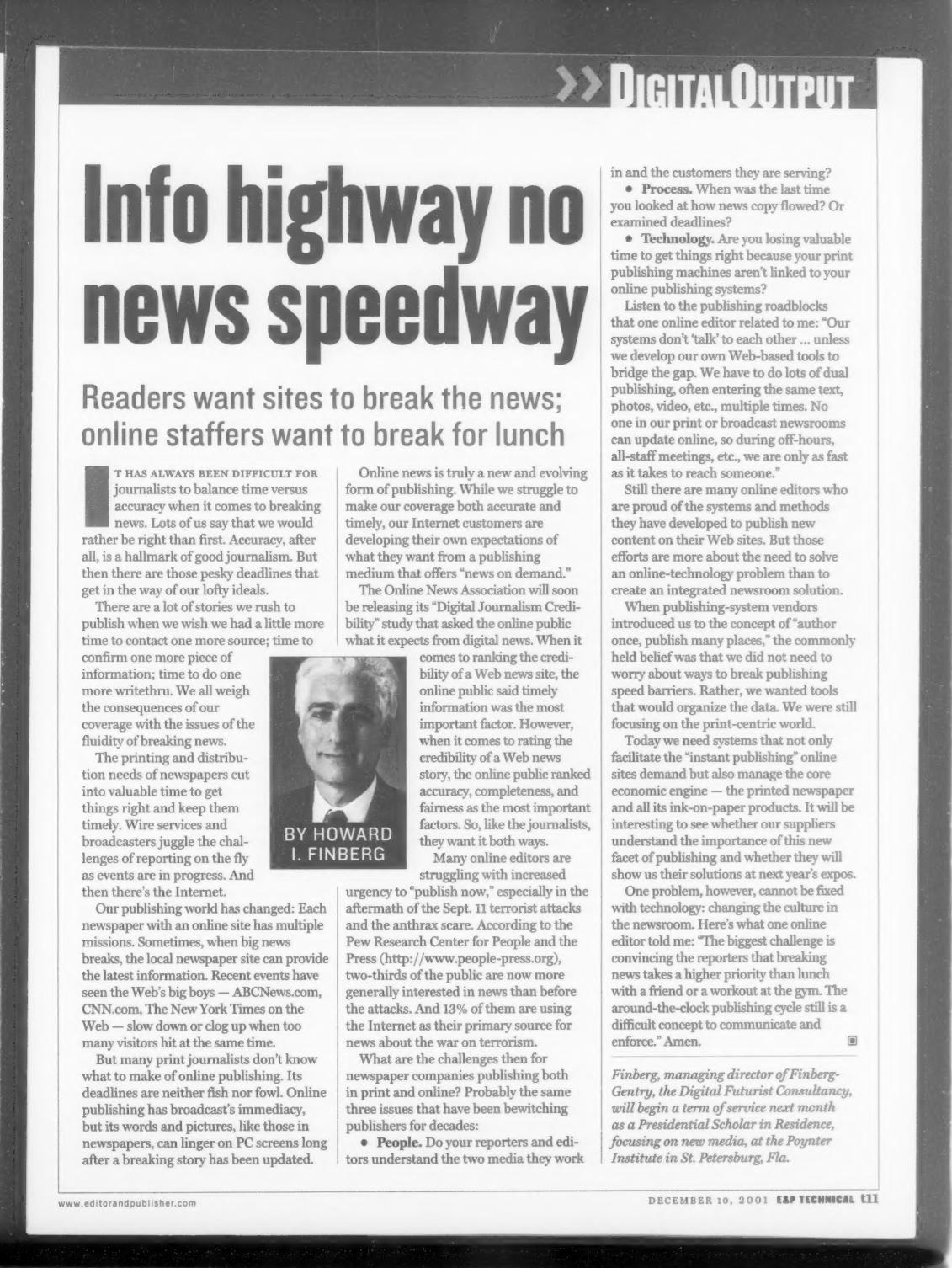
Editor & Publisher column headlined "Info highway no news speedway" from December 10, 2001

Info Highway: No News Speedway

A column I wrote for Editor & Publisher, published December 10, 2001, under the headline “Info highway no news speedway” and the subhead: “Readers want sites to break the news; online staffers want to break for lunch.”

The piece takes up the old tension between speed and accuracy and argues that online publishing has made it harder to resolve, because its deadlines are “neither fish nor fowl” — broadcast immediacy combined with words and pictures that linger on screen the way print does.

It cites the Online News Association‘s forthcoming “Digital Journalism Credibility” study, which found that the online public ranked timely information as the most important factor in judging the credibility of a Web news site, but ranked accuracy, completeness, and fairness first when judging an individual news story:

So, like the journalists, they want it both ways.

The column also notes Pew Research Center for People and the Press findings that two-thirds of the public were more generally interested in news than before the Sept. 11 attacks, and that 13% were using the Internet as their primary source for news about the war on terrorism.

The challenges for companies publishing in both print and online, I wrote, came down to the same three issues that had been “bewitching publishers for decades”: people, process, and technology. One online editor described the roadblocks this way:

Our systems don’t ‘talk’ to each other … unless we develop our own Web-based tools to bridge the gap. We have to do lots of dual publishing, often entering the same text, photos, video, etc., multiple times. No one in our print or broadcast newsrooms can update online, so during off-hours, all-staff meetings, etc., we are only as fast as it takes to reach someone.

The column closes on the one problem technology can’t solve — newsroom culture — quoting another online editor:

The biggest challenge is convincing the reporters that breaking news takes a higher priority than lunch with a friend or a workout at the gym. The around-the-clock publishing cycle still is a difficult concept to communicate and enforce.

The tagline at the end notes that I was then managing director of Finberg-Gentry, the Digital Futurist Consultancy, and would begin a term the following month as a Presidential Scholar in Residence, focusing on new media, at the Poynter Institute in St. Petersburg, Fla.

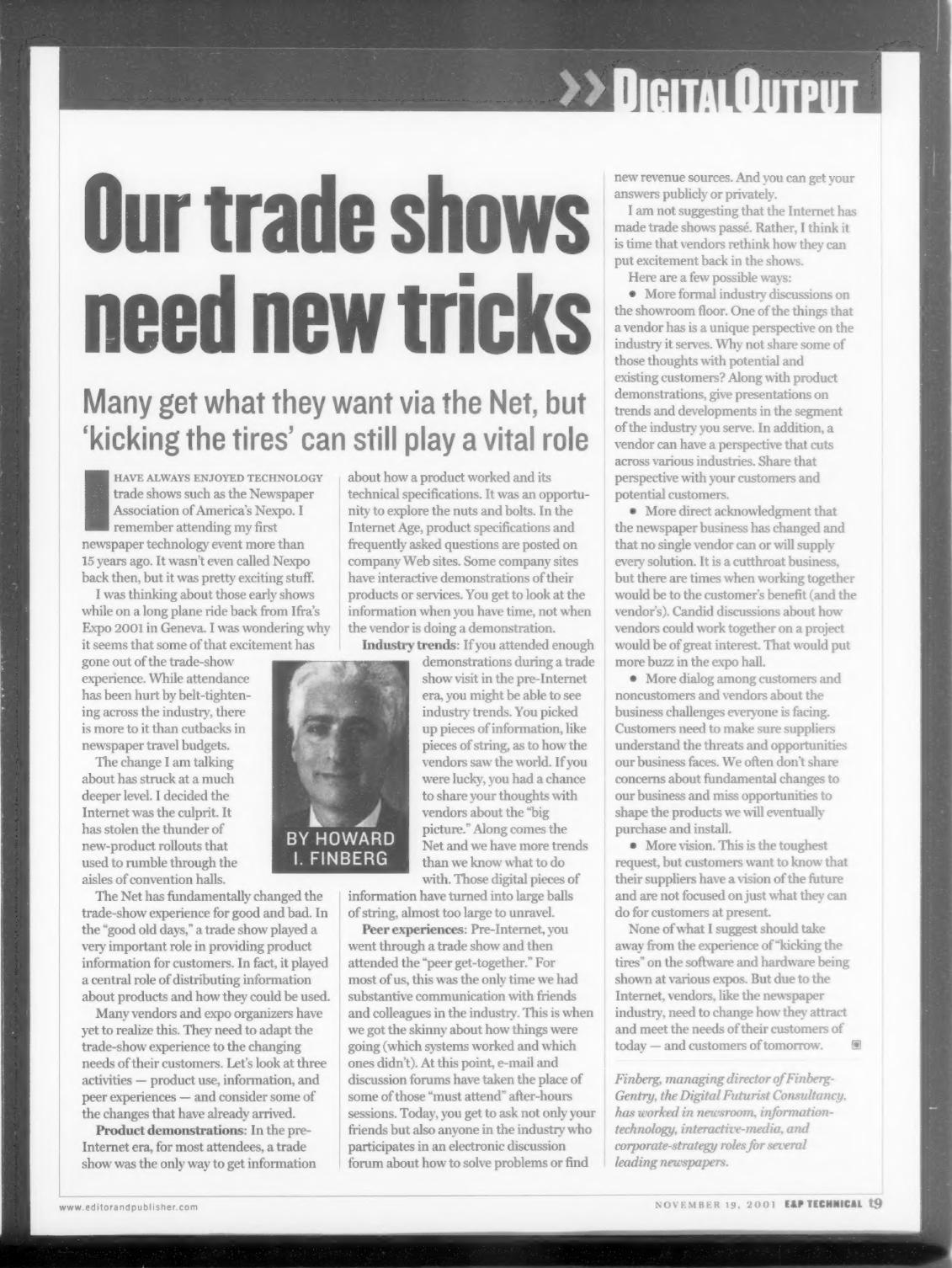
Editor & Publisher column page on newspaper technology trade shows, November 2001

Our Trade Shows Need New Tricks

A column I wrote for Editor & Publisher‘s technical section, published November 19, 2001, arguing that the Internet had drained some of the excitement out of newspaper technology trade shows such as the Newspaper Association of America‘s Nexpo and Ifra‘s Expo 2001 in Geneva.

The piece notes that while attendance had been hurt by industry belt-tightening, the deeper change was elsewhere:

I decided the Internet was the culprit. It has stolen the thunder of new-product rollouts that used to rumble through the aisles of convention halls.

The column looks at three activities — product demonstrations, industry trends, and peer experiences — and how each had already moved online. Product specifications and FAQs were posted on company Web sites, some with interactive demonstrations. Trend-spotting, once assembled from bits of vendor conversation, had become overwhelming:

Those digital pieces of information have turned into large balls of string, almost too large to unravel.

And e-mail and discussion forums had replaced some of the after-hours “peer get-together” sessions where attendees once got “the skinny” on which systems worked and which ones didn’t.

Rather than declaring trade shows finished, the column offers suggestions for vendors: more formal industry discussions on the showroom floor, more direct acknowledgment that no single vendor can supply every solution, more dialog with customers and noncustomers about shared business challenges, and more vision.

None of what I suggest should take away from the experience of “kicking the tires” on the software and hardware being shown at various expos.

The column ran with a note identifying me as managing director of Finbereg-Gentry, the Digital Futurist.

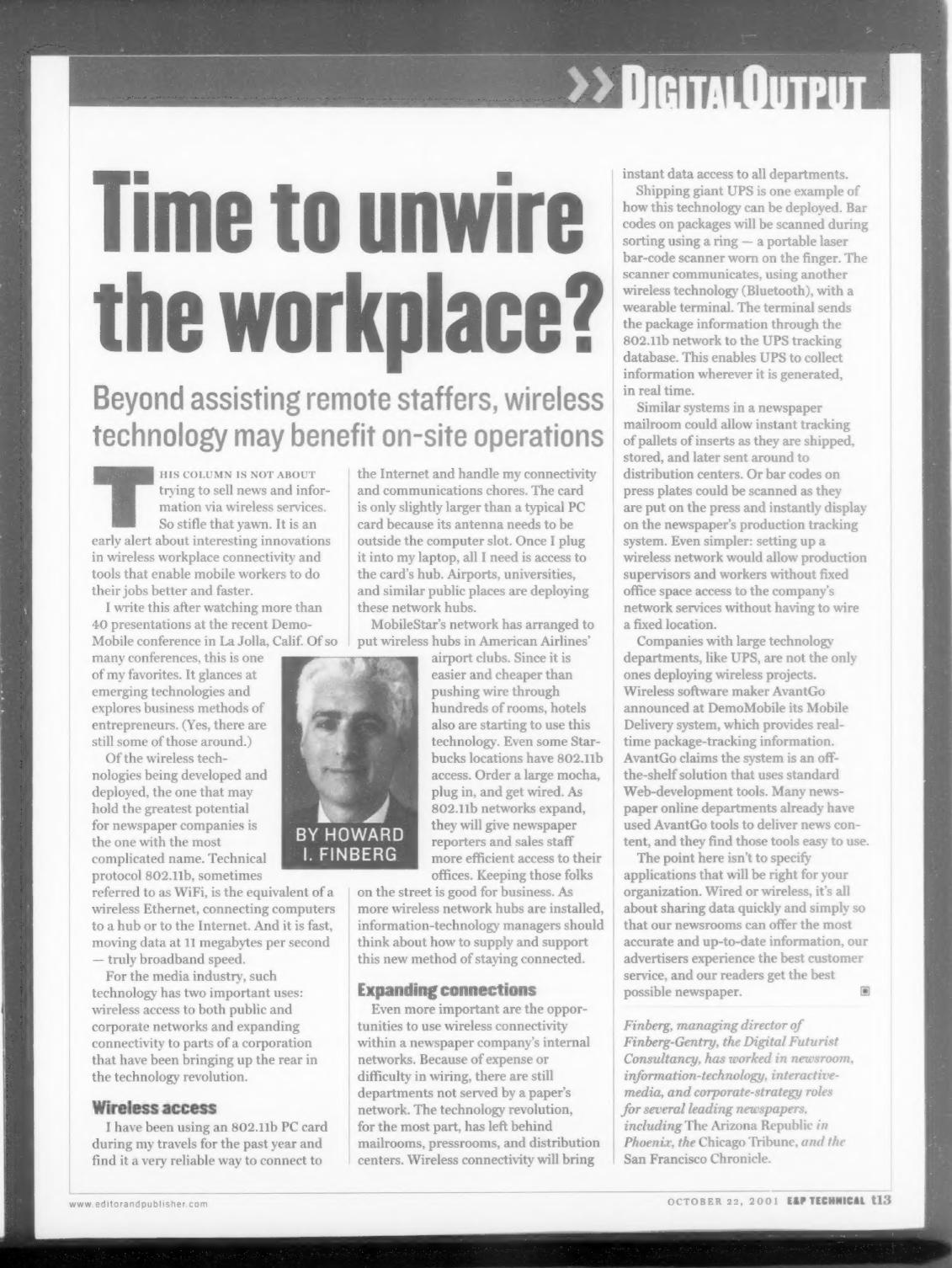
Editor & Publisher technical column from October 22, 2001 about 802.11b WiFi and wireless workplace connectivity

Time to Unwire the Workplace? A 2001 Column on WiFi

This is a column I wrote for Editor & Publisher, published October 22, 2001, in the magazine’s technical section. At the time I was managing director of Finberg-Gentry, the Digital Futurist Consultancy, and the column grew out of a few days spent watching more than 40 product demonstrations at the DemoMobile conference in La Jolla, Calif.

I opened by making clear what the column wasn’t about — selling news to tiny screens, which was the fashionable wireless topic of the moment.

THIS COLUMN IS NOT ABOUT trying to sell news and information via wireless services. So stifle that yawn. It is an early alert about interesting innovations in wireless workplace connectivity and tools that enable mobile workers to do their jobs better and faster.

The technology I singled out was 802.11b — already being called WiFi — which I described as the equivalent of a wireless Ethernet moving data at 11 megabytes per second. I had been carrying an 802.11b PC card on the road for a year, and noted that airports, universities, hotels and even some Starbucks locations were installing hubs. MobileStar had arranged to put hubs in American Airlines’ airport clubs. My advice to newspaper IT managers was to start thinking about how they would supply and support this new way of staying connected for reporters and sales staff.

The second half of the column was the part I cared more about: using wireless inside the building, in the departments that the wiring never reached.

The technology revolution, for the most part, has left behind mailrooms, pressrooms, and distribution centers. Wireless connectivity will bring instant data access to all departments.

I used UPS as the model — finger-worn bar-code scanners talking via Bluetooth to a wearable terminal, which fed the tracking database over an 802.11b network in real time. The newspaper equivalents were easy enough to imagine: tracking pallets of inserts as they moved to distribution centers, scanning bar codes on press plates as they went on the press, or simply giving production supervisors without fixed desks access to company network services. I also mentioned AvantGo, whose Mobile Delivery package-tracking system was announced at DemoMobile, and whose tools a number of newspaper online departments were already using for news content.

The closing point wasn’t really about wireless at all:

Wired or wireless, it’s all about sharing data quickly and simply.

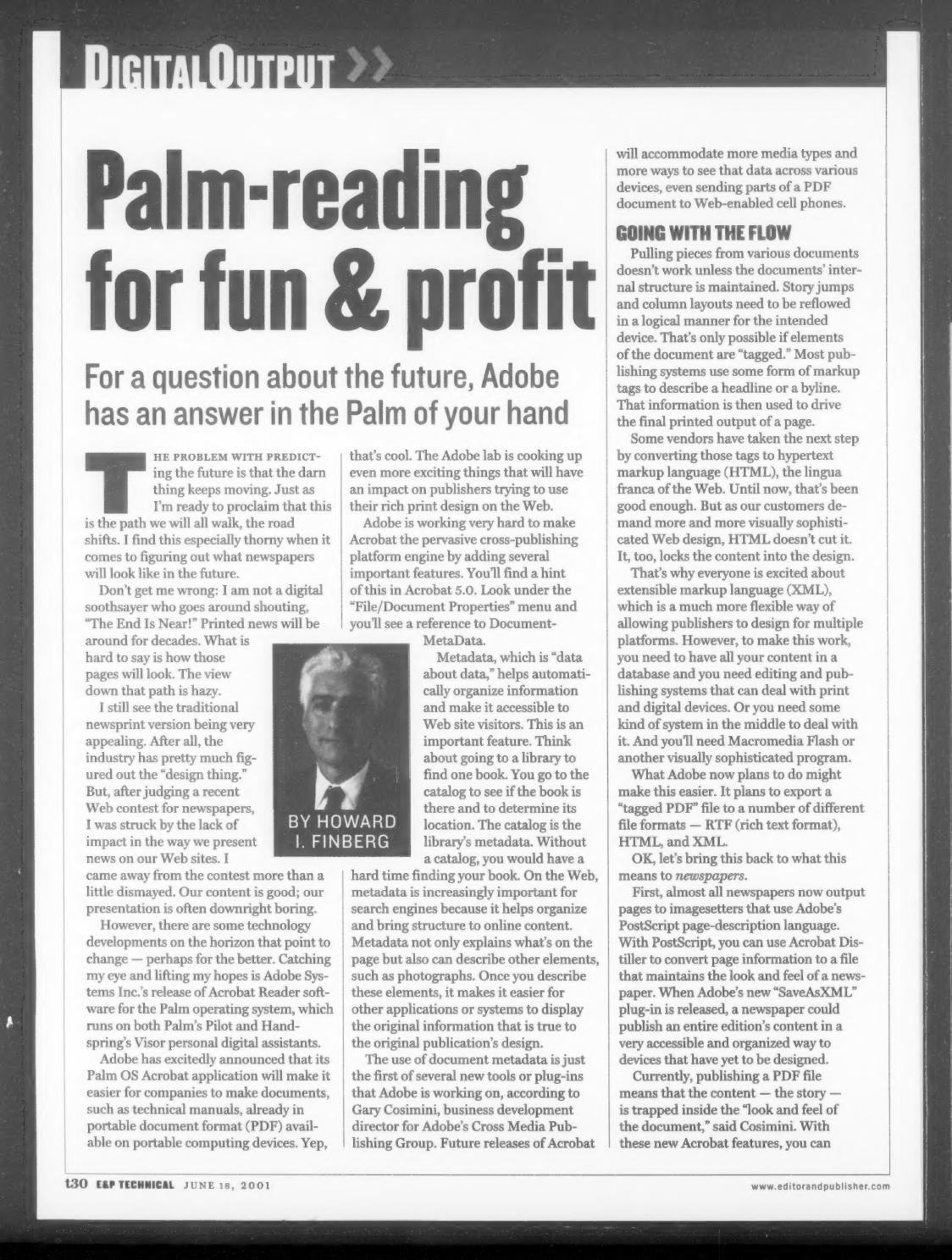
Two ways of looking at an Adobe Acrobat Reader PDF file: on a Palm handheld device and on paper

Palm-Reading for Fun & Profit

A column for Editor & Publisher‘s technical section, published June 15, 2001, under the headline “Palm-reading for fun & profit — For a question about the future, Adobe has an answer in the Palm of your hand.” The subject is Adobe Systems Inc.’s release of Acrobat Reader software for the Palm operating system, which ran on both Palm’s Pilot and Handspring’s Visor personal digital assistants, and what that development might mean for newspaper design across devices.

The problem with predicting the future is that the darn thing keeps moving. Just as I’m ready to proclaim that this is the path we will all walk, the road shifts.

The column argues that printed news will be around for decades, but that newspaper Web presentation was falling short. After judging a recent Web contest for newspapers, the verdict was blunt:

Our content is good; our presentation is often downright boring.

The technical discussion covers tagged documents, the limits of HTML — “It, too, locks the content into the design” — and the promise of extensible markup language (XML) for designing across multiple platforms. Gary Cosimini, business development director for Adobe’s Cross Media Publishing Group, is quoted on the state of PDF at the time, with the content “trapped inside the ‘look and feel of the document.'” The column describes Adobe’s plans to export a “tagged PDF” file to RTF, HTML and XML, and a forthcoming plug-in that would let a newspaper publish an entire edition’s content “to devices that have yet to be designed.”

Under the subhead “The Design Thing,” the column makes the case that publishing skill is itself a newspaper asset:

We know how to communicate by design. We organize and prioritize by design.

It closes by questioning whether the industry and its vendors were ready for a “handle-once” work flow publishing visually rich content across multiple devices, noting that competitors — CNET.com is the example — could run the process in reverse, converting XML- and HTML-formatted documents to PDF for print.

The road just shifted slightly, and there are warning signs ahead

The author’s note identifies Finberg as “a managing director of Finberg-Gentry, The Digital Futurist Consultancy,” with prior roles at The Arizona Republic in Phoenix, the Chicago Tribune, and the San Francisco Chronicle. An accompanying illustration showed “Two ways of looking at an Adobe PDF file: On a Palm device, on paper.”

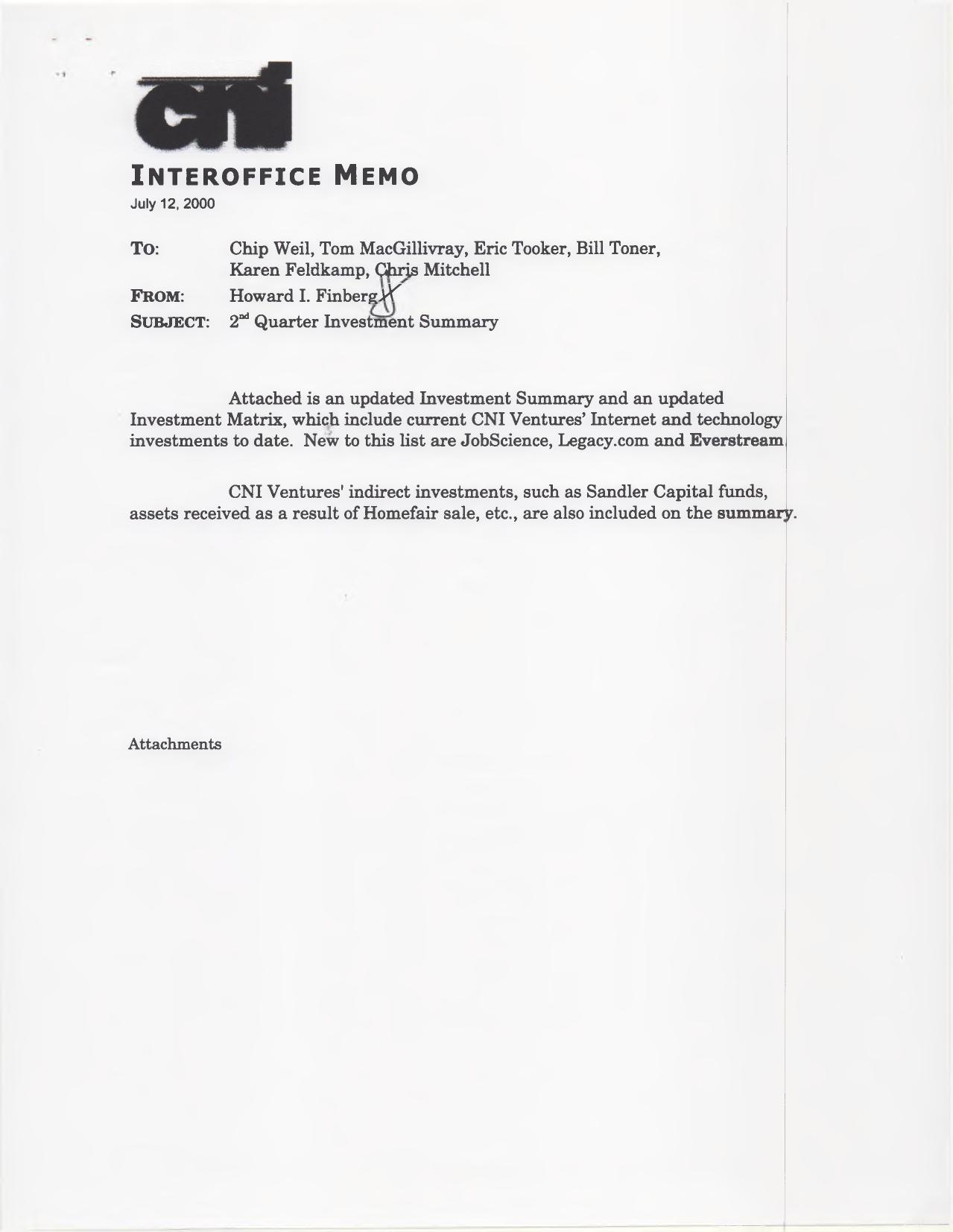
July 2000 CNI Ventures quarterly memo to Central Newspapers executives with attached investment summary and matrix

CNI Ventures: Investment Summary, 2000

As head of Central Newspapers‘ venture capital investments, I sent quarterly reports to the CEO and other senior executives. This one — dated July 12, 2000 — went to Chip Weil, Tom MacGillivray, Eric Tooker, Bill Toner, Karen Feldkamp and Chris Mitchell.

Attached is an updated Investment Summary and an updated Investment Matrix, which include current CNI Ventures’ Internet and technology investments to date. New to this list are JobScience, Legacy.com and Everstream

The memo also notes that indirect investments — the Sandler Capital funds, assets received as a result of the Homefair sale — are included in the summary.

The attachments are the interesting part. The Investment Update Summary lists the portfolio company by company: EntryPoint, WaveShift, Event 411, E-ink, BrightStreet, StreamSearch, GAMUT [SmartTV], JobScience, Everstream and Legacy.com, with $8,882,998 in invested capital against a current valuation of $9,119,411. Add the realized, partially realized and publicly traded holdings — Microsoft, Homestore and the Sandler funds — and total investments come to $25,613,452.

The Investment Matrix, which I created, is the most interesting document because it asked more than “what is it worth?” Each company was tracked against its target market, its relationship to CNI’s businesses, our working relations with the company, and which other media companies were in the deal — Knight Ridder, McClatchy, Tribune Ventures, Cox, Hearst, Gannett, the Washington Post. On E-Ink:

Development of an electronic newspaper and the business models to support product[s]

And the entry for EntryPoint, our oldest holding, is a reminder that not everything worked:

Dormant. PointCast technology; assets were purchased by an IdeaLab company

A $200,000 investment carried at $13,571.

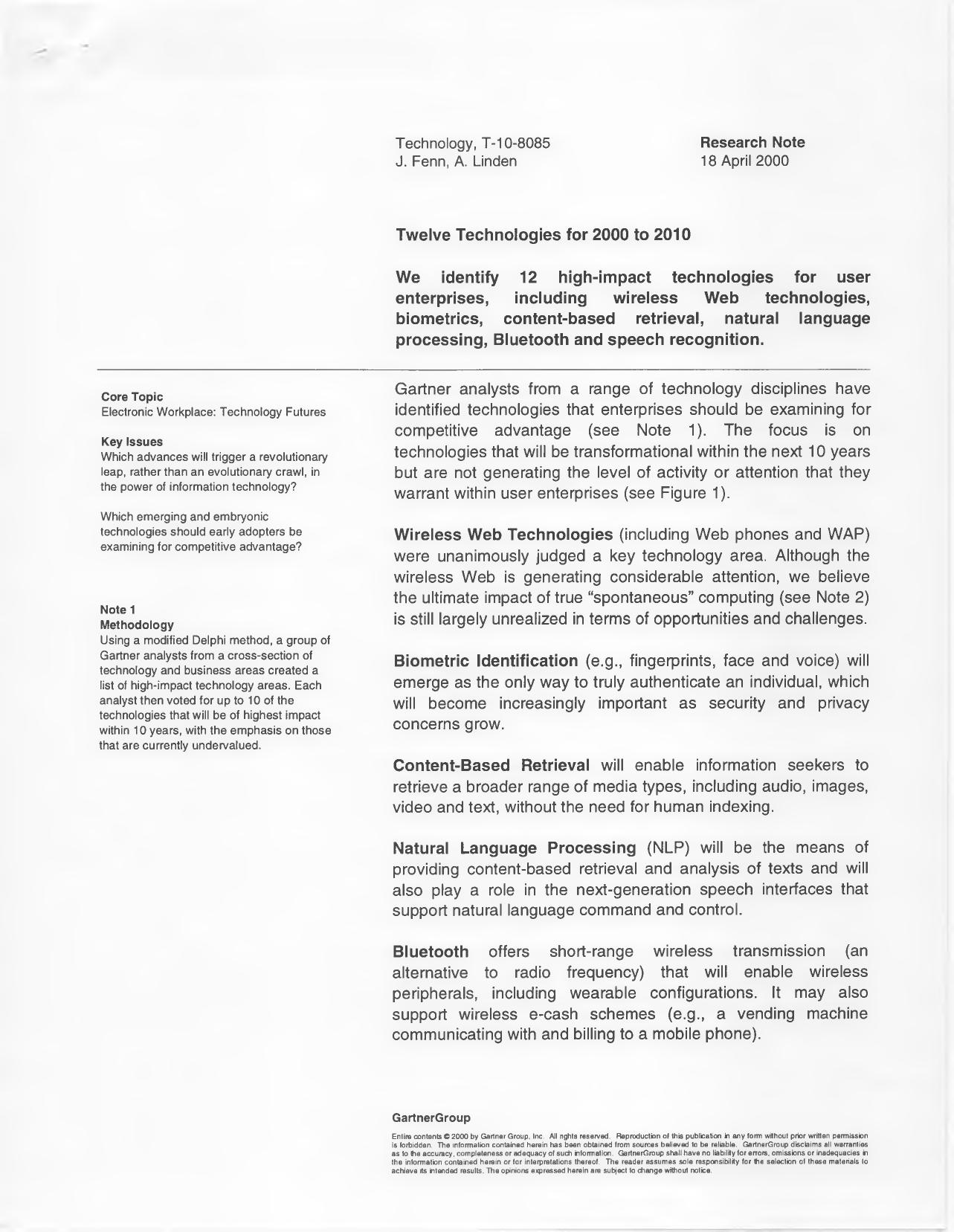
Gartner research note listing twelve high-impact technologies with a Technology Radar Screen adoption timeline

Gartner’s Twelve Technologies For 2000 To 2010

A Gartner research note (Technology, T-10-8085) by analysts J. Fenn and A. Linden, forecasting the technologies that would reshape enterprise computing over the coming decade. The note is short — two pages — but it is a useful snapshot of what the industry’s most-quoted research firm thought mattered as the century turned.

We identify 12 high-impact technologies for user enterprises, including wireless Web technologies, biometrics, content-based retrieval, natural language processing, Bluetooth and speech recognition.

The twelve, as listed: Wireless Web technologies (including Web phones and WAP), biometric identification, content-based retrieval, natural language processing, Bluetooth, speech recognition, Webtops, XML for content and data exchange, embedded miniature computers, pattern recognition, e-cash and display technologies.

The methodology was a modified Delphi process — a cross-section of Gartner analysts built a list of high-impact technology areas, then each voted for up to 10, with the emphasis on those judged currently undervalued. Wireless Web technologies were the only unanimous pick.

A “Technology Radar Screen” figure assigns each technology a year marking “the point at which the technology begins the steepest part of its adoption curve”: XML in 2001, wireless Web, Webtops, Bluetooth and NLP in 2002, pattern recognition and content-based retrieval in 2004, speech recognition and biometrics in 2005, e-cash in 2006, display technologies in 2007, and embedded miniature computers in 2008.

The most interesting passage is a sidebar defining what the analysts called spontaneous computing:

An era of spontaneous computing will begin around 2007, predicated on the availability of ubiquitous, reliable wireless connectivity that will provide any time, any place access to information and messaging through highly portable or wearable systems with speech interfaces.

And the consequence they drew from it:

Instead of being the center of attention, information processing will become a secondary activity achieved while the user is performing some other task (driving or sitting in a meeting), leading to true multitasking.

The note closes with the standard Gartner formulation:

Bottom Line: Technology and business planners should evaluate these technologies as part of their technology portfolios to determine the impact on future IT and business directions.

January 2000 Editor & Publisher clipping announcing that Central Newspapers created CNI Ventures for internet and technology investments

Central Newspapers Creates CNI Ventures

In January 2000, Editor & Publisher ran a short item announcing that Central Newspapers Inc. had created a new business unit to handle its investments in internet and technology companies. The story was only a few paragraphs, but it marked a real shift in how the company — publisher of The Arizona Republic and The Indianapolis Star — thought about where the future of news and information might be built.

Central Newspapers Inc. (CNI), publisher of The Arizona Republic and Indianapolis Star, has created a new business unit – CNI Ventures – to handle the company’s investments in the Internet and technology sectors. CNI Ventures will focus primarily on investments that develop delivery methods for news and information.

The distinction E&P drew was an important one inside the company. The existing newspaper websites were not going into the new unit; they stayed with the newspapers, where they belonged as part of the core business.

Central’s existing newspaper Web sites, such as Arizona Central and StarNews.com, will not become a part of the Ventures division, but remain a part of Central’s core business.

The investments that did move under the Ventures umbrella were a good snapshot of what looked promising at the turn of the century: BrightStreet, described as a provider of online promotions management solutions; E Ink, a developer of electronic display technology; Event411, a creator of online event-planning tools; and WaveShift, a creator of systems and software for new media. Incpad, the company’s high-tech job site — until recently called Westech Virtual Job Fair, as the item notes — stayed with the main internet activities alongside the newspaper sites.

E Ink is the one that still makes me smile. In 2000, electronic display technology was an article of faith, a bet on a future device that would carry news and information without paper. It took a while, but that one worked out.

And then the last paragraph, which is why this clipping is in my files:

Howard I. Finberg, director of technology and information strategies, has been given the added responsibility of vice president at CNI Ventures in order to coordinate the investment committee.

Coordinating the investment committee was a different kind of work than anything I’d done in a newsroom. The timing, of course, is part of the story — January 2000 was very near the top of the market for this sort of enthusiasm. The idea behind the fund was sound: newspaper companies needed to understand and have a stake in the technologies that would deliver news next. The trick, then as now, was picking correctly.

January 1997 memo to Arizona Republic editors on the multi-skilled journalist of the future

The Future: Journalist’s Skills

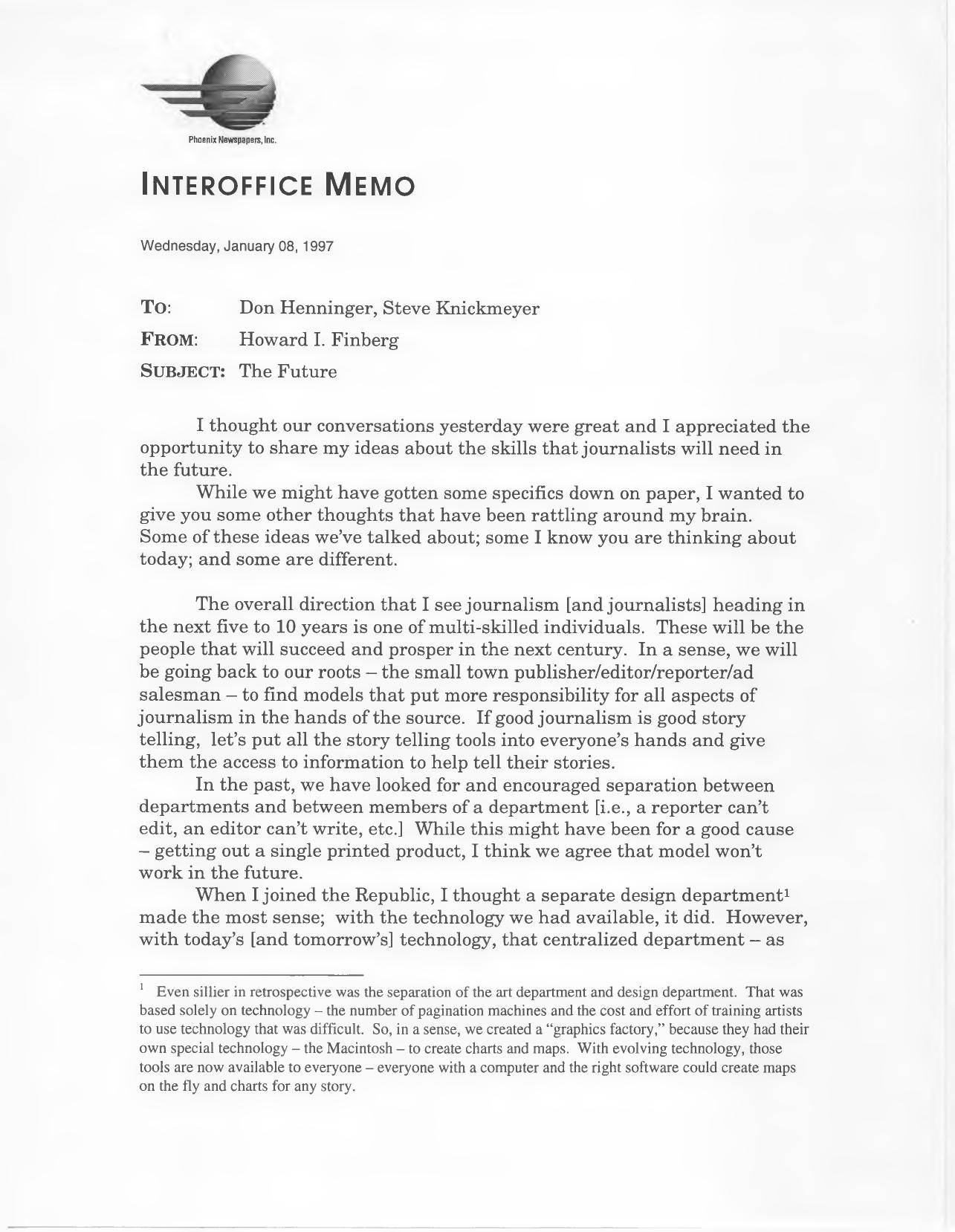
This is a January 1997 memo I wrote to Don Henninger and Steve Knickmeyer, two senior editors at The Arizona Republic and The Phoenix Gazette. It came out of a conversation we’d had the day before about the skills journalists were going to need, and it was very much part of my techno-evangelism at Phoenix Newspapers — trying to help editors prepare for changes coming to journalism and, potentially, to their newsrooms.

The core argument was that the future belonged to people who could do more than one thing:

The overall direction that I see journalism [and journalists] heading in the next five to 10 years is one of multi-skilled individuals. These will be the people that will succeed and prosper in the next century. In a sense, we will be going back to our roots — the small town publisher/editor/reporter/ad salesman — to find models that put more responsibility for all aspects of journalism in the hands of the source.

I used my own history at the newspaper as the example, which felt honest at the time and still does. Creating a separate design department had made sense when I arrived, given the technology we had. By 1997 it made a good deal less sense — and the split between the art department and the design department looked worse still.

So, in a sense, we created a “graphics factory,” because they had their own special technology — the Macintosh — to create charts and maps.

The point wasn’t that everyone should do everything. Specialized talent still mattered. What I expected to disappear were the divisions that existed only because of the equipment:

However, the artificial separation of skills based on technology will be eliminated [and much sooner than the five to 10-year time frame that I’m using].

From there the memo works through photography — why not put a digital camera in every reporter’s hands, since other delivery methods would consume far more visual material than the printed paper had room for — and then video and audio, and what editing skills would be needed to combine words, audio, stills and moving images.

The section I’m still fondest of is the one about the Web not being print and not being broadcast either.

On the Web, you tell stories in non-linear fashion. You need to tell those stories in such a way that the reader/consumer/user can understand the story regardless of where he entered the presentation. This is a different way of presenting news.

And the editing skill that follows from it, which I called “de-composing” linear stories into Web format.

Opening slide from a 1994 American Press Institute seminar presentation for journalism educators in Reno

Technology For Tomorrow’s Journalists — an API Seminar, 1994

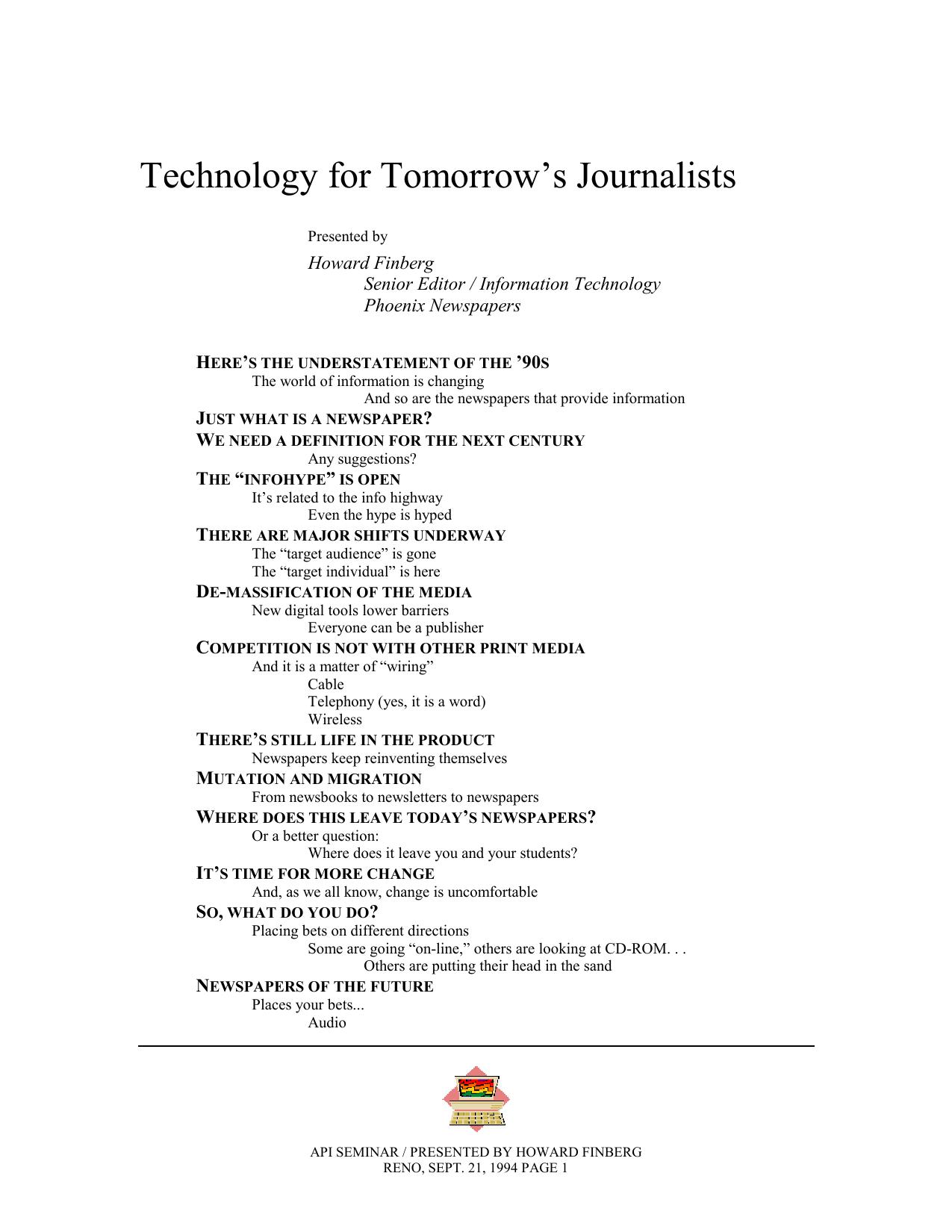
This is the slide outline from a presentation I gave at an American Press Institute seminar for journalism educators, in Reno, on September 21, 1994. At the time I was Senior Editor / Information Technology at Phoenix Newspapers, and the assignment was to talk to the people teaching the next generation of journalists about what was coming at them.

The opening slide set the tone with what I called the understatement of the decade:

The world of information is changing
And so are the newspapers that provide information

Then the harder question, which I put back to the room rather than answering it myself:

JUST WHAT IS A NEWSPAPER?
WE NEED A DEFINITION FOR THE NEXT CENTURY
Any suggestions?

Much of the middle of the presentation was a tour of the bets newspapers were placing in 1994 — audio services over the telephone, fax editions, CD-ROM, “electronic newspapers” delivered by e-mail to a portable computer, online services, and PDAs. I was blunt about the state of play: some publishers were going online, some were looking at CD-ROM, and “others are putting their head in the sand.” The framing throughout was gambling — place your bets, and then:

WILL ANY OF THESE BETS PAY OFF?
What happens if you lose?
What happens if you don’t play?

The numbers are a good reminder of how early this all was. My online services slide reported that 34% of homes had a personal computer and 13% had a modem, with a forecast that by 1997 the computer number would reach 40-50% but modems would only reach 20%. The named players were CompuServe, America Online, Prodigy and Delphi; the partnership examples were Mercury Center and Access Atlanta; the “future players” I listed were Microsoft, Ziff and Sony. And a slide on why modem penetration might not matter at all — because of “cable boxes that have a computer chips inside.”

Because the audience was educators, the second half turned to jobs and curriculum. I argued that reporters could no longer treat the process of getting the story onto the doorstep as somebody else’s problem, and that they would be gathering content for multiple products. Some of it was deliberately provocative:

Even “hot” jobs may disappear
Do we really need designers?

Coming from someone whose career had been built in newspaper design, that was meant to land. So was the slide on teaching:

HOW DO YOU TEACH THESE NEW SKILLS?
It won’t be from a textbook

My prescription was more connection — “Newsroom and classroom need to get closer / Classroom needs to get real.” Two decades later I was still working on exactly that problem, with News University at the Poynter Institute, trying to close the same gap with online training instead of slides.

The closing section was what I labeled my “vision thing”: that newspapers don’t just provide content, they provide context, and that dumping data isn’t journalism — “If you want data, try the phone book.” I also made the point that newspapers were already interactive:

Newspapers are already interactive
They push content
Readers push back

And the last two slides hold up best of all, in 1994 and in 2026:

Understand that “cutting edge” means “bleeding edge”
Look at workflow, not hardware

Followed by “TECHNO-EVANGELISM / Lead by example / Take an interest.” Substitute today’s technology of the moment for CD-ROM and PDAs and the advice doesn’t need much editing.

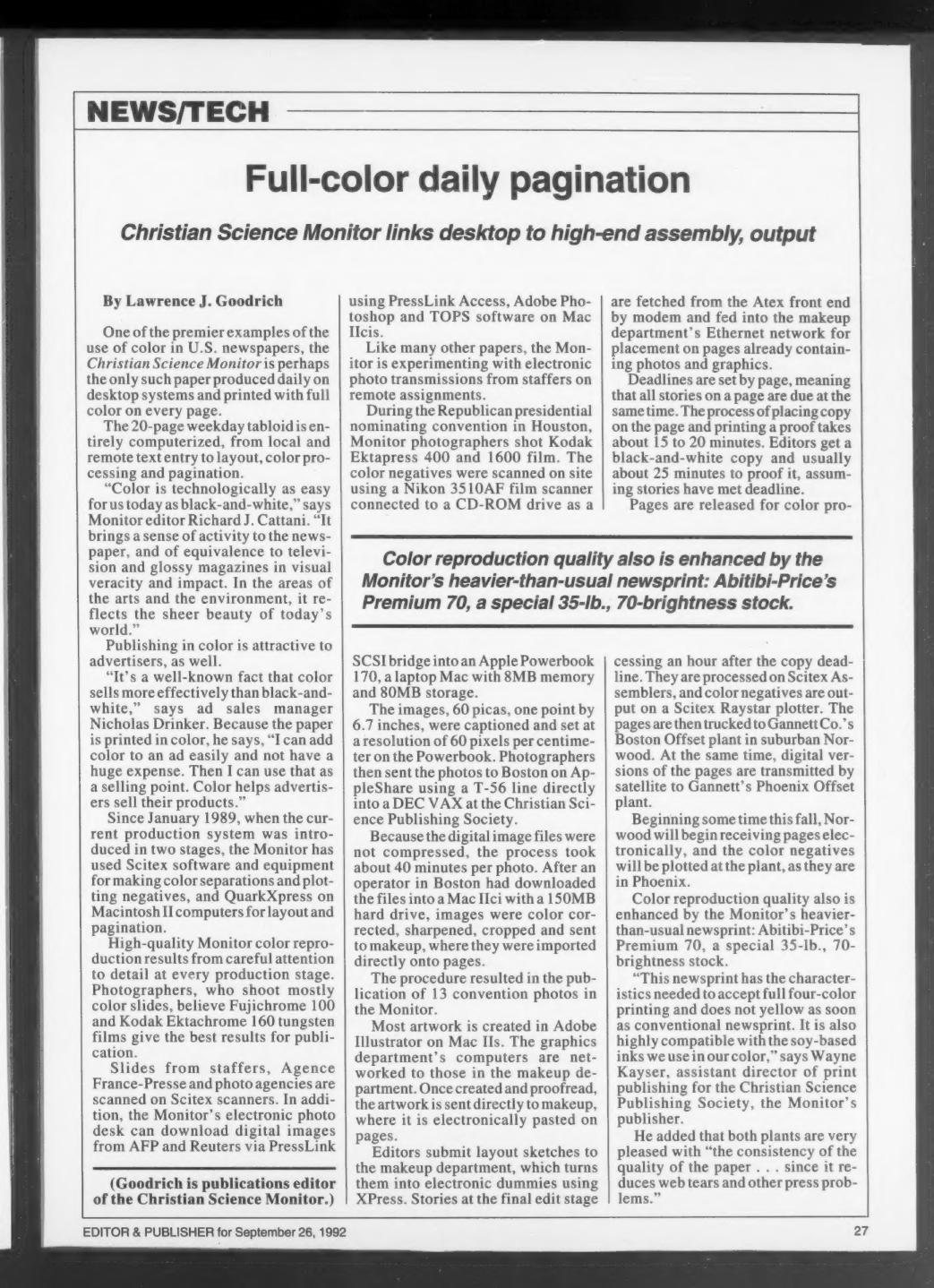
Editor & Publisher clipping from August 1992 covering an INMA conference panel on how to reinvent the newspaper for the next century

Advice for Next Century: An INMA Panel on the Future

An Editor & Publisher story by Ann Marie Kerwin, published August 8, 1992, reporting on a session at the International Newspaper Marketing Association conference in Dallas. The question on the table: how to reinvent the newspaper for survival in the next century’s media environment, at a moment when audiotex, videotex, databases and fax services were all competing for newspaper investment dollars.

The main speaker was Michael Schrage, a visiting scholar at the Center for Coordination Science at the Massachusetts Institute of Technology, who argued that newspapers and media should be in the community-building business rather than the information business.

“New media technology is a medium for relationships. New media affect how people communicate with each other, how people relate to each other. If you change the medium, you change the relationship. … New technology creates new relationships.”

Schrage said the Information Age never happened and isn’t going to happen, that the real value of a medium is not in the information it carries but in the community it creates, and that designing a newspaper for a faster read is the wrong goal — papers should invite readers to spend more time with them. He dismissed the fax newspaper as “a pure packaging job,” suggesting instead that fax be used for polling or for services like menus and maps tied to a restaurant review.

“Humans are information processors, but anybody who defines them that way would be better off programming a computer instead of editing or publishing a newspaper.”

The second half of the story covers the Gannett Company’s News 2000 project, then being implemented at all Gannett-owned papers, with community at the center of the effort. Betty Liddick, executive editor of the Stockton (Calif.) Record, described arriving in Stockton a year earlier:

“I was stunned by reader reaction. Many folks weren’t indifferent to the paper as many readers have become these days. They bitterly hated us. So much so, staffers said they often were reluctant to tell people outside the paper where they worked.”

Readers complained of too much negative news about their community and home, and didn’t want crime news to be the only thing the paper covered. At a meeting with readers and top editors, one man stood up and said, “Show us our heroes.”