Editor & Publisher clipping from August 1992 covering an INMA conference panel on how to reinvent the newspaper for the next century

Advice for Next Century: An INMA Panel on the Future

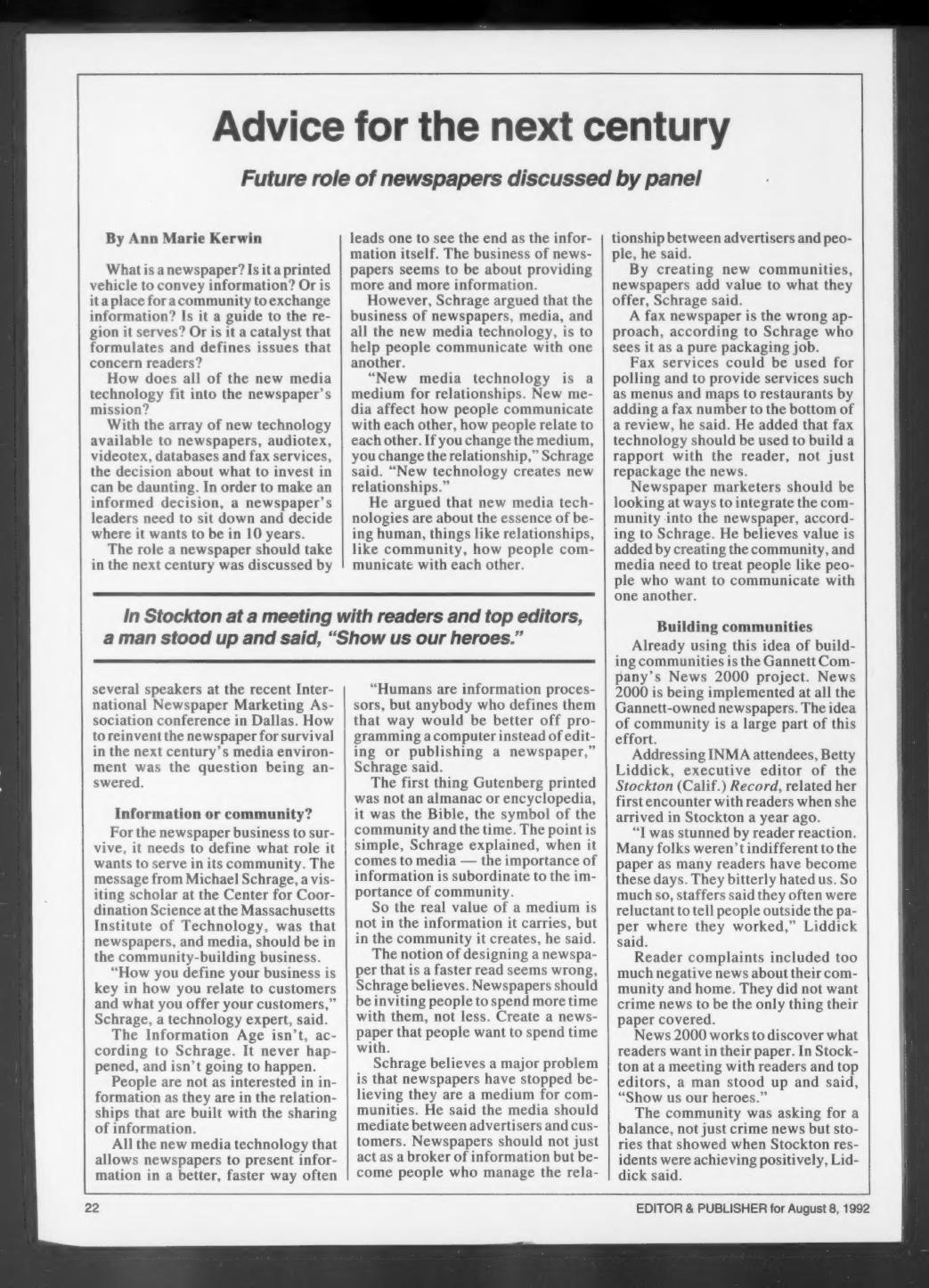
An Editor & Publisher story by Ann Marie Kerwin, published August 8, 1992, reporting on a session at the International Newspaper Marketing Association conference in Dallas. The question on the table: how to reinvent the newspaper for survival in the next century’s media environment, at a moment when audiotex, videotex, databases and fax services were all competing for newspaper investment dollars.

The main speaker was Michael Schrage, a visiting scholar at the Center for Coordination Science at the Massachusetts Institute of Technology, who argued that newspapers and media should be in the community-building business rather than the information business.

“New media technology is a medium for relationships. New media affect how people communicate with each other, how people relate to each other. If you change the medium, you change the relationship. … New technology creates new relationships.”

Schrage said the Information Age never happened and isn’t going to happen, that the real value of a medium is not in the information it carries but in the community it creates, and that designing a newspaper for a faster read is the wrong goal — papers should invite readers to spend more time with them. He dismissed the fax newspaper as “a pure packaging job,” suggesting instead that fax be used for polling or for services like menus and maps tied to a restaurant review.

“Humans are information processors, but anybody who defines them that way would be better off programming a computer instead of editing or publishing a newspaper.”

The second half of the story covers the Gannett Company’s News 2000 project, then being implemented at all Gannett-owned papers, with community at the center of the effort. Betty Liddick, executive editor of the Stockton (Calif.) Record, described arriving in Stockton a year earlier:

“I was stunned by reader reaction. Many folks weren’t indifferent to the paper as many readers have become these days. They bitterly hated us. So much so, staffers said they often were reluctant to tell people outside the paper where they worked.”

Readers complained of too much negative news about their community and home, and didn’t want crime news to be the only thing the paper covered. At a meeting with readers and top editors, one man stood up and said, “Show us our heroes.”
Editor & Publisher page from September 1988 headlined "Will artists become computer nerds?" on Macintosh use in newspaper art departments

Will Artists Become Computer Nerds? —E&P, 1988

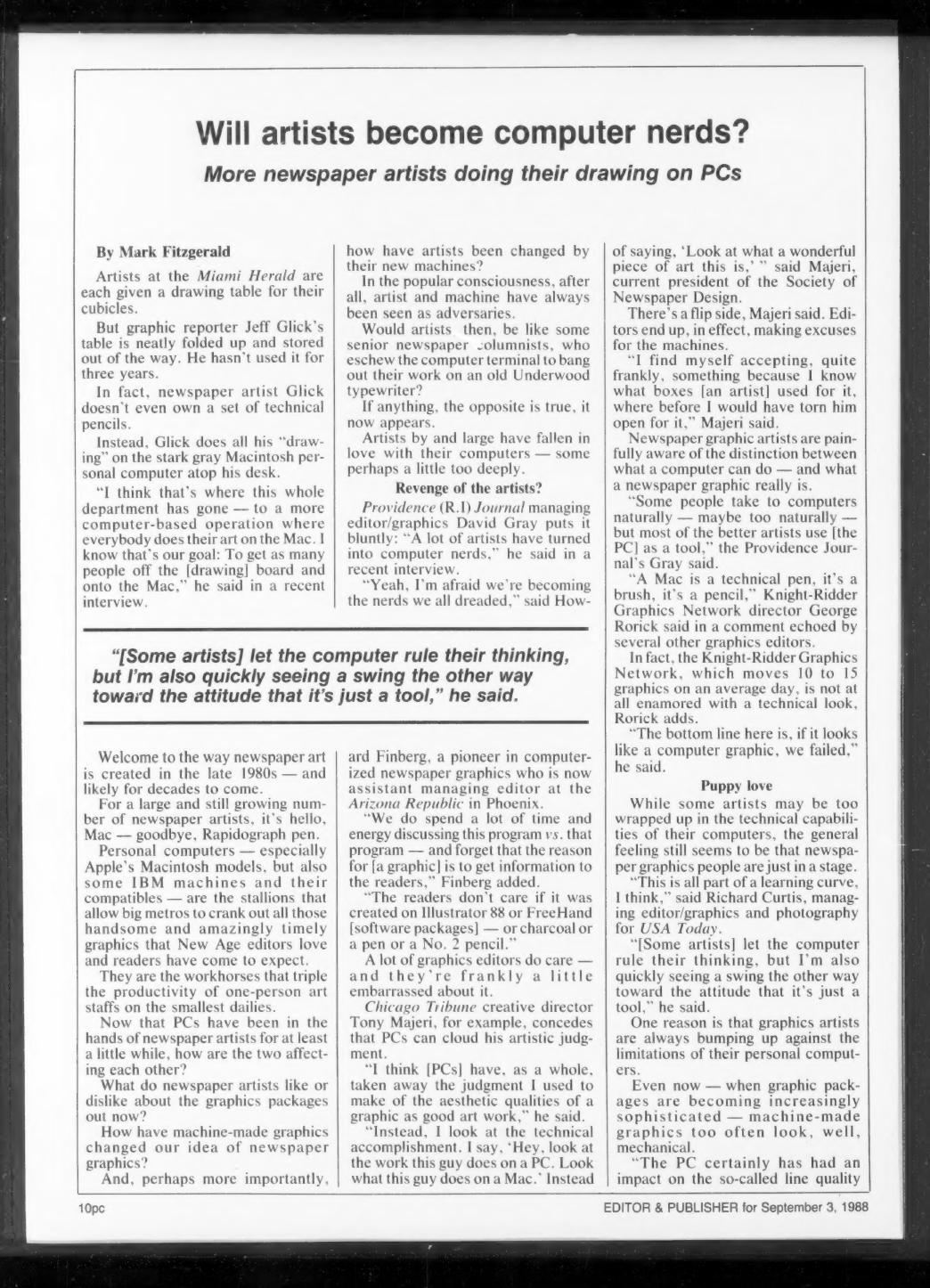
Two related stories by Mark Fitzgerald in the September 3, 1988, issue of Editor & Publisher survey what happened to newspaper art departments once the Macintosh arrived. The first piece, “Will artists become computer nerds?”, reports that artists had largely embraced the machines — Miami Herald graphic reporter Jeff Glick hadn’t used his drawing table in three years — and asks what the shift did to line quality, typography and editorial judgment. The second, “Graphics software,” catalogs the strengths and shortcomings of MacDraw, MacDraw II, Adobe Illustrator 88, Aldus FreeHand and Cricket Draw 1.1, and asks whether vendors were paying attention to the newspaper market at all.

I’m quoted throughout as assistant managing editor at the Arizona Republic in Phoenix, along with David Gray of the Providence Journal, Tony Majeri of the Chicago Tribune, George Rorick of the Knight-Ridder Graphics Network, Richard Curtis of USA Today, Marian Wachter of the Seattle Times and Ray Chattman of the Society of Newspaper Design.

“Yeah, I’m afraid we’re becoming the nerds we all dreaded,” said Howard Finberg, a pioneer in computerized newspaper graphics who is now assistant managing editor at the Arizona Republic in Phoenix.

“The readers don’t care if it was created on Illustrator 88 or FreeHand [software packages] — or charcoal or a pen or a No. 2 pencil.”

On the trade-offs of the technology:

“I think the Macintosh has been both a boon and a bane for information graphics,” said the Arizona Republic’s Finberg. … “The bane has been that the quality of typography and the quality of illustration has suffered.”

And on how the change arrived in newsrooms:

“This revolution in newsrooms in terms of using computer graphics is very interesting because it did not come from the bottom up — it came from the top down.”

The software story records a Society of Newspaper Design member survey taken at the previous fall’s convention: the Macintosh was used by 86.7% of respondents, IBM by 9.2%. It also quotes Rorick’s standard for the Knight-Ridder network — “The bottom line here is, if it looks like a computer graphic, we failed” — and my own less optimistic assessment of the tools then on the market.

“I’m not sure there is a perfect program out there. I don’t know if there ever will be a perfect graphics program,” said Howard Finberg, assistant managing editor at the Arizona Republic in Phoenix.