Scanned pages of The Digital Edge's December 2000 article "Just Learning to Walk," with the Digital Futurist Consultancy website from that year

Learning to Walk: 2000 Look Back at Five Years Online

In December 2000, The Digital Edge, the online publication of the Newspaper Association of America‘s New Media Federation, marked the fifth anniversary of newspapers on the Web by asking seven veterans of the industry’s digital efforts to reflect on what they’d learned. The article, “Just Learning to Walk,” was written by Rob Runett, NAA Manager of Electronic Media Analysis. I was one of the seven, described in the piece as:

Howard I. Finberg, former vice president of Central Newspapers‘ CNI Ventures and CNI’s director of technology and information strategies. (He’s now sharing his wisdom as director of Tempe, Ariz.-based Digital Futurist Consultancy).

The others were Lisa DeSisto of boston.com, Todd Engdahl of DenverPost.com, John Granatino of Belo Interactive, Chris Jennewein of KnightRidder.com, Joe Michaud of MaineToday.com and Chris Morrill of the Hartford Courant’s ctnow.com.

Runett’s framing was that five years is nothing in the life of a medium, but felt like several lifetimes to the people who lived it. The questions ranged from proudest moment to biggest regret, and the answers were candid in a way industry panels rarely are.

My toughest hurdle was not technology. It was classified advertising:

The hardest challenge or hurdle we faced was getting the classified department to understand that that the company needed to move quickly or we’ll lose in the online marketplace. This was early in the development of the site [azcentral.com] and all we really knew was that our readers/customers wanted classifieds. And they wanted them for free, something that went to the opposite of the teachings at classified managers school. We didn’t have a business model, just a business “gut feeling” in 1996.

On business models, I argued that it was far too early to declare winners — and that interactive media was something genuinely new, not simply print extended:

Heck, we aren’t even walking yet and you want us to declare a college major?

Interactive, a.k.a. online, media truly is a new form of communication; it is less of an extension of our existing businesses or business models. Hey, that doesn’t mean we can’t learn from our forefathers. Interactive media should share the best traits of its “parents” and then move out of the house quickly.

Asked what I would undo, I picked the pace of the Web build-out at azcentral — and the pull of an easier revenue stream:

I resisted the temptation and probably should have moved quicker to have the team build out more Web features and spent fewer resources on AOL. But AOL was sending us money every month.

The “most important lesson in two lines or less” question produced the best writing in the piece. Morrill: “The user comes first. The user comes first. The user comes first.” Engdahl: “This isn’t a sprint, it’s a marathon.” Jennewein reminded everyone that traffic, advertising and low costs are Business 101, “but many of us lost sight of this during the dot-com boom.” I failed to follow the rules:

The basics, however, still matter: Quality. Accuracy. Fairness. Fun. Service. To do less is to fail the customer. I have also learned that I probably could never sum up in “two lines or less.”

The same December issue carried a column by New Media Federation President Gordon Borrell, vice president/new media at Landmark Communications, titled “Recommit or Pull the Plug.” Borrell noted that the Arizona Republic had cut 28 new-media positions in November and that Tribune Interactive had terminated 24 online positions in October — and listed me among those on the conference speaking circuit who had found themselves jobless since early summer. He quoted me on how I read the shakeout:

During the next year, the strong will get stronger; the weak will struggle. Those companies that recognize that the Internet is a new medium and not an extension of existing print models will do the best… What dot-com and traditional media businesses need to do is roll up their sleeves and get to work. No one said it would be easy — that’s why they call it work.

Borrell closed his column by agreeing: the 1990s were the years of experimentation and innovation, and what lay ahead was the real work.

Scanned along with these pages is a snapshot of the Digital Futurist Consultancy site as it existed in December 2000 — the biography, the scouting reports from DRUPA and the Jupiter conference, the Arizona Republic “learning journey,” and the 2020 Southwest Republic prototype done for the American Press Institute. Also included is the NAA press release announcing that year’s Digital Edge Awards, which named me the New Media Federation’s New Media Pioneer for 2000.

Reading these predictions now is instructive. DeSisto’s five-year forecast for boston.com included being on Palms, on cell phones and streaming headlines to LCD screens on taxicab roofs — and, she added, the Red Sox winning the World Series. She was right about the Red Sox in 2004, and right about the phones, though not in the way anyone in 2000 expected. Jennewein predicted that newspapers would dominate the local Internet space “with the specter of competition from dot-com startups long dissipated.” That one didn’t age as well.

What holds up, I think, is the thing I kept insisting on: that this was a new medium, not an extension of print. Twenty-five years later, that argument is still being relitigated in newsrooms — and the industry is still, in some important ways, just learning to walk. For others, they have been stopped in their tracks.

Transcript pages from a 1999 American Press Institute seminar presenting newspaper design survey results

Is There a Disconnect Here Someplace?

This is a transcript section from an American Press Institute seminar held in October 1999, where I presented the results of a design and visuals survey I coordinated. It was a follow-up to the survey we did for the 1988 J. Montgomery Curtis seminar, Newspaper Design: 2000 and beyond, with a nod to the survey the Society of Newspaper Design did in 1992. We reused a lot of the same questions so we could see what had changed.

This just goes to show you that if you volunteer to do something, you get to do it again.

The numbers: 628 responses in 1988; a little over 1,200 in 1999, about 200 of those from a Web site we built for the project. Sixty percent came from designers, 40 percent from editors. Ninety percent worked at dailies, and about 45 percent at papers over 100,000 circulation. One notable difference from 1988 — we didn’t ask about color or the use of computers. By 1999 those were givens.

We organized the discussion around five areas: the importance of design, the importance of visual elements, people, the relationship between online and print (new that year), and where all of this material was going to fit in the future.

As for the importance of design, the survey showed that it remains strong in the opinion of both editors and designers. And as for visuals, we’re also optimistic. And that’s the good news. The bad news is there appears to be a big disconnect between editors and designers in how they view the world.

Some of that disconnect showed up in the self-scoring. Asked to rate the quality of newspaper design across the industry on a 1-to-10 scale, 13 percent gave the industry an 8 to 10 and 71 percent put it in the 5-to-7 range. Asked about their own newspapers, more than half rated themselves 8 to 10. As I said at the time: the industry sucks, but we’re doing okay at our own newspaper.

Warren Watson of API‘s staff took the results to some 50 publishers, editors, designers and educators for reaction, and it wasn’t flattering. Terry Quinn of Thomson Newspapers called the 1980s an infatuation period with design. Darrell Moen said design had simply become institutionalized — not special anymore. Around the table, Mr. Sutton put a sharper point on it:

I do think most editors see design simply as layout, and I believe there is a design backlash, because some visual journalists have too much of a “make it pretty” mentality.

The section on informational graphics was the one that stung. As a former graphics editor who toiled in that vineyard when we had nothing but rocks and stumps, I wondered aloud whether informational graphics had just been a fad. Others weren’t ready to concede that. Marty Petty argued that graphics still engage readers and that the failure was in execution — chasing the big, sexy stuff instead of the basic maps and charts that inform. Mr. Curtis tied it to incentives:

Today, editors don’t value them highly anymore because they aren’t rewarded for them, and if you aren’t rewarded, you don’t do it.

On people — which I said then, and still believe, is the greatest challenge — 80 percent of respondents found hiring qualified visual journalists either very difficult or about as hard as it had always been, and the survey said it was getting worse. Asked where they’d put additional staff money, respondents put reporting first at 53 percent, design at 37 percent, online at 30 percent, graphics at 28 percent, photography at 27 percent and illustration at 13 percent. Roger Fidler noted that at Kent State most of the better students were looking at the Web and electronic publishing, and saw newspapers as passé.

The online results astounded me. Only 10 percent thought it highly important that a newspaper’s Web site look like the printed newspaper; 50 percent said it wasn’t important at all. So much for brand. And on leveraging print journalists online, the responses split roughly in thirds — including a third who thought it wasn’t very important at all.

Then there was space. Sixty percent said they had more room for visual packages than five years earlier, and looking ahead, everybody expected still more — this with the 50-inch web coming at the industry.

Everybody thinks they’re going to have more space in the future…what planet were these people on when they answered this question.

Two quotes from the session have stayed with me. Juan Antonio Giner, relayed by Warren: “newspaper design is dead; news design is alive.” And Mr. Lockwood, closing the argument with the Bauhaus:

Laszlo Maholy-Nagy said years and years ago from the Bauhaus that design isn’t a profession; it is an attitude. It is an attitude about information.

I ended on a deliberately hopeful note, pointing out that in Blade Runner — one of the darker visions of the late 20th century — our hero waits for his dinner while reading a printed newspaper. Reading this back now, well past the 2020 horizon we were asked to imagine, the survey’s optimism about space looks even more misplaced, and the disconnect between editors and designers turned out to be the least of the industry’s problems. But the argument about whether visual work is content or decoration never really got settled. It just moved to a different screen.

Editor & Publisher Interactive column from January 1998 about New Century Network layoffs and PAFET cutbacks

About New Century Network and PAFET Cutbacks

This is a Steve Outing column written for Editor & Publisher Interactive and posted January 12, 1998. The news hook was two pieces of bad news arriving at about the same time: New Century Network had laid off 10% of its staff and refocused its work away from anything that might compete with its owners’ own Web sites, and PAFET — Partners Affiliated For Exploring Technology — had closed its two-person central office in Dallas at the end of 1997. Outing used both to ask a question that hung over the industry for years:

Can newspapers really work together in cyberspace?

PAFET was a six-company research and development venture — A.H. Belo Corp., Central Newspapers, Cowles Media Co., Freedom Communications, McClatchy Newspapers, and Pulitzer Publishing Co. Executive director Marla McDonald and her assistant were let go on December 31, but, as Chris Hendricks of Nando.net told Outing, the governing committees would keep meeting as before. I was on the operating committee, and I’m quoted throughout the piece downplaying the closing — the organization had looked at what it wanted to accomplish and decided it didn’t need the Dallas operation, and the decision wasn’t a budget decision. With McDonald gone, Outing noted PAFET didn’t really have a “point person,” and I suggested that informal title probably belonged to Joel Kramer, publisher of the Star Tribune in Minneapolis and chairman of the PAFET management committee.

The column is a good description of how PAFET actually worked: strategic investment recommendations that each company acted on individually — Zip2, PointCast, Firefly and Infoseek — and joint projects like the WorkAvenue classified employment site, conceived together but implemented company by company. The thing I was most pleased about, then and now, was the cooperation itself:

“We have learned how to cooperate, and that’s pretty exciting,” Finberg says. “From my perspective, we have to learn how to cooperate with each other. The days of dealing with a newspaper 1,500 miles away as competition are over.”

Outing also collected outside views. Randy Bennett of the Newspaper Association of America called the two stories “apples and oranges” — PAFET was about research shared among members, NCN was trying to build Internet services itself. Eric Meyer of the University of Illinois and Newslink Associates was blunter about the underlying problem of consortia with multiple masters, and about publishers’ attachment to their own brands:

“I don’t think The Associated Press would have been developed with the attitudes of publishers today,” he says.

There’s a personal footnote at the end of the column, in Outing’s “Movin’ On” item: as of January 1 I had become Central Newspapers‘ director of technology and information strategies, a corporate job I held while staying in Phoenix rather than moving to Indianapolis. David Allen, then information technology director at Indianapolis Newspapers, Inc., took over as director of information technology at The Arizona Republic beginning February 2.

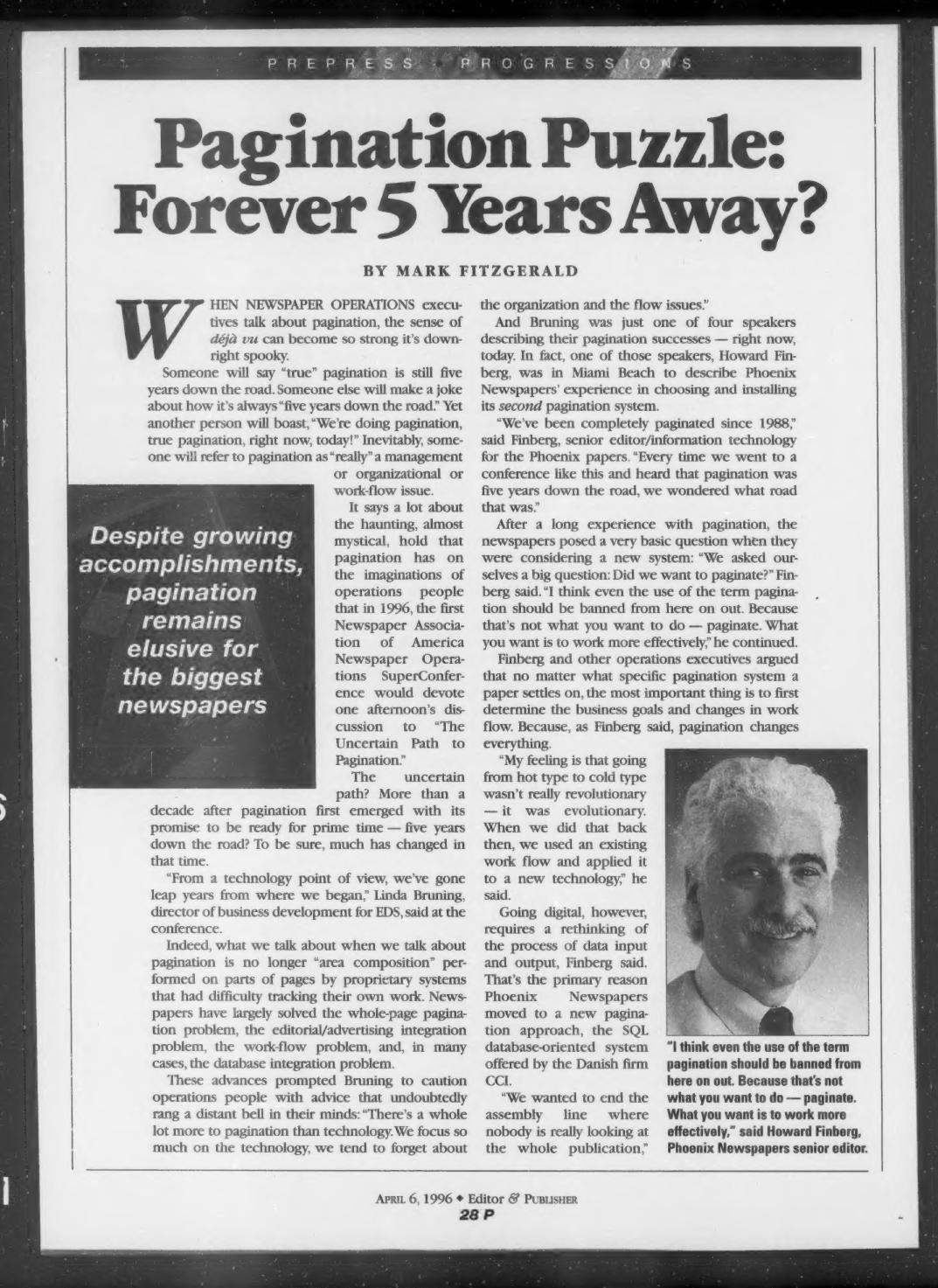
April 1996 Editor & Publisher article about the uncertain path to a newspaper pagination system, with a callout quote from the panel

Pagination: Forever Five Years Away?

This is a story by Mark Fitzgerald in Editor & Publisher, published April 6, 1996, about a session called “The Uncertain Path to Pagination” at the first Newspaper Association of America Newspaper Operations SuperConference. I was one of four speakers, in Miami Beach to talk about Phoenix Newspapers’ experience choosing and installing its second pagination system.

Fitzgerald’s framing was the running industry joke that real pagination was always just over the horizon:

Someone will say “true” pagination is still five years down the road. Someone else will make a joke about how it’s always “five years down the road.”

My contribution was to point out that some of us had already made the trip:

“We’ve been completely paginated since 1988,” said Finberg, senior editor/information technology for the Phoenix papers. “Every time we went to a conference like this and heard that pagination was five years down the road, we wondered what road that was.”

The larger point I was trying to make — and the one that got pulled out as the article’s callout quote — was that the word itself had become the problem.

“I think even the use of the term pagination should be banned from here on out. Because that’s not what you want to do — paginate. What you want is to work more effectively.”

The story records my argument that going from hot type to cold type had been evolutionary, not revolutionary, because we simply applied an existing work flow to a new technology. Going digital required rethinking data input and output — which is why Phoenix Newspapers moved to the SQL database-oriented system from the Danish firm CCI. The goal, as I put it in the piece, was “multiple products from the same information,” using the same database for niche publications and Internet publishing. And there was a virtue in the long installation: it forced you to look at work-flow issues first.

“We wanted to end the assembly line where nobody is really looking at the whole publication.”

The other speakers filled out the picture. Linda Bruning of EDS warned that “There’s a whole lot more to pagination than technology.” Mark Francis, president and publisher of the 27,000-circulation Niagara Gazette, described giving every department an equal vote in picking a system, and said his paper was already 100% paginated with all pages going direct to negative film — while still printing on a Goss Mark I letterpress bought in 1949. Mike Schoepke of Paddock Publications described the Daily Herald‘s deliberate, one-element-at-a-time rollout of DewarView.

The skeptics came from the biggest papers. Paul Lynch of the Chicago Tribune said there were still functionality issues. Tom Cusack, prepress director at the Star-Ledger, put his finger on something that would sound familiar to anyone who has ever moved large files around a building:

“The single largest barrier to paginating medium to large circulation papers is the network and communications issues internally.”

Fitzgerald ended the piece the way the industry always ended these conversations — noting that things might change. Down the road, of course.

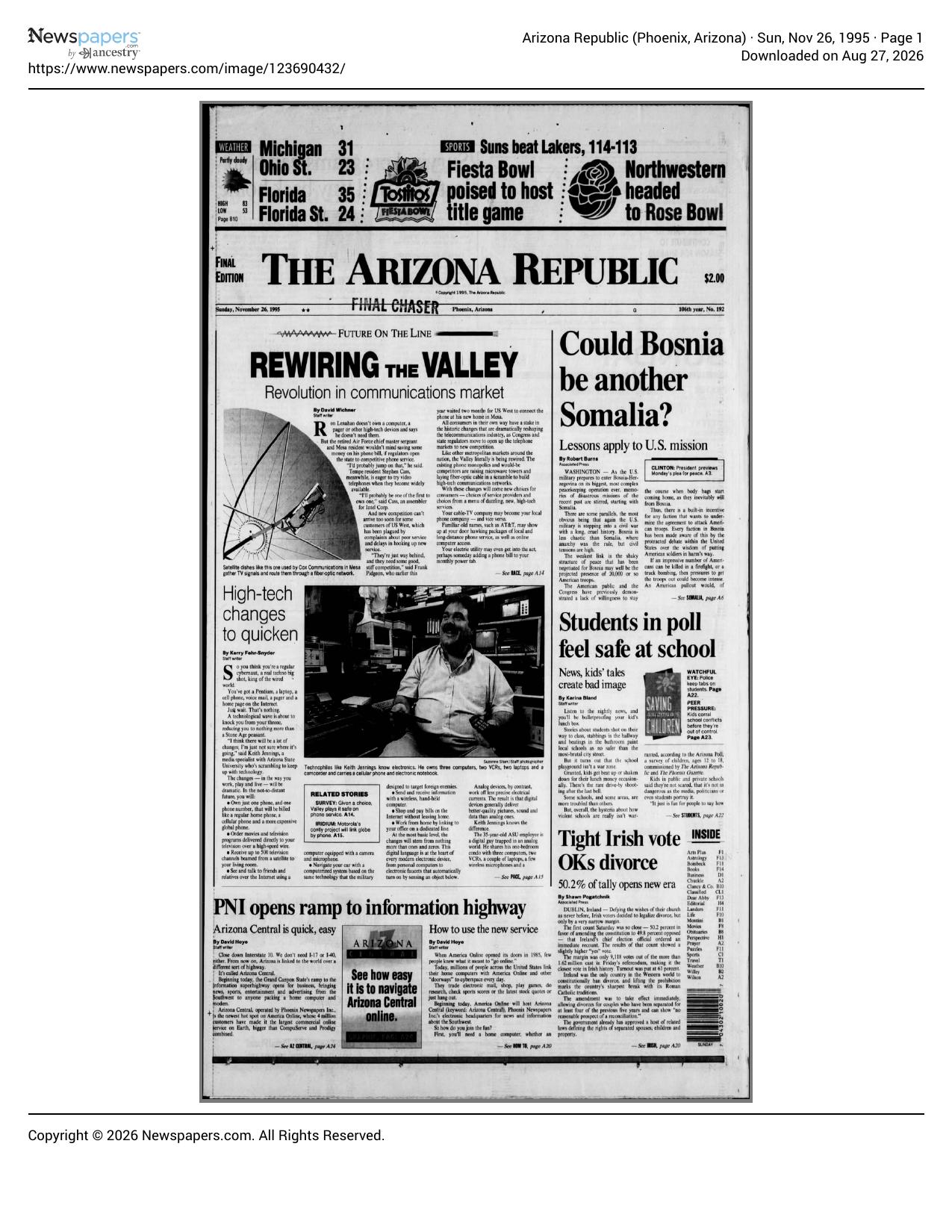
The Arizona Republic front page from November 26, 1995, announcing the Arizona Central online service on America Online and the Web

Arizona Central Opens for Online Business

On Sunday, November 26, 1995, The Arizona Republic told its readers that Phoenix Newspapers Inc. had gone online. The story, by staff writer David Hoye, ran on page one under the headline “PNI opens ramp to information highway,” with a full page inside devoted to explaining what Arizona Central was and how to get to it.

There were two front doors. One was on America Online — at the time, by the paper’s own description, the largest commercial online service on Earth, with 4 million customers, “bigger than CompuServe and Prodigy combined.” The other was on the World Wide Web.

On America Online, type keyword: arizona central

On the Web, http://www.azcentral

The AOL service opened with a set of buttons that would look familiar to anyone who has built a home page since: News/Money, Sports, Destinations, Your Life, At Ease, Sound Off, ALT. and What’s Hot. Sound Off held the columnists, editorials, letters and Steve Benson‘s editorial cartoons. ALT. was aimed at young adults and carried stories written by local students. Elsewhere there were Penelope Corcoran’s restaurant reviews under Taste the Town, interactive TV grids customized to your cable company, a searchable golf-course database, the Pick the Pros contest, a GiftLine for holiday shopping, and a survey button asking readers what they wanted from an online service.

The ambition was larger than shoveling the newspapers onto a screen. As the story put it, Phoenix Newspapers planned “to create nothing less than an online community, where users can learn, communicate, buy and sell and have fun.” The Oasis, Arizona Central’s chat room, was already doing that work — Charles Barkley had spent more than an hour there the week before, taking questions about the 1995-96 Suns season.

John Oppedahl, executive editor of the newspapers, framed it this way:

“Our new effort online is a significant move forward for Phoenix Newspapers Inc.,” said John Oppedahl, executive editor of the newspapers. “I look at this as the beginning of a new era.”

I was quoted as well, in my role at the time:

“It’s instant journalism,” said Howard Finberg, Phoenix Newspapers’ senior editor of information technology. “It’s pretty exciting.”

Worth noting where the launch story sat on that Sunday front page. It shared A1 with a package called “FUTURE ON THE LINE: REWIRING THE VALLEY” — about Congress and state regulators opening the telephone market to competition, cable companies becoming phone companies, and the promise of 500 television channels and video calls over the Internet. The newspaper was covering the coming of the network and joining it on the same day.

The story also made the case to advertisers, with a comparison that has aged into a period piece: online was “the most important new communications medium since Johann Gutenberg‘s experiments with movable type more than 500 years ago.”

Arizona Republic front page from November 26, 1995 announcing Arizona Central, Phoenix Newspapers' new online service on America Online and the Web

Arizona Central Opens for Online Business

On Sunday, November 26, 1995, The Arizona Republic told its readers that Phoenix Newspapers Inc. had gone online. The story, by staff writer David Hoye, ran on page one under the headline “PNI opens ramp to information highway,” with a full page inside devoted to explaining what Arizona Central was and how to get to it.

There were two front doors. One was on America Online — at the time, by the paper’s own description, the largest commercial online service on Earth, with 4 million customers, “bigger than CompuServe and Prodigy combined.” The other was on the World Wide Web.

On America Online, type keyword: arizona central

On the Web, http://www.azcentral.com/

The AOL service opened with a set of buttons that would look familiar to anyone who has built a home page since: News/Money, Sports, Destinations, Your Life, At Ease, Sound Off, ALT. and What’s Hot. Sound Off held the columnists, editorials, letters and Steve Benson‘s editorial cartoons. ALT. was aimed at young adults and carried stories written by local students. Elsewhere there were Penelope Corcoran’s restaurant reviews under Taste the Town, interactive TV grids customized to your cable company, a searchable golf-course database, the Pick the Pros contest, a GiftLine for holiday shopping, and a survey button asking readers what they wanted from an online service.

The ambition was larger than shoveling the newspapers onto a screen. As the story put it, Phoenix Newspapers planned “to create nothing less than an online community, where users can learn, communicate, buy and sell and have fun.” The Oasis, Arizona Central’s chat room, was already doing that work — Charles Barkley had spent more than an hour there the week before, taking questions about the 1995-96 Suns season.

John Oppedahl, executive editor of the newspapers, framed it this way:

“Our new effort online is a significant move forward for Phoenix Newspapers Inc.,” said John Oppedahl, executive editor of the newspapers. “I look at this as the beginning of a new era.”

I was quoted as well, in my role at the time:

“It’s instant journalism,” said Howard Finberg, Phoenix Newspapers’ senior editor of information technology. “It’s pretty exciting.”

Worth noting where the launch story sat on that Sunday front page. It shared A1 with a package called “FUTURE ON THE LINE: REWIRING THE VALLEY” — about Congress and state regulators opening the telephone market to competition, cable companies becoming phone companies, and the promise of 500 television channels and video calls over the Internet. The newspaper was covering the coming of the network and joining it on the same day.

The story also made the case to advertisers, with a comparison that has aged into a period piece: online was “the most important new communications medium since Johann Gutenberg‘s experiments with movable type more than 500 years ago.”

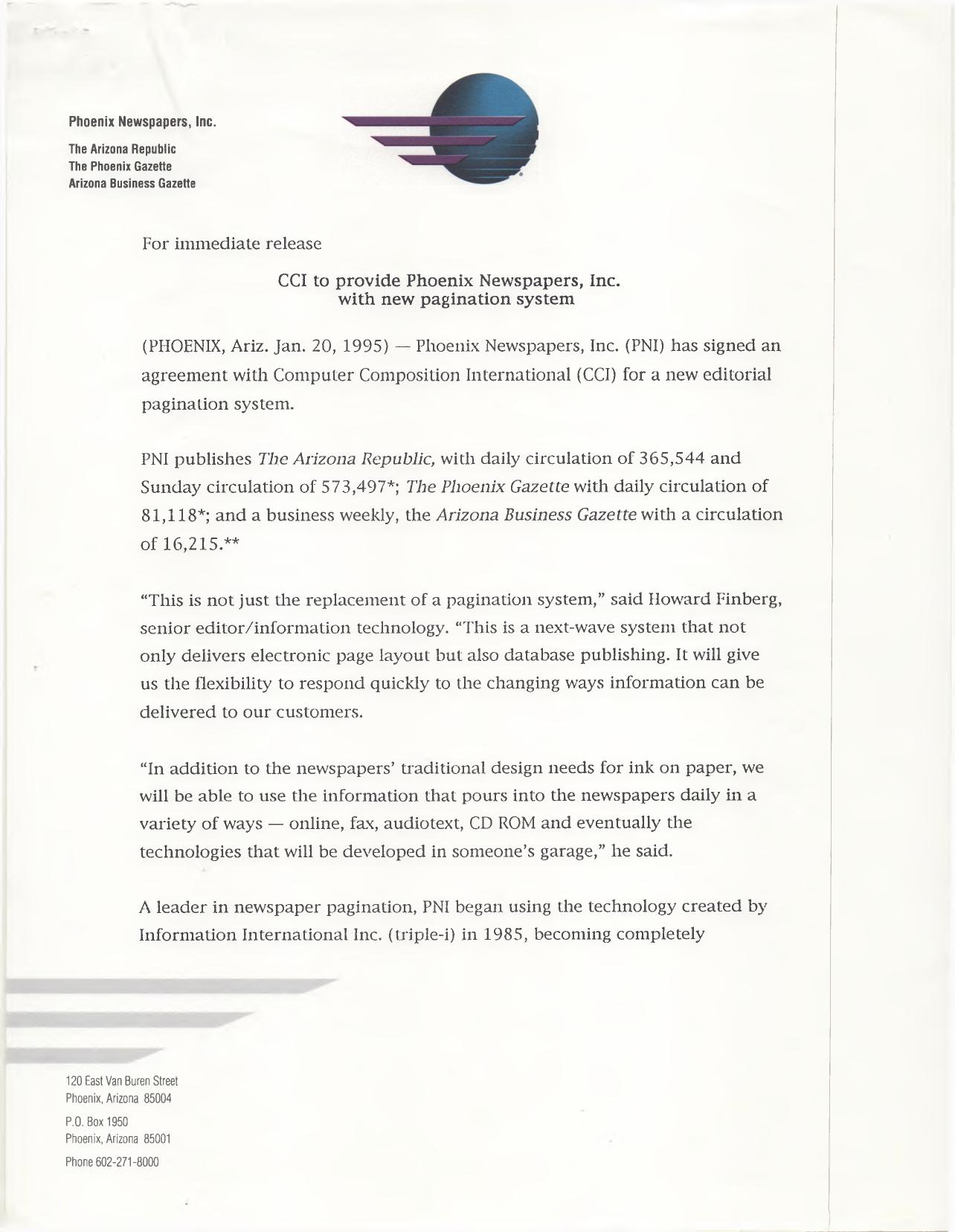
Phoenix Newspapers press release dated January 20, 1995, announcing the CCI pagination system contract

Announcing the CCI Pagination at Phoenix Newspapers

This is the press release Phoenix Newspapers, Inc. issued on January 20, 1995, announcing that PNI had signed with Computer Composition International for a new editorial pagination system. I was senior editor/information technology at the time, and this was the project I led in Phoenix. I also helped other newspapers think through database publishing.

The point I wanted to make in the announcement wasn’t about replacing aging equipment. It was about what a publishing database could do beyond the printed page.

“This is not just the replacement of a pagination system,” said Howard Finberg, senior editor/information technology. “This is a next-wave system that not only delivers electronic page layout but also database publishing. It will give us the flexibility to respond quickly to the changing ways information can be delivered to our customers.”

And on where that information might go:

“In addition to the newspapers’ traditional design needs for ink on paper, we will be able to use the information that pours into the newspapers daily in a variety of ways online, fax, audiotext, CD ROM and eventually the technologies that will be developed in someone’s garage,” he said.

The garage line was a bit of a joke at the time, since Apple Computers started in a garage. Looking back from 2026, it holds up better than the list that preceded it u2014 fax and audiotext are gone, CD ROM is a museum piece, and the things built in garages turned out to be the whole story.

PNI was not new to pagination. The release notes the newspapers began using Information International Inc. (triple-i) technology in 1985 and were completely paginated in 1987, with The Republic, The Gazette and the Arizona Business Gazette paginating roughly 2,000 pages a week. That history mattered: the CCI installation had to coexist with the triple-i pagesetters at the Deer Valley and Mesa production centers and with the triple-i scanners.

What strikes me rereading it is how much of the release is given over to the people who would actually use the system. Johnny Thoegersen of CCI made the WYSIWYG argument u2014 that the same designer could do more pages in the same amount of time, thanks to templates and automatic features u2014 and described the database as a central information repository accessible across departments. But the better quotes came from inside the building.

Dave Seibert, a pagination project team leader at PNI, said the CCI system “will let us pull up data and link photos easily. And the designers won’t have to work in a cavelike, low-light atmosphere anymore. They’ll be able to see a headline in color in their screens, something they can’t do now.”

Jenny Ignaszewski, a Gazette page designer, is looking forward to the new system because “it will make it easier to do wraps, illustrations and typography. We’ll have the capability of doing feature page design more easily under deadline.”

Mike Wilson, project team leader from Information Services, called CCI “the best system on the market today” and flagged the real engineering challenge u2014 the interfaces back to the existing triple-i equipment. The CCI server was to live in the computer room on the third floor of the Phoenix Center. Where the page design system itself would go was, as of the announcement, still undecided.

Installation was scheduled to begin that summer, with the first phase completed in late 1995.

One last artifact worth noting: the contact block at the bottom lists a fax number and an e-mail address, hfinberg@pni.com. In early 1995, listing both was still a hedge.

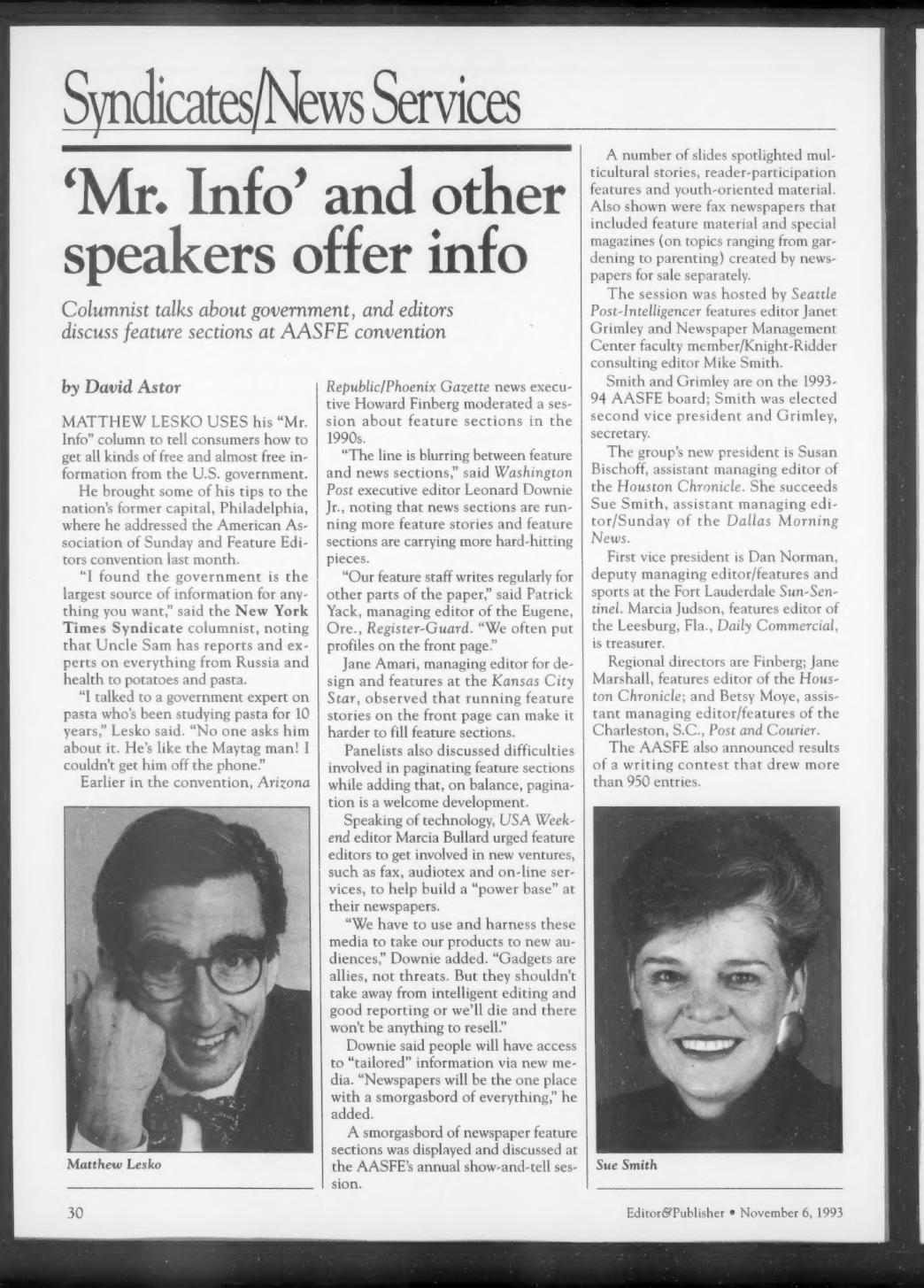
1993 Editor & Publisher article by David Astor on the Philadelphia convention of Sunday and feature editors

Gadgets Are Allies, Not Threats: Feature Editors Meet in Philadelphia

This is a report from Editor & Publisher of Nov. 6, 1993, written by David Astor, covering the American Association of Sunday and Feature Editors convention held the previous month in Philadelphia. The headliner was Matthew Lesko, the New York Times Syndicate columnist behind “Mr. Info,” whose specialty was telling readers how to pry free information out of the federal government. Lesko’s best line was about a federal pasta expert:

I talked to a government expert on pasta who’s been studying pasta for 10 years. No one asks him about it. He’s like the Maytag man! I couldn’t get him off the phone.

Earlier in the convention I moderated a session about feature sections in the 1990s. Astor identified me as an Arizona Republic/Phoenix Gazette news executive — my title at the time. The panel included Leonard Downie Jr., executive editor of the Washington Post; Patrick Yack, managing editor of the Eugene, Ore., Register-Guard; and Jane Amari, managing editor for design and features at the Kansas City Star.

The discussion centered on how the walls between sections were coming down.

The line is blurring between feature and news sections.

Downie noted that news sections were running more feature stories and feature sections were carrying more hard-hitting pieces. Yack said his feature staff wrote regularly for other parts of the paper and often put profiles on the front page. Amari pointed out the flip side: moving feature stories to Page One makes it harder to fill the feature sections. The panel also talked about the difficulties of paginating feature sections, while agreeing that, on balance, pagination was a welcome development.

Technology was the other thread. USA Weekend editor Marcia Bullard urged feature editors to get involved in fax, audiotex and on-line services as a way to build a “power base” at their papers. Downie’s response is the line I’ve remembered:

We have to use and harness these media to take our products to new audiences. Gadgets are allies, not threats. But they shouldn’t take away from intelligent editing and good reporting or we’ll die and there won’t be anything to resell.

He added that readers would soon have access to “tailored” information through new media, but that Newspapers will be the one place with a smorgasbord of everything.

The story closes with AASFE board business. Susan Bischoff of the Houston Chronicle became president, succeeding Sue Smith of the Dallas Morning News. I was listed as one of the regional directors, along with Jane Marshall of the Houston Chronicle and Betsy Moye of the Charleston, S.C., Post and Courier.

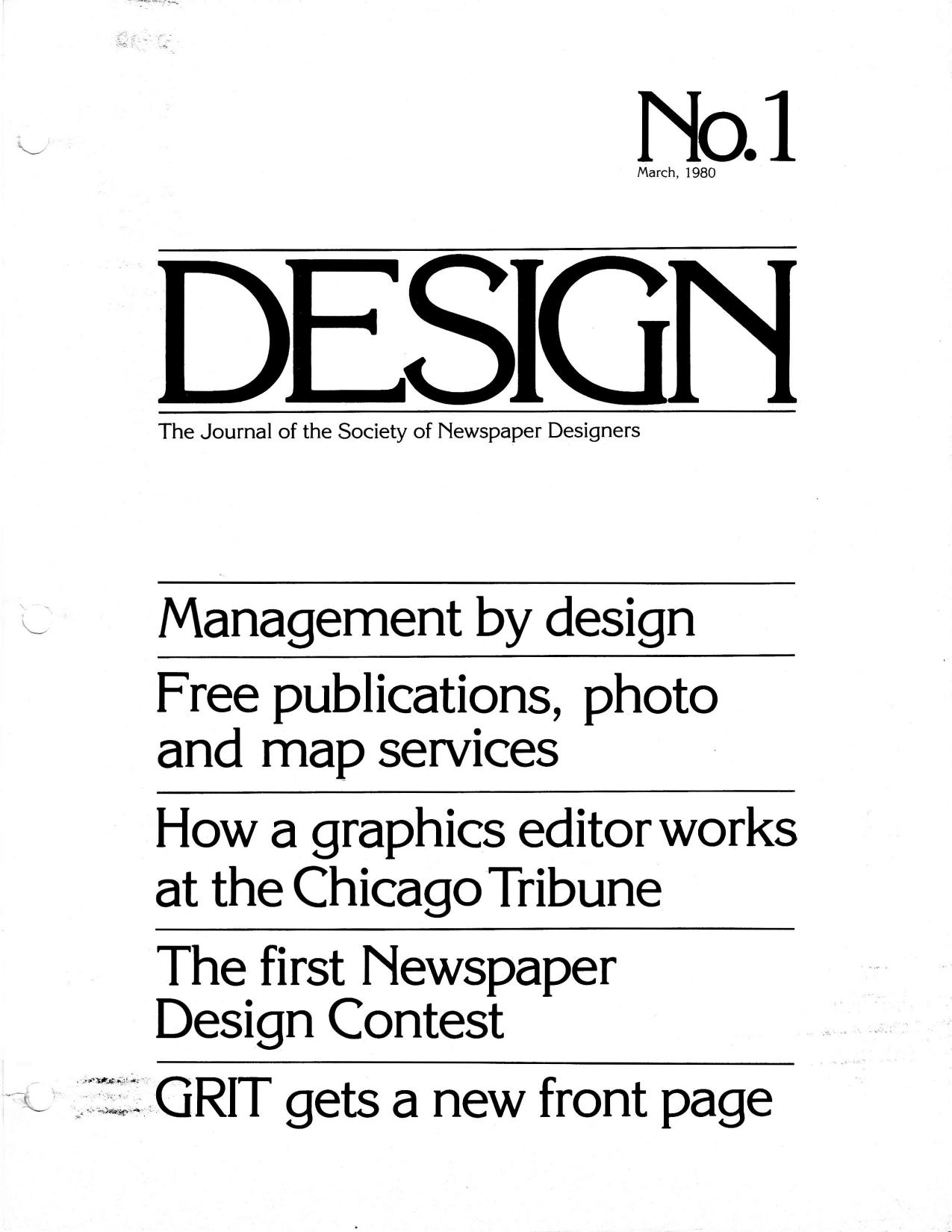
Cover of Design No. 1, March 1980, the Society of Newspaper Designers journal containing the "What is a graphics editor?" talk

“What Is a Graphics Editor?” — The First Issue of Design, March 1980

This is No. 1 of Design, the quarterly journal of the Society of Newspaper Designers, dated March 1, 1980 and edited by Richard Curtis, then assistant managing editor of The News American in Baltimore. The 32-page issue includes Louis Silverstein of The New York Times on design and content, Robert Lockwood’s essay on newspaper management by design, David B. Gray of the Providence Journal-Bulletin on the photo lab as a newsroom resource, Randy Miller’s report on the Kansas City Star/Times seminar, Ed Breen of the Marion (Ind.) Chronicle on words and pictures, a rundown of the Society’s first Newspaper Design Contest, and the redesign of GRIT’s front page.

Curtis used his editor’s note to explain where the organization came from — and how quickly it had grown.

The society was founded, rather informally, in 1978 in a bar in Reston, Virginia during the first American Press Institute seminar on newspaper design.

From a newsletter that went to all 12 members, the Society had reached more than 160 members, produced a videotape presentation called “News by Design,” and mounted its first workshop — held with the Chicago Tribune at the Hyatt Regency in Chicago on Sept. 28, 29 and 30, 1979, drawing nearly 150 participants from the United States, Canada and Costa Rica.

I have a byline in this issue, on a piece headlined “What is a graphics editor?” I didn’t write it. It is a transcription of the talk I gave at that first Chicago workshop, on Sept. 29, 1979, as graphics editor of the Chicago Tribune

My responsibilities at the Tribune are for all graphics that appear in the editorial pages. The question that often arises is, what’s a graphic? The way we define it is charts, maps, combinations… anything that is not what is described as pure illustration. In other words, if it has editorial matter — there are words with it — then it falls under the province of the graphic editor.

Much of the talk was about where the job sits in the newsroom — attending the two daily news meetings, reporting to the assistant managing editor, reading over a reporter’s shoulder before the story lands on the city desk. And about knowing when to say no:

Of course, there’s always one other function of the graphics editor that’s not as pleasant, and that’s knowing when to kill (a graphic). Because there’s nothing worse than a graphic that doesn’t work.

You can have the prettiest looking graphics in the paper and it doesn’t mean anything if it doesn’t communicate with readers.

The issue closes with a membership form ($20 a year, dues covering the magazine), a jobs listing, and a promise for No. 2: an issue built around the question the Kansas City seminar had put to editors — how do we do more with less? Forty-five years on, that’s still the question, and I would go on both to write for this magazine and to be written about in it.

Typewritten 1974 Chicago Tribune staff report titled Proposals for Improving the Chicago Tribune and Attracting Younger Readers

Attracting Younger Readers: 1974 Tribune Report

This is a staff report from my early days at the Chicago Tribune, titled “Proposals for Improving the Chicago Tribune and Attracting Younger Readers.” It carries the names of nine staffers: Ovie Carter, Gary Deeb, Howard Finberg, Clarence Page, Don Pierson, Bill Plunkett, Schickedanz, Rick Soll and Linda Winer. We were tasked to help the Tribune reach younger readers.  We were the younger staff members; I had been at the Trib for just about 2 years.

The introduction doesn’t ease into the problem. It opens with a description of how the paper was being seen from the outside:

Big, bulky. Impersonal. Stodgy. More concerned with things than people. As much fun as drinking cod liver oil (good for you but not so easy to swallow). Nearly devoid of any flair, flamboyance, or personality.

The committee’s argument was that this was a problem of perception and image more than content, and that the attitudes outside the building were mirrored by the attitudes inside it.

Simply stated, the Chicago Tribune takes itself too seriously. This is not to diminish its role as one of the nation’s best newspapers. Rather, it is a suggestion that the time has come for the Chicago Tribune to slaughter, once and for all, many of its sacred cows.

From there the report goes section by section — main news, editorial page, Perspective, Tempo, sports, business, the picture page, comics, Metro, the Sunday paper, copy editing, promotion. The recommendations are specific and, in places, blunt. A page one index every day. Long stories jumped to a designated jump page. A news-feature editor responsible for Column 1 and other offbeat material. Tempo remade from an old-fashioned women’s section into a daily “magazine-of-life,” preferably as an easy-to-handle tabloid pullout for the bus or train commuter. Entertainment and the arts displayed prominently rather than buried. A pop-culture column three times a week. Business pulled out as its own section. Sports writing tightened, with irreverence and humor encouraged.

The masthead got its own recommendation:

Removal of the flag would not necessarily attract new readership by itself. However, the slogan “World’s Greatest Newspaper” should be dumped. Its hyperbolic nature is unsuitable for the Tribune’s newly acclaimed progressive attitude of fairness and credibility.

The editorial page came in for the harshest treatment — described as the single most offensive part of the paper to young readers, with editorials characterized as “prairie populism” and “jumping jingoism.” The committee acknowledged that asking the paper to moderate its editorial stance might be impractical, then added a line I still like:

Editorial writers are advised that it is not always necessary to stand athwart progress hollering “Halt!”

What holds up best, reading it now, are the sections on people rather than packaging. The report faulted the paper for poor use of staff — writers forced to write formula stories, individual voices absorbed into what the report called “the Grey Blob,” and very little discussion between writers and editors about the quality of work. It also pressed on coverage of women and on Black and Latin communities, noting that most coverage of those communities “still consists of crime news, special series, and Operation PUSH,” and calling for the paper’s shortcomings there to be thoroughly investigated.

The closing borrowed the paper’s own advertising line:

To paraphrase the Trib’s current ad-promo line, “We need a friend in the Tribune.”

Fifty-plus years later, the questions in this report — how does a newspaper reach readers who don’t already have the habit, and how does it let its own staff sound like human beings — have never really gone away. Only the platforms changed.