An example of the Chicago Tribune’s photo request form used in 1985. Picture assignments were made through the picture assignment desk, either in the main city room or in the suburban Hinsdale, IL, bureau. Assignments were requested by either the reporter working on a story or by the source editor who is handling the story. However, according to note Howard Finberg wrote in 1985, “the picture assignment editor of the picture editor controls photo assignment traffic and determines which story takes precedent when time and manpower are short.“
“Bits of History” Items
Chicago Tribune Photo Assignment Sheet 1985
This is an example of the workload of Chicago Tribune photographers in December, 1985. The Day Picture assignments on December 26, 1985 run from 7:00 am until 3:30. The notes on the disposition column show the photographer and whether the assignment was completed [OK] or didn’t work [NG].
Changing Jobs Without Moving
In August 1985 I quit the San Jose Mercury News [that’s a different story] and joined the San Francisco Chronicle as its first Photography and Graphics Editor.
Part of the job switch was a ‘run from’ the Mercury News; part was the undeniable challenge of creating a professional editing process for the Chronicle. I love telling this story:
When I went to the Chronicle, I replaced a box. A wooden box that photographers dumped their prints into; a box that wire photos and graphics were dropped. The news editors pulled what they wanted or needed from the box. After my arrival, we established that an editor would help the news editors get the images that best told the story.
By the way, I took the box with me when I left the Chronicle. It holds bits and pieces of digital equipment.
While I joined the Chronicle in early September, the announcement in Editor and Publisher did not come out until Feb. 22, 1986.
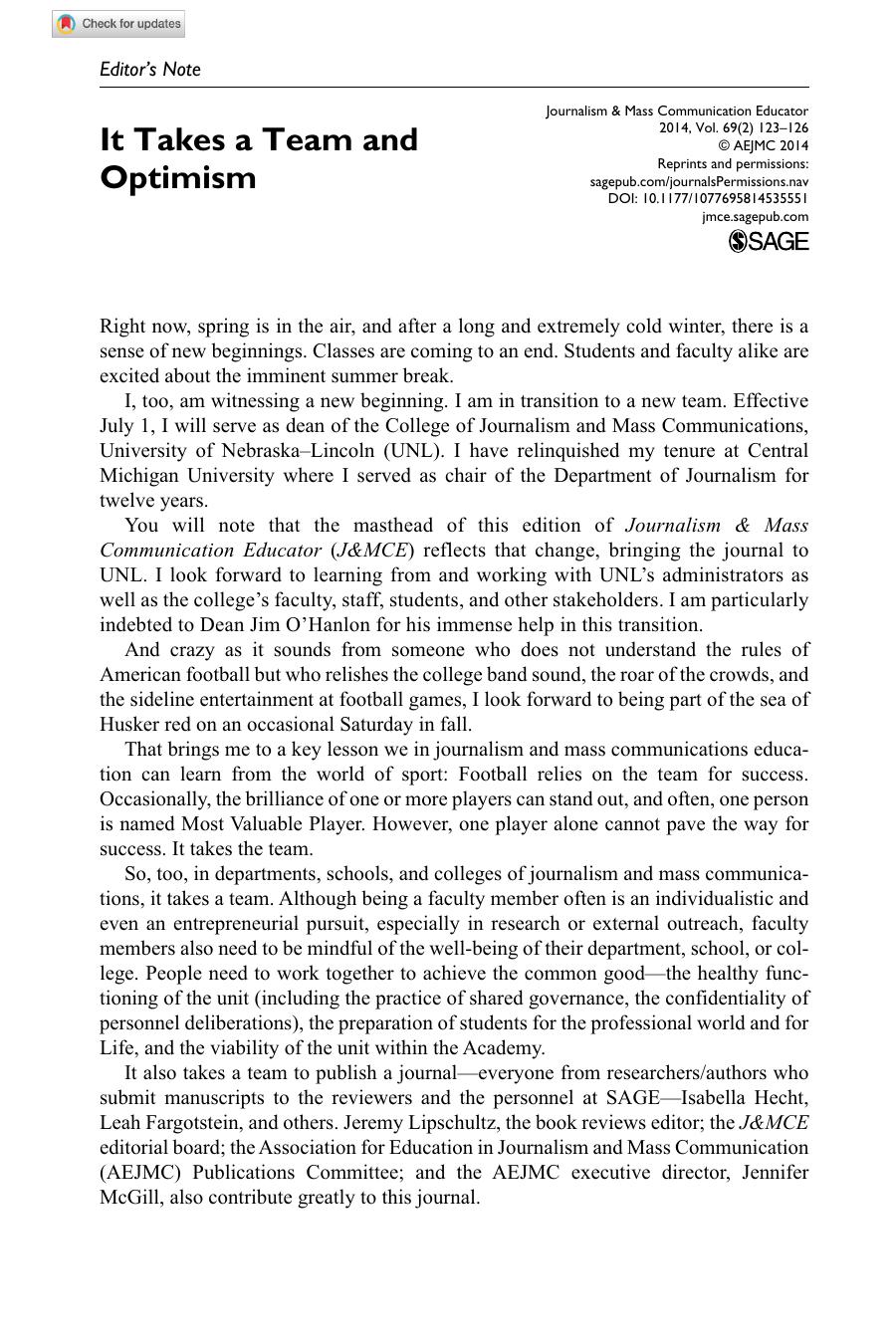
Reasons for Optimism in Journalism, Education
This is an Editor’s Note from Journalism & Mass Communication Educator, written by Maria B. Marron, who was announcing her move to become dean of the College of Journalism and Mass Communications at the University of Nebraska–Lincoln. Most of the piece is about teams — how departments, schools and journals all depend on people working together rather than on a single star player. Then it turns to optimism, and that is where my work shows up.
Marron cited two sources for her optimism about the future of journalism and journalism education. The first was Marty Baron, then editor of The Washington Post, from his keynote at the fifteenth International Symposium on Online Journalism at the University of Texas–Austin:
There is no acceptable alternative to optimism.
The second was my writing about The Core Skills for the Future of Journalism report, which Poynter released on April 9, 2014. The report was research I did with my co-author, Lauren Klinger. Marron quoted my summary of what we found:
shows a wide divergence between professionals and educators in their thinking on the importance of core journalism skills, especially those skills that are essential for mastering new methods of gathering and delivering news and information.
The survey behind the report identified thirty-seven skills, attributes and knowledge areas judged important “for a beginning journalist as he/she looks toward his/her career in the digital/mobile age.” The widest gaps were in multimedia. Marron laid out the numbers: 76 percent of educators versus 46 percent of professionals rated “shoot and edit video” as important; 80 percent versus 52 percent on the “ability to tell stories with design and visuals”; 79 percent versus 53 percent on shooting and editing photographs; and 72 percent versus 38 percent on recording and editing audio. Coding was the outlier in a different direction — students rated the ability to work with HTML or another computer language highly, while only 41 percent of educators and 28 percent of professionals and managers did.
What interests me is how she read those gaps. Lauren and I had framed the divergence as a problem for the industry. Marron read the same data as evidence that educators were ahead of the professionals:
educators are serving as leaders for the industry, not as followers.
That is a more generous interpretation than the one we offered, and it is a fair one. The Core Skills research grew out of years of thinking about training at Poynter’s News University, where the question was always the same: what does a journalist actually need to know, and who is responsible for teaching it? The 2014 answer was that educators, students and freelancers largely agreed with each other, and newsroom professionals were somewhere else entirely.
Reading this in 2026, the specific skills have shifted — the argument now is about AI tools rather than shooting video — but the underlying gap between what the academy teaches and what newsrooms say they value has not gone away. Neither, I hope, has the optimism.
Crisis at San Francisco State: Instant Book
Going to school at San Francisco State University was a great and unusual journalism education. What made it special was not the classroom work, which was good. The real training was in covering the drama in the hallways, the excitement on the campus commons and the turmoil on the streets. My journalism education was attending a college that saw the longest campus strike in United States history. Here’s how the SFSU describes the strike, some forty years later:
…the five-month event defined the University’s core values of equity and social justice, laid the groundwork for establishment of the College of Ethnic Studies, and inspired the establishment of ethnic studies classes and programs at other universities throughout the country.
The Black Student Union and a coalition of other student groups known as the Third World Liberation Front (TWLF) led the strike, which began Nov. 6, 1968 and ended March 20, 1969. Clashes between the strikers and San Francisco Police tactical squads made national news. Students, faculty and community activists demanded equal access to public higher education, more senior faculty of color and a new curriculum that would embrace the history and culture of all people including ethnic minorities.
Those clashes between strikers and police were covered by professional and student journalists. For students it was a great training ground, as you could compare your work against the professionals. After the strike, a number of journalism students, most of whom worked on the journalism department’s newspaper Phoenix, wanted to publish a more interpretive look at events.
We decided to publish a magazine or “instant book”. I was the publisher and editor. But one of driving forces was Steve Toomajian. His writing and hard work helped make the concept a reality.
We called the publication “Crisis at SF State.” We got some money from a distributor, found a printer and published in the summer of 1969 [I think]. Actual dates have been lost. The book is still in a few libraries, but the publication mostly lost in the dustbin of history. Here’s Stanford University’s library record:
Cover title: An interpretive look at San Francisco State College crisis… A collection of articles, essays, interviews, and photographs on the student strikes at San Francisco State College, 1968-1969.
I also put a copy in the library at The Poynter Institute. And I’ve posted a copy on this site.
Chicago Tribune Award Was Extra Sweet
When I worked at the Chicago Tribune, the newsroom had a special awards dinner every December. It was called the “Beck Awards Dinner.” Here’s where the top staffers received recognition [and a very nice check] for accomplishments during the year. Prior to the ceremony, Joe Leonard, an assistant managing editor, told me to make sure Kathy Oakley got to the dinner. Joe knew I was dating Kathy and that she had said that she wasn’t planning to attend the dinner. Joe knew she would win the Johnrae Earl Award for editing.
Kathlyn E. Oakley, who currently occupies the late Mr. Earl’s position in the copy desk slot, was honored for her dedication to good editing, awareness of writers’ sensibilities and grace under deadline pressure.
I also won. An award for professional performance. The next year I would win again. Better still: Kathy [now called Kate] and I got married.
NewsU’s First ‘Public’ Beta
Thanks to the support of the Asian American Journalism Association (AAJA), NewsU was able to create its first online group seminar (OGS). An OGS is a e-learning module that allows for more interaction between faculty and participants and among the participants themselves. Mae Cheng, one of the more forward looking journalists at the association, saw e-learning as an opportunity to provide additional services to AAJA members. Mae asked about the possibility of working with Poynter on e-learning even before Poynter had received the Knight grant for the NewsU project. Here’s her October 2002 email to Paul Pohlman and other members of the faculty. I was the Institute’s Presidential Scholar and wouldn’t join the faculty until January 2003.
—–Original Message—–
From: Mae.Cheng@newsday.com [mailto:Mae.Cheng@newsday.com]
Sent: Wednesday, October 30, 2002 11:46 AM
To: paulp@poynter.org
Cc: Evelyn Hsu; Howard Finberg; Chip Scanlan; Al Tompkins
Subject: aajaHi Paul,
I hope this finds you well.
Just wanted to check back with you on two fronts:
The first is that our convention co-chairs and I have gone through your 2003 course offerings, and the following list are the sessions that most intrigue us. Do you think there’s any way we can get a couple of these sessions to San Diego for our convention in August?
1. Poynter leadership for mid-level editors
2. tough choices: doing ethics
3. advanced power reporting for reporters/photojournalists
4. collaboration conference: storytelling partnerships
5. enterprise and investigative reporting for broadcast
6. reporting on race relations.The second thing I wanted to ask you is if there’s been any further
thought at Poynter about partnering with us to offer an online training program. [Bold added –Hif]Thanks.
Mae
Future of Journnalism Education Speech
I gave keynote speech at European Journalism Centre 20th Anniversary celebration in Maastricht, Netherlands, thanks to the director of the EJC’s director, Wilfried Rutten. The speech [PDF link] gave me an opportunity to build upon remarks I made the previous year at the “Picnic” conference. I was part of a panel that addressed the future of journalism. I also wrote an article for Poynter Online about the topic. I must admit that I love this line: “Journalism education can’t teach its way to the future.”
Here’s the start of the Poynter Online article that captures the spirit of the speech:
As we think about the changes whipping through the media industry, there is a nearby storm about to strike journalism education.
The future of journalism education will be a very different and difficult future, a future that is full of innovation and creative disruption. And, I believe, we will see an evolution and uncoupling between the value of a journalism education and a journalism degree.
When we think about the future, there’s not a single future. The future for a 20-year-old is clearly very different than the future of a 60-year-old. Each will bring a very different perspective.
The future of journalism education is linked to the future of journalism itself. Each is caught within the other’s vortex, both spinning within today’s turmoil of change.
There is a video of the speech on YouTube.
The reaction to both the speech and the article were very good, although it was part of a swirl of postings and speeches about the topic. With the encouragement of my colleague, Vicki Krueger, I decided that this topic needed continued study and that will lead to other reports and writing.
News University Goes Public, 2005
Poynter’ e-learning project, News University, had its public debut on April 11, 2005 at the American Society of Newspaper Editors in Washington DC. I gave the first public showing of site at a roundtable meeting on the future of journalism education. The next day, Poynter Online ran a Q&A by Joe Grimm about the project.
Today, as NewsU is formally launched, the online school has more than 2,000 registered users from around the world. Journalists from India, Portugal, Australia, The Philippines, Canada, Uzbekistan, Albania and China have joined U.S. journalists who have participated in NewsU’s courses.
Here’s a PDF version of that story.
Here’s the stupidest prediction I made about the future of Poynter NewsU:
What do you expect the reach to be like with NewsU?
We’re already at 2,000 registered users. And that’s without any advertising or mailings. I’m sure we’ll double that number in a year. And then perhaps we’ll double again in a couple of years.
We hit those numbers in the first year. NewsU in 2013 has more than 275,000 registered users.
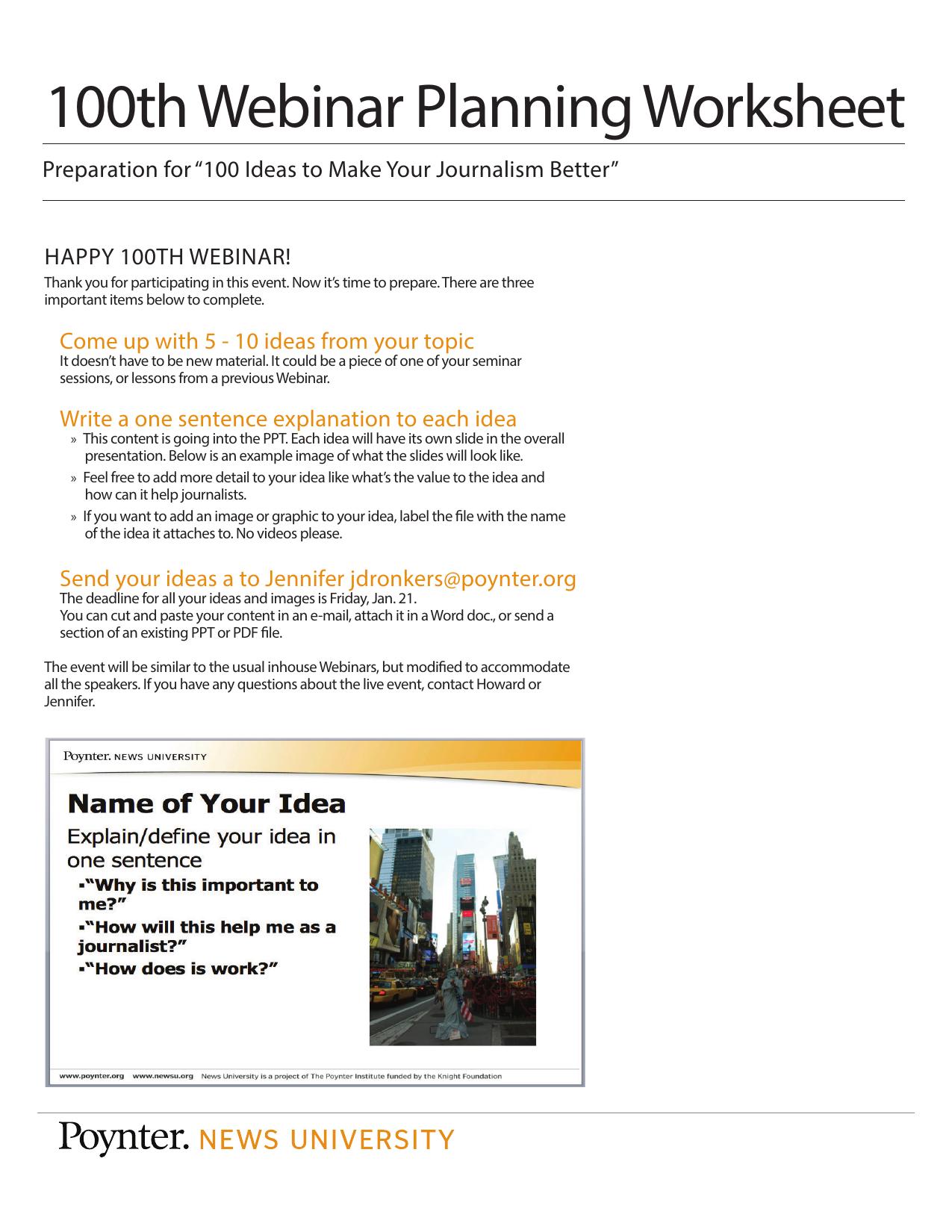
Planning the 100th NewsU Webinar
In January 2011 the Poynter NewsU team began planning a celebration of the 100th Webinar offered to journalists via News University, the project funded by the Knight Foundation. This is the worksheet faculty were given to help prepare their contributions.
The theme was a group effort, with each participant contributing a handful of ideas:
Preparation for “100 Ideas to Make Your Journalism Better”
The instructions were simple — and reassuring for busy faculty:
Come up with 5 – 10 ideas from your topic. It doesn’t have to be new material. It could be a piece of one of your seminar sessions, or lessons from a previous Webinar.
Each idea got its own slide, with a one-sentence explanation answering “Why is this important to me?” and “How will this help me as a journalist?” Ideas and images were due to Jennifer Dronkers by Friday, Jan. 21.
The event will be similar to the usual inhouse Webinars, but modified to accommodate all the speakers.
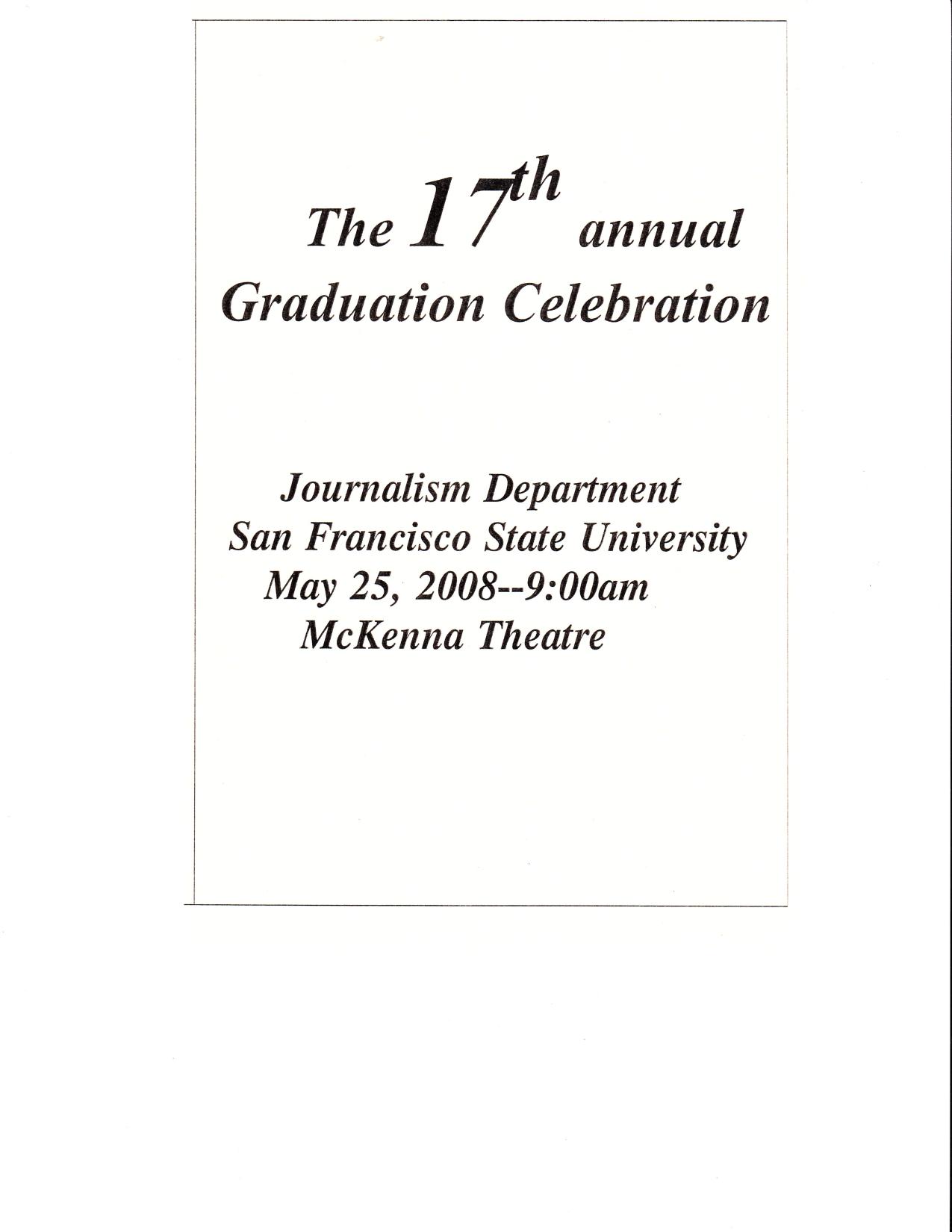
Adding a Sixth W: My 2008 SF State Speech
On May 25, 2008, I went back to where I started. The Journalism Department at San Francisco State University held its annual Graduation Celebration at 9 a.m. in McKenna Theatre, and I was on the program as Distinguished Journalism Alumnus, introduced by Jon Funabiki. Venise Wagner, the department chair, opened the morning. Martin Reynolds was named Journalism Alumnus of Year, introduced by Austin Long-Scott. Khari Johnson was the Class Honors Student, introduced by Cristina Azocar, and Christine Joy Ferrer was the Class Speaker, introduced by John Burks. The ceremony closed with a World Press Pass send-off by the journalism faculty.
The two documents here are the printed program
ed u2014 with the full list of graduates u2014 and my speaking text, marked 22, 2008. Speaking to a room full of new journalism graduates in the spring of 2008 meant speaking into a very bad news cycle for the news business, and I decided not to pretend otherwise.
This is a wonderful time to be a journalist. This is also a lousy time to be at a traditional journalism-based media company.
The rest of the talk was an argument for flexibility, built out of my own ru00e9sumu00e9. I told them I left school with one goal u2014 to become a news editor at a newspaper u2014 and never got there.
That was my career dream. It was a good goal, but I never reached it. I went around it. I went through it. I went over it.
Instead I counted seven careers: copy editor at the San Francisco Examiner and the Chicago Tribune; graphics and picture editor at the Chicago Tribune and The New York Times; newsroom leader at the San Francisco Chronicle and the Arizona Republic; head of information technology at The Arizona Republic; online strategist at Central Newspapers; new media consultant; and educator, trainer and director of interactive learning at The Poynter Institute. My journalism education, I told them, had prepared me for maybe two of those jobs. My wife, Kate, has her own diagnosis for this pattern u2014 she calls me a u201cpioneer addict,u201d someone who is happy only when he creates something new, and she is right that pioneers are easy to spot by the lost look and the absence of a map.
The heart of the speech was a small piece of advice dressed up as journalism 101. Everyone in that theatre already knew the 5Ws. I suggested they add one more.
What you need to add is another W, a 6th W: the u201cWhat Ifu201d.
I framed 2008 as an inflection point u2014 the moment when an industry, a company or a person has to choose between protecting the old or jumping into a future where the rules are unclear. The railroads didnu2019t make that leap. Newspapers, I argued, could have decided in the 1980s that their business was helping people make sense of the world around them, u201cand not just crushing trees and smearing ink.u201d I warned the graduates they would witness the failure of some well-known newspaper and television companies during their careers, and also the birth of new forms of journalism, including nonprofit-supported experiments then under way in Minneapolis and Washington, D.C.
I also reminded them that they were the first truly digital generation u2014 born about when Tim Berners-Lee created the World Wide Web, in fifth grade when the first Palm Pilot shipped, in ninth grade when Napster arrived and took the music industryu2019s business model with it, in high school for Skype, in college for YouTube. My generation still marvels at the Internet; theirs would treat it the way we treat electricity, without noticing the lights are on.
It is your responsibility to think about what the future might hold. It is your responsibility to shape the future. Do you think that you arenu2019t ready for that responsibility? Sorry. Too late. You already have the job.
Rereading this in 2026, the predictions hold up better than I would like. Well-known newspaper companies did fail. Nonprofit newsrooms did grow into a real part of the ecosystem. The one line that makes me smile is my hope for an innovator who would combine the Wii with journalism u2014 a very 2008 way of asking a question that AI and immersive storytelling are now answering in ways I couldnu2019t have named then. The advice underneath it, though, is the same advice I spent the next decade acting on at Poynter, building News University to give working journalists a way to keep learning after the diploma. Formal education can only take you to the starting line. Preparation, as I told the class of 2008, comes from within.
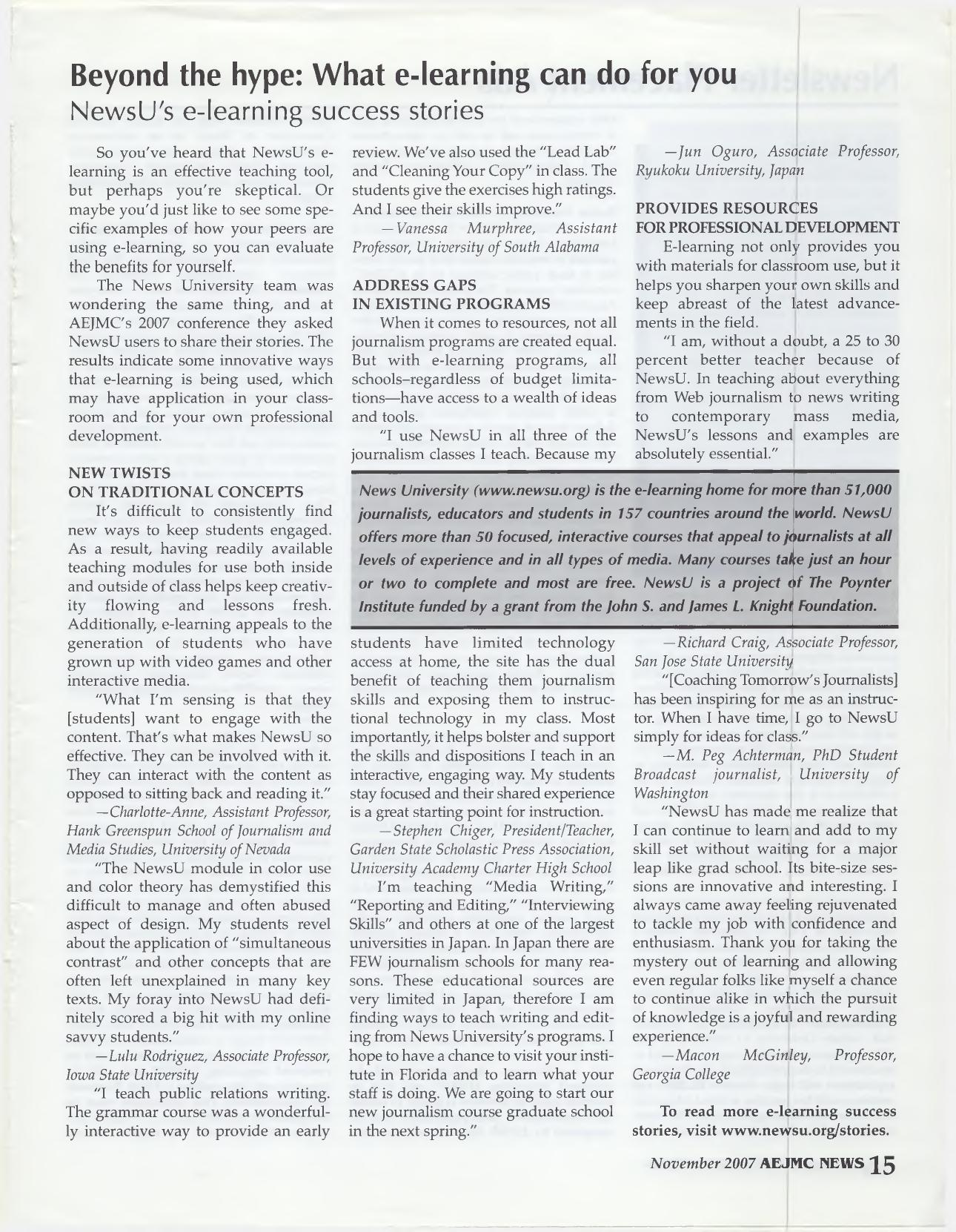
Beyond the Hype: What E-Learning Can Do for You
This is a piece that ran in the November 2007 issue of AEJMC News, built around testimonials the News University team collected from NewsU users at AEJMC’s 2007 conference. The idea was simple: rather than tell journalism educators that e-learning worked, let their peers say it.
The examples range from filling classroom gaps to sharpening the instructors’ own skills. A few that stood out:
“What I’m sensing is that they [students] want to engage with the content. That’s what makes NewsU so effective. They can be involved with it. They can interact with the content as opposed to sitting back and reading it.” —Charlotte-Anne, Assistant Professor, Hank Greenspun School of Journalism and Media Studies, University of Nevada
“The NewsU module in color use and color theory has demystified this difficult to manage and often abused aspect of design. My students revel about the application of “simultaneous contrast” and other concepts that are often left unexplained in many key texts.” —Lulu Rodriguez, Associate Professor, Iowa State University
“I am, without a doubt, a 25 to 30 percent better teacher because of NewsU. In teaching about everything from Web journalism to news writing to contemporary mass media, NewsU’s lessons and examples are absolutely essential.” —Richard Craig, Associate Professor, San Jose State University
One comment came from Jun Oguro, an associate professor at Ryukoku University in Japan, who noted that “In Japan there are FEW journalism schools for many reasons,” and that he was using News University’s programs to teach writing and editing.
The sidebar captures where NewsU stood at that point:
News University (www.newsu.org) is the e-learning home for [more] than 51,000 journalists, educators and students in 157 countries around the world. NewsU offers more than 50 focused, interactive courses that appeal to journalists at all levels of experience and in all types of media. Many courses take just an hour or two to complete and most are free. NewsU is a project of The Poynter Institute funded by a grant from the John S. and James L. Knight Foundation.
Fifty courses and 51,000 registered users was a milestone worth bragging about in 2007. By the time I left Poynter, both numbers had grown well beyond that. What strikes me reading this now, nearly two decades later, is how much of the skepticism we were answering — can online learning really teach anything? — has simply evaporated. That argument was settled by circumstance, not persuasion.
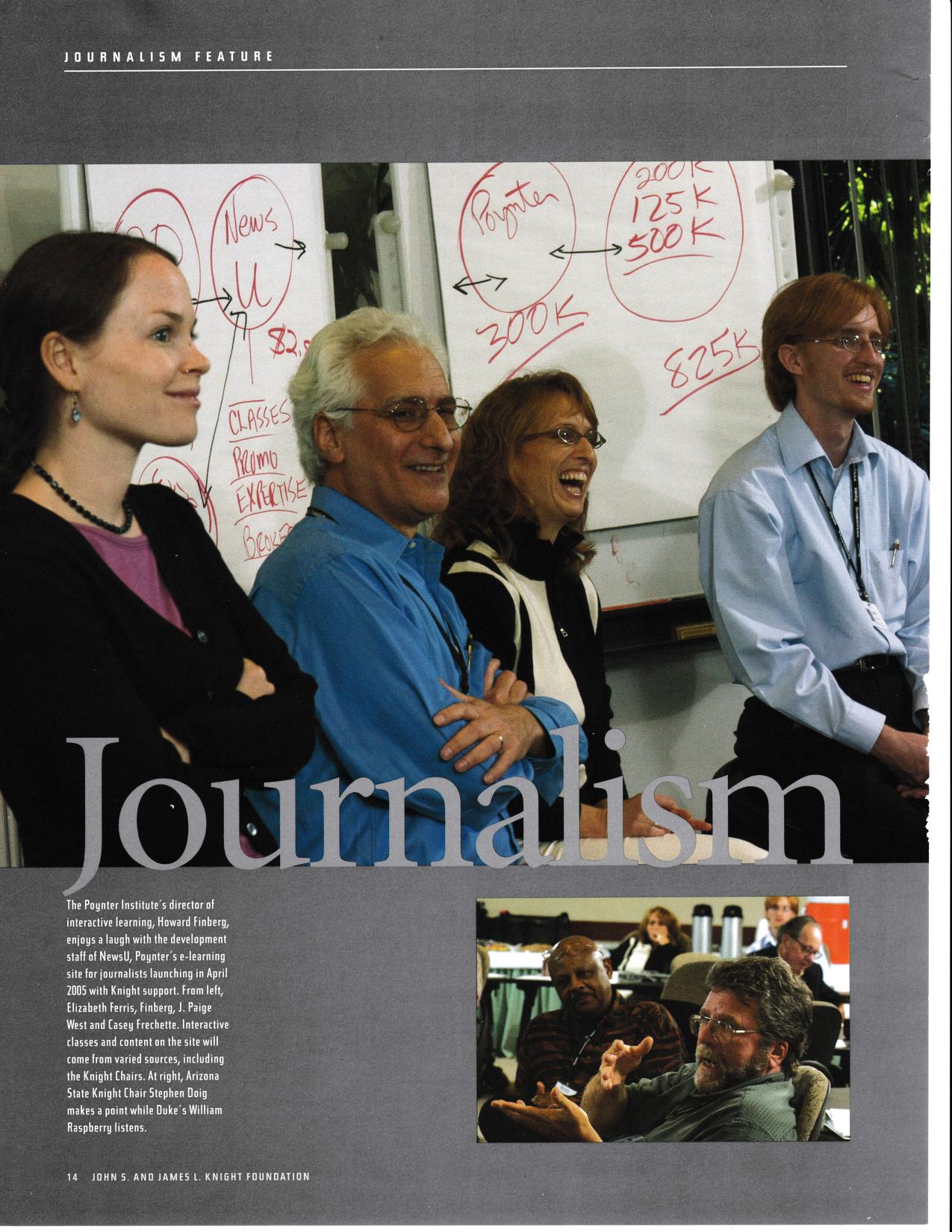
‘A World Full of Connections’ — Knight Foundation Report Feature on NewsU
A journalism feature from the John S. and James L. Knight Foundation annual report, looking at how the foundation’s endowed Knight Chairs in Journalism had begun collaborating with each other and with other Knight journalism partners — including The Poynter Institute‘s News University. The piece opens in St. Petersburg and traces the Knight Chair program back to 1990, when then-foundation president Creed Black announced its creation, saying it would strengthen the quality of American journalism education:
“by bolstering core curricular values and encouraging innovation.”
The story lists examples of that collaboration — Rosental Alves in Latin America, Jim Detjen at Michigan State, Charlotte Grimes at Syracuse, Melinda McAdams at Florida, Jacqui Banaszynski at Missouri, and Haynes Johnson’s work on the Knight-funded study Newsroom Training: Where’s the Investment? — before turning to what the report calls the largest gathering ever of Knight Chairs, who traveled to Poynter in 2004 to learn about News University.
a five-year, $2.8 million project to develop an e-learning program for journalists. The program is a partnership between Knight and Poynter, rated the nation’s top journalism training organization by the Where’s the Investment? study.
At the Poynter meeting the chairs brainstormed course ideas — how to analyze government data, how to understand scientific claims — and the article notes that work began immediately with William Gaines, the Knight Chair in Investigative and Enterprise Reporting at the University of Illinois, on an investigative documents class. The individual web sites of the Knight Chairs were to be promoted through the Learning Links page at NewsU.
The feature describes the official launch at the April 2005 American Society of Newspaper Editors convention, designed to make the case that NewsU is not just informative but a fun resource — “like thousands of journalists at a dinner party” — featuring material from 18 Knight Chairs in Journalism, a Lee Hills Chair in Free Press Studies and a Knight Professor in Constitutional Law and First Amendment. Elsewhere in the report, Reznet’s Dennis McAuliffe Jr. describes his own project’s plan to work with NewsU on a distance-learning course.
The photo caption identifies the NewsU development staff at the time — Elizabeth Ferris, Howard Finberg, J. Paige West and Casey Frechette. The story ends with a line that gave the feature its title:
“Journalism,” Finberg said, “is a world full of connections.”

Spam Filters, Ad Blockers and a 2003 Warning About Pop-ups
This is a feature by Carl Sullivan in the May 5, 2003, issue of Editor & Publisher about a problem that was just coming into focus for newspaper Web sites: the filtering technologies readers were installing to protect themselves from spam and pop-up advertising were also blocking the e-mail and the ads newspapers were sending.
Sullivan opens with the e-mail news alerts newspapers sent when 15-year-old Elizabeth Smart was found near Salt Lake City in March 2003. Words like “teenager,” “kidnapped,” and “girl” tripped spam filters that mistook the alerts for pornography. Ron Currier, chief technology officer of Boulder-based PublishMail, which handled reader e-mail for more than 30 newspapers, described the result:
They bounced like crazy
The other half of the story was ad blocking. Sullivan cites a March 2003 Forrester Research study showing 14% of online consumers were using some form of ad-blocking software, up from about 1% a year earlier — with another 13% saying they hadn’t known such software existed until the pollsters asked, and would now consider installing it. The article quotes a long list of online newspaper executives on pop-ups, pop-unders, blacklists and whitelists, including Jason Krebs of NYTimes.com, Greg Schermer of Lee Enterprises, Ian Murdock of Hearst Newspapers, Ginger Neal of Freedom Orange County Information, and Jeff Webber of USAToday.com.
I was quoted twice, identified as a principal at the Finberg-Gentry consultancy — my partnership with Steve Gentry, also listed in the article as The Digital Futurist Consultancy — and as a faculty member at the Poynter Institute. The first quote follows a mention of our 2001 report for the Newspaper Association of America, which found that many publishers were generating new print subscriptions through pop-up house ads on their own Web sites:
Web publishers have to wean themselves off those or find additional ways to promote the paper. They were effective, but now’s the time to move off of them or to at least supplement them with banner and tile advertising.
Sullivan notes that we were working on a follow-up report about using the Net to promote print subscriptions, expected to be released by NAA that summer. My second quote closes the piece, alongside PowerOne Media’s David Teitler asking whether the Web would end up an advertising-supported medium at all:
Consumers recognize that there’s value in advertising. The real challenge for Web sites is to find the right visual model that conveys the message in an effective way without angering readers.
That challenge didn’t get any easier. The article also points to what became the answer for a while — contextual “sponsored links” served next to editorial content, then being tested at USAToday.com through Applied Semantics, a company Google had just purchased.

JForum Ends: Where the Digital Pioneers Went to School
This is an Editor & Publisher story by Jim Rosenberg, published May 17, 2001, reporting the end of the Journalism Forum on CompuServe. JForum was merged with CompuServe‘s PR Forum into a new service called MediaPro, and the old forum stopped operating.
Rosenberg’s account is a short obituary for something that mattered a great deal to a small number of people. JForum began, as he wrote, on a Radio Shack laptop:
Launched on a Radio Shack laptop in 1985, the then-300-baud journalists’ computer bulletin board eventually served thousands of members worldwide, with job listings and messaging in four languages on a variety of topics.
It was also, the story notes, the first online home of the Society of News Design, the National Press Photographers Association, Investigative Reporters and Editors, and other organizations — and the subject of an early ’90s ruling in which a U.S. judge found CompuServe not responsible for messages it was unaware of that were posted in JForum.
Former NBC News manager Jim Cameron, who started the forum, said he
founded JForum … for the dwindling number of radio news people to share survival tips.
He credited the section leaders and assistants “who really ran JForum as editors.” I was one of them, and Rosenberg quoted me at some length about what made the place work — the effort required to participate at all, and what that effort produced:
You really had to commit to be a member of this community. At that point, you realized the possibility of community was not a geographical issue … It was about shared interest.
And on what its closing meant:
This is a passing of a forefather of a lot of what is going on right now. This was an educational experience for the digital pioneers. This is where we went to school. We learned from each other.
The story closes by noting that Cameron would stay on in an interim capacity, with MediaPro to be operated by PR Forum’s Mike Bayer. Rosenberg was then a senior editor covering newspaper technology for E&P.