Scanned pages of The Digital Edge's December 2000 article "Just Learning to Walk," with the Digital Futurist Consultancy website from that year

Learning to Walk: 2000 Look Back at Five Years Online

In December 2000, The Digital Edge, the online publication of the Newspaper Association of America‘s New Media Federation, marked the fifth anniversary of newspapers on the Web by asking seven veterans of the industry’s digital efforts to reflect on what they’d learned. The article, “Just Learning to Walk,” was written by Rob Runett, NAA Manager of Electronic Media Analysis. I was one of the seven, described in the piece as:

Howard I. Finberg, former vice president of Central Newspapers‘ CNI Ventures and CNI’s director of technology and information strategies. (He’s now sharing his wisdom as director of Tempe, Ariz.-based Digital Futurist Consultancy).

The others were Lisa DeSisto of boston.com, Todd Engdahl of DenverPost.com, John Granatino of Belo Interactive, Chris Jennewein of KnightRidder.com, Joe Michaud of MaineToday.com and Chris Morrill of the Hartford Courant’s ctnow.com.

Runett’s framing was that five years is nothing in the life of a medium, but felt like several lifetimes to the people who lived it. The questions ranged from proudest moment to biggest regret, and the answers were candid in a way industry panels rarely are.

My toughest hurdle was not technology. It was classified advertising:

The hardest challenge or hurdle we faced was getting the classified department to understand that that the company needed to move quickly or we’ll lose in the online marketplace. This was early in the development of the site [azcentral.com] and all we really knew was that our readers/customers wanted classifieds. And they wanted them for free, something that went to the opposite of the teachings at classified managers school. We didn’t have a business model, just a business “gut feeling” in 1996.

On business models, I argued that it was far too early to declare winners — and that interactive media was something genuinely new, not simply print extended:

Heck, we aren’t even walking yet and you want us to declare a college major?

Interactive, a.k.a. online, media truly is a new form of communication; it is less of an extension of our existing businesses or business models. Hey, that doesn’t mean we can’t learn from our forefathers. Interactive media should share the best traits of its “parents” and then move out of the house quickly.

Asked what I would undo, I picked the pace of the Web build-out at azcentral — and the pull of an easier revenue stream:

I resisted the temptation and probably should have moved quicker to have the team build out more Web features and spent fewer resources on AOL. But AOL was sending us money every month.

The “most important lesson in two lines or less” question produced the best writing in the piece. Morrill: “The user comes first. The user comes first. The user comes first.” Engdahl: “This isn’t a sprint, it’s a marathon.” Jennewein reminded everyone that traffic, advertising and low costs are Business 101, “but many of us lost sight of this during the dot-com boom.” I failed to follow the rules:

The basics, however, still matter: Quality. Accuracy. Fairness. Fun. Service. To do less is to fail the customer. I have also learned that I probably could never sum up in “two lines or less.”

The same December issue carried a column by New Media Federation President Gordon Borrell, vice president/new media at Landmark Communications, titled “Recommit or Pull the Plug.” Borrell noted that the Arizona Republic had cut 28 new-media positions in November and that Tribune Interactive had terminated 24 online positions in October — and listed me among those on the conference speaking circuit who had found themselves jobless since early summer. He quoted me on how I read the shakeout:

During the next year, the strong will get stronger; the weak will struggle. Those companies that recognize that the Internet is a new medium and not an extension of existing print models will do the best… What dot-com and traditional media businesses need to do is roll up their sleeves and get to work. No one said it would be easy — that’s why they call it work.

Borrell closed his column by agreeing: the 1990s were the years of experimentation and innovation, and what lay ahead was the real work.

Scanned along with these pages is a snapshot of the Digital Futurist Consultancy site as it existed in December 2000 — the biography, the scouting reports from DRUPA and the Jupiter conference, the Arizona Republic “learning journey,” and the 2020 Southwest Republic prototype done for the American Press Institute. Also included is the NAA press release announcing that year’s Digital Edge Awards, which named me the New Media Federation’s New Media Pioneer for 2000.

Reading these predictions now is instructive. DeSisto’s five-year forecast for boston.com included being on Palms, on cell phones and streaming headlines to LCD screens on taxicab roofs — and, she added, the Red Sox winning the World Series. She was right about the Red Sox in 2004, and right about the phones, though not in the way anyone in 2000 expected. Jennewein predicted that newspapers would dominate the local Internet space “with the specter of competition from dot-com startups long dissipated.” That one didn’t age as well.

What holds up, I think, is the thing I kept insisting on: that this was a new medium, not an extension of print. Twenty-five years later, that argument is still being relitigated in newsrooms — and the industry is still, in some important ways, just learning to walk. For others, they have been stopped in their tracks.
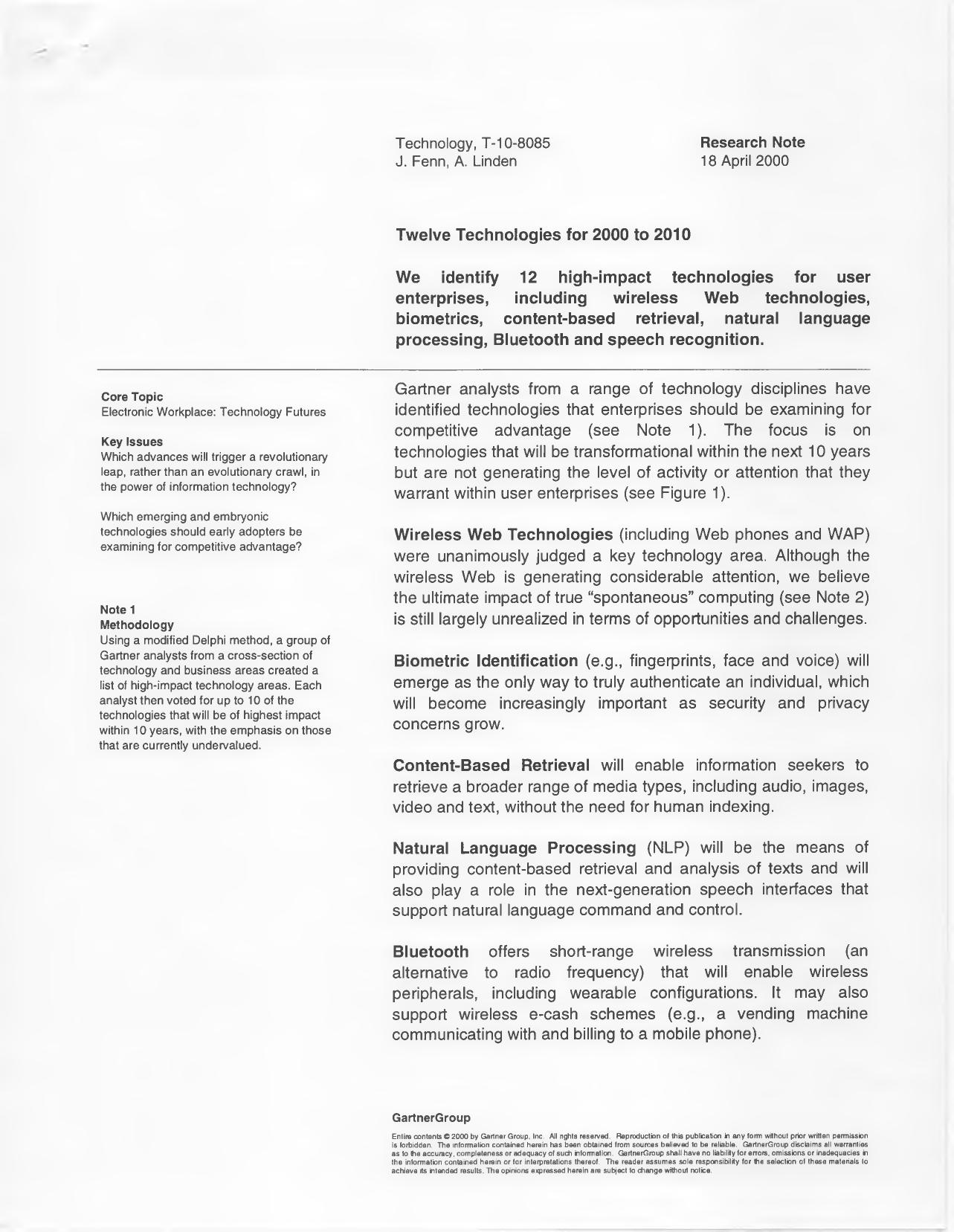
Gartner research note listing twelve high-impact technologies with a Technology Radar Screen adoption timeline

Gartner’s Twelve Technologies For 2000 To 2010

A Gartner research note (Technology, T-10-8085) by analysts J. Fenn and A. Linden, forecasting the technologies that would reshape enterprise computing over the coming decade. The note is short — two pages — but it is a useful snapshot of what the industry’s most-quoted research firm thought mattered as the century turned.

We identify 12 high-impact technologies for user enterprises, including wireless Web technologies, biometrics, content-based retrieval, natural language processing, Bluetooth and speech recognition.

The twelve, as listed: Wireless Web technologies (including Web phones and WAP), biometric identification, content-based retrieval, natural language processing, Bluetooth, speech recognition, Webtops, XML for content and data exchange, embedded miniature computers, pattern recognition, e-cash and display technologies.

The methodology was a modified Delphi process — a cross-section of Gartner analysts built a list of high-impact technology areas, then each voted for up to 10, with the emphasis on those judged currently undervalued. Wireless Web technologies were the only unanimous pick.

A “Technology Radar Screen” figure assigns each technology a year marking “the point at which the technology begins the steepest part of its adoption curve”: XML in 2001, wireless Web, Webtops, Bluetooth and NLP in 2002, pattern recognition and content-based retrieval in 2004, speech recognition and biometrics in 2005, e-cash in 2006, display technologies in 2007, and embedded miniature computers in 2008.

The most interesting passage is a sidebar defining what the analysts called spontaneous computing:

An era of spontaneous computing will begin around 2007, predicated on the availability of ubiquitous, reliable wireless connectivity that will provide any time, any place access to information and messaging through highly portable or wearable systems with speech interfaces.

And the consequence they drew from it:

Instead of being the center of attention, information processing will become a secondary activity achieved while the user is performing some other task (driving or sitting in a meeting), leading to true multitasking.

The note closes with the standard Gartner formulation:

Bottom Line: Technology and business planners should evaluate these technologies as part of their technology portfolios to determine the impact on future IT and business directions.

Transcript pages from a 1999 American Press Institute seminar presenting newspaper design survey results

Is There a Disconnect Here Someplace?

This is a transcript section from an American Press Institute seminar held in October 1999, where I presented the results of a design and visuals survey I coordinated. It was a follow-up to the survey we did for the 1988 J. Montgomery Curtis seminar, Newspaper Design: 2000 and beyond, with a nod to the survey the Society of Newspaper Design did in 1992. We reused a lot of the same questions so we could see what had changed.

This just goes to show you that if you volunteer to do something, you get to do it again.

The numbers: 628 responses in 1988; a little over 1,200 in 1999, about 200 of those from a Web site we built for the project. Sixty percent came from designers, 40 percent from editors. Ninety percent worked at dailies, and about 45 percent at papers over 100,000 circulation. One notable difference from 1988 — we didn’t ask about color or the use of computers. By 1999 those were givens.

We organized the discussion around five areas: the importance of design, the importance of visual elements, people, the relationship between online and print (new that year), and where all of this material was going to fit in the future.

As for the importance of design, the survey showed that it remains strong in the opinion of both editors and designers. And as for visuals, we’re also optimistic. And that’s the good news. The bad news is there appears to be a big disconnect between editors and designers in how they view the world.

Some of that disconnect showed up in the self-scoring. Asked to rate the quality of newspaper design across the industry on a 1-to-10 scale, 13 percent gave the industry an 8 to 10 and 71 percent put it in the 5-to-7 range. Asked about their own newspapers, more than half rated themselves 8 to 10. As I said at the time: the industry sucks, but we’re doing okay at our own newspaper.

Warren Watson of API‘s staff took the results to some 50 publishers, editors, designers and educators for reaction, and it wasn’t flattering. Terry Quinn of Thomson Newspapers called the 1980s an infatuation period with design. Darrell Moen said design had simply become institutionalized — not special anymore. Around the table, Mr. Sutton put a sharper point on it:

I do think most editors see design simply as layout, and I believe there is a design backlash, because some visual journalists have too much of a “make it pretty” mentality.

The section on informational graphics was the one that stung. As a former graphics editor who toiled in that vineyard when we had nothing but rocks and stumps, I wondered aloud whether informational graphics had just been a fad. Others weren’t ready to concede that. Marty Petty argued that graphics still engage readers and that the failure was in execution — chasing the big, sexy stuff instead of the basic maps and charts that inform. Mr. Curtis tied it to incentives:

Today, editors don’t value them highly anymore because they aren’t rewarded for them, and if you aren’t rewarded, you don’t do it.

On people — which I said then, and still believe, is the greatest challenge — 80 percent of respondents found hiring qualified visual journalists either very difficult or about as hard as it had always been, and the survey said it was getting worse. Asked where they’d put additional staff money, respondents put reporting first at 53 percent, design at 37 percent, online at 30 percent, graphics at 28 percent, photography at 27 percent and illustration at 13 percent. Roger Fidler noted that at Kent State most of the better students were looking at the Web and electronic publishing, and saw newspapers as passé.

The online results astounded me. Only 10 percent thought it highly important that a newspaper’s Web site look like the printed newspaper; 50 percent said it wasn’t important at all. So much for brand. And on leveraging print journalists online, the responses split roughly in thirds — including a third who thought it wasn’t very important at all.

Then there was space. Sixty percent said they had more room for visual packages than five years earlier, and looking ahead, everybody expected still more — this with the 50-inch web coming at the industry.

Everybody thinks they’re going to have more space in the future…what planet were these people on when they answered this question.

Two quotes from the session have stayed with me. Juan Antonio Giner, relayed by Warren: “newspaper design is dead; news design is alive.” And Mr. Lockwood, closing the argument with the Bauhaus:

Laszlo Maholy-Nagy said years and years ago from the Bauhaus that design isn’t a profession; it is an attitude. It is an attitude about information.

I ended on a deliberately hopeful note, pointing out that in Blade Runner — one of the darker visions of the late 20th century — our hero waits for his dinner while reading a printed newspaper. Reading this back now, well past the 2020 horizon we were asked to imagine, the survey’s optimism about space looks even more misplaced, and the disconnect between editors and designers turned out to be the least of the industry’s problems. But the argument about whether visual work is content or decoration never really got settled. It just moved to a different screen.

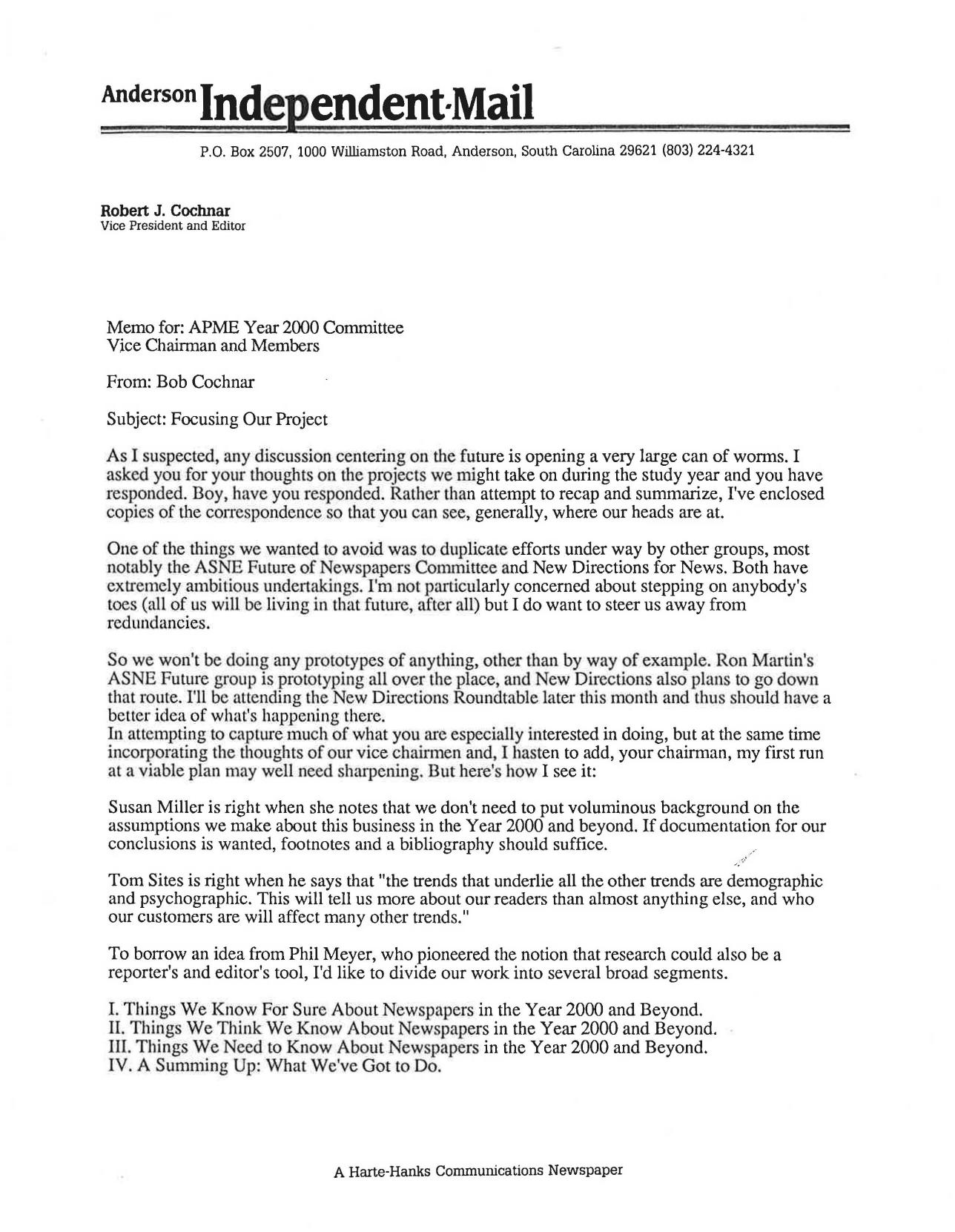
Typewritten memo from editor Robert J. Cochnar to the APME Year 2000 Committee outlining a study plan for newspapers

Focusing a Committee on the Year 2000

This is a memo from Robert J. Cochnar, vice president and editor of the Anderson Independent-Mail in South Carolina, to the members of the Associated Press Managing Editors Year 2000 Committee. He had asked the committee what it should study during its year of work, and the replies — enclosed with the memo, from papers all over the country — make up the bulk of the packet.

As I suspected, any discussion centering on the future is opening a very large can of worms. I asked you for your thoughts on the projects we might take on during the study year and you have responded. Boy, have you responded.

I’m in this document twice: once as a new addition to the committee, and once in the membership list, at 120 E. Van Buren St. in Phoenix.

Incidentally, I’ve expanded our committee a bit with some distinguished folks who have expressed their willingness to add their expertise to the hopper. They are Bob Haiman, who runs the Poynter Institute, and Howard Finberg, assistant managing editor for graphics at the Arizona Republic.

Cochnar’s first concern was not duplicating the work of the ASNE Future of Newspapers Committee, chaired by Ron Martin, or New Directions for News. So no prototypes. Instead he proposed a structure that still strikes me as a smart way to organize thinking about the future:

I. Things We Know For Sure About Newspapers in the Year 2000 and Beyond.
II. Things We Think We Know About Newspapers in the Year 2000 and Beyond.
III. Things We Need to Know About Newspapers in the Year 2000 and Beyond.
IV. A Summing Up: What We’ve Got to Do.

Not essays. An introduction, a conclusion, and in between, well-organized snippets from the literature and from smart people inside and outside the business — contradictions allowed, sources required. Cochnar described the goal as “a sort of extended data bank, or almanac, of facts, ideas and notions” that an editor could cherry-pick from a table of contents. He also liked a committee member’s suggestion that it all be treated as an interim report, with annual updates from future committees on the future, which he thought should adopt Satchel Paige’s line:

“Don’t look back; something may be gaining on us.”

The work was split into two groups: George Blake of the Cincinnati Enquirer on content and production, Susan Miller of Scripps Howard on everything else — circulation, advertising, competition, legal trends. Doug Ramsey at the Foundation for American Communications had proposed a co-sponsored committee meeting; Cochnar was thinking June, in Atlanta.

The enclosed correspondence is the real reward here. Tom Stites of the Chicago Tribune argued for starting with the underlying trends, a point Cochnar quoted back to the committee:

“the trends that underlie all the other trends are demographic and psychographic. This will tell us more about our readers than almost anything else, and who our customers are will affect many other trends.”

Stites also noted that Alvin Toffler wrote “Future Shock” on a personal computer but never mentioned personal computers in the book — a warning I’ve repeated in one form or another for most of my career. Others wrote about pagination and electronic photo handling reshaping newsroom structure, about classified advertising eventually moving to interactive electronic media, about retailing shifting away from the big department stores, about recruiting and keeping women and minorities, and about owners with no history in journalism buying profitable newspapers.

Reading it now, what stands out isn’t what the committee got wrong. It’s how much of it the industry saw coming and how little of it changed anyone’s behavior in time. And a small note of personal history: Bob Haiman joined this committee running Poynter, an institution where I’d spend a good chunk of my later career.

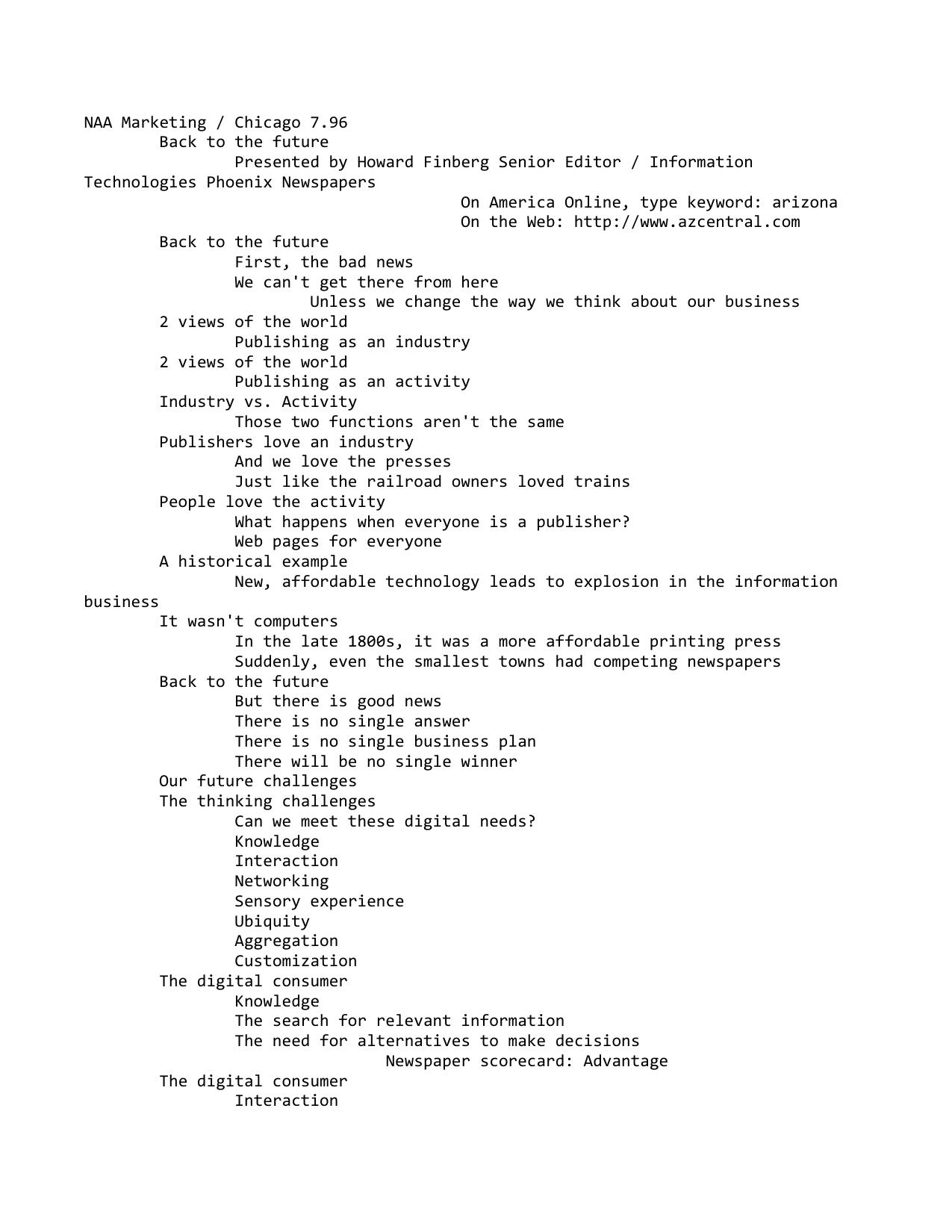
Title slide reading "Back to the future" from a July 1996 NAA marketing and technology meeting presentation in Chicago

Back to the Future: A 1996 Presentation to NAA Marketing

In July 1996 I presented “Back to the future” at an NAA marketing and technology business meeting in Chicago. At the time I was Senior Editor / Information Technologies at Phoenix Newspapers

The argument started with the bad news:

We can’t get there from here
Unless we change the way we think about our business

That change meant seeing the difference between publishing as an industry and publishing as an activity. Publishers love the industry — and the presses — “Just like the railroad owners loved trains.” But people love the activity. My historical example wasn’t computers at all: in the late 1800s a more affordable printing press gave even the smallest towns competing newspapers.

The heart of the talk was a scorecard, rating newspapers against seven digital consumer needs — knowledge, interaction, networking, sensory experience, ubiquity, aggregation and customization. The tally: two advantages, three neutrals, two disadvantages.

I also warned against the era’s favorite word:

Don’t “repurpose” content
Repurpose our role

And about the delivery debate: “It isn’t about dead trees OR live wires.” Forget online, forget the Web, forget about the wires — focus on information value.

Two outside voices made the point better than I could. Mark Hauptschein, director of strategy and business development at Ameritech:

“The old way of throwing advertising – spraying and praying – will weaken over time. Marketing will become a form of content.”

And Eric Berg, Price Waterhouse director of technology:

“In the late 1990s, getting access to information will no longer be an issue. The real issue will be avoiding information. We’re going to need new technology which will enable us to filter, sort and extract the information which is relevant to us.”

The process section covered the questions we were all avoiding — what is news, what are the jobs, what kind of organization — plus the return of the 24-hour newsroom and a caveat I still like: going from hot type to cold type is evolutionary; going digital is revolutionary. Make sure the paradigm really shifts.

There was good news, too. No new technology has yet replaced an older one, and information providers have always found a way, from newsbooks to newsletters to newspapers. I closed with Darwin — survival belongs to the most adaptable — and with people:

Give them information
Give them tools
Give them training
Give them room

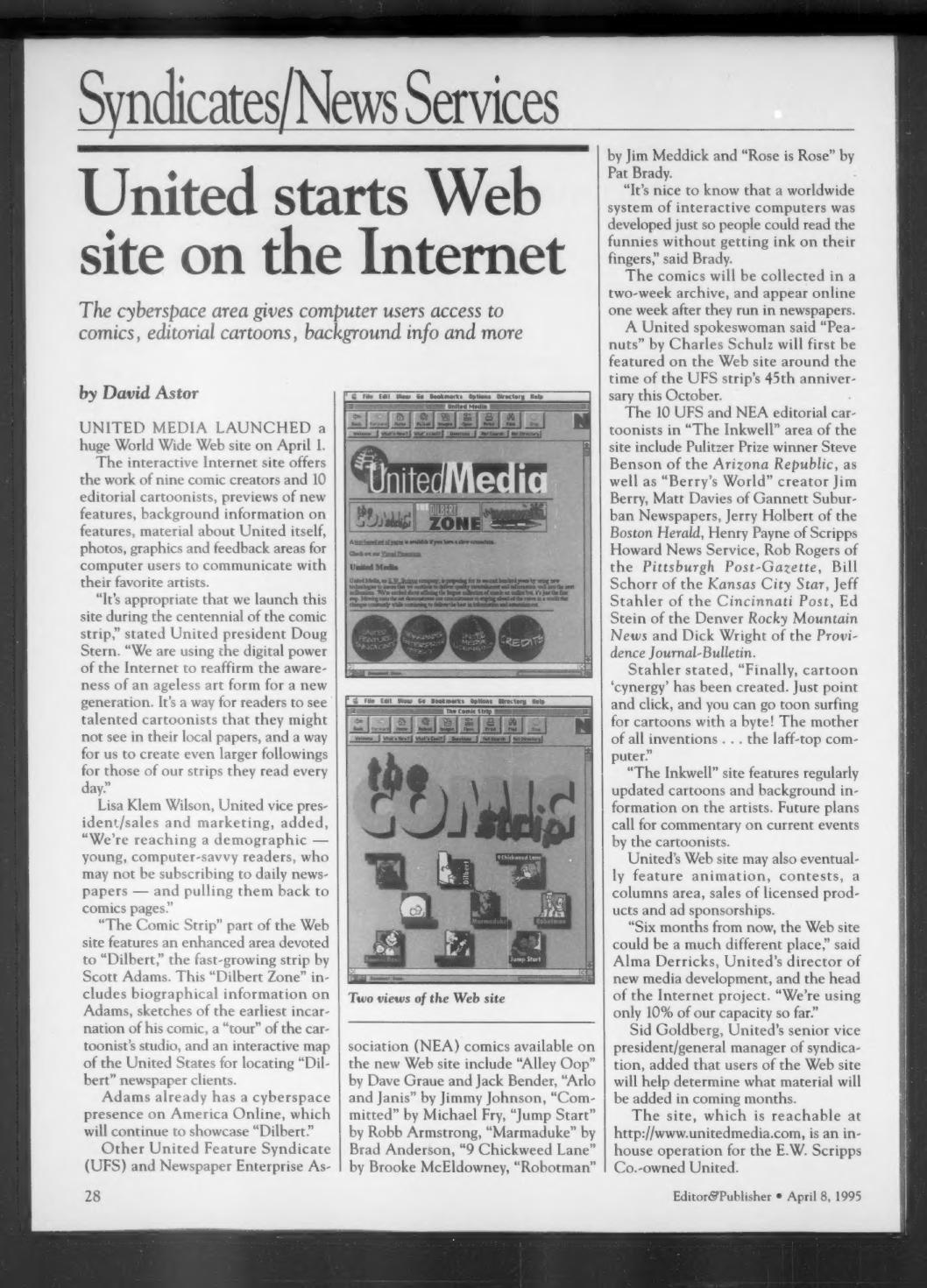
Editor & Publisher syndicates and news services page from April 8, 1995, reporting United Media's World Wide Web site launch

Early Syndicate Efforts on the Web, 1995

A syndicates and news services page from the April 8, 1995, issue of Editor & Publisher, reported by David Astor. The lead story covers United Media‘s April 1 launch of a World Wide Web site at http://www.unitedmedia.com — an in-house operation for the E.W. Scripps Co.-owned syndicate — carrying the work of nine comic creators and 10 editorial cartoonists, along with feature previews, background information, photos, graphics and feedback areas. 

Comics from United Feature Syndicate and Newspaper Enterprise Association were to be collected in a two-week archive and posted online one week after newspaper publication. “The Comic Strip” section included an enhanced “Dilbert Zone” devoted to Scott Adams‘ strip, with biographical material, early sketches, a “tour” of the studio and an interactive map for locating “Dilbert” client newspapers; Adams also maintained a presence on America Online. “The Inkwell” area featured the editorial cartoonists, among them Pulitzer Prize winner Steve Benson of the Arizona Republic.

From United president Doug Stern:

“We are using the digital power of the Internet to reaffirm the awareness of an ageless art form for a new generation. It’s a way for readers to see talented cartoonists that they might not see in their local papers, and a way for us to create even larger followings for those of our strips they read every day.”

Lisa Klem Wilson, United vice president/sales and marketing, framed the audience question:

“We’re reaching a demographic — young, computer-savvy readers, who may not be subscribing to daily newspapers — and pulling them back to comics pages.”

Alma Derricks, United’s director of new media development and head of the Internet project, said the site could eventually add animation, contests, a columns area, licensed product sales and ad sponsorships:

“Six months from now, the Web site could be a much different place. We’re using only 10% of our capacity so far.”

The rest of the page carries shorter items: centennial-of-comics events announced by the Newspaper Features Council, including Sunday night live chat sessions with cartoonists on America Online beginning May 7 with Mort Walker, an AOL centennial area starting May 5, a Library of Congress comics exhibit, U.S. Postal Service cartoon stamps, and an October comic fair in Bryant Park; Universal Press Syndicate‘s new statistics column “Unconventional Wisdom” by Washington Post polling director Richard Morin; Tribune Media Services‘ new panel “True!” by Daryl Cagle; the debut of Tool User Comics, an “online comic book publisher” on the Web; Ray Walker’s promotion to news editor of Knight-Ridder/Tribune News Service; and “Jill Jackson’s Hollywood” from the King Features Weekly Service.

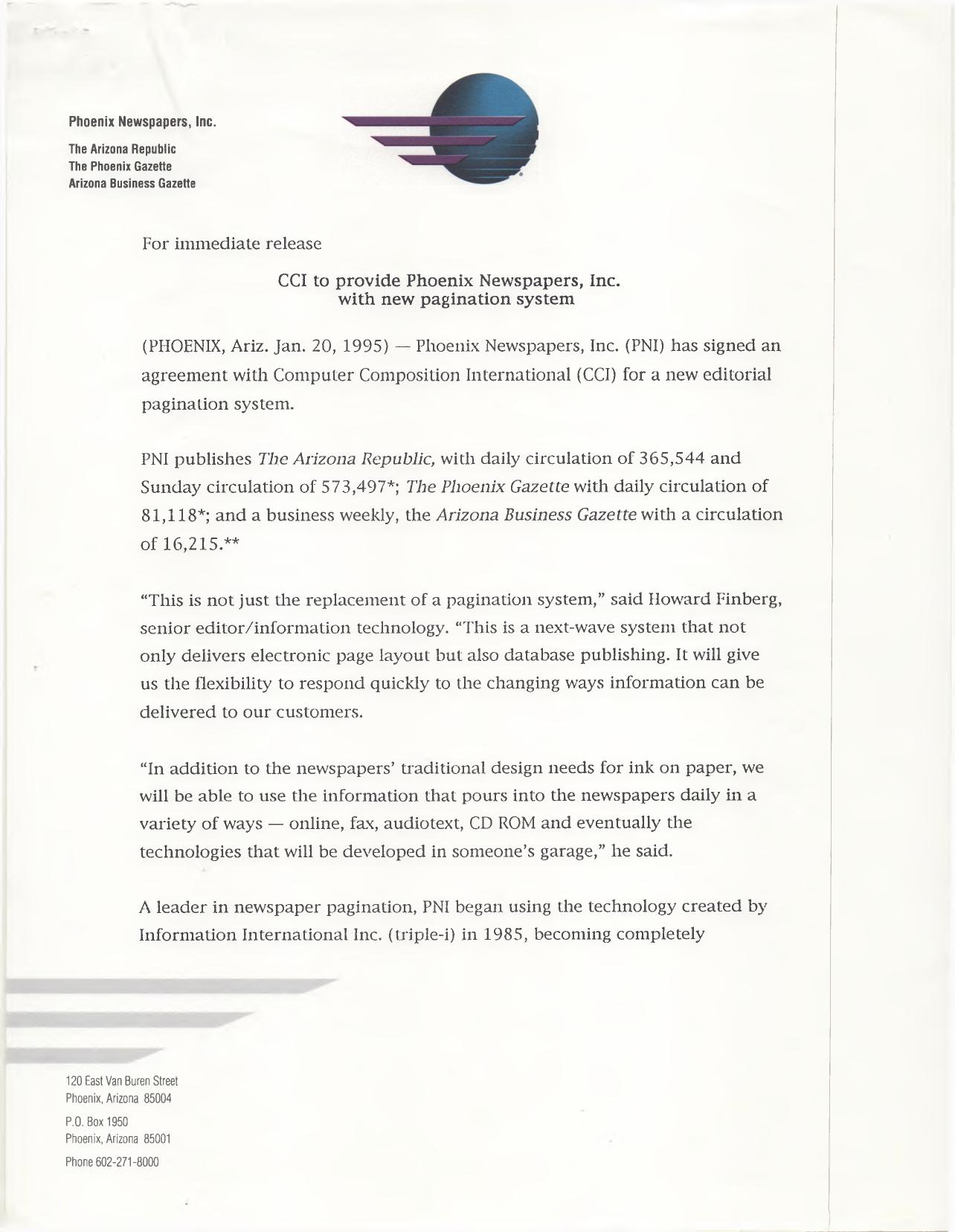
Phoenix Newspapers press release dated January 20, 1995, announcing the CCI pagination system contract

Announcing the CCI Pagination at Phoenix Newspapers

This is the press release Phoenix Newspapers, Inc. issued on January 20, 1995, announcing that PNI had signed with Computer Composition International for a new editorial pagination system. I was senior editor/information technology at the time, and this was the project I led in Phoenix. I also helped other newspapers think through database publishing.

The point I wanted to make in the announcement wasn’t about replacing aging equipment. It was about what a publishing database could do beyond the printed page.

“This is not just the replacement of a pagination system,” said Howard Finberg, senior editor/information technology. “This is a next-wave system that not only delivers electronic page layout but also database publishing. It will give us the flexibility to respond quickly to the changing ways information can be delivered to our customers.”

And on where that information might go:

“In addition to the newspapers’ traditional design needs for ink on paper, we will be able to use the information that pours into the newspapers daily in a variety of ways online, fax, audiotext, CD ROM and eventually the technologies that will be developed in someone’s garage,” he said.

The garage line was a bit of a joke at the time, since Apple Computers started in a garage. Looking back from 2026, it holds up better than the list that preceded it u2014 fax and audiotext are gone, CD ROM is a museum piece, and the things built in garages turned out to be the whole story.

PNI was not new to pagination. The release notes the newspapers began using Information International Inc. (triple-i) technology in 1985 and were completely paginated in 1987, with The Republic, The Gazette and the Arizona Business Gazette paginating roughly 2,000 pages a week. That history mattered: the CCI installation had to coexist with the triple-i pagesetters at the Deer Valley and Mesa production centers and with the triple-i scanners.

What strikes me rereading it is how much of the release is given over to the people who would actually use the system. Johnny Thoegersen of CCI made the WYSIWYG argument u2014 that the same designer could do more pages in the same amount of time, thanks to templates and automatic features u2014 and described the database as a central information repository accessible across departments. But the better quotes came from inside the building.

Dave Seibert, a pagination project team leader at PNI, said the CCI system “will let us pull up data and link photos easily. And the designers won’t have to work in a cavelike, low-light atmosphere anymore. They’ll be able to see a headline in color in their screens, something they can’t do now.”

Jenny Ignaszewski, a Gazette page designer, is looking forward to the new system because “it will make it easier to do wraps, illustrations and typography. We’ll have the capability of doing feature page design more easily under deadline.”

Mike Wilson, project team leader from Information Services, called CCI “the best system on the market today” and flagged the real engineering challenge u2014 the interfaces back to the existing triple-i equipment. The CCI server was to live in the computer room on the third floor of the Phoenix Center. Where the page design system itself would go was, as of the announcement, still undecided.

Installation was scheduled to begin that summer, with the first phase completed in late 1995.

One last artifact worth noting: the contact block at the bottom lists a fax number and an e-mail address, hfinberg@pni.com. In early 1995, listing both was still a hedge.

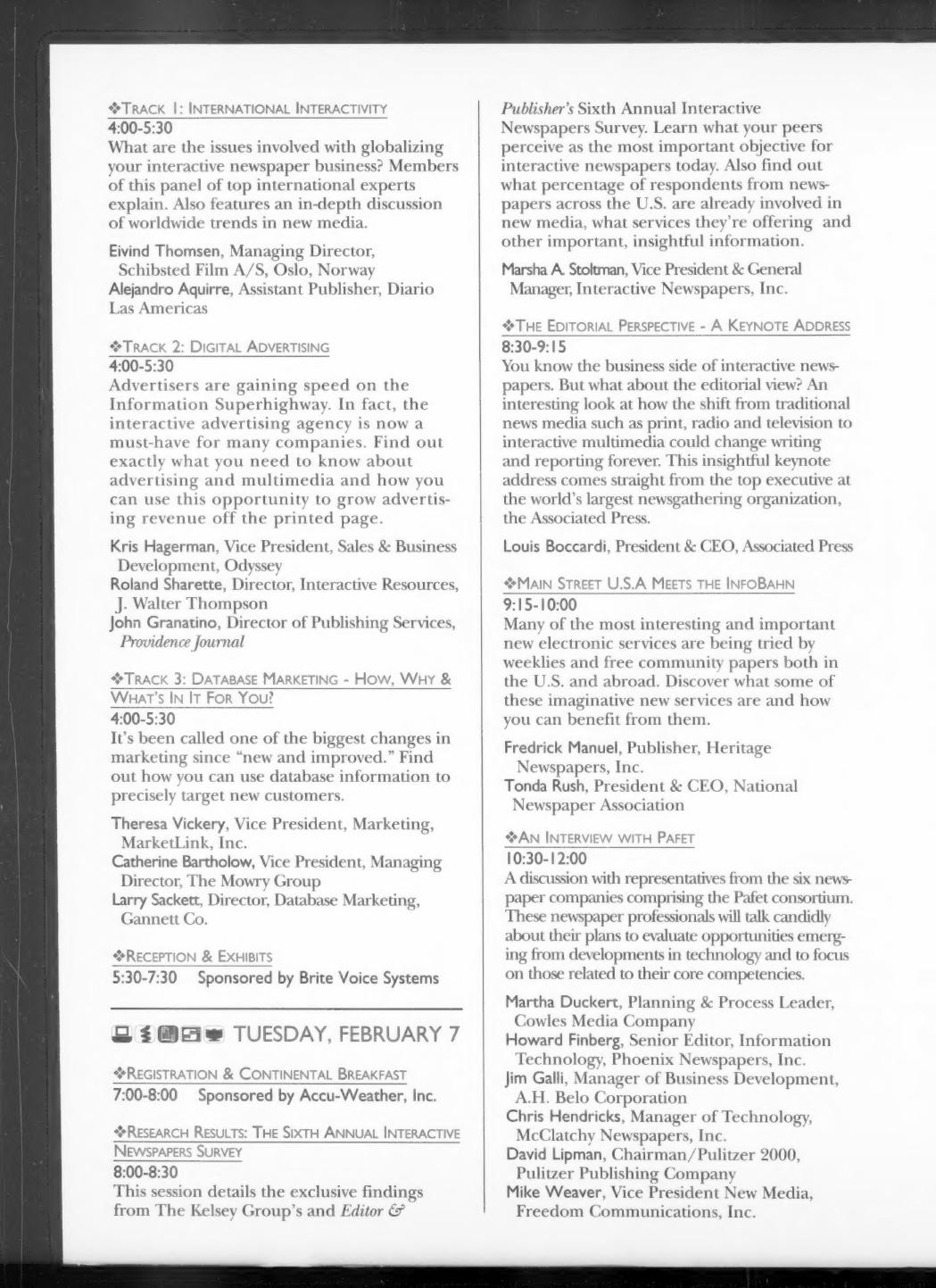
Interactive Newspapers conference program page listing the Pafet consortium panel and its six newspaper company representatives

Pafet Goes Public at Interactive Newspapers Conference

The conference program for the interactive newspapers gathering — built around The Kelsey Group’s and Editor & Publisher’s Sixth Annual Interactive Newspapers Survey — put the Pafet consortium on the Tuesday morning agenda, with a representative from each of the six member companies on stage.

AN INTERVIEW WITH PAFET
10:30-12:00
A discussion with representatives from the six newspaper companies comprising the Pafet consortium. These newspaper professionals will talk candidly about their plans to evaluate opportunities emerging from developments in technology and to focus on those related to their core competencies.

I was there for Phoenix Newspapers, one of six panelists listed:

Martha Duckert, Planning & Process Leader, Cowles Media Company
Howard Finberg, Senior Editor, Information Technology, Phoenix Newspapers, Inc.
Jim Galli, Manager of Business Development, A.H. Belo Corporation
Chris Hendricks, Manager of Technology, McClatchy Newspapers, Inc.
David Lipman, Chairman/Pulitzer 2000, Pulitzer Publishing Company
Mike Weaver, Vice President New Media, Freedom Communications, Inc.

The rest of the program is a nice snapshot of what the industry was worried about at the time: international interactivity, digital advertising, database marketing, and a keynote from Louis Boccardi, President & CEO of the Associated Press, on what he called the editorial perspective. My favorite session title on the page: “MAIN STREET U.S.A MEETS THE INFOBAHN.”

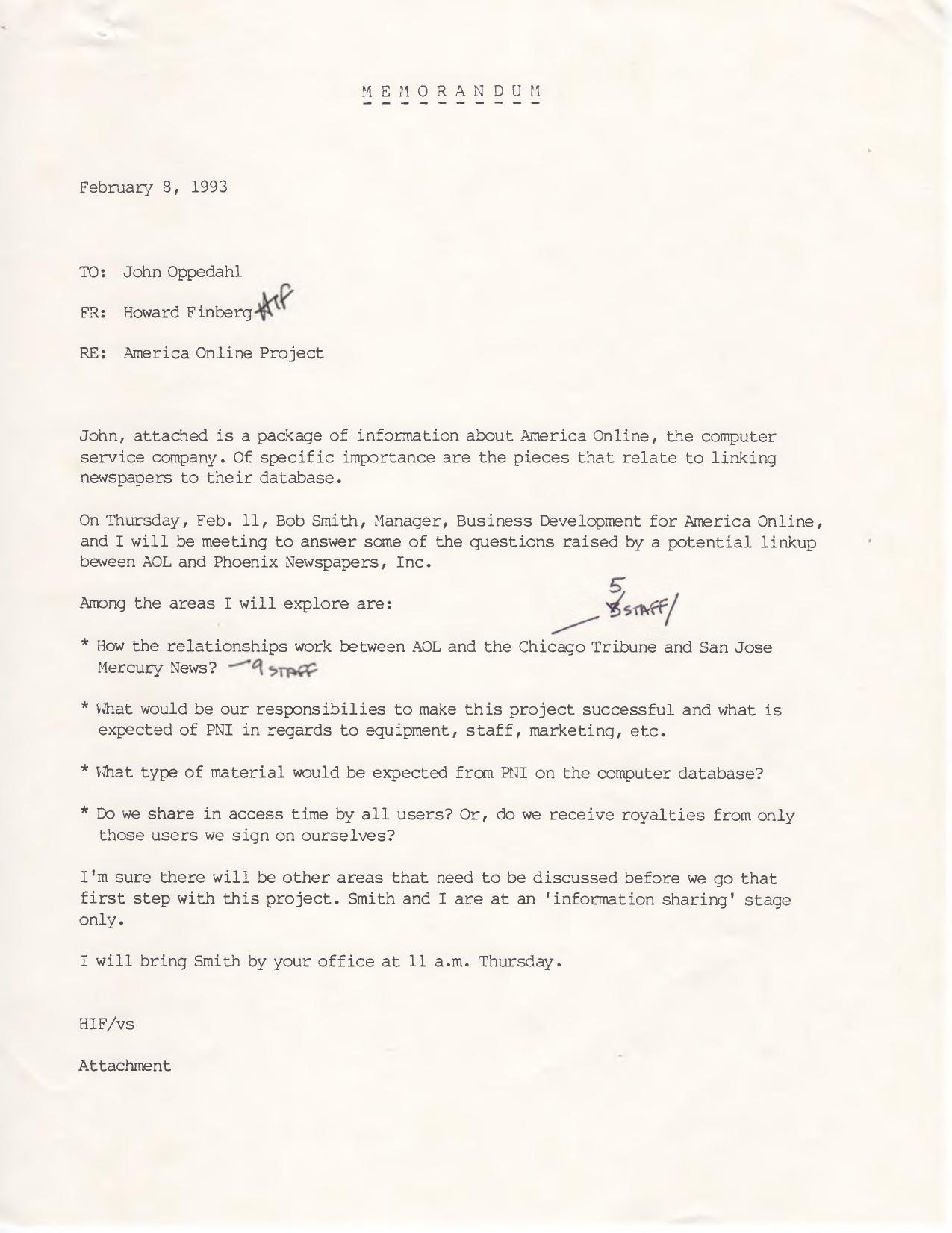
Typed 1993 internal memo to Phoenix Newspapers executive John Oppedahl outlining questions for a meeting with America Online

An Early Look at America Online

This is a short memo I wrote in February 1993 to John Oppedahl, then an executive at Phoenix Newspapers, Inc., about a meeting I had scheduled with America Online. At the time, AOL was signing up newspapers to put content into its database, and I wanted to understand what such a partnership would mean for PNI before anyone committed to anything.

John, attached is a package of information about America Online, the computer service company. Of specific importance are the pieces that relate to linking newspapers to their database.

The meeting was set for Thursday, Feb. 11, with Bob Smith, Manager, Business Development for America Online. The questions I planned to ask were the basic ones any newspaper should have been asking in 1993 — and, honestly, the ones many didn’t ask carefully enough:

* How the relationships work between AOL and the Chicago Tribune and San Jose Mercury News?

* What would be our responsibilities to make this project successful and what is expected of PNI in regards to equipment, staff, marketing, etc.

* What type of material would be expected from PNI on the computer database?

* Do we share in access time by all users? Or, do we receive royalties from only those users we sign on ourselves?

That last question — who gets paid, and for whose audience — turned out to be the one the industry spent the next decade arguing about.

I was careful to keep expectations modest:

I’m sure there will be other areas that need to be discussed before we go that first step with this project. Smith and I are at an ‘information sharing’ stage only.

The memo closes with the smallest of logistical notes: I would bring Smith by Oppedahl’s office at 11 a.m. Thursday.

Postscript: Phoenix Newspapers did sign an agreement with America Online.

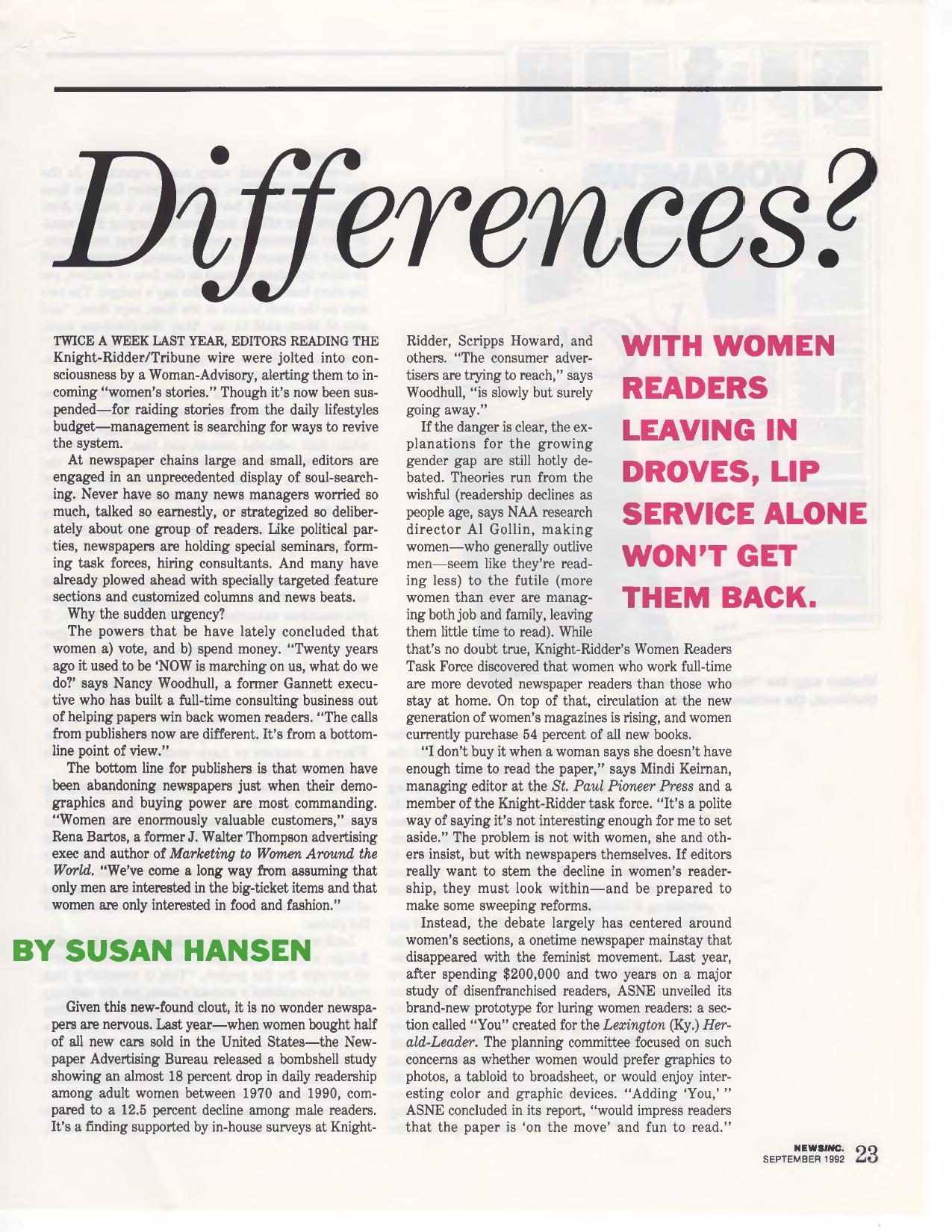
NewsInc. September 1992 article spread headlined "Differences?" examining why women were leaving newspapers

Looking at the Newspaper Gender Gap,1992

An article by Susan Hansen in the September 1992 issue of NewsInc., examining why women were leaving newspapers and what editors were — and weren’t — doing about it. The piece opens with the Knight-Ridder/Tribune wire’s short-lived “Woman-Advisory” alerts and moves through the task forces, consultants, seminars and targeted sections that chains large and small had launched, driven less by principle than by economics.

The powers that be have lately concluded that women a) vote, and b) spend money.

The numbers cited: a Newspaper Advertising Bureau study showing an almost 18 percent drop in daily readership among adult women between 1970 and 1990, compared with a 12.5 percent decline among male readers; women holding only 10 percent of editor and executive editor slots at papers with circulations of more than 250,000, per the National Federation of Press Women; and a Women, Men, and Media Project survey of 20 front pages in February 1992 that found women claimed just 34 percent of bylines and only 13 percent of those referenced or quoted.

Quoted throughout are consultant and former Gannett executive Nancy Woodhull, St. Paul Pioneer Press managing editor Mindi Keirnan, Los Angeles Times associate editor Narda Zacchino, Washington Post columnist Judy Mann, Knight-Ridder vice president for news Jennie Buckner, and Georgetown linguist Deborah Tannen. Keirnan on the “no time to read” explanation:

“I don’t buy it when a woman says she doesn’t have enough time to read the paper… It’s a polite way of saying it’s not interesting enough for me to set aside.”

Much of the industry’s response, the article reports, centered on reviving women’s sections — ASNE‘s $200,000 “You” prototype for the Lexington (Ky.) Herald-Leader, and the Chicago Tribune‘s “Womanews,” which about 60 newspapers signed on to syndicate in its first year. Critics warned of ghettoizing serious coverage. Zacchino:

“I find women saying we need to do more in the rest of the paper. We should start on the front page—make women feel this entire newspaper has something of interest to them.”

A companion feature, “Advice and Dissent,” gave 10 newswomen free rein to critique the front pages of The New York Times and the Los Angeles Times. The panel: Deborah Howell of Newhouse News Service; Jacqui Banaszynski of the St. Paul Pioneer Press; Amy Kisman of USA Weekend; Nina Bernstein of New York Newsday; Emilia Askari of the Detroit Free Press; Renée Loth of the Boston Globe; columnists Judy Mann, Robin Abcarian of the L.A. Times and Betty Bayé of the Louisville Courier-Journal; and graphics director Laura Varon Brown of the Detroit Free Press. Their consensus was to focus on real people, replace foreign roundups with enterprise, and give women a presence.

“The truth about why women are leaving newspapers is self-evident,” says Washington Post columnist Judy Mann. “I don’t exist on these front pages.”

The article closes with examples of papers changing beats rather than adding sections — a full-time day care reporter and family page at the Charlotte Observer, expanded women’s sports and personal finance coverage at the Rocky Mountain News, and at the St. Paul Pioneer Press, reduced local political coverage, doubled education staffing, a new women’s health care reporter, and new consumer and local transportation beats. Keirnan on what convinced her staff, after she made line editors and reporters interview women readers and nonreaders directly:

“When people say to you ‘I read the paper while I blow dry my hair,’ you get religion.”

Cover of the Newspaper Advertising Bureau's October 1987 report summarizing the 1987 Newspaper Inventory Survey of U.S. daily newspapers

Daily Newspapers ’87: Taking Stock

An October 1987 report from the Newspaper Advertising Bureau summarizes the findings of NAB’s 1987 Newspaper Inventory Survey — a mail survey of every daily and Sunday/weekend newspaper in the United States and Canada, and the fifth in a series that began in 1967 and continued in 1974, 1979 and 1983. This volume covers local, English-language weekday editions in the U.S. only; a companion volume handled Sunday and weekend editions.

The survey’s original purpose was commercial: give advertisers and agencies a way to find newspapers carrying particular standing features, so an ad could be positioned next to the right kind of content. Later editions added questions about content, graphics and layout, positioning practices, ROP color, zoning, split runs and home delivery. The 1987 weekday inventory counted twelve kinds of sections and fifty-eight kinds of features or columns. (Pretty quaint given how ads are placed today.)

The base for the tables:

The summary tables shown are based on completed questionnaires from 987 daily newspapers representing 59% of all United States dailies and 79% of total circulation.

On content, the report found the churn of the early 1980s hadn’t slowed:

Findings from the 1987 Newspaper Inventory show that the period of rapid change in content, previously noted in the 1979 and 1983 inventories, continues unabated. Since 1983, nearly seven out of ten newspapers (69%) report substantial changes in content.

The most frequently reported changes were increased business coverage (53% of newspapers), increased sports coverage (45%), and a shift in the ratio of state and local to national and international coverage (35%).

The design numbers are the ones I keep coming back to. Eighty-two percent of newspapers — 91% of circulation — reported substantial changes in graphics or layout since 1983. More use of ROP color (61%) and conversion to Standard Advertising Units (SAU) page and column specs (60%) led the list, followed by changed mastheads, changed typefaces, more photographs, and modular front pages. And then this:

There has also been a substantial increase in use of computer graphics. In the 1987 study, 28% of responding dailies (52% of circulation) reported more use of graphics compared to 2% in 1983 (3% of circulation).

The feature tables are a time capsule. Crossword puzzles appeared in 98% of weekday circulation, spectator sports 94%, astrology 92%, TV log 92%, business and finance 89%, weather map 89%. Ninety-five percent of responding papers carried comic strips, and the typical weekday edition had three physically separate sections. Zoning was reported by 30% of dailies but 59% of circulation. The median share of weekday circulation that was home delivered: 85%.

The study was directed by Charles Lehman of NAB’s Research Department, and the report was updated by Dorothy Shea. A computerized list of editions carrying any particular section or feature was available on request — by telephone.

Reading this in 2026, what stands out isn’t just how many of these features have vanished from print (the TV log, the movie timetable, the radio log, the stock tables) but that the inventory itself was a product for advertisers — a printed, mailed, hand-tabulated database of what newspapers contained. That function moved online long ago, along with the advertising it was built to serve. The Newspaper Advertising Bureau no longer exists as a separate organization; its work eventually merged into the industry association that became the Newspaper Association of America.