I wrote a memo about the future of the Chicago Tribune. It was part of a task force looking to redo the paper.
I wrote a memo about the future of the Chicago Tribune. It was part of a task force looking to redo the paper.
This is the announcement of the Digital Credibility Study, which was funded by the Knight Foundation
The ONA project used virtual brainstorm, facilitated D.S. Griffen & Associates. It was a way to gather a large number of people to brainstorm the project’s main survey
This is a PDF of the Online News Association study on digital credibility, co-authored by Howard Finberg and Martha Stone with assistance from Diane Lynch. Here’s what the goals of the project were:
ONA’s Web Credibility Study, for which it was awarded $225,000 from the John S. and James L. Knight Foundation (www.knightfdn.org), is studying the impact of technology and the Internet on the gathering and dissemination of news.
The study will work to develop and promote principles and guidelines for online journalism focusing on proper relationships between editorial content, advertising and e-commerce; the development of ethical standards and avoidance of conflicts of interest; and appropriate use of hyperlinking in a journalistic environment.
A copy of the announcement that the study results will be released at the ONA convention in Berkeley, Ca. on Oct. 27, 2001
Here’s a copy of the main online credibility presentation given at the ONA convention in 2001. The goal was to share the results of the ONA Credibility study conducted in 2000-2001. This PDF includes notes or a script for the presenters. It has the key elements the authors wanted to share with the audience. I conducted the survey work and wrote a large section of the report and was responsible for creating the presentation.
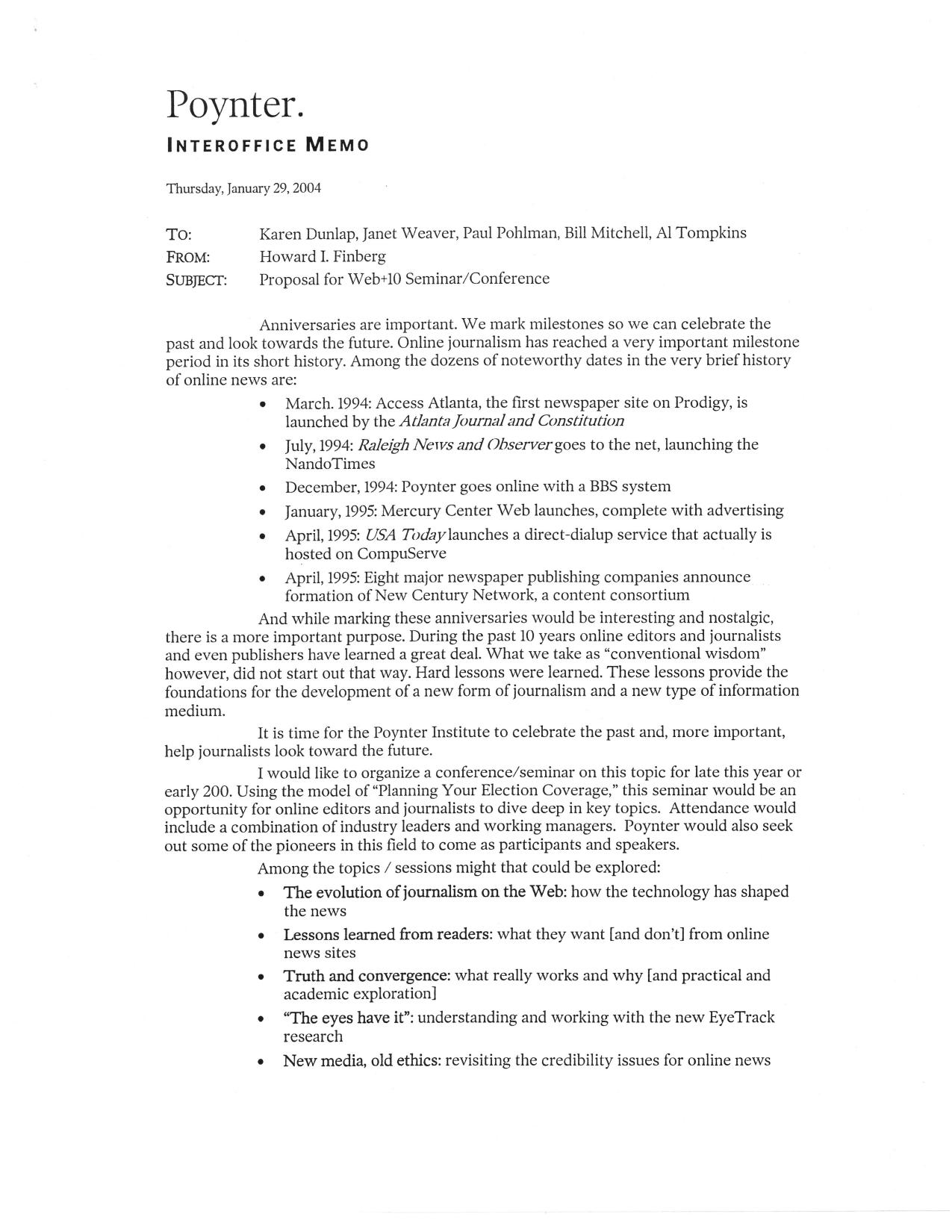
This is an interoffice memo I wrote at the Poynter Institute in January 2004, proposing a seminar to mark — and, more usefully, to learn from — the first 10 years of news on the Web. It went to Karen Dunlap, Janet Weaver, Paul Pohlman, Bill Mitchell and Al Tompkins, with copies to a number of colleagues working on Poynter Online and News University.
The premise was simple:
Anniversaries are important. We mark milestones so we can celebrate the past and look towards the future.
I laid out a short list of the dates that felt like the founding moments of online news: Access Atlanta launching on Prodigy in March 1994, the Raleigh News and Observer’s NandoTimes in July 1994, Poynter going online with a BBS in December 1994, Mercury Center Web in January 1995 (“complete with advertising”), USA Today’s dial-up service in April 1995, and the announcement that same month of New Century Network by eight major newspaper publishing companies.
But nostalgia wasn’t the point. What we had come to accept as conventional wisdom by 2004 had been paid for the hard way:
What we take as “conventional wisdom” however, did not start out that way. Hard lessons were learned. These lessons provide the foundations for the development of a new form of journalism and a new type of information medium.
The proposed format borrowed from Poynter’s “Planning Your Election Coverage” seminar — a mix of industry leaders and working managers, plus some of the pioneers of the field as participants and speakers. The session ideas ranged from the evolution of journalism on the Web to what readers actually wanted from news sites, convergence, the new EyeTrack research, credibility and ethics, changing media habits, “Sight and sound: the emerging Web senses,” and the interactivity challenge I titled “You provide, but I drive.”
I also wanted the seminar to be more than a room in St. Petersburg. The idea was to extend the conversation before and after the in-person meeting using News University as a platform, carry the teaching into Poynter Online, and possibly publish a special Poynter Report as a handbook “to guide online journalism into the next 10 years.”
The postscript is my favorite part of the memo. Just after I finished writing, Robin Sloan posted an item to Convergence Chaser about New York Times Digital CEO Martin Nisenholtz speaking about… Pong. Nisenholtz argued that nytimes.com would evolve
from sorting, distributing and making accessible content created principally for other formats, to creating content that is native to the computing world from which we evolved.
My reaction, in the memo: we needed to bring him to Poynter to explore what “native content” meant for journalists and journalism.
Reading this now, the milestone list looks impossibly early and the questions look impossibly current. We’re well past Web+30, and we are still arguing about credibility, about who drives the experience, and about what content native to a new platform actually looks like — only now the platform is generative AI rather than the browser.
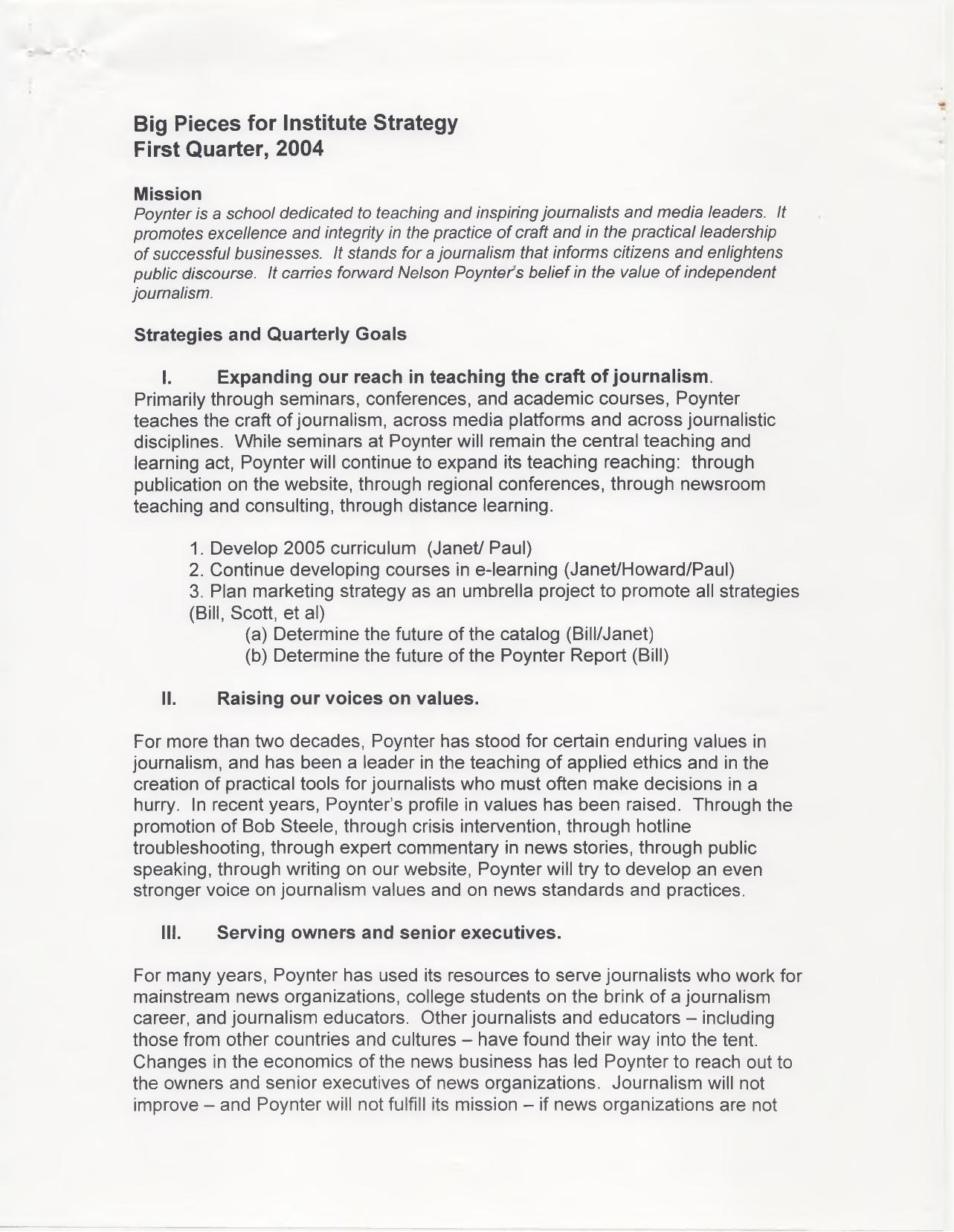
A two-page strategy document prepared for a Poynter Institute strategy session, dated January 15, 2004. It sets out the Institute’s mission and then four strategies, each with quarterly goals and named owners.
The mission statement opens the document:
Poynter is a school dedicated to teaching and inspiring journalists and media leaders. It promotes excellence and integrity in the practice of craft and in the practical leadership of successful businesses. It stands for a journalism that informs citizens and enlightens public discourse. It carries forward Nelson Poynter‘s belief in the value of independent journalism.
The four strategies: expanding the reach of teaching the craft of journalism; raising Poynter’s voice on values; serving owners and senior executives; and building the base at Poynter. Under the first, one of the numbered goals reads simply:
Continue developing courses in e-learning (Janet/Howard/Paul)
On the ethics side, the document describes Poynter’s long-standing role in the teaching of applied ethics and the creation of practical tools for journalists “who must often make decisions in a hurry,” and points to Bob Steele, crisis intervention, hotline troubleshooting, and expert commentary as the vehicles for a stronger voice on news standards and practices.
The third strategy marks the reach toward a new constituency:
Changes in the economics of the news business have led Poynter to reach out to the owners and senior executives of news organizations. Journalism will not improve and Poynter will not fulfill its mission if news organizations are not profitable and if journalists lack the resources they need to carry out their public service.
The final strategy is about the Institute itself: faculty and staff, campus, savings, and revenue, including hiring a development officer, partnerships, and re-evaluating tuition policies. It contains the line that best captures the place:
Poynter is a school that owns a newspaper, which keeps Poynter real, and brings to it resources in the form of stock dividends.
Sadly, things really didn’t work out for the newspaper or the Institute, which would go through a number of revenue models.
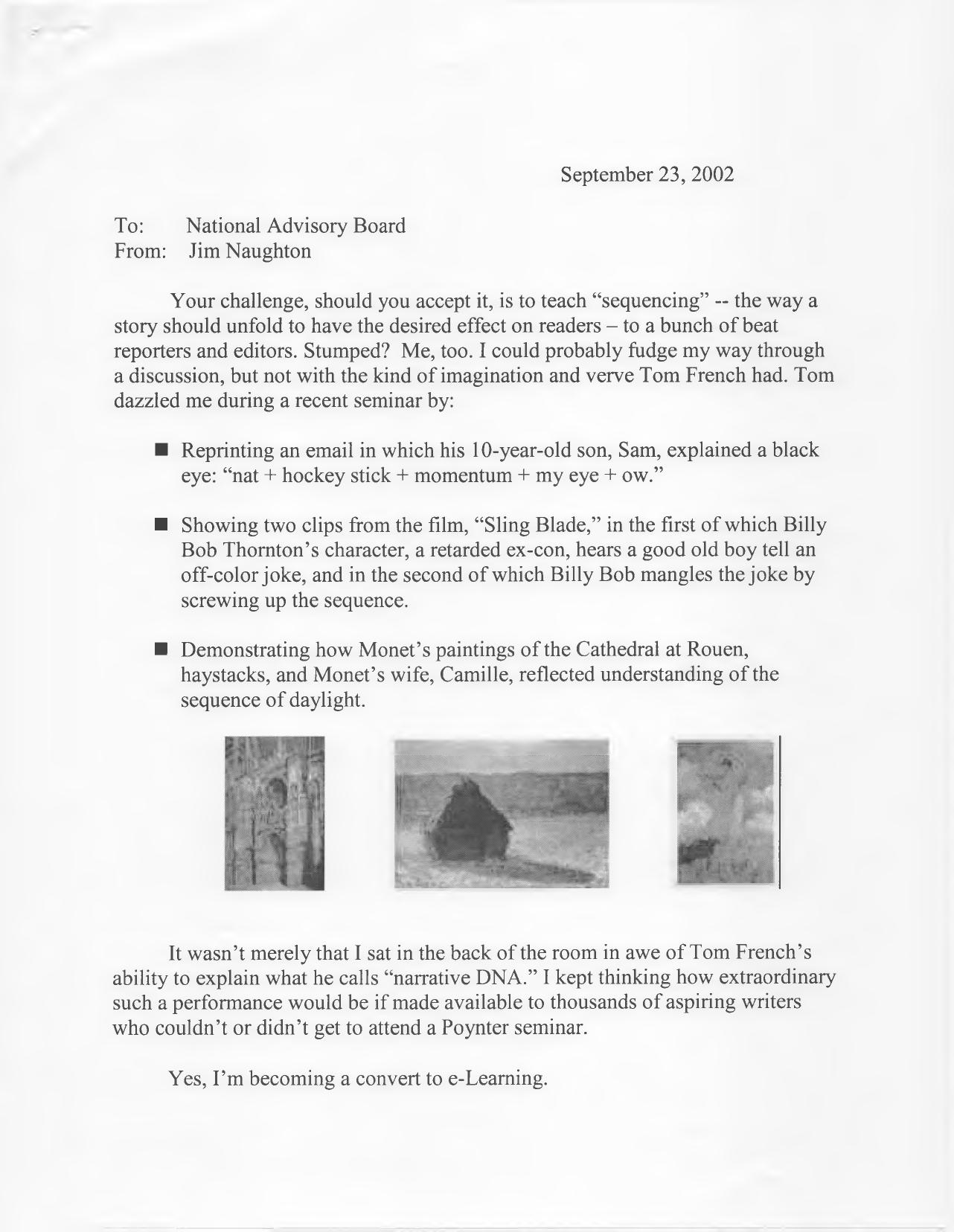
I first came to Poynter as a visiting scholar, hired by the Institute’s president, Jim Naughton. This memo went to the National Advisory Board and Poynter staff ahead of its meeting, and it is Naughton making the case for distance learning.
He opens with the challenge of teaching “sequencing” to beat reporters and editors, admits he’d fudge it, then describes how Tom French did it in a seminar — an email from French’s 10-year-old son explaining a black eye (“nat + hockey stick + momentum + my eye + ow”), two clips from “Sling Blade,” and Monet’s paintings of the cathedral at Rouen. What stayed with Naughton was the size of the room:
I kept thinking how extraordinary such a performance would be if made available to thousands of aspiring writers who couldn’t or didn’t get to attend a Poynter seminar.
Yes, I’m becoming a convert to e-Learning.
The memo notes that Dean Karen Dunlap had briefed the Board of Trustees on the faculty’s exploration of distance learning — “less structured, more self-guided” than what API and others were doing — and recounts Naughton emailing Hodding Carter at the Knight Foundation about collaborating. Carter replied almost immediately that the suggestion “comes at a good time”:
Eric Newton of Knight followed, saying they had been “thinking about Poynter as perfect” to collaborate on what they called “News University.” Naughton’s aside: “News U. Has a certain ring to it.”
And then my name appears, which is why this document is in my files:
As a Poynter visiting scholar, Howard Finberg has guided a faculty task force in considering e-learning. He’s drafted a report outlining our next steps and providing a focus for our discussions with the Knight Foundation.
Naughton’s closing was cautious — “We’ll see where this palaver goes” — but he saw the potential in combining Knight resources and Poynter teaching.
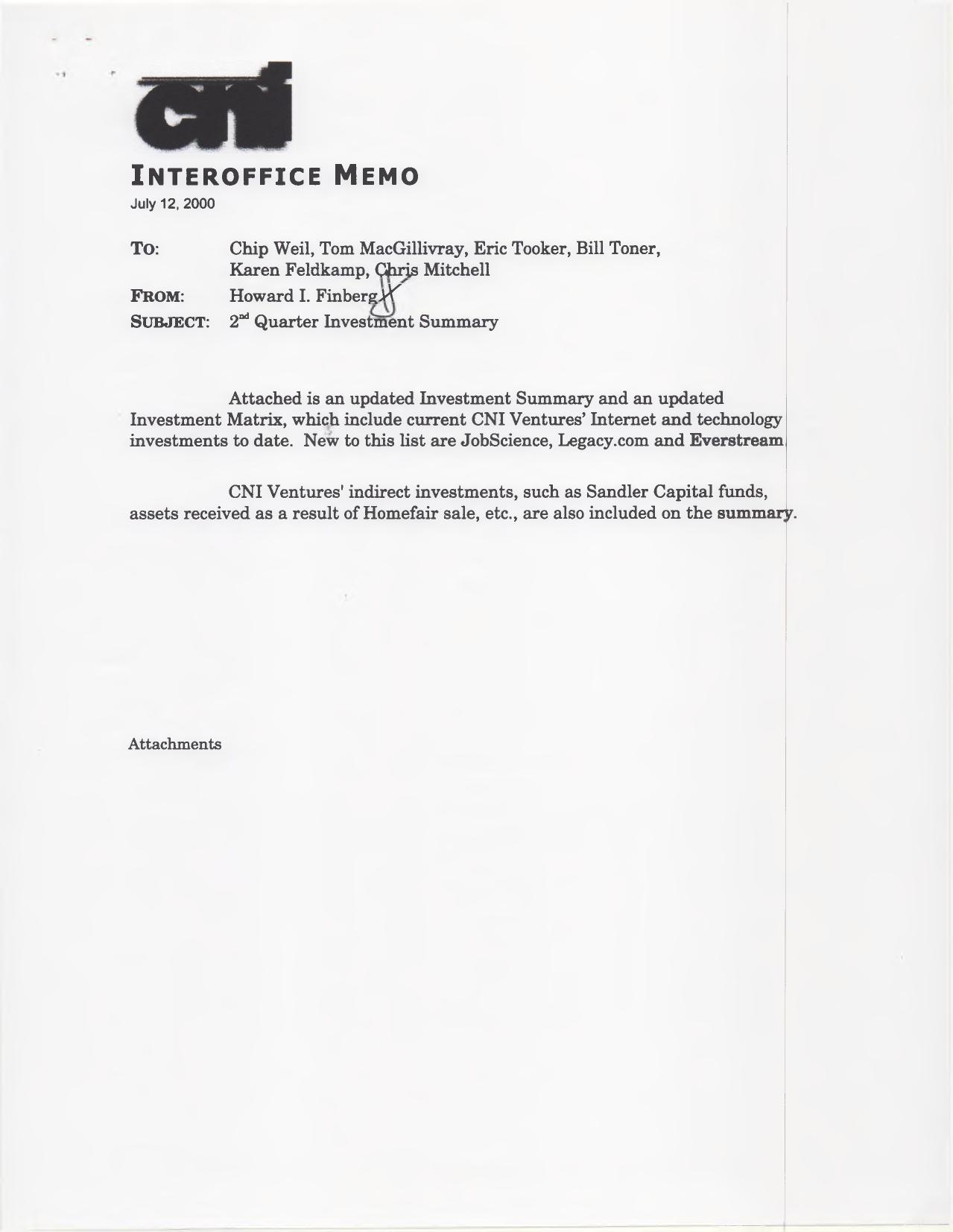
As head of Central Newspapers‘ venture capital investments, I sent quarterly reports to the CEO and other senior executives. This one — dated July 12, 2000 — went to Chip Weil, Tom MacGillivray, Eric Tooker, Bill Toner, Karen Feldkamp and Chris Mitchell.
Attached is an updated Investment Summary and an updated Investment Matrix, which include current CNI Ventures’ Internet and technology investments to date. New to this list are JobScience, Legacy.com and Everstream
The memo also notes that indirect investments — the Sandler Capital funds, assets received as a result of the Homefair sale — are included in the summary.
The attachments are the interesting part. The Investment Update Summary lists the portfolio company by company: EntryPoint, WaveShift, Event 411, E-ink, BrightStreet, StreamSearch, GAMUT [SmartTV], JobScience, Everstream and Legacy.com, with $8,882,998 in invested capital against a current valuation of $9,119,411. Add the realized, partially realized and publicly traded holdings — Microsoft, Homestore and the Sandler funds — and total investments come to $25,613,452.
The Investment Matrix, which I created, is the most interesting document because it asked more than “what is it worth?” Each company was tracked against its target market, its relationship to CNI’s businesses, our working relations with the company, and which other media companies were in the deal — Knight Ridder, McClatchy, Tribune Ventures, Cox, Hearst, Gannett, the Washington Post. On E-Ink:
Development of an electronic newspaper and the business models to support product[s]
And the entry for EntryPoint, our oldest holding, is a reminder that not everything worked:
Dormant. PointCast technology; assets were purchased by an IdeaLab company
A $200,000 investment carried at $13,571.
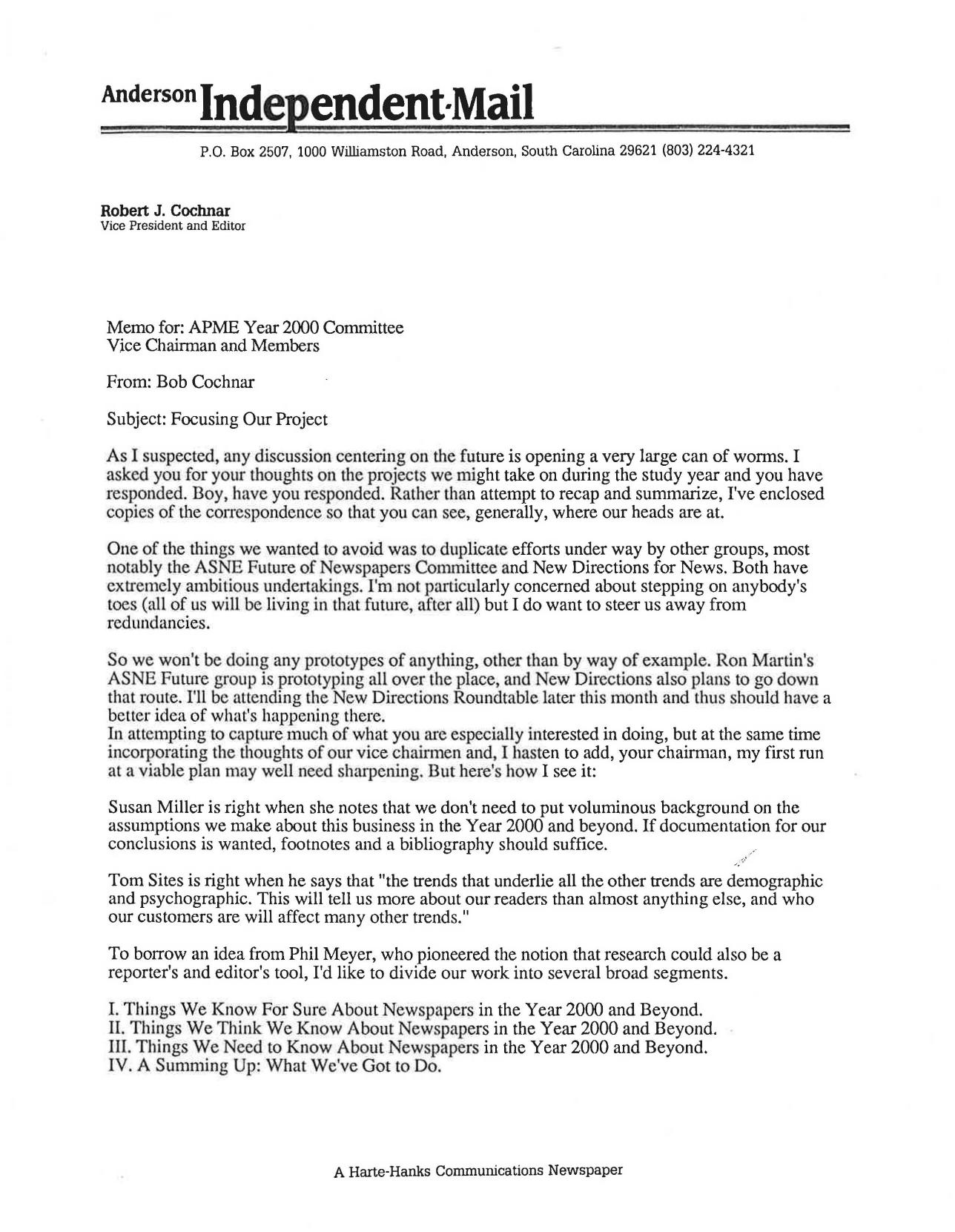
This is a memo from Robert J. Cochnar, vice president and editor of the Anderson Independent-Mail in South Carolina, to the members of the Associated Press Managing Editors Year 2000 Committee. He had asked the committee what it should study during its year of work, and the replies — enclosed with the memo, from papers all over the country — make up the bulk of the packet.
As I suspected, any discussion centering on the future is opening a very large can of worms. I asked you for your thoughts on the projects we might take on during the study year and you have responded. Boy, have you responded.
I’m in this document twice: once as a new addition to the committee, and once in the membership list, at 120 E. Van Buren St. in Phoenix.
Incidentally, I’ve expanded our committee a bit with some distinguished folks who have expressed their willingness to add their expertise to the hopper. They are Bob Haiman, who runs the Poynter Institute, and Howard Finberg, assistant managing editor for graphics at the Arizona Republic.
Cochnar’s first concern was not duplicating the work of the ASNE Future of Newspapers Committee, chaired by Ron Martin, or New Directions for News. So no prototypes. Instead he proposed a structure that still strikes me as a smart way to organize thinking about the future:
I. Things We Know For Sure About Newspapers in the Year 2000 and Beyond.
II. Things We Think We Know About Newspapers in the Year 2000 and Beyond.
III. Things We Need to Know About Newspapers in the Year 2000 and Beyond.
IV. A Summing Up: What We’ve Got to Do.
Not essays. An introduction, a conclusion, and in between, well-organized snippets from the literature and from smart people inside and outside the business — contradictions allowed, sources required. Cochnar described the goal as “a sort of extended data bank, or almanac, of facts, ideas and notions” that an editor could cherry-pick from a table of contents. He also liked a committee member’s suggestion that it all be treated as an interim report, with annual updates from future committees on the future, which he thought should adopt Satchel Paige’s line:
“Don’t look back; something may be gaining on us.”
The work was split into two groups: George Blake of the Cincinnati Enquirer on content and production, Susan Miller of Scripps Howard on everything else — circulation, advertising, competition, legal trends. Doug Ramsey at the Foundation for American Communications had proposed a co-sponsored committee meeting; Cochnar was thinking June, in Atlanta.
The enclosed correspondence is the real reward here. Tom Stites of the Chicago Tribune argued for starting with the underlying trends, a point Cochnar quoted back to the committee:
“the trends that underlie all the other trends are demographic and psychographic. This will tell us more about our readers than almost anything else, and who our customers are will affect many other trends.”
Stites also noted that Alvin Toffler wrote “Future Shock” on a personal computer but never mentioned personal computers in the book — a warning I’ve repeated in one form or another for most of my career. Others wrote about pagination and electronic photo handling reshaping newsroom structure, about classified advertising eventually moving to interactive electronic media, about retailing shifting away from the big department stores, about recruiting and keeping women and minorities, and about owners with no history in journalism buying profitable newspapers.
Reading it now, what stands out isn’t what the committee got wrong. It’s how much of it the industry saw coming and how little of it changed anyone’s behavior in time. And a small note of personal history: Bob Haiman joined this committee running Poynter, an institution where I’d spend a good chunk of my later career.
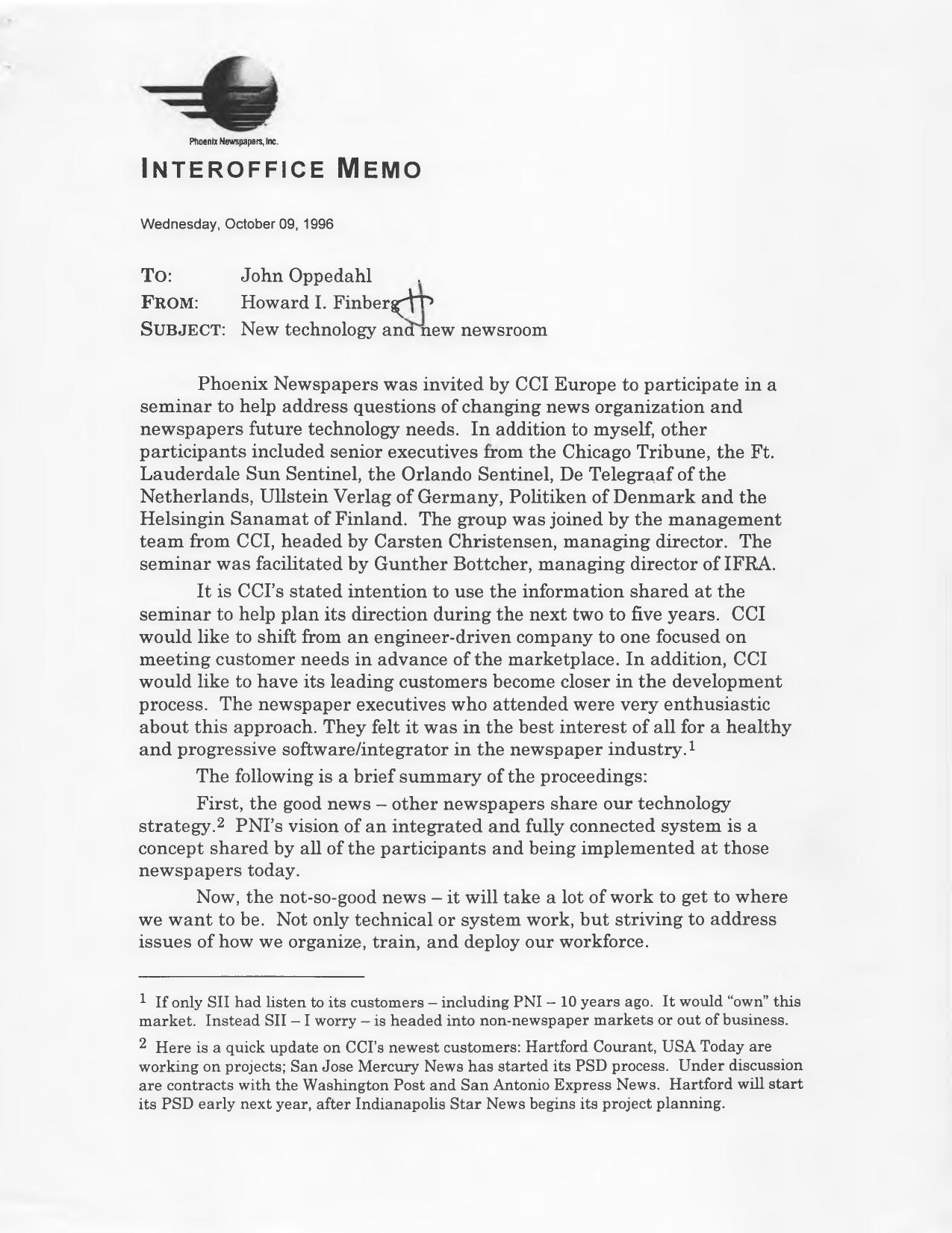
In October 1996 Phoenix Newspapers was invited to a CCI Europe seminar on how news organizations were changing and what technology they would need next. This memo is my report back to John Oppedahl, the senior editor of The Arizona Republic, with copies to Chip Weil, Mal Applegate and Pam Johnson.
The company in the room was good: senior executives from the Chicago Tribune, the Ft. Lauderdale Sun Sentinel, the Orlando Sentinel, De Telegraaf of the Netherlands, Ullstein Verlag of Germany, Politiken of Denmark and the Helsingin Sanomat of Finland, plus CCI’s management team led by managing director Carsten Christensen. Gunther Bottcher of IFRA facilitated. CCI wanted to use what it heard to plan its own direction for the next two to five years, and to shift from an engineer-driven company to one focused on customer needs. The newspaper people at the table liked that idea a great deal.
My summary came in two parts. The good news was that Phoenix Newspapers wasn’t out on a limb:
PNI’s vision of an integrated and fully connected system is a concept shared by all of the participants and being implemented at those newspapers today.
The not-so-good news was that getting there would take a great deal of work — and most of it wouldn’t be technical:
Not only technical or system work, but striving to address issues of how we organize, train, and deploy our workforce.
The workforce piece would be the toughest, with or without union considerations. We were fond of our journalistic traditions and our workflow, and the org chart was easy to manage. But business processes would have to change if the technology investment was going to pay off:
Flying a jet between two cities 50 miles apart is a waste of equipment.
Much of the memo is about the new newsroom. The seminar group predicted a shift toward “content teams” organized around products rather than coverage areas — closer to the way we had already built advertising sales teams. That meant more skills, more training, and an end to the unspoken single-task job description: I’m a copy editor, I don’t write; I’m a reporter, I don’t edit. With no expectation of hiring beyond existing staffing levels, the goal was multi-skilled specialists.
The day of the “designer only” is coming to an end.
The idea I still like best here is the difference between re-purposing and pre-purposing — deciding early that a story will be written for and published in multiple mediums, rather than pushing it through the production system for print and then reusing it. Which also means tracking and archiving every element. Hard enough for print, as I told Oppedahl. Add video, audio and other data types and it gets harder.
The section on communication tools holds up too. E-mail worked one-to-one, but broadcast a request on deadline and most people ignored it, assuming it wasn’t meant for them. What the newsroom needed was closer to shouting a question across the room:
This communication model is a “many-to-many” system that allows everyone to join the discussion.
I pointed to PNI’s Lotus Notes discussion databases as proof we already had the technical ability. What we lacked was the cultural shift. The memo closes with a short list of other issues — content management, production management, user interfaces, and system manageability, where I wondered whether the network computer might replace the personal computer.
This is a report I put together in August 1996 for managers at Phoenix Newspapers who didn’t quite understand what “going online” meant — or where it was headed. Rather than argue in the hallway, I built a briefing book: talking points, traffic charts, a project list, revenue and expense projections, and a stack of clippings from the trade and business press so no one had to take my word for the direction of the market.
The first section is organized around questions from Chip Weil, then President and CEO of Central Newspapers, with my answers filled in:
I’ve taken some of Chip Weil’s questions [the italics] and added some general answers and/or talking points that could be discussed at the meeting. Marilyn Tanious was helpful regarding some key points that should be discussed.
Most of the questions were about classified advertising — real estate and employment — which was where the money was and where the threat was. The report notes on-going discussions with the area’s multiple listing service [ARMLS] for complete property-for-sale data, work on getting employment display advertising online, more “Virtual Job Fairs” starting in September, an outside company [Moore Data] on a rentals database, and an automotive push with the AIG group and with Bill Luke, which wanted to put its used-car inventory online.
Asked about strategy over the next 24 months, I listed four areas: consumer acceptance, broadband delivery, directory publishing and transactions. Longer term, commerce systems and agency relationships — shared “ad space” with content partners. PAFET, the newspaper technology consortium, gets credit for access to experiences that would have been hard to duplicate, along with the strategic alliances with InfoSeek and Pointcast. On the money: about $2.3 million being spent CNI-wide, with a projected 10% expense increase for 1997 and capital spending estimated at $150,000.
The overview section reprints a piece I’d written for the first edition of an in-house newsletter, the Cyber Chronicles, aimed at a general newsroom audience:
While using a 17th Century technology — ink on paper — to communicate what’s happening with PNI’s online efforts may seem strange, it helps make the point that the newspaper isn’t going away. Frankly, there are just some things you can do better on newsprint.
Arizona Central ran two editions — one on the Web, one on America Online — and a good part of the internal confusion was about why we bothered with both. The answer in the report is blunt:
We are often asked, “Why have any content on AOL?” The reason is simple: It reaches a different audience than the Internet.
AOL was then the world’s largest commercial online service with six million customers, sharing market revenue with PNI and paying bounties for each customer we signed up with a special Arizona Central disk. The distinction I drew was between “the technically advanced” — comfortable with IP addresses and hunting on the Web — and “the technically evolving,” who preferred the safer environment of a commercial service.
The traffic charts are a reminder of how crude measurement was. Web numbers were “hits,” with a note that our pages used only three or four image files while boston.com used 19 on its home page — so our hit counts looked small by comparison. The big spike came from putting employment liners online in late June; the flattening was blamed on the Olympic games, a drop seen across AOL as well. AOL, at least, could count actual paid entries into Arizona Central. Median age was 43.7 on AOL and 43.5 on the Web, and the daypart charts show AOL peaking at 8 p.m. while Web use tracked working hours — traffic from major Valley employers and corporate sites around the country.
The project list is the part I still enjoy: movie times, Living Here, Meet Your Match, calendars formatted for database searching, Prep Stats, Holiday Lights with the Downtown Association, and a SAVE system to search and purchase past stories. And the honest bottom line, stated up front:
While it is unlikely that online will be profitable this or next year, revenue is running ahead of projections.
Thirty years on, what strikes me is how much of the argument was about audience rather than technology — where readers actually were, and the willingness to publish in two places at once to reach them. That part of the job hasn’t changed at all.
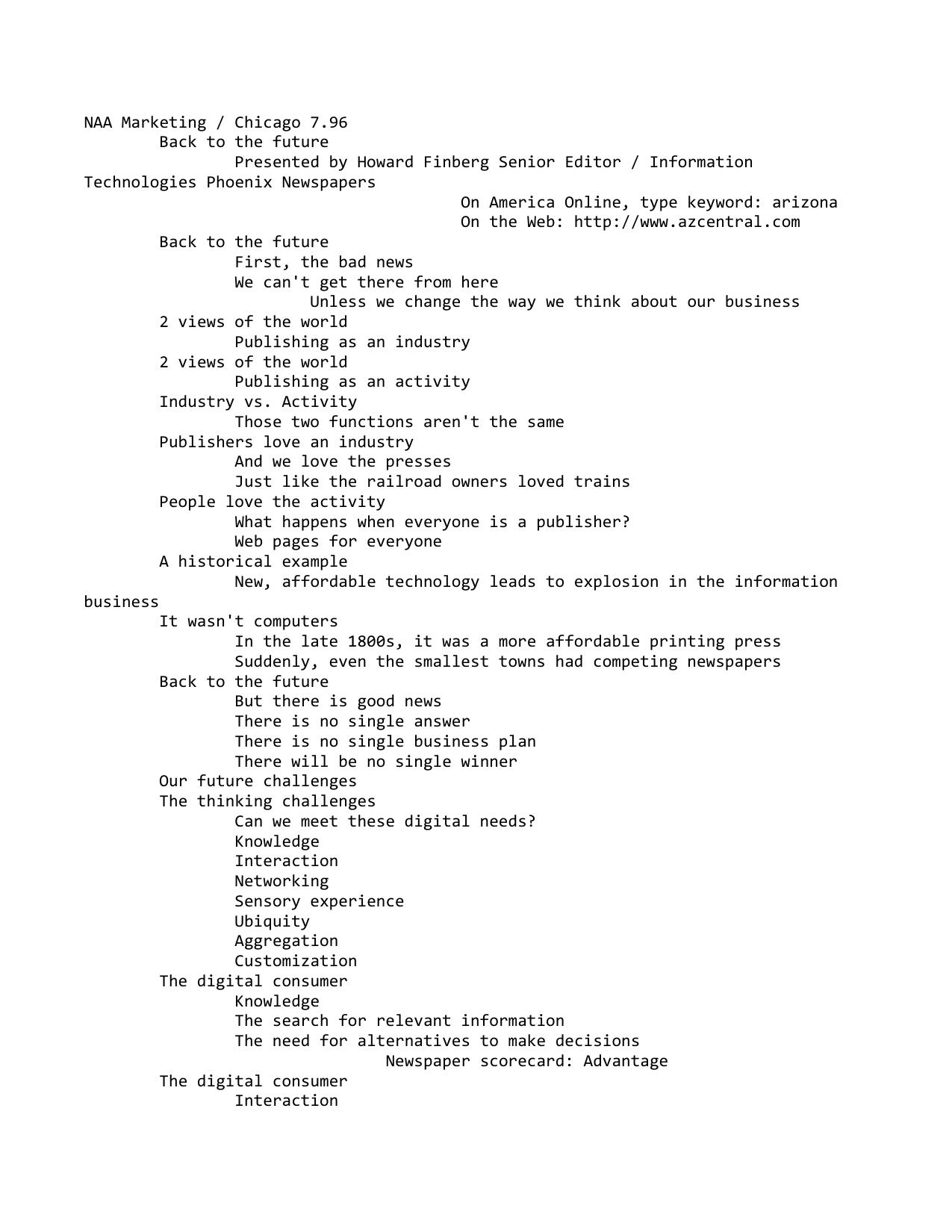
In July 1996 I presented “Back to the future” at an NAA marketing and technology business meeting in Chicago. At the time I was Senior Editor / Information Technologies at Phoenix Newspapers
The argument started with the bad news:
We can’t get there from here
Unless we change the way we think about our business
That change meant seeing the difference between publishing as an industry and publishing as an activity. Publishers love the industry — and the presses — “Just like the railroad owners loved trains.” But people love the activity. My historical example wasn’t computers at all: in the late 1800s a more affordable printing press gave even the smallest towns competing newspapers.
The heart of the talk was a scorecard, rating newspapers against seven digital consumer needs — knowledge, interaction, networking, sensory experience, ubiquity, aggregation and customization. The tally: two advantages, three neutrals, two disadvantages.
I also warned against the era’s favorite word:
Don’t “repurpose” content
Repurpose our role
And about the delivery debate: “It isn’t about dead trees OR live wires.” Forget online, forget the Web, forget about the wires — focus on information value.
Two outside voices made the point better than I could. Mark Hauptschein, director of strategy and business development at Ameritech:
“The old way of throwing advertising – spraying and praying – will weaken over time. Marketing will become a form of content.”
And Eric Berg, Price Waterhouse director of technology:
“In the late 1990s, getting access to information will no longer be an issue. The real issue will be avoiding information. We’re going to need new technology which will enable us to filter, sort and extract the information which is relevant to us.”
The process section covered the questions we were all avoiding — what is news, what are the jobs, what kind of organization — plus the return of the 24-hour newsroom and a caveat I still like: going from hot type to cold type is evolutionary; going digital is revolutionary. Make sure the paradigm really shifts.
There was good news, too. No new technology has yet replaced an older one, and information providers have always found a way, from newsbooks to newsletters to newspapers. I closed with Darwin — survival belongs to the most adaptable — and with people:
Give them information
Give them tools
Give them training
Give them room
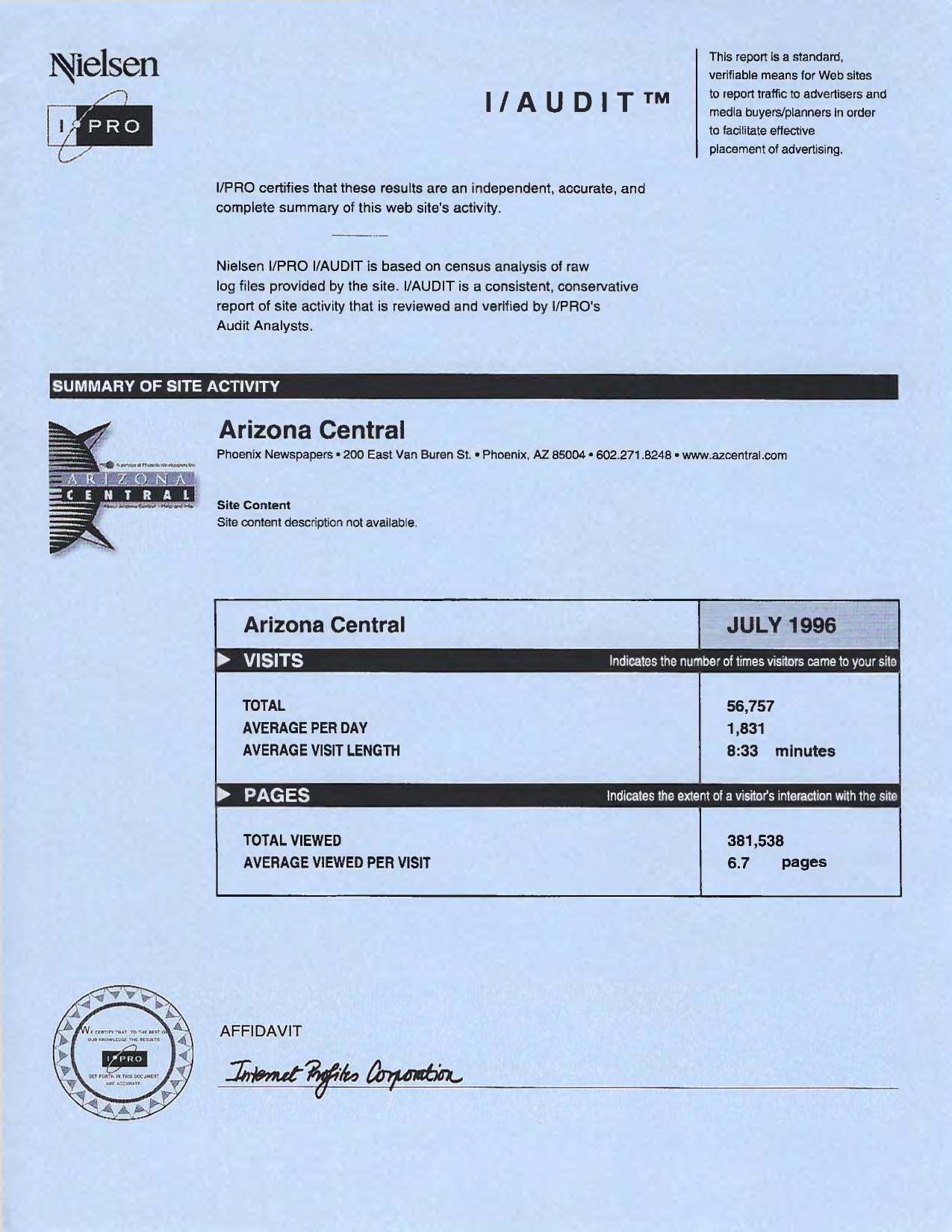
This is the Nielsen I/PRO I/AUDIT report for Arizona Central for the month of July 1996. I was managing Arizona Central at the time, and this was one of the first attempts by anyone to put an independent, third-party number on what a newspaper web site was actually doing.
The point of the exercise was advertising. If we were going to sell space on the site, someone other than us had to vouch for the traffic:
This report is a standard, verifiable means for Web sites to report traffic to advertisers and media buyers/planners in order to facilitate effective placement of advertising.
I/PRO built the audit from a census analysis of our raw log files, reviewed by their audit analysts, and certified the results as “an independent, accurate, and complete summary of this web site’s activity.” The affidavit language matters more than it might seem now — media buyers had no reason to trust self-reported server numbers.
The month’s totals:
VISITS … TOTAL 56,757 / AVERAGE PER DAY 1,831 / AVERAGE VISIT LENGTH 8:33 minutes
And on the content side, 381,538 pages viewed, an average of 6.7 pages per visit. The top 50 pages accounted for 299,906 pages, or 78.6 percent of everything viewed.
What those top pages were is the interesting part. Job Search, under the classifieds directory, drew 13,584 page views — a reminder of how early classifieds moved online. Alongside the standard departments (FLASH, FEATURES, FUN, comics, Dining, Destinations, the Arizona Golf Guide, the interactive TV listings, Home Buying Choices), the news pages that show up are exactly the stories of that summer in Arizona: “Phoenix bombing plot,” “Symington indicted,” and “Arizona’s Olympians.” There’s also a page titled “Tell us what you think!” — 617 views for the survey.
The visitor-by-organization table is its own time capsule. America Online alone delivered 14,143 visits, more than seven times the next name on the list, Primenet, at 1,824. Arizona State University, GoodNet, CompuServe, Netzone, Microsoft Network, Internet Direct — the local ISPs and the national online services were the on-ramps. The top 50 organizations were 60.7 percent of all site visits. Geographically, 91.0 percent of activity came from the United States, with Canada at 1.8 percent and a scattering from Australia, the Netherlands, Japan, the U.K., and Germany.